E-Newsletter
An Electronic Publication of the North Central Massachusetts Chamber of Commerce

Inside this edition, you’ll discover the latest Chamber initiatives and success stories from across our region. From economic development projects and upcoming networking events to policy updates and workforce training opportunities, we’re keeping you connected to what matters most for your business and North Central Massachusetts.
The North Central Massachusetts Chamber of Commerce is here to help – with trusted resources, a strong business network, and a support system to keep your business and the region moving forward
Sign provides recognition of civic pride for residents and visitors alike
The North Central Massachusetts Chamber of Commerce today announced it has sponsored the construction of a new welcome sign for the City of Leominster located on the Leominster Connector.
The new sign is part of a project to construct welcome signs at key gateways in communities in the region to boost civic pride and serve as a positive first impression for visitors. The project was partially funded by a grant secured by the Chamber.
The signs were designed and produced by Add-A-Sign in Leominster and represent the region’s traditional New England style. The Leominster welcome sign includes a carving of the City of Leominster’s seal and is painted in the proud city colors of blue and gold. In addition to Leominster, similar welcome signs have also been installed at key gateways in Fitchburg, Gardner and Westminster. Each sign is carved with the community’s seal and painted to match their official colors. Additional signs will be constructed for other communities in North Central Massachusetts as funding becomes available.
“One of the goals of our regional economic redevelopment plan, One North Central, was to capitalize on our region’s unique locations,” said Roy Nascimento, President and CEO, North Central Massachusetts Chamber of Commerce. “Each city brings a distinctive experience to the region and with this project, those entering Leominster will learn about the city while receiving a warm welcome as they arrive.”
“Leominster is truly a gateway city to the North Central Massachusetts region and the new signage will serve as a great way to show our visitors what Leominster is all about,” said Mayor Dean J. Mazzarella, City of Leominster. “We are proud of our heritage in Leominster, and we are grateful for the opportunity to share the story of our legacy through the welcome sign.”
Leominster, MA | Chamber of Commerce | North Central Massachusetts | Economic Development | North Central Massachusetts Chamber | New England Town | Worcester County | Community Development | Economic Diversity | Leominster Welcome Signage
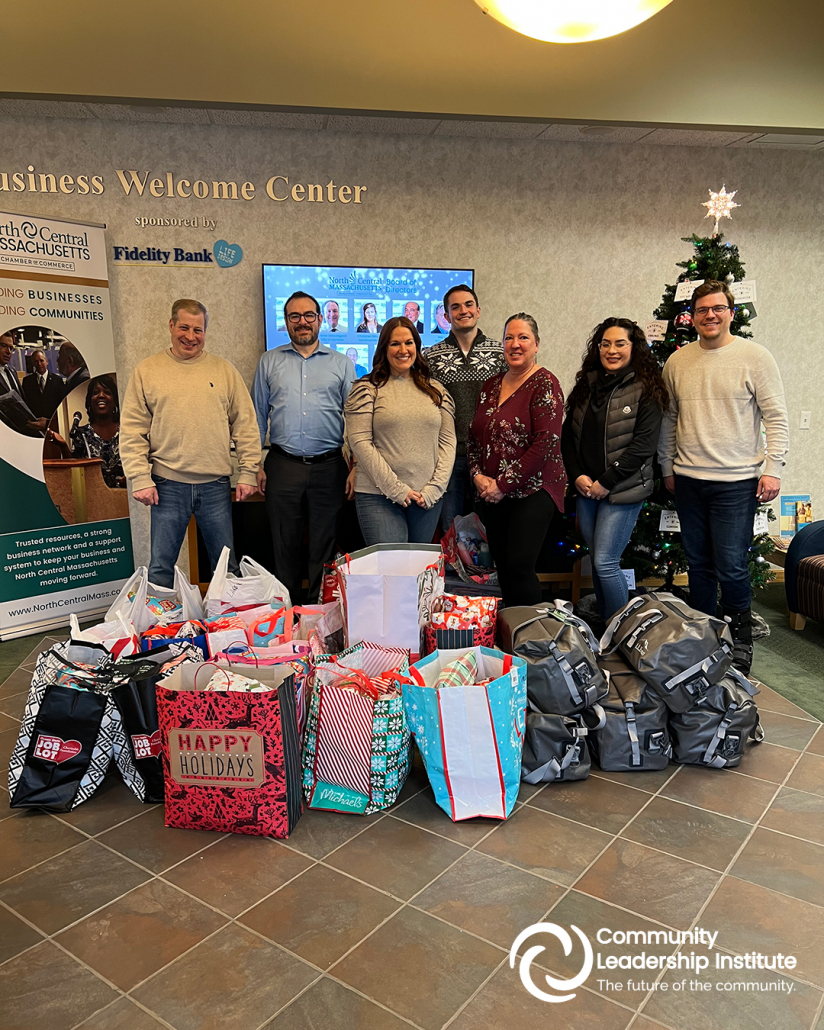
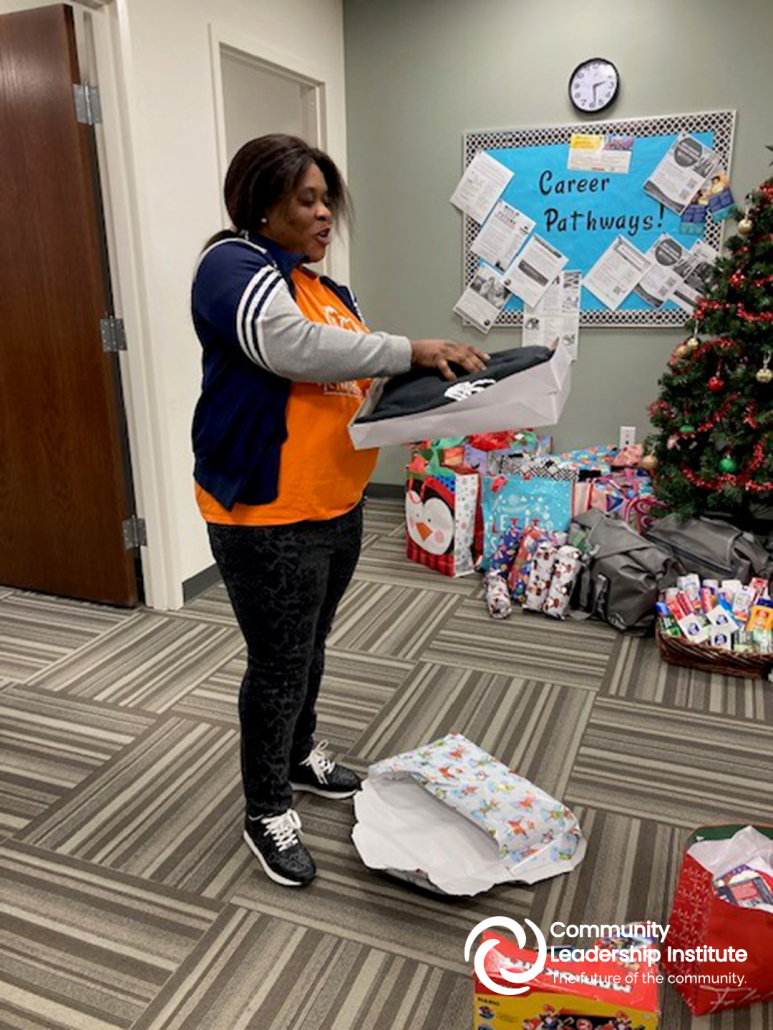
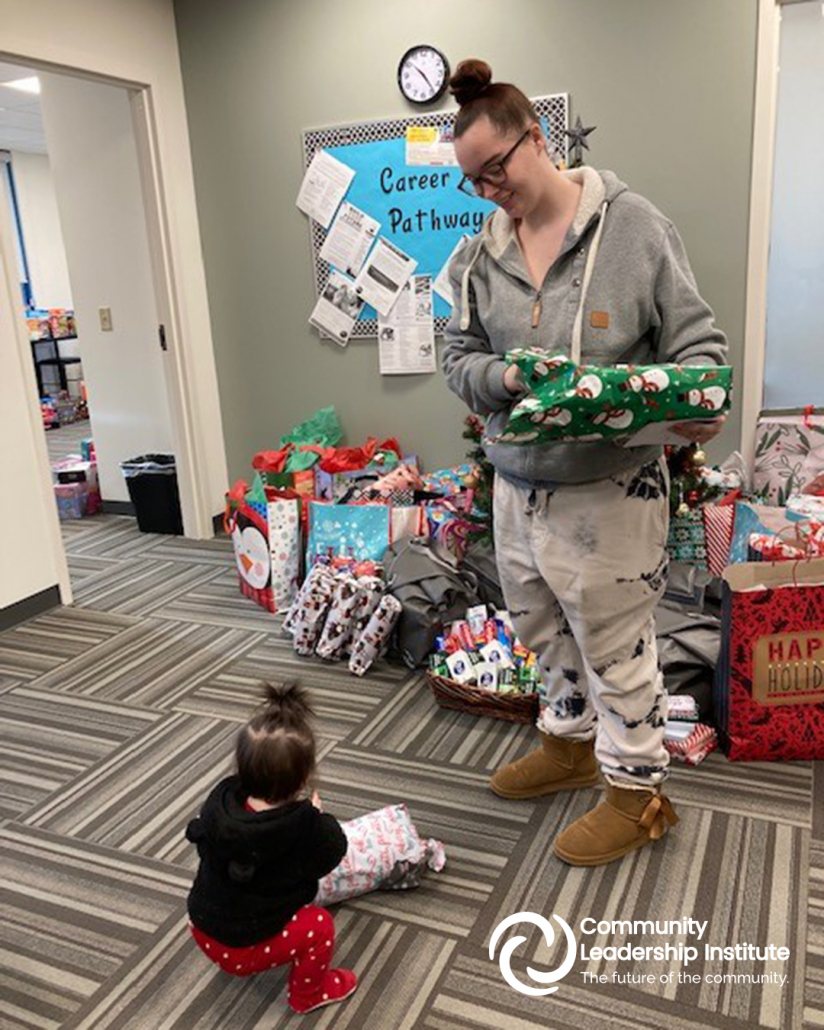
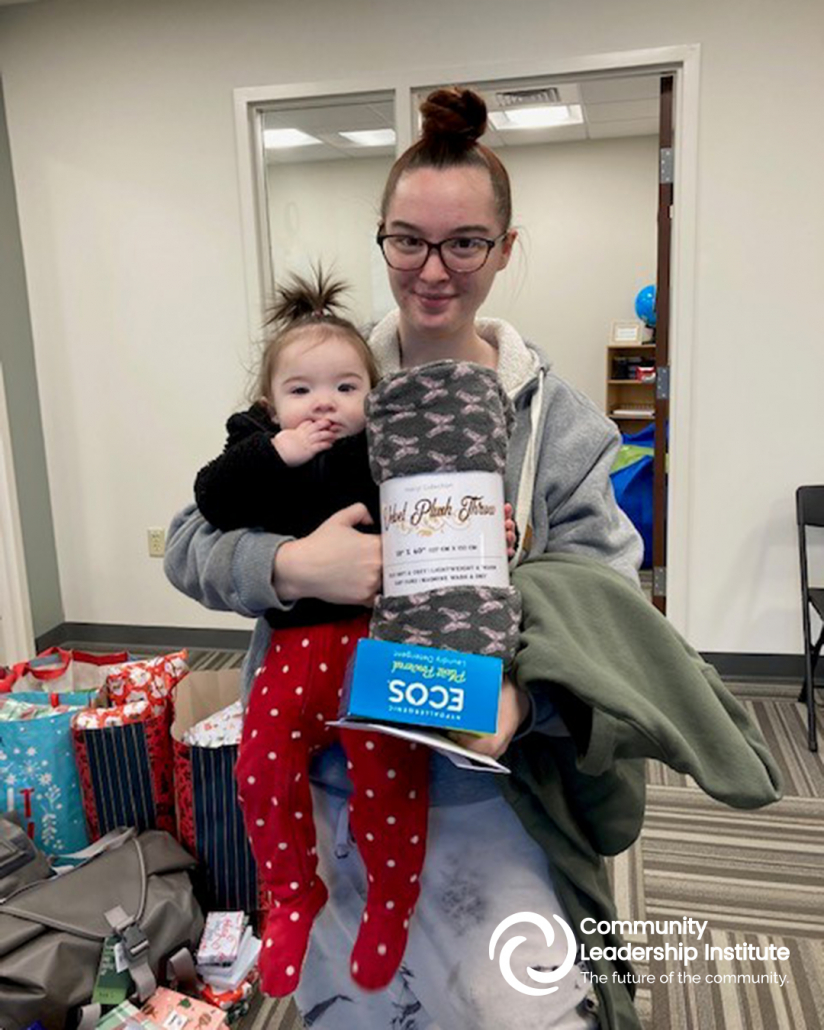
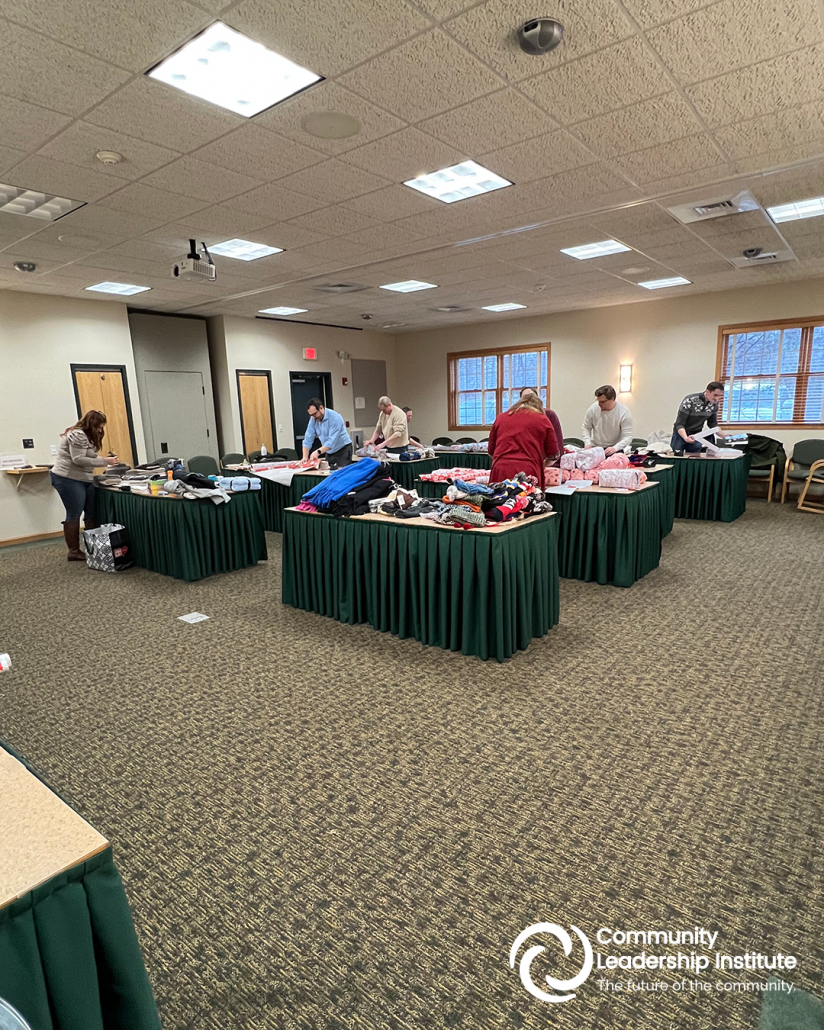
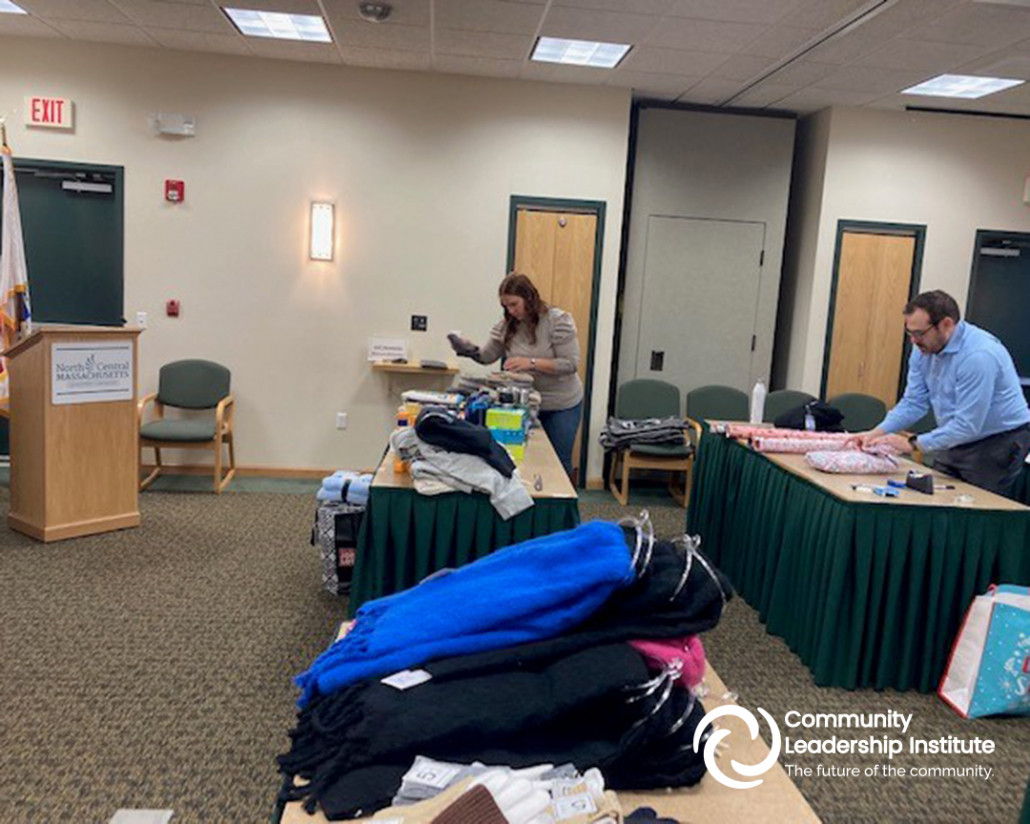
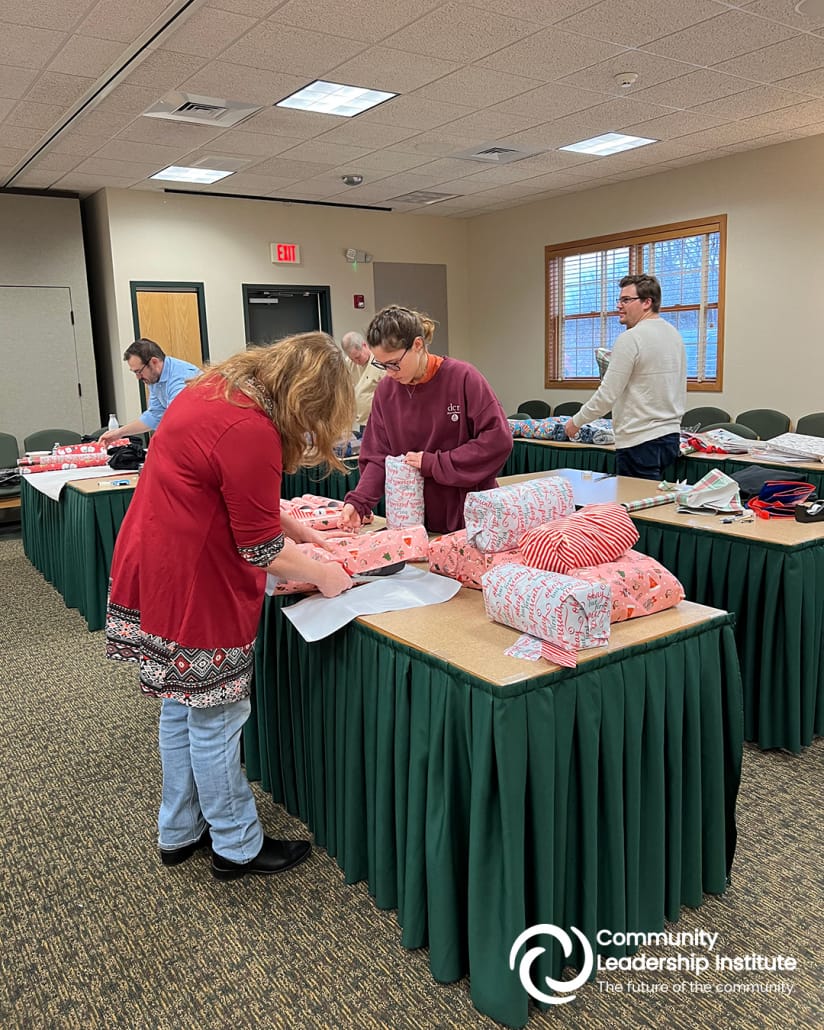
The Community Leadership Institute (CLI) class of 2023, chose My Turn, Inc. of Fitchburg as a community service project for the holiday season. Since 1984 My Turn, Inc. has focused on “the forgotten half”, the economically, socially and educationally disadvantaged youth in poorer neighborhoods and communities. There are currently, 35 individuals actively participating in this program.
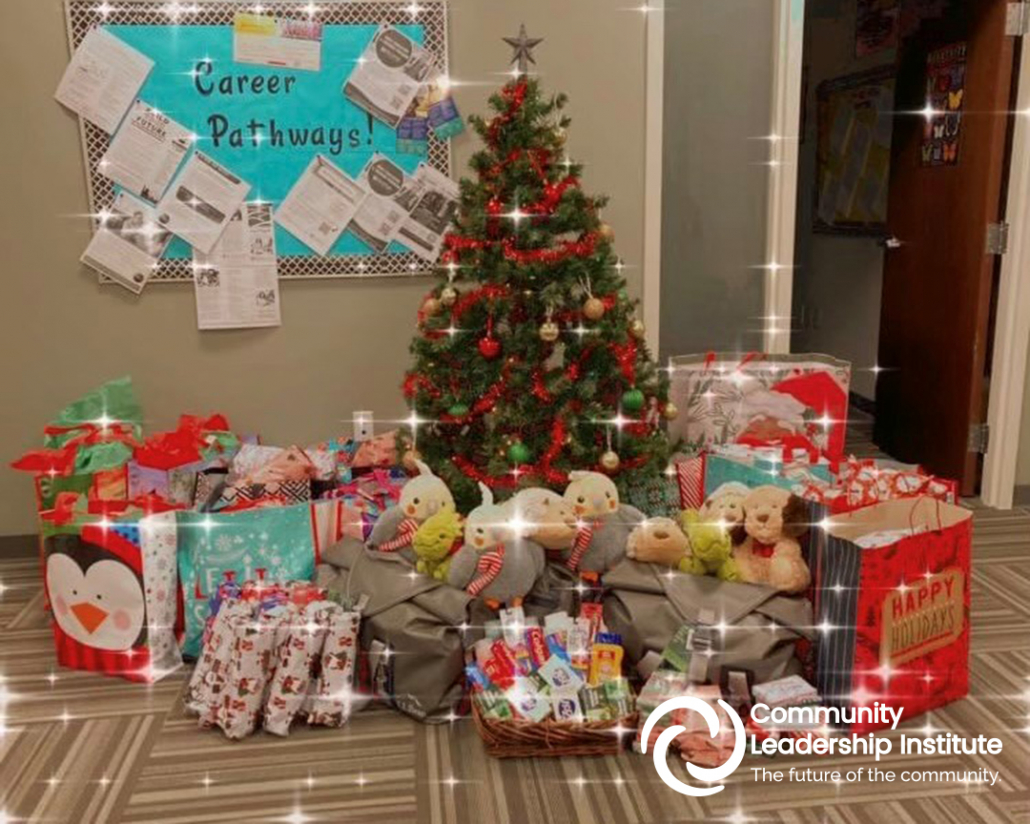
A group from the CLI class of 2023 organized the fundraiser and set a goal of $4,000 in order to purchase items for the participants for the holiday season. With a “gofundme” campaign and donations from Fidelity Bank, Leominster Credit Union, IC Credit Union, Rollstone Bank, Enterprise Bank and AIS a total of $4,099.95 was raised in just 3 weeks!
On Friday, December 16th, several individuals from the CLI class gathered to wrap gifts to prepare for drop off at My Turn. With the generous donations, we were able to purchase items in need such as grocery and gas gift cards, warm winter attire, blankets, phone chargers, hygiene products, and much more. The gifts were delivered to My Turn where manager of north central Massachusetts Programs, Nicole Conroy, expressed her heartfelt gratitude for the endless bags of gifts we put under the tree, “All that you all have done is so very appreciated. The students were all so appreciative. I had two in tears over the thoughtfulness and generosity. These are all low income, young moms who go without so they can provide toys for their kids at Christmas. It was incredible for them to receive items for them”.
To learn more about the Community Leadership Institute contact Kat Deal at
Leominster, MA | Chamber of Commerce | North Central Massachusetts | North Central Massachusetts Chamber | Community Leadership Institute (CLI) class of 2023
As employers in North Central Massachusetts continue to struggle to find skilled labor, the North Central Massachusetts Chamber of Commerce recently announced a study aimed to offer suggestions to balance the labor market now and into the future.
The North Central Workforce Study was prepared by the UMass Donahue Institute’s Economic and Public Policy Research Group, a leading provider of applied research to help clients make more informed decisions about strategic economic and public policy issues. Focusing on workforce growth barriers and solutions, including barriers related to geography, skills, structure and work/life balance, the study includes short-, mid- and long-term recommendations focused on growing the region’s workforce.
“This project has very tangible recommendations and sets North Central up as a thought leader in this space,” said Dr. Mark Melnik, Director, Economic and Public Policy, UMass Donahue Institute. “The chamber is thoughtful about the characteristics of the region and the needs of the businesses. They are one of the first out of the gate in the state to acknowledge the workforce challenges their region is facing and have a strong desire to learn how to change those challenges into opportunities.”
With the collaboration of regional business and education leaders and workforce development experts, the study revealed two classes of workers who are not being fully utilized within the current workforce, but who have skills local employers need.
“Hidden workers” are identified as applicants who are screened out of consideration for jobs or those who have no choice but to remain out of the workforce due to barriers out of their control, and “future workers” are those workers who will be in the labor force in the future due to age, location, technology and other factors.
“Similar to many other areas of the Commonwealth, North Central Massachusetts is feeling the impacts of stagnant labor force engagement beyond the effects of the pandemic shutdowns,” said Roy Nascimento, President and CEO, North Central Massachusetts Chamber of Commerce. “Our region is particularly susceptible to labor force shrinkage due to our aging population and slower population growth, but also because groups of our hidden and future workers within the region have other needs which are not being met by the current labor market here. In fact, some workers are finding the job search to be just as difficult as it was before the pandemic began. The barriers and recommendations in the plan will require all different community stakeholders in North Central to work together to meet the regions’ work force needs.”
While the study revealed many workers are willing and ready to work, barriers facing today’s workers, including where they live, what skills they have and spoken (and unspoken) rules and regulations, can limit a person’s ability to obtain a job.
From a lack of affordable housing adjacent to jobs and transportation from where affordable housing is available, to current skills that no longer align with industries in the area and overly aggressive online applicant filters that may discriminate an applicant’s past, the challenges facing today’s workforce are unique to those of years past.
“We are definitely seeing transportation challenges,” said Robin Therrien, Career Transitions Specialist, Shriver Job Corp., located in Devens, and who recently attended the Manufacturing Bus Tour hosted by the Chamber. “Not everyone is from the larger areas, like Fitchburg and Leominster, and we have students who live outside of these areas seeking opportunities, but there is no affordable housing and transportation to get them to these areas.”
Jeffrey Roberge, Executive Director at MassHire North Central Workforce Board agrees. “Transportation is an issue, especially for those people who live in rural areas of the region,” he said. “But the silver lining here is that several stakeholders in the region are constantly looking at ways to get people to the jobs here and have a commitment to the workforce system to develop transportation services for the workforce.”
Roberge pointed to the Montachusett Area Regional Transport (MART), which is looking at modified plans to support workforce development. “We are fortunate to have our local transit authority recognize workforce development as a priority, and I know they are looking at bus routes to better align with shift schedules.”
To combat transportation issues, the study recommends employers implement ride share programs, which are similar to a carpool system among fellow employees, and encourage companies to coordinate a van system, which helps workers complete the last mile to and from public transportation locations to the company location. Roberge said this type of system has experienced much success in the Boston area.
But transportation isn’t the only challenge employers are facing when hiring workers. The study revealed the most diverse set of issues faced by both workers and employers relates to work/life balance, such as prioritizing shift times, benefits, and location over things such as industry, company or position in the company.
“The future is hybrid and preliminary data has shown there hasn’t been reduced production of work when people are working from home,” added Roberge. “While certain industries have more challenges with a hybrid work schedule, such as manufacturing and health care, I think employers really need to think about aligning schedules and shifts with what their industry can handle and provide remote or hybrid opportunities as much as possible. I don’t think we will ever go back to the traditional workday of being in the office eight hours a day, five days a week.”
The study recommends multi-purpose solutions for North Central related to work-life balance, including a shorter work week, flexible working agreements, the expansion of benefits to include childcare, more permissive policies for time-off requests, incentives for career advancement and rewards for longevity, incentives for employees who have a healthy work/life balance, and coordination with other community stakeholders to increase the supply of childcare, among others.
The study also explored a variety of solutions to engage hidden and future workers into the labor force, such as through the creation of innovative training and credentialing programs, and fostering relationships with local community colleges, businesses and prisons.
“North Central’s workforce is aging and slowed population is projected to continue,” said Nascimento. “In order to meet North Central’s workforce needs, employers, educational institutions and workforce development agencies must collaborate to identify overlapping strategies to help enhance the engagement of these groups in the labor force.”
Local institutions, such as Mount Wachusett Community College and Fitchburg State University, currently collaborate with employers to coordinate programs geared toward community and employer needs. For example, in collaboration with employers, Mount Wachusett Community College began developing a new Veteran Worker’s Initiative that assists local veterans with the transition from military skills to college/civilian skills. This program connects regional employers to students on campus, hosts panel discussions with organizations that educate employers on how to be responsive and sensitive to veteran needs and utilizes the college’s career services by connecting students with business partners in the area.
“We have so many great partners and we want the industry professionals in our area to be involved with educating the future workforce,” said Kijah Gordon, Director of Workforce Access and Education, Mount Wachusett Community College. “We are taking a step back from traditional programming and really looking at what our employers need to fill their open positions.”
At Shriver Job Corp., which serves those between the ages of 16 to 24, programs are offered to students who may not have had a good support system throughout their lives and who may not have life skills that make them attractive to employers. “Our students are not all at-risk youth,” said Denise Schultz, Work-based Learning Specialist, Shriver Job Corp. “The truth is we have good kids who might not have the best focus, but who are committed to learning a skill so they can be contributing members in their communities while also building a good life for their families. We want to work with local employers on filling their open positions and they just need to let us know what they need so we can help find the right fit.”
In an effort to facilitate the collaboration between employers and educational institutions, the Chamber recently hired a Talent and Education Initiatives Program Manager to support the development, retention and attraction of a qualified labor force. “By working with employers, regional partners and educational institutions on developing strategies and programs to build and strengthen our current and future workforce, it was important for us to have a team member focused on these efforts to help strengthen the collaboration,” added Nascimento.
“Terry Young (the Chamber’s Talent and Education Initiatives Program Manager) is doing a great job recruiting for our program,” added Gordon. “The future for us is working with the high schools on how to make our programming more appealing to students.”
While collaboration will be key to growing the labor force in North Central, the study concludes that employers need to make working easier by overcoming the identified barriers.
“What stood out to me about the region was the level of collaboration between higher education and businesses combined with a strong Chamber of Commerce,” said Melnik. “There is really good DNA in the region for collaboration and forward thinking, and the people who we spoke with (as we developed the study) realize that timing for this work is important as the issues at hand will only become bigger if they are not addressed.”
Nascimento agreed the region is unique because the collaboration among its businesses, educators and other key stakeholders is already strong. “The Chamber of Commerce is in a unique position to gain trust from businesses and locals with a goal of establishing connections necessary to better meet worker needs and ultimately bring additional people into the labor force,” said Nascimento. “It is our hope that by commissioning the North Central Workforce study that all stakeholders will have a shared roadmap to overcome the challenges and set forth a bright future for employers and workers alike in the region.”
While the study outlines challenges and opportunities to overcome them, many people are bullish on the region’s workforce development, including Roberge.
“We have a vibrant workforce development system, and the outlook is bright as we have solutions to combat our challenges,” said Roberge. “We are very lucky that our businesses, educators, career centers, social service agencies and many others are talking with each other toward a common goal of making North Central a place to live, work and raise a family. We know what we need to do, and we have a community of engaged and committee people to do it.”
Read the North Central Workforce Study in its entirety here.
Chamber of Commerce | North Central Massachusetts | North Central Massachusetts Chamber | North Central Workforce Study

The reception features an open bar and gourmet appetizers.
View
Event
Join us for Connect North Central
Friday, September 25, 2026
8am-9am
View
Event
North Central Golf Tour Championship: Fore the Future
An FLNC Non-Traditional Scholarship Fundraiser
View
Event
Thank you Series Supporting Sponsor empHowered PR
View
Event
Join us for our 11th Annual
Congressional Luncheon
View
Event
Wednesday October 28, 2026
5:00pm - 7:00pm
View
Event
Join us for this in person HR Legal Update
View
Event
November 19, 2026
7:15am - 9:00am
View
Event
Chamber members are provided with the opportunity to engage with the Mayors of Fitchburg, Gardner, and Leominster who provide updates on projects and other things happening in their Cities. These events are by invitation only, please contact Travis Condon for more details.
View
Event
Bull Run Restaurant
215 Great Rd. Shirly, MA
View
Event
Join us for our last Connect North Central of the year!
Friday, December 11, 2026
8am-9am
View
Event
Chamber members are provided with the opportunity to engage with the Mayors of Fitchburg, Gardner, and Leominster who provide updates on projects and other things happening in their Cities. These events are by invitation only, please contact Travis Condon for more details.
View
Event
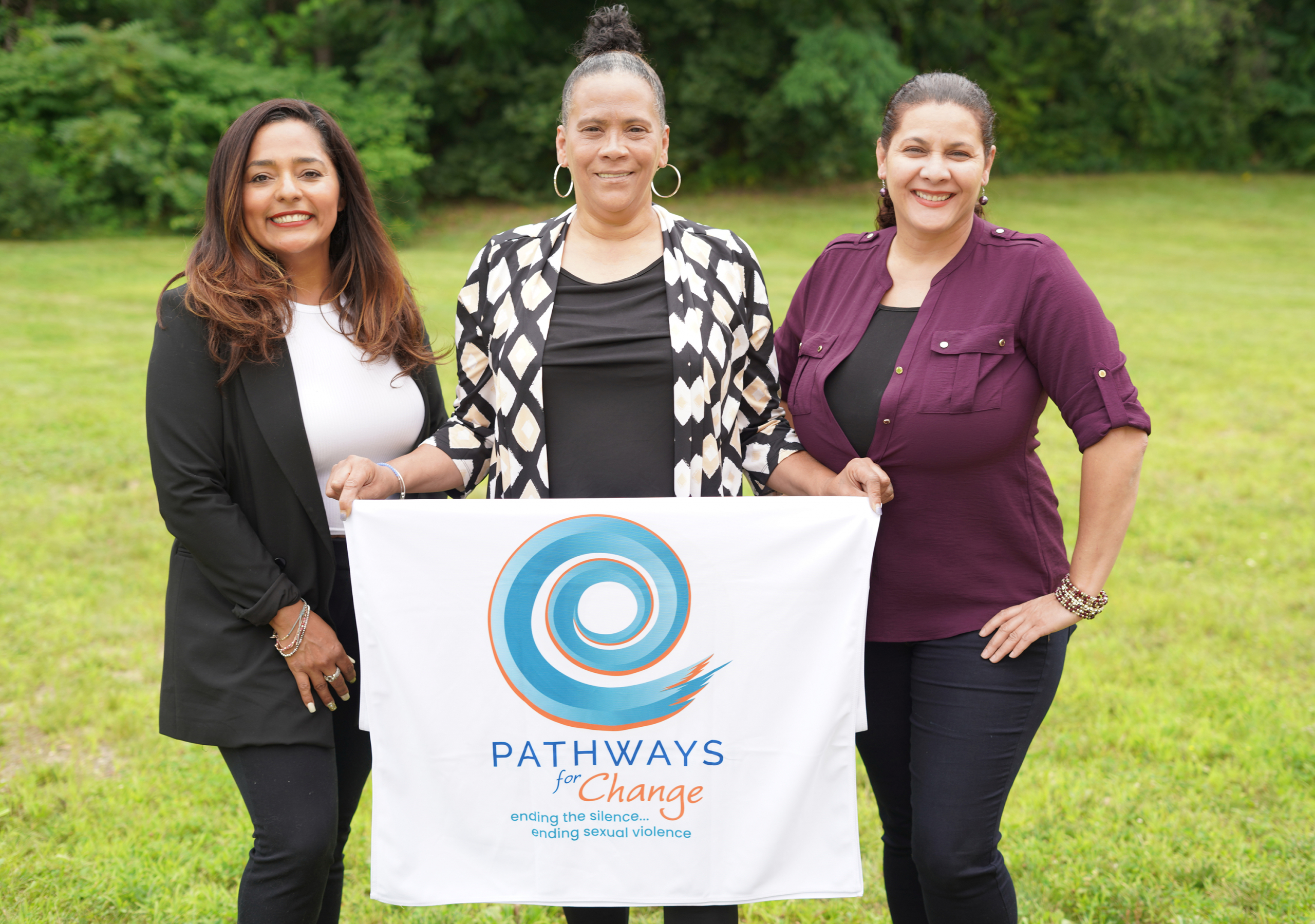
Pathways for Change received a grant to pilot the Males Advocating Change (MAC) program. Pictured left to right is Wendy Aguilar, Assistant Director of Education & Outreach; Marguerite Mowry, Youth Education Specialist and Amparo L. Cruz, Director of Education & Outreach.
Grants given to eight agencies to tackle rising youth mental and behavioral health issues stemming from COVID-19 pandemic
United Way of North Central Massachusetts (UWNCM) recently awarded $90,000 in grants to 8 local agencies to pilot youth mental and behavioral health initiatives. The grants are part of a new area of work for UWNCM that seeks to address challenges faced by young people arising from increased isolation during and after the COVID-19 pandemic.
The following agencies received grants: Boys & Girls Club of Fitchburg/Leominster, Boys & Girls Club of Lunenburg, Girl Scouts of Central & Western Mass, LUK Crisis Center, Inc., Montachusett Community Branch YMCA, Mount Wachusett Community Foundation, Pathways for Change, Inc., and Spanish American Center, Inc.
Grants will support a variety of programs serving diverse populations from different perspectives, from providing free behavioral health services for uninsured marginalized youth, to enabling girls to discover art and nature as tools for mental well-being, and using dance movement therapy to support youth who identify as Latino, Black, and Indigenous.
UWNCM first identified a need for increased youth mental and behavioral health services after hosting a community roundtable on the topic in December 2022. Participants, including representatives from local agencies and the health field, noted that in the wake of the COVID-19 pandemic, many young people have become isolated and unprepared for healthy social relationships.
The grant program is a new initiative for UWNCM that seeks to begin identifying the most effective ways of delivering services to young people who are struggling with mental and behavioral health. Grants will run through June 30, 2024, and results will be used to create targeted programs going forward.
Pathways for Change, Inc., based in Worcester, received a grant to pilot Males Advocating Change (MAC), a program that will engage middle school, high school and college-aged men to address male violence, particularly sexual and dating violence against women.
Kim Dawkins, CEO/President of Pathways for Change, says, “We are grateful to UWNCM for our recent Youth Mental/Behavioral Health grant. The role of MAC is to raise awareness of the myths about masculinity and play a part in building and expanding young males’ understanding of healthy, non-violent masculinity. These funds will provide critical resources needed to continue our work to engage young males and train them to be leaders in our effort to end sexual violence in North Central Massachusetts.”
Judy Tomlinson, Director of Community Impact at UWNCM, adds, “Youth mental and behavioral health problems are reaching crisis levels in our region. With our new grant program, UWNCM is dipping our toes in the water of a larger issue and learning as we go. We are excited to support a wide variety of initiatives that will use creative methods to support our youth.”
The United Way of North Central Massachusetts serves the communities of Ashburnham, Ashby, Athol, Ayer, Devens, Fitchburg, Gardner, Groton, Harvard, Hubbardston, Leominster, Littleton, Pepperell, Lunenburg, Petersham, Phillipston, Royalston, Shirley, Templeton, Townsend, Westminster and Winchendon.
The MassHire Department of Career Services (MDCS) is pleased to announce that MassHire North Central Career Center is the recipient of the MDCS Jobs for Veterans State Grant (JVSG) Incentive Award. The MassHire North Central Career Center is the 2023 JVSG “RISING STAR” Winner of $3,105.
The JVSG Incentive Awards recognize the efforts of an entire One-Stop Career Center (not just a Veterans unit or Veterans staff) whose efforts demonstrate: improvement and modernization of employment, training, and placement services for Veterans; the reward and celebration of excellence in priority of service; development and delivery of best practice techniques and improved performance outcomes for Veterans.
The North Central Career Center demonstrated these ideals through their teamwork, using a unified approach to engaging partners and employers in support of Veterans through a tight integration of all Career Center staff and programs.
Creates Network Upgrades to benefit new Community Center at Waterford Street School and Improve School Security
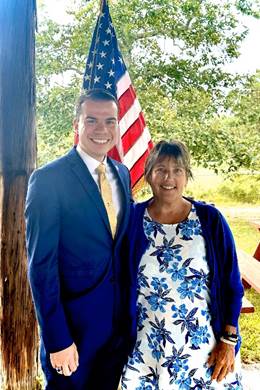
Mayor Mike Nicholson and Anne Gobi, Massachusetts Director of Rural Affairs at the Grant Award Ceremony for the Commonwealth Community Compact Municipal Fiber Grant Award Ceremony. Director Gobi presented the awards on behalf of the Healey-Driscoll Administration.
The City of Gardner was awarded a $200,000 grant as a part of the State’s Community Compact Municipal Fiber Grant Program. The funding will allow the city to connect its School Department, Police Department, and the new location of the Gardner Senior Center at Waterford Street School to a single fiber optic network. This will allow for a streamlining of the management of IT infrastructure by adopting a unified approach which covers network monitoring, cybersecurity, records management, and backup and recovery, achieving a long-held goal of more efficient and secure communications between city departments.
Speaking on the Grant, Mayor Michael Nicholson expressed high hopes for the new project, “This funding will do a lot of good in helping us improve our public safety efforts and our work to create a new community center at the Waterford Street School location. Thank you to Director Gobi, Rep. Zlotnik, and all of our state partners for their efforts to give local governments the tools they need to be successful. I would also like to thank our City’s Director of Technology, Bob O’Keefe, for his efforts in writing and obtaining this funding for the City.”
“The immediate benefit will be the police will have access to school cameras from the Police Station. Future benefits include faster internet and greater internet connectivity.” said Gardner Director of Information Technology Bob O’Keefe, “The fiber connection to the former Waterford School will bring Internet Service without a monthly recurring cost. This will save our Senior Center approx. $60,000 over the next ten years. The savings will also be available for the non-profits that will be in that building. With the fiber the City’s Tech Dept will be able to monitor and maintain its computers, phones, and security without leaving City Hall.”
The Municipal Fiber Grant Program offers competitive grants to support the closing of critical gaps that exist in municipal networks. Awards are focused on connecting municipality-owned facilities and assisting municipalities in achieving critical goals associated with their fiber networks, including protection from the growing risk of cyber security exploits targeting local government, the expansion of remote work and meeting the expectations of constituents who enjoy the convenience of interacting with government online.
State Representative Jon Zlotnik also voiced his opinion of the importance of the grant, stating, “These funds from the state are important Mayor Mike Nicholson and Anne Gobi, Massachusetts Director of Rural Affairs at the Grant Award Ceremony for the Commonwealth Community Compact Municipal Fiber Grant Award Ceremony. Director Gobi presented the awards on behalf of the Healey-Driscoll Administrationto make sure Gardner’s IT infrastructure is capable of serving its purpose to the fullest, and is secure. These systems are critical to the operations of the City and the services it provides, so these investments are equally important.”
The substantial funding received through the Community Municipal Fiber Grant Program will pave the way for an essential communication upgrade in the city, enabling crucial connections between the School Department, The Police Department, The Senior Center, and the connection to the Radio Repeater. With this integration, the city has taken a significant step towards streamlining its IT infrastructure management. By adopting a unified approach encompassing network monitoring, cyber security, records management, backup and recovery, this development will provide for an improved communications environment amongst crucial city departments.
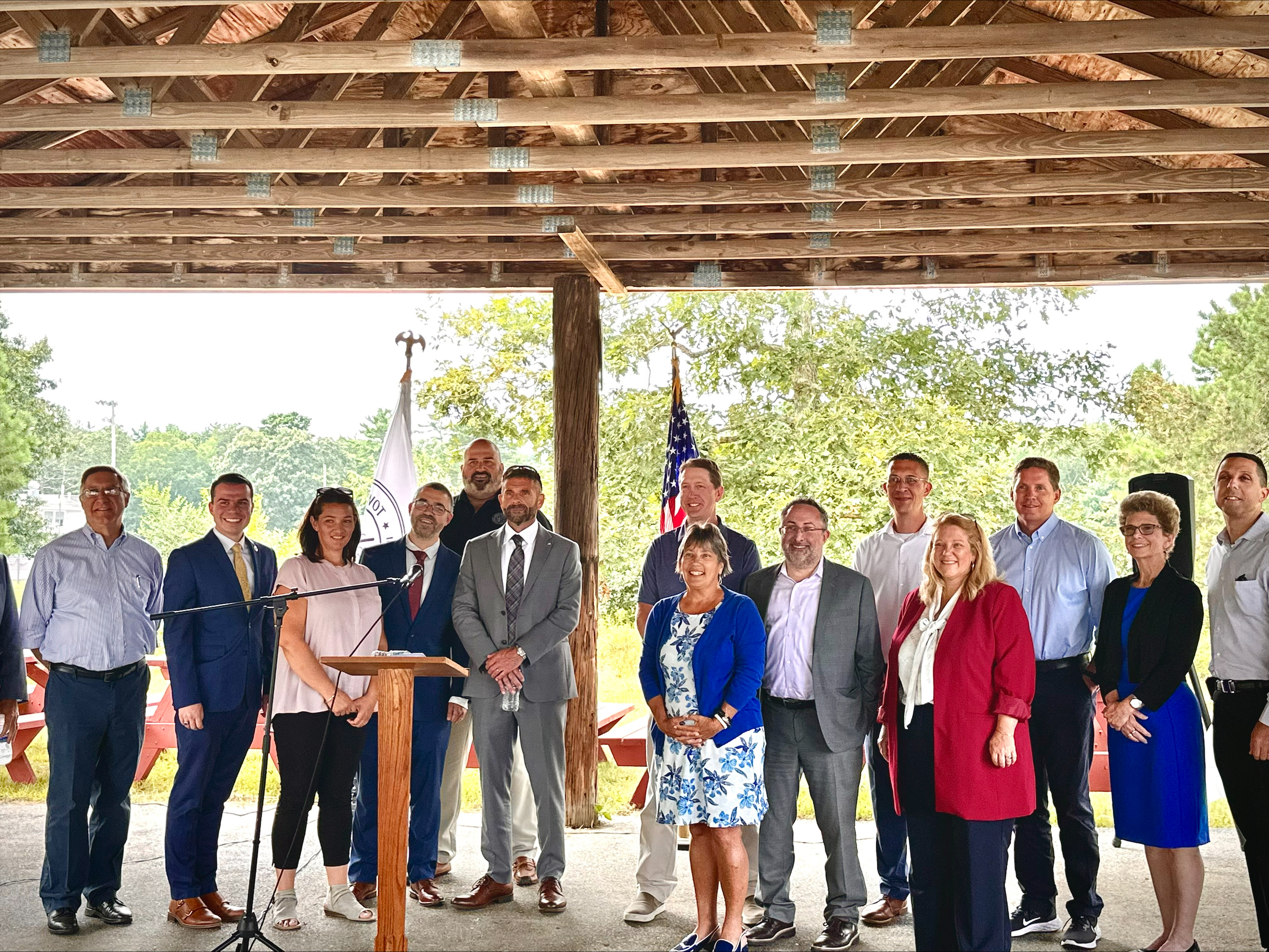
Representatives of Cities and Towns who were awarded grants from the Commonwealth Community Compact Municipal Fiber Grant Program gather with Massachusetts Rural Affairs Director Anne Gobi as awards are announced. Mayor Nicholson represented the City of Gardner at the ceremony.
“Having reliable communication is important for delivering quality emergency response to the citizens as well as providing a critical safety lifeline to first responders” said Fire Chief Greg Lagoy, going into detail about the importance of the connection to the radio repeater for first responders. “The City is in the process of making upgrades to the site, including the installation of a new communications equipment shelter building. This new fiber connection will provide a dedicated, reliable connection for radio, data, and security systems from the repeater site to the City’s Public Safety agencies and the Central Dispatch Center at the Police Station. This is an excellent upgrade for the City, and will provide future expansion capability for emerging technology in Public Safety communication systems.”
This project continues the progress that the City has made in connecting its municipal buildings to one fiberoptic network. Currently, Gardner City Hall, Gardner Fire Headquarters, and the Gardner Police Headquarters are all connected by fiberoptic cable.
City Council President Elizabeth Kazinskas added “The installation of these services is costly and essential, and the receipt of this grant is a financial and operational win for our city. Rep. Zlotnik and our State partners continue to recognize our needs in Gardner, and in this instance have rewarded our active pursuit for assistance to improve infrastructure – many, many thanks to them.”
In this round of funding, $4 million was given as grants to benefit 32 municipalities and school districts across Massachusetts.
FOR MORE INFORMATION:
OFFICE OF MAYOR MICHAEL NICHOLSON:
Colin Smith, Executive Aide to the Mayor
978-630-1490
OFFICE OF STATE REPRESENTATIVE JON ZLOTNIK
Nolan King, Legislative Aide
OFFICE OF CITY COUNCIL PRESIDENT ELIZABETH KAZINSKAS
When the workday ends and the lights go down, Custom Cleaning Service of Peabody, Inc. gets to work. “We operate as our clients’ silent partner after business hours,” says Adam Paicos, of Templeton, who now serves as Director of Operations and oversees the company’s expansion into North Central MA. “We are not often seen, but we ensure facilities are clean, secure, and ready for business each day while serving as the eyes and ears for our clients when they are not on site.”

Discover local business stories through our Inside North Central Massachusetts Podcast series. Listen as Chamber members share their journeys, insights, and contributions to our thriving regional business community.

Looking for your next opportunity? Explore current job openings from employers across North Central Massachusetts on our Jobs Board. Whether you’re starting a new career or making a change, you’ll find a variety of local positions available to help you take the next step.
CapEx Facility Services & Construction · Leominster, MA
TaraVista Behavioral Health Center · Harvard, MA
DRS Power Technology, Inc. · Fitchburg, MA
AIS · Leominster, MA