E-Newsletter
An Electronic Publication of the North Central Massachusetts Chamber of Commerce

Inside this edition, you’ll discover the latest Chamber initiatives and success stories from across our region. From economic development projects and upcoming networking events to policy updates and workforce training opportunities, we’re keeping you connected to what matters most for your business and North Central Massachusetts.
The North Central Massachusetts Chamber of Commerce is here to help – with trusted resources, a strong business network, and a support system to keep your business and the region moving forward
No Longer on Bottom, State Recovery Still Lags Nation
Article Source: State House News Service
Article By: Chris Lisinski

Less than half of the job cuts prompted by COVID-19 in Massachusetts have been restored despite four straight months of gains, according to federal data. [Graphic: Chris Lisinski/SHNS]
SEPT. 18, 2020…..Massachusetts employers reported adding 51,600 jobs in August, while the statewide unemployment rate dropped nearly 5 percentage points, bucking a two-month trend of the Bay State bearing the highest jobless rate in the country.
New preliminary jobs data released Friday by federal and state officials showed month-over-month improvement through the late summer amid the economic chaos wrought by the COVID-19 pandemic. The state’s unemployment rate dropped from a revised rate of 16.2 percent in July to 11.3 percent in August, officials said. That 4.9 percentage point change was the largest decrease in the country.
Despite the improvement, Massachusetts still lagged behind the national unemployment rate of 8.4 percent last month. After reporting the highest unemployment rate nationwide in both June and July, Massachusetts tied with New Mexico in August for the sixth-highest rate among all states and the District of Columbia.
Almost all of the 51,600 positions added in August came in the private sector, according to data from the state Executive Office of Labor and Workforce Development. The largest gains occurred in education and health services, leisure and hospitality, and trade, transportation and utilities, while only one of the industry groups tracked, financial activities, reported losses in August.
Monthly unemployment and jobs data are based on two separate surveys. The unemployment rate comes from the Local Area Unemployment Statistics survey of households, which also produces an estimate of total employment, total unemployment and the size of the labor force. Jobs gained and industry-specific figures come from a survey of employers known as the Current Employment Statistics program.
The labor force household survey estimated total employment in Massachusetts to be 3.14 million in August, with 65,500 more people employed than in July. According to that series, the state has added back about 290,000 jobs of the more than 870,000 jobs lost in the first two months of the pandemic.
Meanwhile, the employer survey estimated Massachusetts had 3.29 million nonfarm employees in August, 51,600 more than last month. Under that data series, the Bay State has gained back 272,000 of about 690,000 jobs lost.
Officials used figures from both programs in Friday’s release. The state labor office cited 51,600 jobs gained based on the employer survey and also said that total August employment was 3.14 million based on the household survey.
Through July, the economic damage from the pandemic had been felt more acutely in cities and in communities of color. Eight of the 10 communities with the highest unemployment rates in July have majority nonwhite populations.
August job gains, which are critical to the tens of thousands of workers affected and to the state’s overall recovery, come as Beacon Hill tries to figure out how to address key budget uncertainties. Lawmakers may need to make tough decisions on whether to impose tax hikes or scale back state services amid the economic jolt.
Tax collections have fared better than projected at the beginning of the crisis, but Sen. Michael Rodrigues — his chamber’s top budget official — said this week that he expects revenues to drop $5 billion below last year. The state will likely need to dip “deeply” into its $3.5 billion emergency savings fund without additional federal aid, Rodrigues said.
Senate President Karen Spilka, meanwhile, said Friday that she is optimistic another federal relief package will come from Congress.
Another key question the Legislature will need to answer is whether to step in and relieve businesses from an impending hike in the taxes they pay toward unemployment insurance.
Due to the unprecedented surge in joblessness, the Baker administration projects that the unemployment insurance trust fund will end 2020 nearly $2.5 billion in the red, triggering an increase of almost 60 percent in the per-employee contribution employers pay.
Sen. Patricia Jehlen, who co-chairs the Labor and Workforce Development Committee, said last month that she believes the Legislature will seek a rate freeze but needs federal assistance to make such a move possible.
When COVID-19 hit the United States, one of the specialists that took a hit from the shutdown was the dental care sector.
According to the American Dental Association (ADA), Dental practice activity in terms of patient volume and practice employment has rebounded, though these markers are still below pre-COVID-19 levels. In Fitchburg, MA, Watkin Dental Associates remains resilient as the economy slowly renews its hustle and bustle.
Arnold Watkin, DDS, MScD Prosthodontist, earned his specialty degree in prosthodontics in 1972 from Boston University, and saw a need for a multi-specialty practice, rather than sending patients across town or further away for different specialist, which generated the Watkin Dental Associates that is present today.
“COVID forced us to not only be much more self-protective, but also more patient-protective because of the virus,” Dr. Arnold Watkin stated. “Dentistry is a safe place, both before and during this COVID-19 pandemic. The dental sector is profoundly concerned for the personal protection equipment (PPE) aspect for it. In a way, there’s not much that is different, but it can affect the productivity of the business and industry.”
Watkin Dental is a vertically-integrated practice that takes care of what a patient needs. They offer all aspects of dentistry specialties at Watkin Dental, so that whatever the patient might need, they can take care of in the office, creating a well-rounded and convenient dental practice.
They offer a complete range of services for every patient: Cosmetic Treatment, Dental Implants, Dental Sealants, Bruxism Nightguards, Dental Veneers, Fillings, Fluoride Treatment, Full & Partial Dentures, Invisalign, Oral Cancer, Root Canal Treatment, and Smile Analysis. They even offer a Launch Loyalty program for those patients without dental insurance.
The Launch Loyalty program is a unique in-office discount insurance that patient can join, which can offer up to 30% off of the standard office fees for all services. There are other bonuses with the Launch Loyalty program as well, such as vision discounts, glasses, and more.
Dr. Watkin is excited for the sophistication of the dental implant industry, as it’s the best it’s been in the last few decades, as well as the importance of customized sports guards for upcoming activities.
“We have a machine here in-office that is specifically made to make these guards,” Dr. Watkin commented, “even if it’s playing in the backyard with a basketball.” These machines specialize in fit so that it is comfortable for the wearer.
Another topic that Dr. Watkin emphasized is their office’s co-management of obstructive sleep apnea (OSA), which is a highly undiagnosed concern for the dental industry. Watkin Dental has a self-evaluation/scoring form that helps patients and the practice identify if they should go see a sleep specialist to help with OSA.
Watkin Dental is a member of the North Central Massachusetts Chamber of Commerce and is currently accepting new patients. The practice is located at 26 Whalon St, Fitchburg, MA and can be contacted via phone 978.345.6919. You can also request an appointment online via their website at www.watkindental.com.
DOR Will Issue Emergency Regulations
Article Source: State House News Service
Article Author: Colin A. Young
SEPT. 16, 2020…..Small businesses hit hard by the government’s economic shutdown, particularly restaurants and lodgings, will now have until May 2021 to pay some state taxes from March 2020 through April 2021, Gov. Charlie Baker and legislative leaders announced Tuesday evening.
Through emergency regulations to be issued by the Department of Revenue, state government plans to further delay tax deadlines for small businesses around the state, some of which have not been allowed by the state to reopen since first closing in the spring. Sales, meals and room occupancy taxes for qualifying businesses for March 2020 through April 2021 will not be due to the state until May 2021, and those that wait will not face any penalties or interest. Without the change, those taxes would have been due this month.
“Our Administration is committed to supporting local businesses and Main Street economies recovering from the impact of COVID-19, and we’re glad to work with our legislative colleagues on this additional measure to provide administrative tax relief,” Baker said. “Extending the tax relief measures we put into place earlier this year will help support companies across Massachusetts including small businesses in the restaurant and hospitality industries.”
Any businesses that paid less than $150,000 in regular sales plus meal taxes or less than $150,000 in room occupancy taxes in the year ending Feb. 29 will qualify for relief, according to a press release. Businesses that do not qualify but have meals tax and room occupancy tax obligations will have late-file and late-pay penalties waived, the administration said.
Tax relief is a topic frequently debated over the years in the Legislature but this new round of relief was the latest example of the governor taking unilateral action to address impacts of the pandemic, which has already prompted a wave of restaurant closures with more expected as fall and winter approach.
House Speaker Robert DeLeo and Senate President Karen Spilka were each quoted in the administration’s press release supporting the extension of administrative tax relief measures. DeLeo said the further extension “will provide a clear business pathway, especially to our restaurant and hospitality industries.”
Last year, the House started a working group to find ways to promote the state’s restaurants and culinary culture, but that panel was repurposed as a Restaurant Recovery Commission when the COVID-19 pandemic hit and the government’s mitigation efforts dealt a devastating blow to the restaurant industry.
Earlier this week, Salem Sen. Joan Lovely filed a bill (SD 3047) with the backing of House Assistant Minority Leader Rep. Brad Hill meant to help businesses that are unable to reopen access property tax relief.
The bill specifically seeks to help businesses in Phase 4 of the Baker administration’s reopening plan. Those businesses, which include bars, wedding venues and theaters, are not expected to be allowed to reopen until there is a vaccine or significant breakthrough in COVID-19 treatment, the governor has said.
Any business designated as part of Phase 4 would be allowed to “apply for a real estate tax abatement during any quarter of the fiscal year” under Lovely’s bill and the state would be on the hook to make up the difference in what a city or town receives as a result of an abatement obtained under the bill. The authorization would expire 90 days after the governor’s state of emergency order lapses or is lifted.
“Local companies and hard-working employees form the backbone of every Massachusetts municipality,” Lovely said. “I know every establishment wants to open again, but until we can safely do so I want to help businesses and their workers by giving them badly needed relief on the tax side so that they can hang on until Phase IV begins.”
Peabody Rep. Tom Walsh, who joined Lovely and Hill at a Topsfield wedding venue Monday to unveil Lovely’s bill, said that while many businesses have been creative in finding ways to stay afloat during the pandemic, Phase 4 outfits “don’t even have that opportunity.”
Despite Housing and Economic Development Secretary Mike Kennealy — who co-chairs the state’s reopening advisory board with Lt. Gov. Karyn Polito — having said Phase 4 “is predicated on a medical breakthrough,” Lt. Gov. Karyn Polito has said the administration “would be willing to look at” an exception to allow some fans to attend New England Patriots games at Gillette Stadium this fall.
It is unclear whether the administration would consider similar exceptions for businesses that are less politically connected than one owned by Robert Kraft, who helped Baker secure a key shipment of protective gear from China at the height of the COVID-19 surge this spring. The administration’s phase designations are not static and the governor recently allowed arcades, which had been part of Phase 4, to reopen under specific guidelines as soon as Thursday.
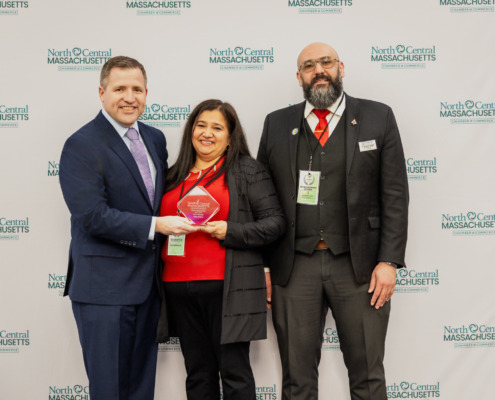

Chamber members are provided with the opportunity to engage with the Mayors of Fitchburg, Gardner, and Leominster who provide updates on projects and other things happening in their Cities. These events are by invitation only, please contact Travis Condon for more details.
View
Event
Bull Run Restaurant215 Great Rd. Shirly, MA
View
Event
Join us for our last Connect North Central of the year!
Friday, December 11, 2026
8am-9am
View
Event
January 14, 20277:15am - 9:00am
View
Event
Erin Logan | NBC 10 Reporter
View
Event
Chamber members are provided with the opportunity to engage with the Mayors of Fitchburg, Gardner, and Leominster who provide updates on projects and other things happening in their Cities. These events are by invitation only, please contact Travis Condon for more details.
View
Event
Kate Shaffer has loved to make art her whole life, just as she has always loved jazz, particularly jazz vocalists such as Ella Fitzgerald, Etta James, and Peggy Lee. These women and others are the great jazz artists she began listening to when she was a teenager, and they are the featured subject matter of her upcoming exhibition at Zavo on April 2.
“Women of Jazz” focuses on the ten great women interpreters of jazz of the twentieth century. Most of them faced tremendous adversity throughout their lives — poverty, abuse, racism — but managed to triumph over all these difficulties, each one relying on their strong, striking personalities in addition to their considerable musical talents. The ten are captured in portraits, or what the artist also refers to as the style of “abstract figurative.”
“Each woman is ‘mid-song,’” Kate explains. “The open mouths are not just about the music, but also about their voices being heard in the world.” Each image is derived from photographs (except for Betty Carter’s, which Kate sketched from one of the singer’s videos). These are not individuals posing but captured in action, brilliantly expressing what Ms. Shaffer calls the “aliveness” of these extraordinary performers.
What comes through in each of the paintings is a strong sense of who these women were, what extraordinarily brave people they were, and how they used music to have their say about the world around them.
“When I say that each of these women found her ‘voice,’” says Kate, “I mean they found out how to be heard in this world — what they felt, what they thought about.” These women became very influential, not just in the jazz world but sometimes in terms of political and social movements as well. Nina Simone was one of the most inspiring voices of the civil rights movement, and Billie Holiday lost work at many clubs after singing and recording “Strange Fruit,” the shockingly graphic song about the lynching of young Black men still occurring in the U.S. in the 1950s.
“Jazz is described as both ‘hot’ and ‘cool,’” Ms. Shaffer says. Fittingly, “colors of that temperature,” both hot and cool, are employed in the pictures. Both kinds of colors are so striking they practically sing. “I wanted very vibrant colors, not dull, sedate ones,” Kate explains.
These women came to the notice of bandleaders and producers through such venues as talent shows and often singing for free at various clubs when they were still just teenagers. Everyone knows about the famous talent contests at The Apollo Theater on 125th Street in Harlem, which brought lots of new talent into the spotlight in the 1930s and ’40s. Ella Fitzgerald’s first experience there demonstrates how the music business found new talent in those days. First prize at those contests was $10 and (much more important) a week-long gig at The Apollo. Fitzgerald was homeless for some time as a teenager in Harlem . “Ella was so scruffy-looking,” says Kate, that even though she won the contest she didn’t get her prize because the theater owner was embarrassed to have her on stage. The Apollo producers were the ones who were really embarrassed later on when Fitzgerald became one of the biggest, brightest stars in American music.
“Most people don’t know anything about these women,” says Ms. Shaffer. Introducing them to art lovers was a big motivation for producing “Women of Jazz.”
Other paintings in the show portray two of the famous nightclubs where these jazz legends sang. “New York Skyline” (1 and 2) presents the artist’s vision of The Cotton Club, and “Chicago Skyline” shows us Dreamland in the Second City. “Ladies Night” is a picture of an all-female jazz band.
The ten “Women of Jazz” painted by Ms. Shaffer are profiled as follows.
Dinah Washington was born Ruth Lee Jones in 1924 and played piano and sang as a youngster in church. She got her big break when she won a talent contest at age 15. She began performing in Chicago with such greats as Fats Waller and playing clubs like The Three Deuces. When she went to see Billie Holiday at the Garrick Stage Bar she got the opportunity to sing for club owner Joe Sherman. He hired her on the spot and Dinah worked the upstairs room while Billie sang in the main lounge. She went on to record with such non-jazz artist as Hank Williams but also with jazz immortals such as Duke Ellington and Count Basie. Dinah went on to record many hits and won a Grammy in 1959 for “Unforgettable.” Her chops as a cross-over artist is evident from her being inducted into the Big Band and Jazz Hall of Fame (1984) as well as the Rock and Roll Hall of Fame (1993). She died from a drug overdose at the tragically young age of 39.
Etta James was born in 1938 and started recording in 1954, climbing the charts with songs like “Tell Mama,” “Something’s Got Ahold of Me,” “A Sunday Kind of Love,” and her biggest hit, “At Last.” Her personal life threatened to obscure her career. She struggled with heroin addiction and severe domestic violence. Etta was subject to the abuse of a vocal teacher at a young age and also went through a string of abusive foster homes. In spite of all this turmoil, Etta won six Grammys and was inducted into the Rock & Roll Hall of Fame in 1993. “At Last” is still played on the radio and is a perennial favorite at wedding receptions.
At age 15, Ella Fitzgerald found herself alone in the world, after her mother’s death from injuries sustained in a car accident. Ella moved to Harlem to live with an aunt. She ended up in reform school, broke out, returned to Harlem, and was homeless for a time before her winning performance singing in the talent show at The Apollo. About a year later she won the opportunity to sing at the Harlem Opera House where she met bandleader Chick Webb. He decided to take a chance on her, cleaned her up, and let her sing with his band. Ella never looked back. She sang with greats from every era and genre — jazz, pop, soul and blues. With her exquisite purity of tone, diction and intonation, she was well-known to, and loved by, audiences all over the world. She had a remarkable career that lasted for over 50 years. She died in 1996, still known to music lovers as the Queen of Jazz and the First Lady of Song.
Nina Simone was, to say the least, a natural musician. She taught herself to play the piano at the age of three. By the time she reached adolescence she could play almost anything by ear. She studied classical piano during high school. She applied to the prestigious Curtis Institute of Music in Philadelphia. She was turned away, and Nina always thought it was because of her race. She developed a fusion style that combined jazz, blues and classical music. In 1963, she was shaken by the assassination of civil rights leader Medgar Evers. She became a very outspoken champion of civil rights for African Americans. This very open, militant political stand cost her many bookings. She recorded what turned out to be her seminal work in 1978. Nina never liked “Mississippi Goddamn” or the album, “Baltimore,” but fans and critics alike raved. Nina felt the goal of a musician is “to make people feel on a deep level. It’s difficult to describe because it’s not something you can analyze; to get near what it’s about you have to play it.” Nina died in her sleep at her home in France in 2003.
Billie Holiday was born Eleanor Fagan in 1915. She took on name Billie Holiday and was also given the sobriquet “Lady Day” by her friend and music partner, Lester Young. Billie’s voice is one of the most distinctive and recognizable voices in the history of music. Although she had a very limited range of only about one octave, she developed vocal styling inspired by the phrasing of musical instruments. She was a gifted vocal improviser and a standout among jazz singers. Her vocalization has been an inspiration to current stars like Mariah Carey and Lady Gaga. Billie had massive success during the ’30s and ’40s with both Columbia and Decca Records, but by the 1940s she struggled with drug abuse and legal troubles. In the 1950s she had a major triumph with two sold-out concerts at Carnegie Hall. She died of alcoholism in 1959. Strangely, some of her recordings had not been released by the time of her death. Some believe her work was censored because she refused to stop singing “Strange Fruit.” But most of her songs have now been released, enhancing her reputation for whole new generations of music lovers.
Peggy Lee was born Norma Egstrom in 1920. She changed her name to Peggy Lee and moved to Los Angeles at the age of 17. Peggy had a big hit in 1943 with “Why Don’t You Do Right?” which made her famous. She co-wrote and recorded many hit songs with her husband, Dave Barbour. In 1952 she appeared in her first film, “The Jazz Singer,” for which she won an Academy Award for Best Supporting Actress. She lent her voice to several characters in Disney’s “Lady and the Tramp.” She won many awards, including the Pied Piper Award from the American Society of Composers, Authors and Publishers (ASCAP), the President’s Award from the Songwriters Guild of America, the Ella Award for Lifetime Achievement from the Society of Singers, and the Living Legacy Award from the Women’s International Center. Lee was nominated for twelve Grammy Awards, winning Best Contemporary Vocal Performance for her beloved 1969 hit, “Is That All There Is?” In 1995 she was given the Grammy Lifetime Achievement Award. She continued to sing well into the 1990s, sometimes even from her wheelchair. She died of complications from diabetes in 2002.
During her long career, Shirley Horn collaborated with many jazz greats, including Miles Davis, Dizzy Gillespie, Toots Thielemans, Ron Carter, Carmen McRae, Wynton Marsalis and others. She was most noted for her ability to accompany herself with nearly incomparable independence on the piano while singing, a skill described by arranger Johnny Mandel as “like having two heads.” Producer and arranger Quincy Jones was fascinated by her rich, lush voice, a smoky contralto. “She seduces you with her voice,” Jones said of the singer. Shirley was nominated for nine Grammy Awards, winning Best Jazz Vocal for “I Remember Miles.” She was recognized by Congress for her contributions to American jazz and culture, and she performed many times at the White House for many different presidents. She received an honorary doctorate from Berklee College of Music in Boston, as well as a National Endowment for the Arts Jazz Masters Award. Shirley Horn died of diabetes in 2005.
Born Lillie Mae Jones in 1929, Betty Carter learned to be very independent from an early age. There was little close affection in her family. Her parents objected to the idea of her pursuing a singing career, but by the age of 16 Betty was regularly sneaking out nights to audition for local shows. Growing up in the Detroit hot bed of jazz, Betty introduced a new singing style. Her famous breathy quality became her trademark, as did her remarkable ability to sing “scat.” Victory in a talent contest led to an opportunity to sing with jazz greats Dizzy Gillespie and Charley Parker. Shortly thereafter Lionel Hampton signed her to sing with his band, although later he came to dislike her strong, independent nature. She disdained Hampton’s strict “swing” style and openly refused to sing the songs his way. During the two-and-a-half years Betty sang with Hampton’s band, he fired her seven times. She toured with Ray Charles in the 1960s but often refused to sing pop music. She started up her own record label in 1969. In 1988 she won a Grammy for Best Jazz Album and made a guest appearance on “The Cosby Show.” In 1997 she was awarded the National Medal of Arts by President Clinton. Betty continued to tour and sing until her death from pancreatic cancer in 1998.
When Nancy Wilson won a talent contest in her hometown of Chillicothe, Ohio at the age of 15, she was awarded a twice-weekly appearance on a local TV show that she later hosted. Nancy soon left Chillicothe for New York City. She got her big break just a month after arriving, filling in for another singer at the Blue Morocco. The club signed her to appear four times a week, which she did while holding down a day job as a secretary. Wilson signed with Capitol in 1960 and recorded five albums between 1960 and 1962. In 1964 and 1965, four of her albums reached the top 10 on the charts. In 1967-68, she hosted her own show called (of course) “The Nancy Wilson Show,” for which she won an Emmy. Nancy won three Grammy Awards, a Peabody Award, and an NAACP Image Award. In 2005, Wilson was inducted into the International Civil Rights Walk of Fame at the Martin Luther King Jr. National Historic Site. She said of the honor, “This award means more to me than anything else I have ever received.” Her name appears on the Hollywood Walk of Fame, and there is a street named after her back in Chillicothe. Nancy Wilson died after a long battle with kidney cancer in 2018.
Sarah Vaughan was born in 1924 into a musical and very religious family. Sarah grew up playing piano and singing in the church choir. She fell in love with popular music and began sneaking out in her teens to play and sing illegally in a local nightclub. Soon she found herself in New York. In 1942, after playing piano as accompaniment for a friend at The Apollo competition, she decided to go back and compete herself. Sarah won the $10 prize and a week of performances at the theater. She returned to claim her prize — opening for Ella Fitzgerald! After singing with Earl Hines’ band and with Dizzy Gillespie, in 1945 Sarah went out on her own. She was picked up by Musicraft Records and in 1947 became the first singer to record “Tenderly,” which was a huge hit. Sarah later signed with Columbia Records, where she recorded a string of hits. She rose to widespread acclaim and had an almost non-stop touring schedule. Her personal life was much more challenging. Her first marriage left her with little money in spite of her tremendous commercial success. Her second husband was violently abusive, and after her divorce she found he had left her $150,000 in debt. Sarah had an enormous vocal range and sang many different kinds of music. She could have sung grand opera, but that art form “wasn’t for her.” Artists who show Sarah’s influence in the world of music include Phoebe Snow, Anita Baker, Sade Adu and Rickie Lee Jones. Sarah was diagnosed with lung cancer and sang her last performances at the Blue Note in New York City. Sadly, she was too ill to finish her scheduled appearances. She died in 1990 at age 66 while watching a television movie co-starring her daughter.
________________________________
Kate Shaffer was born in central New York and grew up on a farm until the age of 10. Her father loved music and played guitar at the local square dances. Kate began singing at the age of three at the square dances where her father played. The music she loved to listen to had colors, she felt, and movement. She imagined putting those colors together into art.
She began a new chapter in her life after her youngest daughter left home. The “empty nest” became an active professional artist’s studio. She paints with joy and exuberance. The colors and textures themselves express almost explosive emotional intensity.
Kate derived her technique come from much experimentation and exploration of different media. She employs an aggressive “no fear” approach, whereby she keeps experimenting in order to bring her subject matter to life. One experiment leads to more questions and more exploration. The never-ending process is what keeps her fascinated and keeps expanding her “palette” of media.
Ms. Shaffer has exhibited in local art shows and in her own gallery at 205 School Street in Gardner, Mass. She has won two honorable mentions in her first two years as professional artist. Ms. Shaffer belongs to both the Gardner Area League of Artists and the Fitchburg Art Museum. She shares a studio/gallery with twelve other artists in a community named the School Street Art Studios.
Kate has a very clear conception of her own working methods. “In life,” she says, “as we go through the day-to-day activities and then find ourselves, suddenly, in that perfect moment — so I am with my art. I begin to lay down my first layers and then respond to those as I lay down the next. As I proceed, the layers begin to combine and become the ‘moments’ that reveal a subject I respond to and build upon.”
The artist has written eloquently about her love of jazz and her admiration for these ten jazz greats: “Jazz doesn’t care what color you are. It doesn’t care how old, what gender or nationality you are. Jazz only asks one question: ‘Can you deliver the music?’ These amazing women delivered the music.”
This exhibition will take place at Zavo, 1011 Third Avenue in midtown Manhattan, 5:30 to 7:30 p.m. on Tuesday, April 2. Art lovers (and music lovers) should visit kateshafferfineart.com and gallerysitka.com/kate-shaffer for more information.
HUDSON, Mass., March 15, 2019 – 3 Media Web a local digital agency providing custom tailored web solutions to medium and enterprise sized businesses has opened a second location in Grand Rapids, MI.
Over the past five years, 3 Media Web has grown significantly – more than 200%. Most markedly this growth has been due to the company’s success in developing web solutions for both enterprise-sized technology and manufacturing companies in Massachusetts and beyond.
“We are geographically targeting look-alike companies in the verticals we have had a very successful track record in, and know we can make an impactful difference,” says Lysa Miller, VP of Business Development.
In 2018, 3 Media Web completed more than eight major web projects for these global, national, and local technology and manufacturing corporations. MA-based companies like Microgroup, American SuperConductor, New England Wire Products, SigfoxUSA, and PA-based Hardinge Inc. Most were complex ventures that included eCommerce, multiple languages, and accessibility features very specific to the manufacturing vertical.
In Grand Rapids, 3 Media Web is also hoping to continue to build on its success with its “Agency Partner Model.” The company has found success working as a value-added partner to marketing and creative agencies who don’t provide complex web design, development, or digital marketing for their clients.
“This model allows specialized agencies to continue to work with their clients, even when they themselves don’t provide the services required by bringing in a trusted partner,” says Miller. 3 Media Web has been very successful in applying this model to its current MA-based business.
Marc Avila, CEO & Founder, explained, “One major manufacturing project came to us from one of our partners, Red Javelin, a Boston area public relations agency.”
While Red Javelin managed the communications and messaging portion, 3 Media Web handled the design, development, and integration of the website overhaul project for Hardinge a PA-based global manufacturing enterprise.
“When we needed to choose a partner to work with us on this large website project, 3 Media Web was the obvious and easy choice for us,” said Dana Harris, co-founder, and principal at Red Javelin. “Their process, creativity and ‘do what it takes’ attitude worked to meet the needs of an international manufacturing business with several web properties, thousands of SKUs, multiple language requirements, and a tight deadline.”
Marc Avila added, “We are very excited to be in Grand Rapids, MI. Michigan has a wealth of tech-manufacturing companies. Manufacturers are specialized complex businesses that require vertical expertise. The industry also needs to attract new, young people to the workforce, and are looking for partners to help them develop a strong brand and presence on the web. We are excited to work with them to do just that.”
3 Media Web is located in Hudson, MA and Grand Rapids, MI. They can be visited at 3mediaweb.com.
About 3 Media Web:
3 Media Web is an award-winning website design and digital marketing agency that specializes in designing, developing, and promoting websites on the WordPress platform for growing organizations.
3 Media Web has been the recipient of numerous industry awards, including Communicator Awards, Davey Awards, IWA Awards, Interactive Media Awards, and W3 Awards. Most recently, 3 Media Web was named to the 2018 Entrepreneur 360 List of small businesses who, according to Entrepreneur Magazine, “ … are mastering the art and science of growing a business.”
About Grand Rapids:
As early as the mid-1800s Grand Rapids, Michigan, was known as “Furniture City,” a leading producer of fine residential furniture. Today manufacturing in the area has grown to include a diverse roster of more than 2400 manufacturers that include automotive, medical devices, personal care products, bullet-proof composites for military and industrial vehicles, food processing, technology, aerospace and defense, and a thriving craft beer industry.
Contact 3 Media Web:
Lysa Miller
(508) 439-4781
Boston Area:
7 Felton St.
Hudson, MA 01749
Grand Rapids Area:
99 Monroe Building, Suite 200
Grand Rapids, MI 49503

When the workday ends and the lights go down, Custom Cleaning Service of Peabody, Inc. gets to work. “We operate as our clients’ silent partner after business hours,” says Adam Paicos, of Templeton, who now serves as Director of Operations and oversees the company’s expansion into North Central MA. “We are not often seen, but we ensure facilities are clean, secure, and ready for business each day while serving as the eyes and ears for our clients when they are not on site.”

Discover local business stories through our Inside North Central Massachusetts Podcast series. Listen as Chamber members share their journeys, insights, and contributions to our thriving regional business community.

Looking for your next opportunity? Explore current job openings from employers across North Central Massachusetts on our Jobs Board. Whether you’re starting a new career or making a change, you’ll find a variety of local positions available to help you take the next step.
CapEx Facility Services & Construction · Leominster, MA
TaraVista Behavioral Health Center · Harvard, MA
DRS Power Technology, Inc. · Fitchburg, MA
AIS · Leominster, MA