E-Newsletter
An Electronic Publication of the North Central Massachusetts Chamber of Commerce

Inside this edition, you’ll discover the latest Chamber initiatives and success stories from across our region. From economic development projects and upcoming networking events to policy updates and workforce training opportunities, we’re keeping you connected to what matters most for your business and North Central Massachusetts.
The North Central Massachusetts Chamber of Commerce is here to help – with trusted resources, a strong business network, and a support system to keep your business and the region moving forward

How to Grow When It’s Slow: What Not to Do Right Now
Cameron Herold is a top business consultant, speaker, and author of Double Double – How to Double Your Revenue and Profit in 3 Years or Less.
We got to take a peek into a conversation business expert Cameron Herold had with one of his clients via a recent podcast interview on Real Estate Rockstars Radio. He’s the mastermind behind hundreds of companies’ exponential growth and teaches today’s most dynamic business leaders.
Cameron asked his client, “What revenue ideas have you come up with?”
“We haven’t had time for that,” she replied.
“So what marketing have you been doing in the last 10 days,” Cameron asked?
“We haven’t had time for that,” she repeated.
“You’ve never gone two weeks without doing sales and marketing and business development in your history,” Cameron explained. “Why would you stop now?”
This series has been offering ideas on what you can do to grow your business, it seems appropriate that we share some suggestions for what NOT to do. For example, don’t stop marketing!
There is a lot that business leaders can do to ensure their company grows when it is slow. However, some mistakes could prove costly in the long run. Inspired by Cameron, here are some things we would discourage during a crisis:
Don’t Change Your Strategic Plan
Crises can send business leaders into a frenzy as they take measures to protect the company and employees. To avoid making mistakes, you should look at the areas where you can cut costs while at the same time remaining focused on the future. When the ground starts shaking, avoid the temptation to change your strategic plan immediately. It would be necessary to think, consult, and discuss the business’s future with the relevant stakeholders to help you grow both during and after the crisis.
Don’t Lie to Achieve Short-Term Goals
It can be difficult to deal with the pressure that comes with a crisis and slow growth. Companies will do everything in their power to ensure they get paid for their products and services. You should be careful not to lie to achieve short-term revenue targets. When managing a crisis, it is important that you think long-term. Having a long-term plan will allow you to do your sales and marketing while at the same time mitigating risks and losses.
Don’t Put Unreasonable Pressure on Teams to Deliver Results
Some managers will double sales goals or ask employees to deliver higher numbers to the company in tough times. However, it is important to understand that the employees are trying to adapt to changes as well. Crises present a challenging working environment that may make it difficult for many employees to deliver the expected results. It should not feel as though business leaders are out of touch and tone-deaf. Managers should set realistic targets that will encourage employees to deliver.
Don’t Give Bad Behavior A Pass
When trying to navigate the tough environment and lead your team forward, you should remember that this is a stressful time. Your employees may be under pressure both at work and at home. However, this is not to say that bad behavior should be condoned in the workplace. An angry outburst at work can erode trust and ruin relationships between colleagues. Whenever you notice any bad behavior, you should not give it a pass. Instead, call out the bad behavior to ensure it does not undermine focus and hard work.
Don’t Be Slow to Adapt
Most crises will lead to a change in interests and habits, which can cause a shift in the competitive landscape, making it necessary to respond quickly to the changes. When circumstances appear to be dire, keeping a competitive edge can be very challenging. However, you will have to adapt quickly if you want to pursue new markets and opportunities. Failure to do this may see you falling behind on the competition and struggling to recover when the crisis fades.
For information about how to become a better business owner or operator, check out the Second In Command Podcast at CameronHerold.com/podcast.
And stay tuned for the next article in the 6-part series How to Grow When It’s Slow on the topic of how to change your business for the better.
And that’s the download!
How to Grow When It’s Slow: What Your Team Needs Right Now
“To really grow quickly,” says business expert Cameron Herold, “You have to be slightly more than a business, slightly less than a religion.”
Cameron explains further that, when you add publicity to a great culture, you attract more of the talented people who will fit your culture as you grow.
“The culture is what was going to allow us to bring those people into the organization quickly,” he adds.
Cameron Herold is a top business consultant, speaker, and author of Vivid Vision. We caught up with him via a recent podcast interview he did for Real Estate Rockstars Radio. He’s the mastermind behind hundreds of companies’ exponential growth and teaches today’s most dynamic business leaders.
Business leaders play a critical role in getting companies through slow growth periods. A crisis is characterized by enormous pressures and challenges that make it necessary for organizations to learn quickly in the fast-moving environment. Inspired by experts like Cameron, we’ve compiled a few suggestions for your business.
Demonstrate true leadership
Employees, customers, and suppliers will be looking to the management for direction when there is a crisis. Business leaders will need to stay connected with reality without focusing too much on the crisis. Instead, the leaders should clearly define the future so that staff can fit into the plan. Difficult and uncertain situations will require leaders who can remain calm, focused, energetic, and confident. A confident leadership will inspire the confidence of the different stakeholders, making it easier to navigate the tough times.
Transparent communication
The natural reaction for many people during a crisis will be fear and anxiety. Business leaders have to understand this and take steps to reassure stakeholders by maintaining transparent communication at all times. Employees will want to know the measures that have been put in place to ensure a secure work environment. Investors and customers will also want their concerns to be addressed proactively. Sometimes explicit communication will mean admitting to stakeholders that you are afraid or do not know something.
Encourage collaboration
When responding to a crisis, you will not have all the answers. You should consider calling on the capabilities of your employees and team members to help overcome the uncertainty. Leaders can bring talents together through task forces, and sub-taskforces with clearly defined roles. Continuous engagement with employees in this manner will reduce rumors and fear-mongering. Your staff will also have confidence in you and rely on your leadership for direction, creating a calm environment in which meaningful progress can be achieved.
Accelerate digital transformation
Businesses are continuously pursuing digital transformation programs to improve the efficiency of their operations. However, a crisis that causes major disruptions across many industries will make this transformation an urgent priority. Business leaders will have to accelerate the process to ensure that they find new ways of working and creating value through technology. Considering that employees will work remotely when it is slow, digital transformation will help address the current and future needs of your business.
Proper financial management
For any business to grow when it is slow, leadership teams will have to make tough decisions to cut costs. In essence, cash is king at a time of crisis, making it essential to focus on the company’s short-term and long-term financial health. It would be important to consult widely and make smart decisions that will place your business on the growth path. Prudent financial management will enable you to conserve the available resources and keep your business running.
Have a clear vision
Leadership teams should learn important lessons from any crisis and make the necessary adjustment to ensure the business is prepared for other crises in the future. These adjustments will also help to develop a clear vision that will be shared with the employees. The vision should describe every aspect of the business, painting a picture of where the leadership wants to take the company in the coming years. As you do this, you should not lose sight of other risks that could pose a threat to your business.
For information about how to become a better business owner or operator, check out the Second In Command Podcast at CameronHerold.com/podcast.
And stay tuned for the next article in the 6-part series How to Grow When It’s Slow on the topic of what not to do right now.
Article Source: The Statehouse News Service
Article Author: Matt Murphy
AUG. 14, 2020…..Apologies to Pink Floyd, but experts agree kids do need some education. The nagging question is how best to provide it.
Learning is supposed to resume in a matter of weeks, but tension abounds between the state, districts, teachers’ unions, and parents about whether it’s safe to return to the classroom and whether remote learning is an acceptable substitute.
The state’s two major unions – the Massachusetts Teachers Association and the American Federation of Teachers – want school buildings to remain shuttered, at least to start the year. But Gov. Charlie Baker said he “can’t imagine” why most kids wouldn’t be returning to school given the current status of the virus in Massachusetts.
After creeping up and ringing some alarm bells, the statewide positive test rate is back down around 1.5 percent, which is the lowest it’s been since widespread testing began.
Baker has preached local control throughout much of the pandemic, and rolled out a new rubric this week for people, including school administrators, to make decisions based on what’s happening in their own communities, not just across the state.
But he also made clear where he comes down on the question of remote versus in-person schooling. He’s had less to say about fall athletics, though his administration also warned this week that sports like football and basketball are inherently more risky than tennis.

Gov. Charlie Baker looked up at a television screen displaying the state’s new color-coded COVID-19 infection rate map during a Tuesday news conference. [Sam Doran/SHNS]
The colors correlate to average new daily cases reported over the previous two weeks, with “green” towns reporting fewer than four daily cases per 100,000 people, and “red” towns reporting more than eight new cases a day for every 100,000 people.
A fourth category – white – means a municipality has had fewer than five new cases reported in total over the past two weeks.
“If you’re in a green or a white community, I can’t imagine a good reason not to go back, whether it’s full-time or some sort of a hybrid, because for all intents and purposes you meet all the benchmarks that are being used across the country and across New England to make decisions about whether it’s safe to go back to school,” Baker said.
The governor said that unlike remote learning in the spring, the start of a new school year means students starting new grades with teachers they don’t know, and vice versa. Learning to read, he has said, is not a virtual exercise.
The Department of Elementary and Secondary Education formalized the governor’s position when it told the 305 green and yellow communities that the state expected them to prioritize in-person learning, though there’s no consequence for disobedience.
For 46 other communities, that is not their situation.
In these higher-risk communities, the state has put together an inter-agency task force to offer assistance with testing, contact tracing and enforcement of public and private gathering size limits.
The state said it will also help, if asked, with public awareness campaigns to remind people to stay focused.
“We’re making progress and have made progress in our fight, but we’re seeing the effects of too many people letting their guard down and simply relaxing, get in the way of some of our continued move forward,” Baker said.
Eleven municipalities have been put in the most at-risk “red” category, including Chelsea, Everett, Lynn, Revere, Fall River, Granby, Holyoke, Hull, Lawrence, Saugus and Salem. Those cities and towns, Education Commissioner Jeff Riley said, should begin the year with remote instruction.
Solving the school conundrum is not easy, but there was no controversy over what should happen with the Democratic National Convention next week, which was supposed to take place in Milwaukee before the pandemic.
The DNC will be fully remote. Not even Joe Biden, the presumptive Democratic nominee, will be there in person.
U.S. Sen. Elizabeth Warren scored a Wednesday night speaking role at the virtual DNC, but it was not the time slot many of her supporters may have been hoping to see. Biden this week announced California Sen. Kamala Harris as his running mate, making the daughter of Indian and Jamaican parents the first Black woman to run on a major party presidential ticket. She will give her acceptance speech on Wednesday night.
In picking Harris, Biden passed over Warren who was on the list of women the former vice president vetted for the job. But given the pressure on Biden to pick a woman of color, the outcome was not unexpected.
“I don’t worry about where she ends up or her influence on what happens during a Biden presidency. She’s already proven they work together well, and she’ll be a number one player wherever she is,” said Gus Bickford, chair of the Massachusetts Democratic Party.
Some have Warren ticketed for the Treasury if Biden can topple President Donald Trump in November, while others think she could be more powerful in the Senate, especially if Democrats can regain control of that body.
Regardless, there were probably more than a few eager Democrats who had to put their ambitions on ice, at least for now, as they wait to see whether a Senate seat opens up before 2024.
The competition for the state’s other Senate seat heated up, with U.S. Sen. Edward Markey and U.S. Rep. Joseph Kennedy III squaring off in their second-to-last debate before the Sept. 1 primary.
Polling has shown the race to be tight, and after refusing to sign a pledge to keep outside money out of their race, Markey is now hammering Kennedy over the support he is receiving from a new super PAC that may, or may not, be funded in part by Kennedy’s father, who himself was a congressman.
Markey has also benefited from super PAC spending, which Kennedy’s team is all too willing to point out.
Things may be getting uglier in the Senate race, but not as ugly as they got this week out west where UMass College Democrats accused Holyoke Mayor Alex Morse, who is gay, of inappropriately contacting students through social media channels. Morse denies taking advantage of his position as a UMass lecturer to meet men, but says he won’t apologize for using dating apps in his personal life.
Some LGBTQ lawmakers like Sen. Julian Cyr have come to Morse’s defense, suggesting a double standard in the face of unsubstantiated claims. Some reports have even suggested it may have been an orchestrated attempt to hurt Morse’s campaign against U.S. Rep. Richard Neal, who has denied any involvement.
The truth may be a bit blurred, but it’s clear it’s crunch time for a lot of campaigns as early voting is underway.
Dave Cavell, the one-time speechwriter in the Obama White House who advised Attorney General Maura Healey before leaving her office to run for Congress, saw his time running out.
Cavell suspended his campaign in the Fourth Congressional District, and endorsed Jesse Mermell. In doing so, Cavell not only talked up Mermell’s progressive credentials, but said he it was a strategic move to avoid further splintering the vote in what’s now an eight-person field in a way that could make it easier for Newton City Councilor Jake Auchincloss to win.
Auchincloss has become the crowded field’s favorite punching bag after the Boston Globe’s editorial board endorsed his campaign, despite some controversial comments he’s made in the past on social media.
For instance, his rivals view his free-speech comparison between the Confederate Flag and Black Lives Matter banners as disqualifying. He has since called those comments a mistake.
Cavell, however, was only the tip of the iceberg, because after he exited the race his former, and much better known, boss Healey also endorsed Mermell.
The attention on the campaign trail this week is what August is usually like in an even-numbered year, even though this is no usual year and the Legislature extended its session beyond the traditional July 31 recess date.
Legislative leaders suggested they would call lawmakers back into session this month if and when any of the conference committees negotiating policing, climate change, telehealth, economic development and transportation spending bills reached a deal.
So far, that hasn’t happened.
Also this past week:
STORY OF THE WEEK: To Zoom or not to Zoom, that is the superintendent’s question.
SONG OF THE WEEK: No matter how students return this fall, they can always be true to their school
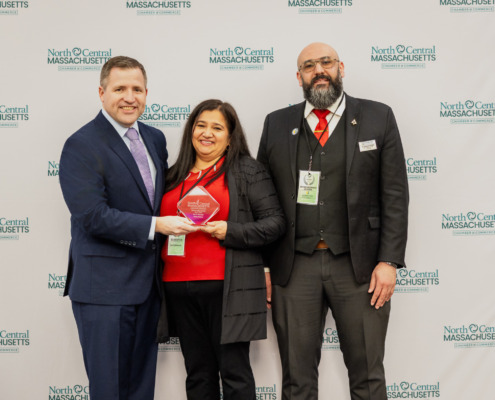

The reception features an open bar and gourmet appetizers.
View
Event
Join us for Connect North Central
Friday, September 25, 2026
8am-9am
View
Event
North Central Golf Tour Championship: Fore the Future
An FLNC Non-Traditional Scholarship Fundraiser
View
Event
Thank you Series Supporting Sponsor empHowered PR
View
Event
Join us for our 11th Annual
Congressional Luncheon
View
Event
Wednesday October 28, 2026
5:00pm - 7:00pm
View
Event
Join us for this in person HR Legal Update
View
Event
November 19, 2026
7:15am - 9:00am
View
Event
Chamber members are provided with the opportunity to engage with the Mayors of Fitchburg, Gardner, and Leominster who provide updates on projects and other things happening in their Cities. These events are by invitation only, please contact Travis Condon for more details.
View
Event
Bull Run Restaurant
215 Great Rd. Shirly, MA
View
Event
Join us for our last Connect North Central of the year!
Friday, December 11, 2026
8am-9am
View
Event
Chamber members are provided with the opportunity to engage with the Mayors of Fitchburg, Gardner, and Leominster who provide updates on projects and other things happening in their Cities. These events are by invitation only, please contact Travis Condon for more details.
View
Event

Check it out by going to: https://www.tdovideo.com/
For more details: nashobatech.net/community_ed

When the workday ends and the lights go down, Custom Cleaning Service of Peabody, Inc. gets to work. “We operate as our clients’ silent partner after business hours,” says Adam Paicos, of Templeton, who now serves as Director of Operations and oversees the company’s expansion into North Central MA. “We are not often seen, but we ensure facilities are clean, secure, and ready for business each day while serving as the eyes and ears for our clients when they are not on site.”

Discover local business stories through our Inside North Central Massachusetts Podcast series. Listen as Chamber members share their journeys, insights, and contributions to our thriving regional business community.

Looking for your next opportunity? Explore current job openings from employers across North Central Massachusetts on our Jobs Board. Whether you’re starting a new career or making a change, you’ll find a variety of local positions available to help you take the next step.
CapEx Facility Services & Construction · Leominster, MA
TaraVista Behavioral Health Center · Harvard, MA
DRS Power Technology, Inc. · Fitchburg, MA
AIS · Leominster, MA