E-Newsletter
An Electronic Publication of the North Central Massachusetts Chamber of Commerce

Inside this edition, you’ll discover the latest Chamber initiatives and success stories from across our region. From economic development projects and upcoming networking events to policy updates and workforce training opportunities, we’re keeping you connected to what matters most for your business and North Central Massachusetts.
The North Central Massachusetts Chamber of Commerce is here to help – with trusted resources, a strong business network, and a support system to keep your business and the region moving forward
State House News Service
Author: Chris Lisinski
Nearly two years after COVID-19 upended the world and sent unemployment claims skyrocketing, Massachusetts officials are still working to decipher the seismic shifts to the labor market.
Employers around the state — and much of the country — continue to tell their elected representatives about struggles attracting qualified workers, and those challenges are difficult to attribute to a single prevailing factor, Labor and Workforce Development Secretary Rosalin Acosta told lawmakers on Tuesday.
“What we are seeing right now, and I know that you are all hearing, is all employers calling you saying they can’t find enough people and certainly can’t find enough trained people. I get the calls, you get the calls, I get the calls from you telling us that there’s not enough folks,” Acosta said at a Ways and Means Committee budget hearing. “Why does our labor force look different now than it did before? There are so many different reasons for that.”
On both the public health and economic fronts, the pandemic wrought disproportionate consequences, hitting lower-income areas and communities of color harder than wealthier, whiter areas.
Working mothers in particular faced significant strain, leaving jobs in droves as child care became inaccessible or unaffordable. While Acosta agreed with lawmakers that child care played a role in the reshaping of the labor force over the past two years, she said the data paint a more complicated picture.
“When I look, for example, at women in the labor force and how women have dropped out of the labor force, curiously enough, women from the age of 45 to 54 have dropped off significantly compared to 2019,” Acosta said. “You could say that could certainly be child care, but it could also be burnout. We know that our health care providers have worked really hard and been incredible heroes over these last two years. We see retirements in there, we see people just needing a break.”
Immigration is down, too, further shrinking the pool of available workers and muddying the outlook for businesses ready to hire. Acosta said the administration estimates Massachusetts has “about 33,000 fewer people in the commonwealth this year than in the past,” though it was not clear if she specifically meant 33,000 fewer new immigrants.
Some workers might also worry that wages are not keeping up with inflation or have found that their priorities changed during the crisis.
Acosta said some employees today are no longer interested in jobs that require a physical, in-office presence and only want to pursue remote work.
“These are all influences in that tight labor shortage that we’re feeling,” Acosta said.
Unemployment surged to record levels in Massachusetts early in the crisis, jumping from 2.7 percent in March 2020 to 16.4 percent a month later before embarking on a gradual decline.
By December 2021, the statewide joblessness rate had fallen to 3.9 percent. And while employers added 537,000 jobs between April 2020 and December 2021, those gains clawed back only a bit more than 80 percent of the jobs lost in the emergency’s early months, leaving total employment below pre-pandemic levels.
The administration plans to launch a survey to try and “find some of these folks that have dropped out of the workforce that are still fairly young and not retiring,” Acosta said, hoping to get a better sense of why swaths of employees chose not to work any longer and whether they intend to return.
Another area of focus will be to connect workers with training and certification programs to help them fill slots in high-demand industries.
About 35 percent of the state’s job openings are in professional services, Acosta said, while many claims for unemployment insurance over the past two years came from workers in industries such as retail, hospitality and food service.
A “future of work” report the Baker administration sought estimated the state needs to retrain 30,000 to 40,000 employees per year to keep up with evolving demand and needs, according to Acosta.
One program aimed at closing that gap is the Career Technical Initiative, which seeks to connect thousands of workers to hands-on vocational and technical education using a combination of daytime classes for students, afternoon programming for students enrolled in traditional high school, and after-dark options for adults seeking retraining or career changes.
Gov. Charlie Baker proposed $17.9 million in funding for the initiative in his FY23 state budget. Another $25 million in American Rescue Plan Act federal aid will support the program, which Acosta said aims to retrain more than 15,000 adult workers for sought-after technical and vocational jobs over the next several years.
As elected leaders grapple with the constantly shifting economic landscape, the Baker administration is also placing new trust in a formerly “very quiet” state office to help chart a path forward.
The Department of Economic Research, a smaller division within the Executive Office of Labor and Workforce Development, faced a surge of new requests for analysis and insight during the pandemic on topics ranging from unemployment insurance trust fund modeling to statewide economic comparisons.
Acosta said she sought a “complete transformation” of the economic research team in response to its new popularity, elevating it from under the Department of Unemployment Assistance umbrella to report to her directly and hiring a director and chief economist.
“It’s actually always been there, but it’s been very quiet,” Acosta said.
Baker’s $45.8 billion FY23 budget for the first time includes a line item for the Department of Economic Research, proposing $600,000 in dedicated funding.
“Our hope is that we’ll be able to add value to all of you as well as all of our academic institutions and our workforce partners to make sure we’re making very sound and solid decisions as we all get used to this new economy that we’re all working in,” Acosta said.

Gagnon brings entrepreneurial spirit, experience in variety of industries to serve Chamber members
The North Central Massachusetts Chamber of Commerce is pleased to announce the appointment of Tracy Gagnon as Manager of Membership Recruitment and Engagement. In this position, she will be responsible for managing marketing and outreach to prospective members while also providing superior service and support for current members.
Gagnon comes to the Chamber with years of experience serving in various roles in sales, hospitality and education. Most recently, she served as the COVID-19 Coordinator for the Town of Lancaster Board of Health. She also worked at the University of New Hampshire on its Keene and Durham campuses where she served in a variety of administrative roles. Earlier in her career, she served as Membership Director at the Dover New Hampshire Chamber of Commerce.
“As the child of entrepreneurs and an entrepreneur herself, Tracy has the unique ability to understand the needs of our members,” said Roy M. Nascimento, President & CEO of the North Central Massachusetts Chamber of Commerce. “Her energy, experience and passion for the work of the Chamber and our affiliates made a positive impression during the selection process. She will play an important role in our efforts to engage business leaders in North Central Massachusetts.”
She holds a bachelor’s degree in Organizational Management from Daniel Webster College and a master’s degree in Educational Leadership/Counseling from Plymouth State University, where she also obtained certification for K-12 School Counseling.
In addition to her work at the Chamber, she and her husband own and operate several rental properties that they manage. She is also active in the Wachusett Area Rotary Club and the West Boylston Board of Health.
Current members or businesses interested in learning more about the North Central Massachusetts Chamber of Commerce can reach out to Tracy Gagnon at 978.353.7600 ext. 239 or via email at .
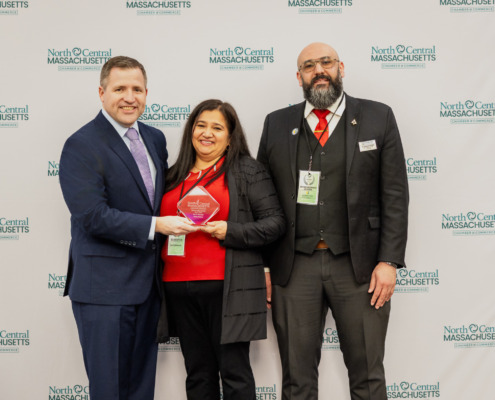

The reception features an open bar and gourmet appetizers.
View
Event
Join us for Connect North Central
Friday, September 25, 2026
8am-9am
View
Event
North Central Golf Tour Championship: Fore the Future
An FLNC Non-Traditional Scholarship Fundraiser
View
Event
Thank you Series Supporting Sponsor empHowered PR
View
Event
Join us for our 11th Annual
Congressional Luncheon
View
Event
Wednesday October 28, 2026
5:00pm - 7:00pm
View
Event
Join us for this in person HR Legal Update
View
Event
November 19, 2026
7:15am - 9:00am
View
Event
Chamber members are provided with the opportunity to engage with the Mayors of Fitchburg, Gardner, and Leominster who provide updates on projects and other things happening in their Cities. These events are by invitation only, please contact Travis Condon for more details.
View
Event
Bull Run Restaurant
215 Great Rd. Shirly, MA
View
Event
Join us for our last Connect North Central of the year!
Friday, December 11, 2026
8am-9am
View
Event
Chamber members are provided with the opportunity to engage with the Mayors of Fitchburg, Gardner, and Leominster who provide updates on projects and other things happening in their Cities. These events are by invitation only, please contact Travis Condon for more details.
View
Event
GARDNER, MA – September 1, 2022 – Mount Wachusett Community College held a pinning for its Dental Assisting program graduates on Friday, August 26, 2022.
“I would like to take the opportunity to congratulate each of you and thank you for choosing the Mount for your education,” noted MWCC President James Vander Hooven. “Tonight is just the beginning of your next journey, as you enter this field, a caring field I ask you to stay in touch with us and with each other. We look forward to your continued success.”
Students were welcomed by Dental Education Program Director Cynthia Cadoret, and were pinned by faculty members Kristen Columbus, Nicole Galloway, Kaitlyn Geise, and Kelly Jancaitis.
The Dental Assisting Certificate is one of three dental education options at Mount Wachusett Community College. MWCC also offers a two-year Dental Hygiene Associate Degree and a new Dental Radiology Certification program.
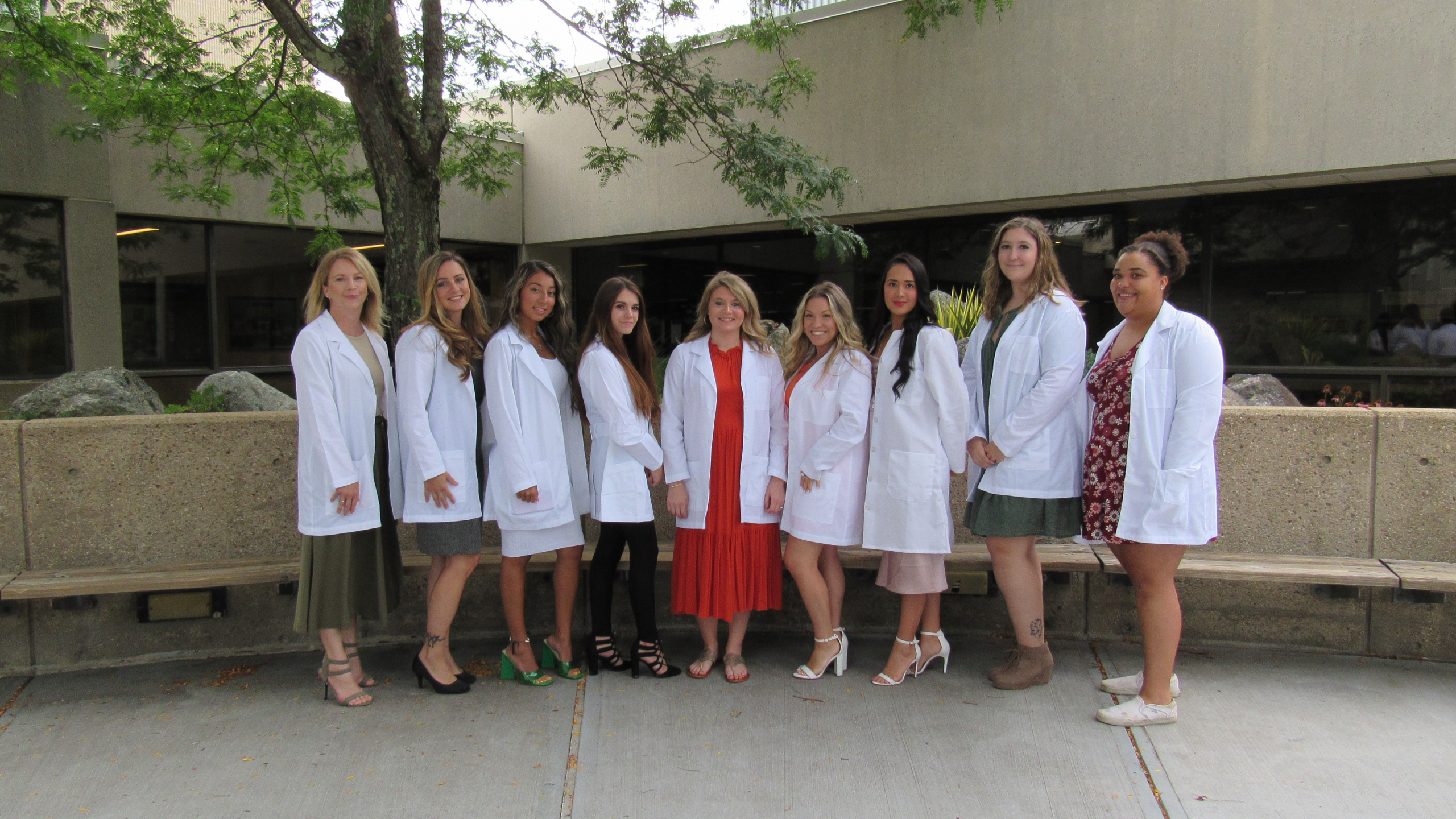
Photo caption left to right: Christina Raisdanaee, Stephanie Constant, Xenia Rodriguez, Mary Miller, Alyssa Patnaude, Olivia Olmeda, Abigial Sarante, Sophia Wenning, Sky Hutchful
The students who earned their Dental Assisting Certificate are:
Stephanie Constant – Leominster, MA
Sky Hutchful – Fitchburg, MA
Mary Miller – Gardner, MA
Olivia Olmeda – West Townsend, MA
Alyssa Patnaude – Keene, NH
Christina Raisdanaee – Leominster, MA
Xenia Rodriguez – Fitchburg, MA
Abigail Sarante – Leominster, MA
Sophia Wenning – Leominster, MA
To learn more about the Dental Education Programs offered at Mount Wachusett Community College, please visit mwcc.edu.
Contact: Tamar Russell Brown — 978.425.6290
Susan Wadsworth — 603.801.6746 or

The work is mostly very recent, and features Ms. Wadsworth’s latest interests, including the challenge of executing huge pastel murals, capturing stunning sunsets at sea, and employing a new freedom with ink in the landscapes of mountains and trees. This is the artist’s first solo show at a commercial gallery, and she is very excited to be exhibiting so much new work.
The big “show piece” in the exhibition is Quoddy I. It was inspired by the Quoddy Head State Park in downeast Maine, near the Canadian border. It is the fifth very large piece (42″ x 108″) that Ms. Wadsworth has completed since April 2020, in addition to three “smaller” pieces — each a mere six feet wide.
The medium for all of these is pastel and ink on paper. Formerly the artist always began with pencil, later going over these lines with India ink. Now she finds she can do smaller studies applying the ink directly. But with very large pieces, she still relies on some underlying graphite lines to work out the overall structure of the composition. Further on in the process, she adds pastels in multi-colored layers — as many as 20 such layers! These she rubs by hand to achieve a smooth finish. The ink is the final ingredient, contrasting very energetically and solidifying the entire work.
The Covid crisis of 2020 forced many exhibitions online. This turned out to produce a unique opportunity, as Ms. Wadsworth had much less to worry about in terms of “frame-ability” of her paintings. “I could submit works, large or small…I was free to experiment with sizes and formats,” she says. “And thanks to the visionary support of Tamar Russell Brown and Gallery Sitka, that is exactly what I will be doing with this upcoming show.”
In May of this year, the artist “escaped” to Maine for 10 days, “knowing only that I wanted to draw rocks.” She found plenty of inspiration at Bailey Island, Pemaquid, Schoodic, and Quoddy, this last location nestled beside Quoddy Head State Park. From her base in Lubec, she hiked, stopping to sketch when she found a view that was especially beautiful and inspiring. She produced 10 studies and took numerous photographs. From these, she pieced together the vistas now that appear in Quoddy I. The large pieces might appear to be from one point of view, but in fact they are meticulously constructed combinations of at least five different viewpoints. She compares these to some landscapes well known to admirers of Cubism. The difference between her own work and those cubist paintings, says the artist, is that her vision is more “organically connected.”
Ms. Wadsworth’s understanding of her own work tends to change and develop over time. This process is reflected in the relationship between different artistic schools and even across national borders. An admirer of Chinese and Japanese art, she has long studied the rocks depicted in Chinese scrolls, perhaps once imagining bearded sages strolling in the hills at a leisurely pace, surrounded by the natural beauty of the exotic rock formations looming over the river below. (Well, exotic for North Americans, perhaps. Obviously, the Chinese, accustomed to their surreal, bulging rock cliffs on the banks of the Yang-tze, may find the mesas of Monument Valley quite exotic indeed.) The rocks that she draws from life in New England and in Canada, do not exude peace of mind. “These rocks suggest trouble,” she says, “but one that is negotiable. And the light, I hope, suggests spiritual hope.” In other words, the images drawn straight from nature are often quite beyond words, but they conjure up powerful thoughts and feelings when she takes another look at one of her landscapes months or years afterward. “The inner content of my work,” she muses, “sometimes evolves with the work itself or becomes evident later on.”
The artist directs viewers to the kanji — Japanese characters — that she sometimes includes along with the images. These can be imperfectly translated as “transform…transcend…eternity…breath…true…be,” among others. The use of kanji is purposeful in terms of meaning and the graceful, decorative emphasis on planes that we see in Japanese screens. The kanji create a kind of “pictorial tension — a play of planes and flatness” — in place of traditional perspective.
This Sitka show also has small tableaux of unframed pieces, of a size (c. 10.5″ x 13.5″) that fit comfortably into the artist’s drawing backpack. She executed many of these as “walk and draws.” She hikes until she is tired — or inspired. Then she sits down and begins to draw.
Another new section for the show will be Ms. Wadsworth’s sunsets. These were completed on two different cruises — one through the Panama Canal in late 2021, and the other in March 2022 from Brazil to Barbados. The artist intensely studied these spectacular sunsets, taking as many as a hundred photos, in the process catching many subtle changes in the color and composition of the sky, the sea, and the sun in the course of one shoot. The artist created drawings from those photos. “I tried to create a focused essence of each sunset,” she observes, “without all the encircling details that are possible but often distracting.”
The last bank of drawings at Sitka will be “mountains and trees” done on walks near the Vermont border and at Lake Temagami in Ontario. Here the artist plays with color and layered lines, seeing them more as “energy lines.” She maintains: “There is always something else going on that is more than just a mechanical reproduction of reality.”
Susan Wadsworth earned a Master of Fine Arts (MFA) degree at Cranbrook Academy of the Arts near Detroit, and an MA in Art History at Tufts University in Medford, Mass. Readers who want to learn more about her work or the Gallery Sitka show can contact Ms. Wadsworth or the hostess of the exhibition, Tamar Russell Brown, at the numbers and email address listed above.
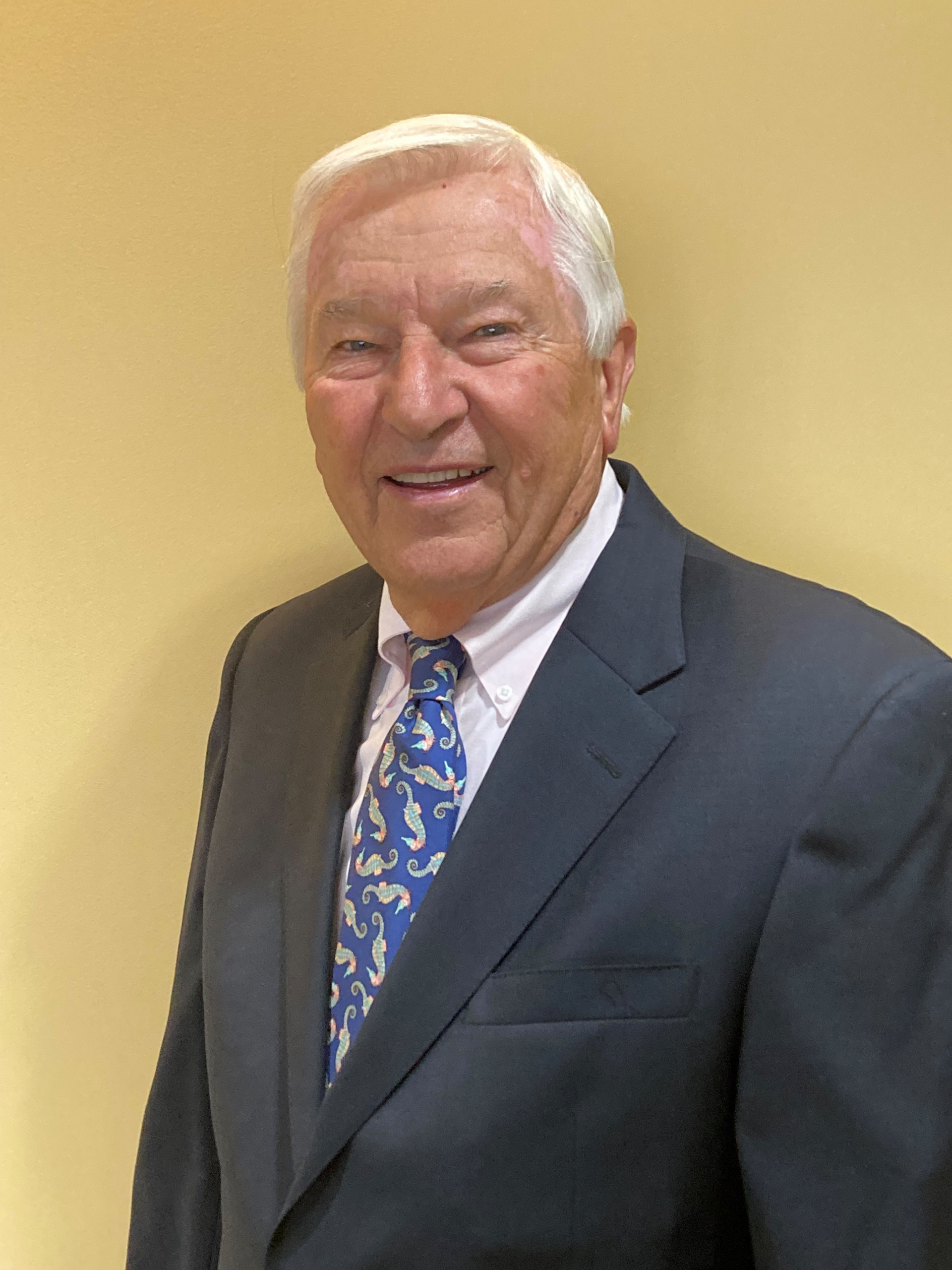
Richard A. Sheppard was appointed Chairman of the Board. Sheppard serves on the Executive Committee and has served on the board since 2006.
Michael J. Sauvageau, Vice Chair. Sauvageau has been on the Board since 2007. Sauvageau serves on LCU’s Executive, Credit, Investment and Compensation Committees.
Nancy L. Graves, Treasurer. Graves serves on the Executive, Audit and Advisory Committees. She has served on the LCU Board of Directors since 2004.
Guilio G. Greco, Assistant Treasurer. Greco most recently held the position of Chairman. Greco serves on LCU’s Executive, Audit and Investment Committees. Greco has served on the Board since 1978.
Joseph V. Quintal, Clerk. Quintal serves on Executive, Credit, Compensation and Advisory Committees. Quintal has served on the Board since 2006.
Joining the officers on the 2022-2023 Board of Directors are; Robert J. DelleChiaie, Joyce G. Leger, Henry C. Kulik, Jr. and John W. Reedy.

When the workday ends and the lights go down, Custom Cleaning Service of Peabody, Inc. gets to work. “We operate as our clients’ silent partner after business hours,” says Adam Paicos, of Templeton, who now serves as Director of Operations and oversees the company’s expansion into North Central MA. “We are not often seen, but we ensure facilities are clean, secure, and ready for business each day while serving as the eyes and ears for our clients when they are not on site.”

Discover local business stories through our Inside North Central Massachusetts Podcast series. Listen as Chamber members share their journeys, insights, and contributions to our thriving regional business community.

Looking for your next opportunity? Explore current job openings from employers across North Central Massachusetts on our Jobs Board. Whether you’re starting a new career or making a change, you’ll find a variety of local positions available to help you take the next step.
CapEx Facility Services & Construction · Leominster, MA
TaraVista Behavioral Health Center · Harvard, MA
DRS Power Technology, Inc. · Fitchburg, MA
AIS · Leominster, MA