E-Newsletter
An Electronic Publication of the North Central Massachusetts Chamber of Commerce

Inside this edition, you’ll discover the latest Chamber initiatives and success stories from across our region. From economic development projects and upcoming networking events to policy updates and workforce training opportunities, we’re keeping you connected to what matters most for your business and North Central Massachusetts.
The North Central Massachusetts Chamber of Commerce is here to help – with trusted resources, a strong business network, and a support system to keep your business and the region moving forward
New program directs $50 million toward businesses reaching underserved markets, minority-, women-, and veteran-owned businesses, and $25 million for businesses that did not qualify for prior MGCC aid
Today, the Baker-Polito Administration announced the launch of a new $75 million grant program to support Massachusetts small businesses impacted by the COVID-19 pandemic. The new program is part of the plan to spend $4 billion in American Rescue Plan funding that was signed into law by Governor Charlie Baker in December 2021. The new program is modeled after Massachusetts Growth Capital Corporation’s (MGCC) successful COVID-19 small business relief program. Under that effort, which became the biggest state-sponsored business relief program in the nation, MGCC oversaw the distribution of approximately $705 million to over 15,000 small businesses across Massachusetts. Today’s announcement was made at Luanda Restaurant and Lounge in Brockton, a family-owned business that received financial support through MGCC’s prior COVID relief grant program.
“We have been proud to support small businesses in every corner of the Commonwealth through the MGCC small business program during the pandemic, but we know that some challenges remain for many businesses,” said Governor Charlie Baker. “With the launch of this new effort, we can build on MGCC’s successful work and direct important federal funding to those businesses with the greatest need quickly and effectively.”
“Restaurants like Luanda are fundamental to the character of our neighborhoods, main streets and downtowns in every city and town in Massachusetts,” said Lt. Governor Karyn Polito. “This new initiative will ensure that businesses that need help the most will be able to take advantage of additional opportunities.”
The $75 million will be focused on small businesses that employ between two and 50 people, with $25 million directed toward businesses that did not qualify for previous MGCC grants because of a lack of revenue loss in 2020; and $50 million directed to businesses that reach underserved markets and historically underrepresented groups, or are minority-, women-, or veteran-owned businesses, or are owned by individuals with disabilities or who identify as a member of the LGBTQ+ community.
Under both categories, grants will range from $10,000 to $75,000, and will be capped at the lesser of $75,000 or three months of operating expenses. Grant funding can be used for employee and benefit costs, mortgage interest, rent, utilities, and interest on debt.
“The challenges faced by Massachusetts’ small businesses during COVID have been enormous, but in my district and across the state I have seen so many entrepreneurs and innovators respond with incredible perseverance and grace. Small businesses are the backbone of our economy, and they deserve our support,” said Senate President Karen E. Spilka. “Today’s grants represent a choice by the Legislature to center small businesses in our effort for an equitable recovery. I am grateful to the Massachusetts Growth Capital Corporation for their work to distribute these funds to so many deserving businesses and I am thankful to all of the small businesses who have done so much for Massachusetts.”
“I am pleased to hear that the small business grant program, created through the Legislature’s ARPA bill, is now accepting applications, and will soon be distributing these funds to our small businesses,” said Speaker of the House Ronald J. Mariano. “Delivering on the Legislature’s intent to pass a bill truly focused on equity, a significant portion of the funds from the small business program will specifically target minority-owned, women-owned, and veteran-owned small businesses, as well as small businesses that didn’t receive previous grants during the pandemic. Small businesses are oftentimes the backbone of our communities and local economies, and I look forward to seeing these investments remain a priority for the House of Representatives moving forward.”
“When help was needed the most during the pandemic, the Massachusetts Growth Capital Corporation scaled up a nation-leading program to support our small businesses and the families and entrepreneurs behind them,” said Housing and Economic Development Secretary Mike Kennealy. “I’m grateful to the MGCC team for once again stepping up to direct vital funding to the neighborhoods and communities that continue to face challenges created by this unprecedented public health crisis.”
“MGCC is pleased to be an instrument of recovery for the smallest of businesses throughout Massachusetts most affected by COVID-19 with these two new grants programs,” said Lawrence Andrews, CEO and President of MGCC. “The Baker-Polito Administration and the Legislature recognize that certain communities have been disproportionately impacted by the pandemic, and the goal of this funding will bring relief and stability to additional businesses throughout the Commonwealth.”
In addition to prioritizing applications from businesses that did not qualify for prior aid and businesses owned by individuals from historically underserved populations or operate in underserved markets, eligible businesses must currently be in operation and based in Massachusetts. Applicants must also demonstrate that business revenues for 2020 were between $40,000 and $2.5 million.
Learn more at EmpoweringSmallBusiness.org.
State House News Service
Author: Chris Lisinski
Massachusetts will steer another $101 million toward its COVID-19 response under a spending bill Gov. Charlie Baker signed over the weekend that also shifts the statewide primary election date up to Sept. 6.
Baker on Saturday approved all of the spending on COVID-19 emergency paid sick leave, rapid tests, high-quality masks and vaccine access that lawmakers included in the supplemental budget (H 4430). He vetoed two outside policy sections and returned another two, including an attempt by the Legislature to codify a vaccine equity plan, with amendments.
The new law calls for $76 million in direct state spending aimed at boosting access to masks, COVID-19 vaccines and rapid tests, particularly for schools, congregate care facilities and homeless shelters. It also allots another $25 million in available federal funds to the state’s COVID emergency paid sick leave program.
Baker struck down two outside sections that he said together would have required the state Department of Public Health to “issue and post guidance on mask usage and testing, quarantining, and isolation periods related to COVID-19 within 30 days.”
The department already works to publish up-to-date guidance, Baker said, arguing the additional language in the bill would “serve no purpose if signed into law.”
One section Baker returned to lawmakers with an amendment called for the secretary of health and human services to craft and implement a COVID-19 vaccination equity plan with a goal of eliminating disparities in vaccination rates within 120 days.
Baker’s amendment strikes the 120-day target, a change that he said would “reflect the continuing challenge faced by nearly every country in the world and every state in the country of achieving total vaccine equity.”
The Republican governor defended his administration’s work to make vaccines are available and accessible across Massachusetts, recounting steps the administration took such as prioritizing 20 hard-hit cities and towns — in which 12 have rates of residents with one vaccine dose above the national average, according to Baker — and steering additional funding to community organizations.
“Our administration is committed to continuing our efforts to reduce disparities in vaccination rates in Massachusetts,” Baker wrote. “But the challenge of eliminating disparities in vaccination rates altogether is a project that will require us all to work beyond the 120 day deadline envisioned by the language of this section.”
Baker added that he plans to comply with other language in the bill requiring the administration to file a vaccination equity plan within 30 days and regular progress reports every 60 days.
The other amendment Baker offered deals with public employees who come out of retirement to resume working for their former employer. Lawmakers proposed extending a pandemic-era waiver on earnings and hours caps for those workers through the rest of the year, and Baker instead suggested linking the extension to the public health emergency so it is “tied to a specific time period where a heightened response may be necessary.”
Lawmakers can choose to override Baker’s vetoes with a two-thirds vote in either chamber, where Democrats hold supermajorities.
In addition to his vetoes and amendments, Baker wrote that he “disapprove(s) language” requiring masks, testing and vaccines to be made available by Feb. 28. He called it “simply unrealistic” to expect to hit those deadlines in two and a half weeks.
The mid-year spending bill also officially sets the statewide primary election for Sept. 6, two weeks earlier than the default date under existing state law.
Changing the primary date has evolved into a biennial tradition in Massachusetts, and Secretary of State William Galvin had warned that the original Sept. 20 date for this cycle would not provide him enough time to make ballots ready for military and overseas voters.
Galvin announced on Sunday that nomination papers would become available to candidates starting at 10 a.m. Monday, a day ahead of the codified deadline he faces.
Depending on the office sought, candidates must collect between 150 and 10,000 signatures from registered voters.
Those running for district and county offices have until May 3 to submit signatures to local registrars for certification, then until May 31 to submit certified signatures to Galvin’s Elections Division. Party candidates seeking statewide office or Congress must file signatures locally by May 10 and with Galvin by June 7, while non-party statewide and congressional candidates have until Aug. 2 to provide signatures to local officials and until Aug. 30 to hand them to the secretary’s office.
The new law also extends several pandemic-era policies — including remote open meeting law flexibility, remote notarization authorization, flexibility for municipalities to lower town meeting quorums and allowance of remote reverse mortgage counseling — until July 15.
Assisted living facilities could waive certain staffing and training requirements until that date. The bill would also temporarily revive through the end of February liability protection measures for health care workers in situations where patient care may have been impacted by COVID-19.
Other sections would revive an early education and care review commission and give it a March 1 deadline and extend the deadline for a state seal and motto commission to finish its work from July 31 to Dec. 31. 2022.
The legislation also includes language regarding overpayments made by the state unemployment insurance system during the pandemic upheaval. It would require the Department of Unemployment Assistance to submit a detailed report by March 1 estimating how many people received overpayments and how much the department paid in excess.
Under the law, DUA could also reconsider determinations or redeterminations that resulted in overpayments one year after the date of the original decision. The department would need to launch a $1 million public awareness campaign to inform recipients of overpaid benefits that they have more time to appeal their cases.
The Massachusetts Medical Society applauded Baker’s signature of the supplemental budget, praising in particular “the focus on health equity throughout the law.”
“Citing the pivotal role of education in children’s mental, physical and emotional development, the Medical Society has long advocated for safe in-person learning, and we are incredibly pleased that funding is allocated for high-quality masks for school children and increased access to COVID-19 testing, especially in early education and childcare settings,” said Mass. Medical Society President Dr. Carole Allen. “The Massachusetts Medical Society is grateful for the inclusion of liability protections that protect providers and patients alike when care is rendered under unusual and extreme circumstances. These protections are crucial as physicians and health care teams remain resolute in their commitment to help our patients safely through the pandemic to what we all hope will be healthier times.”
Baker still has not acted on two other local land bills affecting Savoy and Northampton nor on legislation allowing emergency medical personnel to treat and transport police dogs injured in the line of duty (S 2573).
The governor said last week he intends to approve that bill, referred to by supporters as “Nero’s Law,” and convene a formal signing ceremony.
Funding to support specialty business started during pandemic
The North Central Massachusetts Development Corporation (NCMDC), the economic development arm of the North Central Massachusetts Chamber of Commerce recently approved a $15,000 loan to Pawsitive Identity K9 Services in Hubbardston. Owned by Thomas and Nina Welch, Pawsitive Identity K9 Services works directly with hotels and apartment complexes to identify bedbugs and collaborates with pest control companies for remediation. The loan will support the purchase, certification and training of dogs to detect bedbugs and support local pest control companies.
Tom Welch was a K9 officer for 21 years with the Worcester County Sheriff Department, where he trained and worked with several dogs during his career. When Tom retired from his K9 duties, a local pest control company recruited him to work with the company-owned dog that specialized in detecting bedbugs. At the onset of the pandemic, the company eliminated the bedbug detecting part of the business but offered Tom the company dog. Soon thereafter, Tom started his own business during the pandemic with the help of his wife, Nina, and together, they have steadily expanded their customer base.
“Nina and I started Pawsitive Identity K9 Services during the pandemic and this loan facilitated the purchase of a new dog, Charlie, to complement the work of current K9 Kirby,” said Tom Welch. “Kirby is getting older, and Charlie was recently acquired with the loan funds, which will also be used to train and certify Charlie and allow us to prepare for Kirby’s eventual retirement.”
“Thanks to the financial assistance and support from the North Central Massachusetts Development Corporation, we have fulfilled a dream to open our own business and deliver an important service to our local community,” Welch said. For more information visit https://www.facebook.com/pawsitiveidentityK9.
As a microloan lender, NCMDC can provide loans to small businesses up to $250,000 for working capital, real estate, equipment, inventory, expansion and working with our banking partners to provide gap financing for the final piece of a project.
For more information about the NCMDC loan programs, please call 978.353.7607 or visit NorthCentralMass.com or ChooseNorthCentral.com.
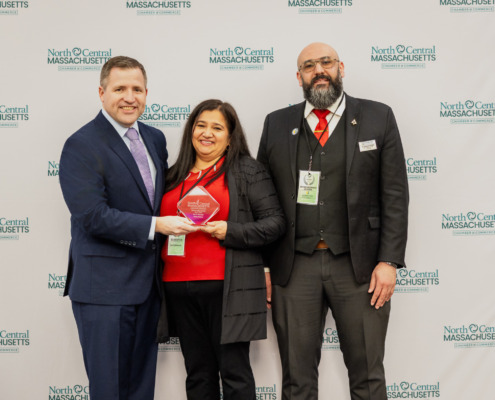

The reception features an open bar and gourmet appetizers.
View
Event
Join us for Connect North Central
Friday, September 25, 2026
8am-9am
View
Event
North Central Golf Tour Championship: Fore the Future
An FLNC Non-Traditional Scholarship Fundraiser
View
Event
Thank you Series Supporting Sponsor empHowered PR
View
Event
Join us for our 11th Annual
Congressional Luncheon
View
Event
Wednesday October 28, 2026
5:00pm - 7:00pm
View
Event
Join us for this in person HR Legal Update
View
Event
November 19, 2026
7:15am - 9:00am
View
Event
Chamber members are provided with the opportunity to engage with the Mayors of Fitchburg, Gardner, and Leominster who provide updates on projects and other things happening in their Cities. These events are by invitation only, please contact Travis Condon for more details.
View
Event
Bull Run Restaurant
215 Great Rd. Shirly, MA
View
Event
Join us for our last Connect North Central of the year!
Friday, December 11, 2026
8am-9am
View
Event
Chamber members are provided with the opportunity to engage with the Mayors of Fitchburg, Gardner, and Leominster who provide updates on projects and other things happening in their Cities. These events are by invitation only, please contact Travis Condon for more details.
View
Event
Fidelity Bank only central and western Massachusetts-based bank to appear on Forbes list; recognized on Banker & Tradesman Fast 50 list
Leominster, Mass –Fidelity Bank has experienced recognition over the summer for its commitment to client satisfaction and growth. The bank today announced it was named one of Forbes “America’s Best Banks in Each State 2022.” Forbes announced the list on June 21. Additionally, Fidelity Bank was recognized by Banker & Tradesman as one of this year’s Fast 50 in Commercial and Residential Lending. Banker & Tradesman announced the list on August 15.
In an article published by Forbes, more than 26,000 U.S. citizens from all 50 states participated in in-depth interviews, providing an overall satisfaction score, and answering several questions based on six facets of their banking relationship. Forbes reported that only 2.7 percent of all banks nationwide made the cut for the best-in-state rankings.
Fidelity Bank is the only bank based in central and western Massachusetts to appear on this year’s list.
“Part of what makes Fidelity Bank unique is our LifeDesign banking approach of providing care, clarity, and confidence when guiding our clients as they make important financial decisions,” said Ed Manzi, Chairman and CEO, Fidelity Bank. “This recognition is a clear representation of our LifeDesign approach in action and our commitment to building strong, personal relationships with each and every client.”
Banker & Tradesman, a leading publication for news and insights for Massachusetts banking, commercial, industrial, and real estate industries, recently named Fidelity Bank as one of its Fast 50 for Commercial and Residential Lending, placing 13th for number of commercial loans. Fidelity Bank experienced a 133 percent increase in the number of commercial loans, with a total 28 commercial loans in 2022 compared to 12 commercial loans in 2021. The Fast 50 is compiled from data collected by the Banker & Tradesman market share module, ranking the 50 fastest-growing loan providers in Massachusetts, comparing the number and volume of loans from January 1 through June 30, 2021, to the number and volume from the same timeframe in 2022.
“As our commercial loan team works hard to build deep relationships through our LifeDesign approach to banking and C.A.R.E. process, our clients are confident in the decisions they make to help them achieve their goals,” said Joseph Silva, Chief Lending Officer, Fidelity Bank. “Banker & Tradesman is a respected publication in our industry and to be recognized as a Fast 50 is certainly an honor.”
To learn more about the Forbes “America’s Best Banks in Each State 2022” and for a complete listing, visit https: www.forbes.com/best-in-state-banks/#58cd2c4f5873. To learn more about the Banker & Tradesman Fast 50 list, visit https: bankerandtradesman.com/special-sections/banker-tradesmans-fast-50/
Leominster, MA – Leominster Credit Union will hold a Shred-A-Thon at its 910 West Boylston Street, Worcester, MA location on Saturday, September 17, 2022 from 9:00AM – Noon.
Members and non-members can get rid of old, sensitive documents by shredding and recycling them at the Shred-A-Thon. All items will be shred on site by a secure shredding service, New England Security Shredders.
Members of the community can bring up to three legal size file boxes or three 13-gallon kitchen trash bags to be shred for free. However, we will be accepting donations for Habitat for Humanity during the event. The Shred-A-Thon helps raise awareness about recycling and of course the importance of shredding personal documents to protect against identity theft.
Important documents to bring to the Shred-A-Thon include bank statements, tax returns, medical bills, credit card statements and other personal documents.
For more information contact Joanne Lattanzi, AVP/Marketing 978-466-7240 or .

We have added a tagline of “Sharing the Arts Together” to succinctly encapsulate our primary mission of offering an accessible and inclusive environment for everyone; regardless of whether you enjoy taking an occasional class and performing or you love competing as a member of our Dance Company. The goal is to support each other and appreciate the differences and gifts we share.
We encourage students to participate in all classes and performances throughout their journey at our School. Starting with the initial exposure to Dance and the Theatre Arts, students continue to learn about the many Cultural Differences within the United States and in other countries; which often mark key Historical Milestones through the choreography depicted in performances. Mary Elizabeth and Matthew’s academic, performing and teaching credentials as described on the MEM Dance Theatre website, www.memdancetheatre.com provide families and their children through the teenage years, and adult students a safe, fun and skilled experience in studying dance and the theatre arts. In doing so to continue to help harness and empower young minds, cultivate a broad base of community relationships, and sustain a successful business model which will continue to provide ample and enriching resources.

Mary Elizabeth Tinervin, Owner, Artistic Director and Ballet Mistress
Matthew M. Kooyomjian, Owner and Executive Directo

When the workday ends and the lights go down, Custom Cleaning Service of Peabody, Inc. gets to work. “We operate as our clients’ silent partner after business hours,” says Adam Paicos, of Templeton, who now serves as Director of Operations and oversees the company’s expansion into North Central MA. “We are not often seen, but we ensure facilities are clean, secure, and ready for business each day while serving as the eyes and ears for our clients when they are not on site.”

Discover local business stories through our Inside North Central Massachusetts Podcast series. Listen as Chamber members share their journeys, insights, and contributions to our thriving regional business community.

Looking for your next opportunity? Explore current job openings from employers across North Central Massachusetts on our Jobs Board. Whether you’re starting a new career or making a change, you’ll find a variety of local positions available to help you take the next step.
CapEx Facility Services & Construction · Leominster, MA
TaraVista Behavioral Health Center · Harvard, MA
DRS Power Technology, Inc. · Fitchburg, MA
AIS · Leominster, MA