E-Newsletter
An Electronic Publication of the North Central Massachusetts Chamber of Commerce

Inside this edition, you’ll discover the latest Chamber initiatives and success stories from across our region. From economic development projects and upcoming networking events to policy updates and workforce training opportunities, we’re keeping you connected to what matters most for your business and North Central Massachusetts.
The North Central Massachusetts Chamber of Commerce is here to help – with trusted resources, a strong business network, and a support system to keep your business and the region moving forward
Since 1908, the Aubuchon Hardware name has been a staple for hardware stores around the New England area. The business itself – W.E. Aubuchon Co., Inc.– has always been a good, old fashioned family company, with fourth generation family member Will Aubuchon currently as President and CEO.
The first and initial generation – founder William (Willie) Aubuchon – decided to expand quite rapidly, even through the hardships faced during that time due to the Great Depression. He had a plan to grow and with that, the second generation took advantage of the tailwinds of WWII, with so much growth and acceleration throughout New England, including more sophisticated warehousing and distribution methods. The third generation not only persevered through an onslaught of new big box competition but continuously reinvested back into the business with not only capital but training and development as well.
Aubuchon Hardware recently celebrated its 114th anniversary in February 2022, and with it embraced a rebrand of the corporate entity to “The Aubuchon Company.”
This name change supports the idea of “multi-brand” – a clear vision that the fourth generation has in mind for the future of the company- acquiring stores well beyond the northeast, and being flexible and capable of absorbing different branded stores into the Aubuchon family. Recent examples include Village Hardware in Alexandria, VA and four True Value stores in Pennsylvania.
Despite this rapid growth, Aubuchon’s core customer still remains the homeowner.
“You’re not going to go to a hardware store to build a kitchen,” Aubuchon said, “the focus is more on home maintenance and repair.”
Pet owners, gardeners, and painters are all additional segments to the Aubuchon strategic initiative – serving businesses in local markets, not just paint or gardening tools, but anything that they need, delivering supplies out of the back door whenever they need them.
One large part of the Aubuchon rebrand is getting out of distribution and rethinking strategies to expand and grow, including technology. Historically, the company was self-admitably slow in embracing certain technologies, adding phones to stores as late as 1992 and point of sale computers in 1998. But all that has now changed as the company quickly embraces new technologies like curbside for customers and mobile devices and apps for employee productivity.
The fourth generation, Will Aubuchon’s generation, really embraced and focused on the technology aspect as computers and phones turned into the light speed they are today.
“We are fully embracing a new mindset, rethinking ways of doing business, and growing beyond New England – a collection of brands in the future. All of the generations before me had critical success: a commitment to each other as a family. We’ve had a special sensitivity to relationships, but also to attract really good employees within the company. It’s these folks that have made the success over the years,” he said.
The Aubuchon Company continues to grow despite the current pandemic.
“We prepared for all of this by luck, which also goes back to getting out of distribution pre-pandemic,” Aubuchon said. “There’s a lot of flux in uncertainty, and we just need to remain agile, and focus on productivity. You can only control what you can control and we are embracing this new mindset with curbside pick-up, inventory on the website, even upgraded technology for the front line with handheld devices with apps, making them more capable.”
Since being founded in 1908 right in Fitchburg, Massachusetts, the North Central Massachusetts Chamber of Commerce has also played a key role for The Aubuchon Company. “It was Marcus Moran, Jr. who preached that the solution to the world’s problem would be W2s; that jobs are essential to any problem. The North Central Massachusetts Chamber of Commerce helps to support and expand the number of W2s in our local community. The more W2s, the stronger the community,” Aubuchon said.
In the near future, they will be relaunching their website and adding more acquisitions this year.
You can learn more about The Aubuchon Company on their website at https://aubuchon.company.
Podcast offers state candidates the opportunity to connect with voters in the North Central Massachusetts region
The North Central Massachusetts Chamber of Commerce announced it has launched a podcast series focused on providing the region’s businesses and residents the opportunity to hear directly from candidates running for state offices in the upcoming 2022 election.
The podcast, Inside North Central Massachusetts 2022 Election Series, features candidates running for Governor, Lt. Governor, Attorney General, and State Auditor. The Chamber has invited all the major Democrat and Republican candidates for these open statewide offices to participate in the podcast series.
“We wanted to make sure candidates are aware of the issues important to our region,” said Roy M. Nascimento, President and CEO, North Central Massachusetts Chamber of Commerce. “This podcast series connects us with those who are seeking to represent us at the state level while providing the region’s voters the opportunity to hear directly from the candidates so they can make informed decisions when they head to the polls later this year.”
This special election series of the Inside North Central Massachusetts Podcast is part of the Chamber’s continuing efforts to promote civic engagement and advocate for regional equity. In addition to this podcast series, the Chamber is also a founding member of Elect North Central Massachusetts, a non-partisan coalition of media, education and community leaders in North Central Massachusetts with a mission to make the democratic process accessible and assure local and regional issues are examined and addressed by candidates running for statewide and federal offices.
The special election podcast covers several topics relevant to businesses and residents in North Central Massachusetts, such as the candidate’s platform, their qualifications for the office they are seeking, workforce challenges in the region, economic development, tourism, pandemic response and equitable recovery, and climate change.
Candidates already invited to participate in the podcast include:
Governor
Senator Sonia Chang-Díaz *
Geoff Diehl
Chris Doughty
Attorney General Maura Healey
Darius Mitchell
Orlando Silva
Lieutenant Governor
Bret Bero *
Kate Campanale *
Salem Mayor Kim Driscoll *
Representative Tami Gouveia *
Senator Adam Hinds *
Senator Eric Lesser *
Attorney General
Andrea Campbell
Shannon Liss-Riordan
Jay McMahon
Quentin Palfrey *
Auditor
Anthony Amore *
Chris Dempsey *
Senator Diana DiZoglio *
*Already appeared on the podcast or confirmed for an upcoming episode
The podcast is currently live on the North Central Massachusetts Chamber of Commerce website, and also available on Apple Podcasts® as well as on Spotify®.
The Primary Election is scheduled for Tuesday, September 6, 2022, and the General Election is set for Tuesday, November 8, 2022, in the Commonwealth of Massachusetts.
State House News Service
Author: Matt Murphy
With state tax revenues crushing expectations but geopolitical turmoil creating economic uncertainty, the House on Wednesday will debate a $1.6 billion mid-year spending bill that would pour $700 million into COVID-19 controls like testing and vaccinations and extend relief to restaurants by allowing expanded outdoor dining options and to-go cocktail service to continue through next spring.
The bill represents a slimmed down version of what Gov. Charlie Baker filed last month and excludes $450 million that the governor proposed to extend stabilization grants for child care providers through the next fiscal year.
The House bill also nixed Baker’s proposal to put $50 million into the recruitment, training and salaries of guardians ad litem within the court system. The governor wants to mandate the use of the child advocates in every alleged case of child abuse or neglect in response to the disappearance of 7-year-old Harmony Montgomery, a child who had been in the care of the Department of Children and Families but went missing in New Hampshire after a Massachusetts court gave custody to her father, who had a long criminal history.
The House Ways and Means Committee on Tuesday morning polled a redrafted version of the governor’s bill (H 4479) in preparation for a debate on Wednesday afternoon when the House has a formal session planned.
While Baker’s bill proposed $2.4 billion in spending at a net cost of $1.6 billion to the state, the bill prepared by House leadership trimmed the bottom line to $1.6 billion at a cost of $842 million to the state.
The bill includes the $700 million requested by Baker for COVID-19 pandemic-related expenses, including $432.7 million for tests, $72 million for treatments, $45.4 million for expanded vaccine access, $25 million for personal protective equipment and $124 million for related future workforce costs.
The Federal Emergency Management Agency is projected to reimburse more than $440 million of those expenses.
The House bill also proposes to spend an additional $100 million to repair local roads from winter damage, $100 million in rental assistance, $55 million for rate increases for human service providers, $10 million to support the resettlement of Ukrainian refugees and $140 million to support staffing and program needs at private special education schools.
House officials said Ways and Means Chairman Aaron Michlewitz chose to focus spending in the bill on fiscal year 2022 needs, and views other requests by the governor, such as $60 million for counseling, advocacy and intervention services for victims of crime until federal Victims of Crime Act resources are restored, as issues that would be more appropriately addressed in the annual fiscal 2023 budget.
After posting a surplus in fiscal year 2021, the state has continued to see strong revenue growth throughout fiscal year 2022, and collections are currently outpacing revenue projections through February by more than $1 billion, even after the Baker administration upgraded estimates by $1.5 billion.
With special pandemic authorization for outdoor dining set to expire on April 1, the House bill would extend that program through April 1, 2023. The state’s permission for restaurants to sell beer, wine and cocktails for take-out is also set to expire this spring, and the bill would extend that authorization from May 1 to April 1, 2023.
Baker proposed the use of guardians ad litem in all DCF cases that go before a judge as an “important way to make sure that the interests of the child are best represented when they’re in court,” but top House officials said they were bothered that the “best interest of the child” standard used by the court advocates can perpetuate systemic racism.
One senior House Democratic official, who asked to speak on background only, said Speaker Ron Mariano does not believe the supplemental budget is the “right vehicle” to address reforms within the Department of Children and Families or the courts, and indicated the Committee on Children, Families and Persons with Disabilities is working on a “more comprehensive” approach.
That same House official said Baker’s proposed funding to extend Commonwealth Cares for Children (C3) stabilization grants for child care providers through fiscal year 2023 would benefit private-pay child care centers without prioritizing the state’s most vulnerable children. Furthermore, it would rely on one-time federal resources that could create a “cliff effect” when the money runs out.
“The Education Committee and the Early Education & Care Economic Review Commission will soon make recommendations to expand access to high-quality, affordable early education and childcare in an equitable manner. We will use those recommendations as a framework moving forward,” the official emailed.
House leaders did support Baker’s recommendation to exempt recipients of COVID-19 bonus checks from paying personal income tax on the premium pay.
The Legislature last year created a $500 million bonus-pay program for low-income workers with state funds from the American Rescue Plan Act, and the administration said last month that the first round of $500 checks would be mailed to about 500,000 low-income workers by the end of March.
The income tax exemption would cost the state an estimated $16 million.
Secretary of State William Galvin is also seeking $5 million, which was not included in the House bill, as a downpayment on the $26.6 million he says he will be needed to cover the costs of printing ballots, producing mail-in ballot applications, postage, extended polling hours and envelopes for the November elections. The Legislature has yet to finalize legislation that would permanently authorize voting-by-mail and other election reforms.
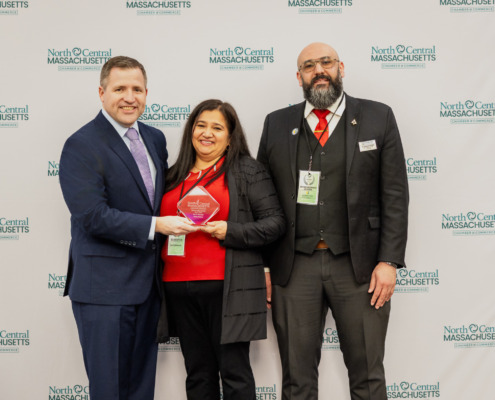

The reception features an open bar and gourmet appetizers.
View
Event
Join us for Connect North Central
Friday, September 25, 2026
8am-9am
View
Event
North Central Golf Tour Championship: Fore the Future
An FLNC Non-Traditional Scholarship Fundraiser
View
Event
Thank you Series Supporting Sponsor empHowered PR
View
Event
Join us for our 11th Annual
Congressional Luncheon
View
Event
Wednesday October 28, 2026
5:00pm - 7:00pm
View
Event
Join us for this in person HR Legal Update
View
Event
November 19, 2026
7:15am - 9:00am
View
Event
Chamber members are provided with the opportunity to engage with the Mayors of Fitchburg, Gardner, and Leominster who provide updates on projects and other things happening in their Cities. These events are by invitation only, please contact Travis Condon for more details.
View
Event
Bull Run Restaurant
215 Great Rd. Shirly, MA
View
Event
Join us for our last Connect North Central of the year!
Friday, December 11, 2026
8am-9am
View
Event
Chamber members are provided with the opportunity to engage with the Mayors of Fitchburg, Gardner, and Leominster who provide updates on projects and other things happening in their Cities. These events are by invitation only, please contact Travis Condon for more details.
View
Event
GARDNER, MA – September 12, 2022 – Mount Wachusett Community College has been awarded an Upward Bound Math and Science grant from the US Department of Education for five years beginning September 1, 2022. The grant amount is $312,480 annually or $1.6 million over 5 years. The Upward Bound Math and Science (UBMS) grant aims to prepare high school students for postsecondary education that leads to careers in the fields of math and science.
The 5-year grant will provide a comprehensive academic year, summer, and bridge program customized to the needs of each participant, preparing high school students for postsecondary education programs that lead to careers in the fields of math and science. The UBMS program will serve 63 high school students from Gardner, Athol, and Winchendon.
“Upward Bound Math and Science programs have touched the lives of many students and their families in North Central Massachusetts,” states MWCC President James Vander Hooven. “This funding ensures that we can continue our mission to support students, families and schools in providing access to STEM career exploration and higher education opportunities.”
During the academic year, UBMS students receive support and guidance in developing a comprehensive individual success plan. Within these plans, students will be provided a variety of in-school and out-of-school services: tutoring, advisement on secondary course selection, assistance with secondary school entry and alternative education programs, and workshops for students and parents/guardians. Additionally, STEM-based cultural/academic enrichment, hands-on labs, career speakers, and field trips are provided. Upperclassmen will have access to dual enrollment courses, SAT preparation, a college fair, college admission assistance and course selection.
“We are so excited to be able to continue to provide this opportunity for students in North Central Massachusetts. Upward Bound Math & Science students have profound learning experiences that help to inform career decisions, provide exposure to math and science in many different forms, and help students to navigate through the college decision, application, and transition process,” states Fagan Forhan, Assistant Dean of K-12 Partnerships and Civic Learning. “We are thrilled to be partnered with Winchendon, Gardner and Athol, who are all deeply committed to expanding STEM opportunities for students who perhaps don’t have a parent who have attended higher education, or who struggle to make ends meet.”
In the summer, students will complete four courses in the areas of math, science, foreign language, and literature/composition during a six-week residential academy hosted on a college campus. Graduating UBMS seniors will participate in college survival and matriculation workshops as well as be encouraged to enroll in college-level courses. Up to five graduating UBMS seniors may serve in a work study capacity as a student leader for UBMS.
Upward Bound Math and Science is part of the Federal TRIO Programs, founded in 1990 to address the need for specific instruction in the fields of math and science, aimed at addressing the underrepresentation of economically disadvantaged college students in math and science careers.
Learn more about the UBMS program at MWCC on https://mwcc.edu/academics/k-12/programs/upward/

With nearly fifty exhibitors there will be something for everyone. Highlights of the EXPO include acupuncture, massage therapy, pet therapy, the new nutrition, volunteer & learning opportunities as well as resources galore.
There will be ample opportunities to assess one’s health such as testing eye pressure, blood pressure and fall risks. One can also preregister for the COVID booster clinic.
The AGEwell EXPO is free for all ages with a specific focus towards our older adult population. The EXPO is Thursday, September 29th at Great Wolf Lodge (150 Great Wolf Way, Fitchburg, MA 01420) from 11am – 3pm.
To learn more about the 2022 AGEwell EXPO, or Aging Services of North Central Massachusetts—including programs and services being offered, and ways you can donate or volunteer, please visit www.AgingServicesMA.org or contact David Ginisi, Chief Marketing Officer, at (978) 466-1571 or by email at .
GARDNER, MA – Mount Wachusett Community College is pleased to announce their Fall Open House to be held on Saturday, October 29, 2022 from 9 am to 12 pm.
Prospective students and families will have the opportunity to speak with academic advisors, explore academic and career programs, bachelor’s degree transfer options, and learn about financial aid and the wide range of student support services available at the Mount.
“Whether students are attending college for the first time, transferring from another college or university, or exploring new career options, our Open House is a great first step for prospective students and families to learn what makes MWCC so special,” states Associate Vice President of Enrollment Management Marcia Rosbury-Henne. “Whether students are looking to start in January, next summer, or next fall, all are welcome.”
Check in and registration will open at 8:30 am, with a welcome and overview at 9:00 am followed by breakout sessions at 10 am and 11 am. Throughout the event, admissions staff will be available for on-the-spot application and acceptance, and student financial services will be available to help with financial aid applications.
To learn more and register, please visit mwcc.edu/openhouse.

When the workday ends and the lights go down, Custom Cleaning Service of Peabody, Inc. gets to work. “We operate as our clients’ silent partner after business hours,” says Adam Paicos, of Templeton, who now serves as Director of Operations and oversees the company’s expansion into North Central MA. “We are not often seen, but we ensure facilities are clean, secure, and ready for business each day while serving as the eyes and ears for our clients when they are not on site.”

Discover local business stories through our Inside North Central Massachusetts Podcast series. Listen as Chamber members share their journeys, insights, and contributions to our thriving regional business community.

Looking for your next opportunity? Explore current job openings from employers across North Central Massachusetts on our Jobs Board. Whether you’re starting a new career or making a change, you’ll find a variety of local positions available to help you take the next step.
CapEx Facility Services & Construction · Leominster, MA
TaraVista Behavioral Health Center · Harvard, MA
DRS Power Technology, Inc. · Fitchburg, MA
AIS · Leominster, MA