E-Newsletter
An Electronic Publication of the North Central Massachusetts Chamber of Commerce

Inside this edition, you’ll discover the latest Chamber initiatives and success stories from across our region. From economic development projects and upcoming networking events to policy updates and workforce training opportunities, we’re keeping you connected to what matters most for your business and North Central Massachusetts.
The North Central Massachusetts Chamber of Commerce is here to help – with trusted resources, a strong business network, and a support system to keep your business and the region moving forward
Ethos Cannabis opened its Fitchburg location on Halloween day in 2020 and is already looking to expand.
The location is ideal, business is strong and the overall cannabis market is growing, said Alex Hardy, president of the Ethos Massachusetts market.
“Sales are building every day,’’ he said. “Word is getting out. Our reputation as a quality cultivator and knowledgeable staff is getting out there.’’
Ethos Cannabis has locations in Massachusetts, Maryland and Pennsylvania.
The Fitchburg site, located on Route 31 just off Route 2, is an adult-use dispensary, meaning it is open to anyone 21 and older. It’s also a cultivation, processing and cultivation site. Hardy said they are looking to add a medical license to Fitchburg location as well.
Ethos currently sells products from a number of different cultivators throughout Massachusetts and its own product line. Its own product line – flower strains and pre-rolls, is only available at the Ethos locations.
Hardy said business is booming as the stigma of cannabis is going away, particularly in Massachusetts.
“Massachusetts has been one of the leading markets and most progressive markets on the East Coast,’’ Hardy said. “Massachusetts in a lot of ways has led the way.’’
In Massachusetts, medical purchase was approved in 2012 and adult-use in 2016.
“Things are really changing very rapidly,’’ he said. “The stigma that used to surround cannabis as a product is really disappearing so fast. People of all ages use cannabis for a variety of reasons.’’
Ethos also carries concentrates, edible, vaporizers, tinctures and topicals.
“There is a wide variety of products that can be made using cannabis. People still prefer smoke-able flower above anything else,’’ he said. “And that’s where the quality of our strains shine through.’’
Because cannabis is a federally-illegal substance, every product sold in Massachusetts is produced in Massachusetts. After it’s produced, it goes out for testing by an independent lab. The products are tested for contaminants, bacteria, potency, chemical compounds and terpenes.
“There is also a series of terpenes produced and they affect the flavor, aroma and smoking experience,’’ Hardy said. “It does a lot to dictate flavor profile. It’s really a critical factor that helps consumers as they become more sophisticated.’’
So who are their customers?
“There are certainly plenty who use it recreationally for fun,’’ Hardy said. “It’s a great experience but even an adult use location such as ours, a relatively large portion of our customer base uses it for medical purposes – anxiety, stress, pain. We’re happy to talk them through what products are good for them depending on what they’re looking for and why they are doing it.’’
The Fitchburg location has 40 employees and they are still hiring. A property expansion is also being planned.
Hardy said next year, they are looking to add capacity and product lines to start making edibles and concentrates of their own products.
Ethos is located at 20 Authority Drive in Fitchburg. It can be reached at 978-614-0070 or by visiting https://ethoscannabis.com/dispensary-locations/ma/fitchburg/.
Article source: State House News Service
Author: Matt Murphy
MARCH 5, 2021…..Form a line, single file. No talking. And stay to the right.
Teachers are used to enforcing these rules for their pupils, but when it came to their own COVID-19 vaccinations it was only by breaking them that this week they wound up getting exactly what they said was necessary to safely return all children to the classroom.
The pressure campaign to vaccinate teachers has been building for weeks, but reached fever pitch after Gov. Charlie Baker announced last week that he would seek to return all students back to in-person learning this school year, beginning with elementary students by April.
House Speaker Ron Mariano had already said he supported pushing teachers up the priority ladder, and Senate President Karen Spilka joined the cause Tuesday when she called on Baker to not only make teachers eligible to get vaccinated this month, but she wanted to see doses set aside for teachers and school staff as the state’s supply increases.
The real tipping point, however, came later Tuesday when President Joe Biden called on all states to begin vaccinating teachers in March, if they hadn’t started already. He said he would begin pushing vaccine doses through the federal pharmacy program to chains like CVS and Walgreens to help make it happen.
The next day, teachers were already booking appointments at CVS when Baker said they could start making appointments at state run sites on March 11 — next Thursday. But due to the limited supply, he said would not be earmarking any doses. Because everyone knows how he feels about earmarks.
The relenting of the administration on teacher vaccinations was hailed as a victory by the MTA and other supporters of the idea, but if Baker thought he might be buying a modicum of support from the union for his plan to return to in-person learning he was wrong. He now has other groups of workers lobbying louder for their turn to come sooner, and the teachers are still at his throat.
As Education Commissioner Jeff Riley went before the Board of Elementary and Secondary Education on Friday seeking the emergency authority he would need to force hold-out districts to scrap their remote and hybrid learning models, MTA President Merrie Najimy warned that letting the state decide when it’s safe would create an “extremely chaotic” situation and violate the spirit of local decision-making.
Najimy and the MTA may have won the vaccine battle, but they lost the in-person learning fight. And the rubber match over MCAS testing has already begun, with the state announcing Friday the test would be delayed into May and June, but not cancelled.
A new poll released this week by Advantage and paid for by the Massachusetts Fiscal Alliance found that nearly 47 percent of Democrats favor a hybrid learning model in their districts, compared to 22 percent of Republicans, while over 58 percent of GOP voters want to see a return to in-person voting and only 12 percent of Democrats feel the same way.
That same poll found that Democrats and Republicans saw Baker’s handling of the pandemic similarly, with 43 percent of Republicans and nearly 41 percent of Democrats approving of his performance, though Republicans were more likely to feel “strongly” one way to the other.
What that means for 2022 remains to be seen, but this poll showed that Lt. Gov. Karyn Polito may have some strategizing to do if Baker doesn’t seek a third term because she could find herself running neck-and-neck with former state Rep. Geoff Diehl, who trailed her by less than two points with 58 percent undecided in a head-to-head matchup. Meanwhile, Democrats were all in for Attorney General Maura Healey if she runs, according to the poll.
Speaking of cancelling, anyone who had planned to get their second dose of Moderna or Pfizer vaccine after March 27, after getting first dose at Fenway Park, will now be heading to the less-alluring Hynes Convention Center instead.
With the Red Sox set to resume practicing and playing baseball at Fenway on April 1, Baker and CIC Health are moving the operation to the Back Bay convention center to avoid confusion. Plus, Baker said, if the feds ever do get around to delivering more vaccines CIC Health will be able to administer up to 5,000 shots a day at Hynes, as opposed to 1,500 at Fenway.
Vaccinations will begin at Hynes on March 18, and Fenway will cease to be a health clinic on March 27.
The closure of the Fenway mass vaccination site is too bad for all those people who were hoping to pair an “I Voted at Fenway” sticker with an “I Got Vaccinated at Fenway Park” button in their pandemic journals.
In fact, the very notion of going to a polling station at all may sound quaint by the time the history books on this era are written.
House Speaker Ron Mariano this week continued to drive his agenda, pushing through an extension of voting by mail through June as the Legislature considers whether and how to make the practice permanent. He also announced that the House would soon take up a child protection and foster care bill that came close to passing last session, but ultimately fell short as the House and Senate differed on the details and ran out of time.
Mariano said the drop in reports of child abuse and neglect to DCF during the pandemic shows that children are falling through the cracks in the system. “The House is steadfast in its position that the Commonwealth’s children cannot wait,” the speaker and three of his chairs said in a joint statement.
Wait, that is, for the bill filed by Rep. Paul Donato to make its way through the normal legislative process, which would typically include a hearing before the Joint Committee on Children, Families and Disabilities.
At times, Senate President Karen Spilka has been onboard with Mariano’s why-wait approach. Like when the two Democratic leaders partnered to repass a climate bill vetoed by Baker last session.
But the Senate threw the brakes on the vote-by-mail extension this week to accept testimony through Monday, and has not commented on the foster care bill.
Mariano and Spilka do appear to be on the same page on taxes, with neither eyeing tax hikes at the moment to cover state spending. And why would they?
Though it always comes with a heavy dose of caution, the Department of Revenue reported this week that taxes collected in February shattered expectations by $372 million. The state, which has twice upgraded its estimate of collections this fiscal year, is now sitting on a healthy cushion as it enters the home stretch of the fiscal year with some of the biggest risk-reward months for tax collections to come.
That bit of good news arrived a couple of days after the House and Senate Ways and Means Committee opened the budget hearing season by inviting the administration and other Constitutional officers to testify on Baker’s restrained $45.6 billion budget proposal for fiscal 2022.
The hearing shed some light on several priorities that won’t be able to wait until a budget is finalized in June or July. One is the question of how the state should approach taxing Paycheck Protection Program loans that have been forgiven by the federal government and other state recovery grants going to small businesses.
The administration estimates that up to $175 million in state-level taxes are on the line, and there appears to be support for exempting the grants to further help small businesses. Insiders, however, said House and Senate Democrats are leery of looking like they’re giving too much away to the business community, and are searching for ways to package a tax fix and limits on unemployment insurance hikes this month with new benefits for workers.
Secretary of State William Galvin also told lawmakers that they need to start thinking about changing some of the statutory deadlines for redistricting now that the U.S. Census Bureau has said it won’t be able to deliver community-level data until the fall, and Galvin wants more money in the budget for himself in case he needs to sue over the Census’s alleged undercounting of Bay State residents.
Winthrop’s Jeff Turco could find himself thrust right into the middle of all of these debates over spending, taxes, testing and vaccination if he is able to win the special general election for the 19th Suffolk District seat on March 30.
The self-proclaimed “Reagan Democrat” prevailed in a Democratic primary Tuesday that featured three more progressive candidates, topping second place finisher Juan Jaramillo of Revere by about six percentage points. But he must still get through Republican Paul Caruccio and independent Richard Fucillo to claim the seat held most recently – and for 30 years – by former Speaker Robert DeLeo.
Turco’s victory is being held up by the liberal wing of the party as more evidence of why ranked-choice-voting, which was rejected by voters on the ballot in November, is necessary.
The COVID-19 pandemic has forced many businesses to shift gears or risk being left behind.
And while many businesses may not know how to navigate these new challenges, empHowered PR in Leominster can help.
empHowered PR, LLC, was founded by Lauren Howe, an award-winning public relations professional with more than 20 years of experience working in the healthcare, manufacturing and non-profit industries.
Her public relations firm, which opened in the midst of the pandemic, specializes in highly-tailored communications services to “empHower’’ businesses and non-profit organizations to build strong a strong brand and reputation and to develop the tools needed to effectively respond to – and during – a crisis.
“With the pandemic, a lot of businesses had to pivot and respond in ways they didn’t have to before,’’ she said. “Even I had to pivot in the dark. I thought my business would be in crisis communications but a lot of my business right now is helping other businesses figure out their brand based on the pandemic and how they’ve had to pivot.’’
Howe left her job in corporate America on Valentine’s Day 2020. She took some time off to relax with her daughter before starting her own businesses.
She met with the North Central Massachusetts Chamber of Commerce on March 7 looking for assistance and shared networking space. She set up appointments with a lawyer, accountant, and financial advisor. And then the state shut down.
She decided to hold off opening until July 2020 and rented space at the chamber.
“They were super helpful to me for everything,’’ she said. “My business has really grown a lot since then.’’
Howe recently decided to head out on her own and set up shop in downtown Leominster, the city where she was born and raised.
While most of her current clients are not local or even in Massachusetts, Howe hopes that changes as she’s not aware of another public relations firm in Fitchburg or Leominster.
“I want to help my local businesses. This is an opportunity for me to share my expertise with my peers,’’ she said. “It’s an opportunity to network and support them and help them pivot because I had to. I’m one of them.’’
Her core services include brand strategy, crisis communications planning and support, reputation management, corporate social responsibility, media training and writing services.
One area in which she can help is preparing businesses for the unexpected.
“When the next thing happens, and it’s going to, whether it’s a pandemic, fire, financial loss or impact in reputation, we can help you navigate through that and weather the storm,’’ she said.
Another area of focus for Howe is sharing the importance of being a good corporate citizen.
“When you have a strong brand and when you’re engaged in the community, if and when a crisis hits you, you will have those relationships and trust,’’ she said.
Howe said she practices what she preaches.
She is an active member of the community, serving on the boards of the 658 Foundation, which is the philanthropic arm of the Fay Club, and the Boys & Girls Club of Lunenburg. She previously served on the board of directors for Girls Inc. of Worcester and each August, rides in the Pan-Mass Challenge to raise money for the Dana-Farber Cancer Institute.
empHowered PR is located at 20 Main St., Suite 2E in Leominster. For more information, call 978-400-3036 or visit http://www.emphoweredpr.com/.
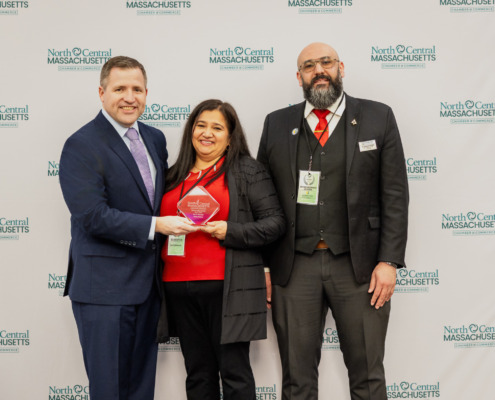

The reception features an open bar and gourmet appetizers.
View
Event
Join us for Connect North Central
Friday, September 25, 2026
8am-9am
View
Event
North Central Golf Tour Championship: Fore the Future
An FLNC Non-Traditional Scholarship Fundraiser
View
Event
Thank you Series Supporting Sponsor empHowered PR
View
Event
Join us for our 11th Annual
Congressional Luncheon
View
Event
Wednesday October 28, 2026
5:00pm - 7:00pm
View
Event
Join us for this in person HR Legal Update
View
Event
November 19, 2026
7:15am - 9:00am
View
Event
Chamber members are provided with the opportunity to engage with the Mayors of Fitchburg, Gardner, and Leominster who provide updates on projects and other things happening in their Cities. These events are by invitation only, please contact Travis Condon for more details.
View
Event
Bull Run Restaurant
215 Great Rd. Shirly, MA
View
Event
Join us for our last Connect North Central of the year!
Friday, December 11, 2026
8am-9am
View
Event
Chamber members are provided with the opportunity to engage with the Mayors of Fitchburg, Gardner, and Leominster who provide updates on projects and other things happening in their Cities. These events are by invitation only, please contact Travis Condon for more details.
View
Event

In response to the extreme vulnerability Fitchburg businesses have faced with the Governor’s phased approach to reopening, the FRA has developed the Reopening Grant consisting of an award of up to $2,500 to eligible grantees having a physical space within the Fitchburg business community. Funding is limited but the FRA hopes to provide relief to approximately 40 businesses that have been significantly vulnerable during this unprecedented time.
Applications for the grants will be available online through the FRA’s website and Facebook page starting Monday, July 27, 2020 and review will continue until the funding runs out.
(Acton, MA) July 23, 2020 – No running shoes? No problem! You’ll be a winner every time and get a medal as soon as you cross the Starting Line at Habitat for Humanity North Central MA’s Second Annual “0.0 Race” scheduled for Thursday, August 6th, 6:00 – 8:00pm at the Bull Spit Brewing Company, 339 7 Bridge Road, Lancaster, MA.
Join us at the expanded, socially distanced, outdoor seating area. Masks are required (and will be available) and your entrance fee will help Habitat NCM to get started on building three more homes! Registration is just $25.00 and includes admission to the event, a race bag and a commemorative medal. Individuals can register for the event at [ncmhabitat.org]ncmhabitat.org.
Located at Kalon Farm, the Bull Spit Brewing Company uses only the freshest of ingredients partnered with the experience of a Master Brewer to craft outstanding beers. Also on tap, event goers can jam out to the fun folk sounds of Groton-based band Snow Crow. A variety of wines will also be available for purchase in the venue’s outdoor area.
The event will include door prizes, a raffle, a beer & wine pull, and tasty street grub from Bull Spit Brewery’s food truck — all served up in a socially distanced manner. Masks are required to attend and share in the camaraderie.
Habitat for Humanity NCM would like to extend a very special thanks to this year’s Race Sponsors Aubuchon Hardware and Middlesex Bank.
Habitat for Humanity North Central MA
Through volunteer labor and donations of money and materials, Habitat NCM builds and rehabilitates simple, decent houses alongside our homeowner partner families. Habitat NCM also operates the Leominster ReStore which raises funds through the sale of discounted or recycled materials and furniture. Habitat NCM builds strength, stability and self-reliance through shelter in 25 towns and cities in North Central Massachusetts, including Acton, Ashburnham, Ashby, Ayer, Berlin, Bolton, Boxborough, Clinton, Fitchburg, Gardner, Groton, Harvard, Hudson, Lancaster, Littleton, Lunenburg, Leominster, Maynard, Pepperell, Princeton, Shirley, Sterling, Stow, Townsend, and Westminster.

“We are pleased to welcome Sarah to our medical team,” said Korry Dow, president of Nashoba Valley Medical Center. “Her addition to the medical staff expands our audiology services and continues to meet the growing needs of our community.”
Prior to joining Nashoba Valley Medical Center, Linskey worked at Arrigg Eye and Ear Associates in Lawrence, Massachusetts. She earned a Bachelor of Science degree in communications disorders from the University of Massachusetts, Amherst, and a Doctor of Audiology degree from Northeastern University in Boston. Linskey is a member of the American Speech Language and Hearing Association and American Academy of Audiology.
About Nashoba Valley Medical Center
Nashoba Valley Medical Center (NVMC) offers community-based primary care and specialty
services. NVMC was awarded its fourth consecutive A, the highest grade possible, in hospital safety by The Leapfrog Group for the Spring 2018 assessment period. The hospital was a recipient of the Joint Commission Gold Seal of Approval and was named to Leapfrog’s annual list of Top Hospitals in 2014. Areas of clinical strength include emergency medicine, diagnostic imaging, geriatric psychiatry, cardiology, gastroenterology, ophthalmology, oncology, orthopedics, physical therapy and general surgery. NVMC also offers a comprehensive Center for Pain Management, Diabetes and Endocrine Center, Travel Clinic and Occupational Health Services. Nashoba Valley Medical Center is part of Steward Health Care, the largest private, tax-
paying physician-led hospital operator in the United States. Additional information is available at www.nashobamed.org.

When the workday ends and the lights go down, Custom Cleaning Service of Peabody, Inc. gets to work. “We operate as our clients’ silent partner after business hours,” says Adam Paicos, of Templeton, who now serves as Director of Operations and oversees the company’s expansion into North Central MA. “We are not often seen, but we ensure facilities are clean, secure, and ready for business each day while serving as the eyes and ears for our clients when they are not on site.”

Discover local business stories through our Inside North Central Massachusetts Podcast series. Listen as Chamber members share their journeys, insights, and contributions to our thriving regional business community.

Looking for your next opportunity? Explore current job openings from employers across North Central Massachusetts on our Jobs Board. Whether you’re starting a new career or making a change, you’ll find a variety of local positions available to help you take the next step.
CapEx Facility Services & Construction · Leominster, MA
TaraVista Behavioral Health Center · Harvard, MA
DRS Power Technology, Inc. · Fitchburg, MA
AIS · Leominster, MA