E-Newsletter
An Electronic Publication of the North Central Massachusetts Chamber of Commerce

Inside this edition, you’ll discover the latest Chamber initiatives and success stories from across our region. From economic development projects and upcoming networking events to policy updates and workforce training opportunities, we’re keeping you connected to what matters most for your business and North Central Massachusetts.
The North Central Massachusetts Chamber of Commerce is here to help – with trusted resources, a strong business network, and a support system to keep your business and the region moving forward
Massachusetts will advance to Step 1 of Phase IV on March 22; Replaces Travel Order with Travel Advisory
BOSTON — Today, the Baker-Polito Administration announced that Massachusetts will advance to Step 1 of Phase IV of the Commonwealth’s reopening plan on Monday, March 22. The Administration continues to take steps to reopen the Commonwealth’s economy with public health metrics continuing to trend in a positive direction. This includes drops in average daily COVID cases and hospitalizations. Massachusetts also continues to be a national leader in vaccination rates. The Administration also replaced the Massachusetts Travel Order originally issued in July 2020 with a Travel Advisory, effective March 22.
In addition, the Administration also announced nearly $31 million in awards to 710 additional small businesses in the tenth round of COVID-19 relief grants administered by the Massachusetts Growth Capital Corporation (MGCC).
Phase IV, Step 1 and Gathering Changes:
On March 1, Massachusetts loosened capacity restrictions for several industries and advanced to Step 2 of Phase III of the reopening plan. Since then, hospitalizations dropped by 20% and deaths dropped by 24%. The seven day average of new cases in long-term care facilities dropped by 53%. The positive test rate remains below 2% and has been for several weeks now. The seven day average of new cases is also down over this time by 7%.
Effective Monday, March 22, all communities in Massachusetts will move into Step 1 of Phase IV of the state’s reopening plan. This will open a range of previously closed business sectors under tight capacity restrictions that are expected to be adjusted over time if favorable trends in the public health data continue. Effective on the planned advancement to Step 1 of Phase IV, the following large capacity sports and entertainment venues will be permitted to operate at a strict 12% capacity limit after submitting a plan to the Department of Public Health (DPH):
Also effective on March 22, gathering limits for event venues and in public settings will increase to 100 people indoors and 150 people outdoors. Outdoor gatherings at private residences and in private backyards will remain at a maximum of 25 people, with indoor house gatherings remaining at 10 people.
Additionally, dance floors will be permitted at weddings and other events only, and overnight summer camps will be allowed to operate this coming summer. Exhibition and convention halls may also begin to operate, following gatherings limits and event protocols. Other Phase IV sectors must continue to remain closed.
Travel Order:
Effective Monday, March 22, the Massachusetts Travel Order will be replaced with a Travel Advisory.
The new travel advisory will urge all persons entering Massachusetts, including returning residents, are advised to quarantine for 10 days upon their arrival if they have been out of the state for 24 hours or more.
The advisory does not apply to anyone in the following categories:
Travelers are additionally encouraged to consult and follow the CDC’s guidelines and requirements for travel.
COVID-19 Business Relief Grants:
Today, the Baker-Polito Administration announced approximately $31 million in awards for 710 additional businesses in the tenth round of COVID relief grants administered by the Massachusetts Growth Capital Corporation (MGCC). As in prior rounds, each grant recipient meets sector or demographic priorities set for the grant programs administered by MGCC.
With the addition of this round of grants, the Administration has awarded over $633 million in direct financial support to 14,056 businesses across the Commonwealth.
Grants for this round were awarded to 327 minority-owned, and 293 women-owned, businesses; 240 recipients are located in Gateway Cities, and 245 businesses awarded grants have not received any prior aid.
Additionally, MGCC will soon be announcing the availability of funding to support small business technical assistance and community development financial institutions.
Article Source: State House News Service
Author: Colin A. Young and Michael P. Norton
[Coverage Developing] All Massachusetts residents ages 16 or older will become eligible for a COVID-19 vaccine by April 19, the Baker administration announced Wednesday morning. Residents 60 or older and certain workers become eligible March 22. Residents 55 or older and those with one qualifying health condition will become eligible April 5 and the general public will become eligible April 19. “The Administration has received assurances from the federal government that an increased vaccine supply will be available to states soon,” Baker’s office wrote in a press release. “Depending on supply, it could take weeks for people to be notified that an appointment is available at a mass vaccination site.” Baker is due to tour a vaccination site at The Shaw’s Center in Brockton at 10:30 a.m. and planned to discuss the timeline for getting the remaining adult population of Massachusetts vaccinated during a press conference to follow the tour. President Joe Biden said last week that he was directing all states to make all adults eligible to be vaccinated no later than May 1. Baker’s administration had planned to make the general public eligible for vaccine doses sometime in its final rollout phase, which has long been scheduled to begin in April. Baker’s office also announced a new $24.7 million investment in its Vaccine Equity Initiative meant to “increase trust, vaccine acceptance and administration rates … and to meet the needs of priority populations.”(North Central, MA) – Community and business leaders will look to the future of the economy in North Central Massachusetts at the Annual Economic Forecast program scheduled for Friday, March 26, 2021 from 8:00 a.m. to 9:00 a.m. This year’s program will be held online due to the COVID-19 pandemic and will include presentations intended to help business leaders make sense of the economic climate created from the COVID-19 pandemic and potential future trends in our local and global economies.
The Chamber is excited to announce that this year’s featured speakers are Dr. Bo Zhao, Senior Economist at the Federal Reserve Bank of Boston and Simon Anderson, a nationally recognized futurist and author.
Bo Zhao is a senior economist at the New England Public Policy Center in the Federal Reserve Bank of Boston Research Department. He specializes in public finance and urban and regional economics. In 2013, he received the Boston Fed’s President’s Award. Zhao earned his PhD in economics and his MS in applied statistics from Syracuse University. He joined the Boston Fed in 2005 and served on the Municipal Aid Subcommittee of the Massachusetts Municipal Finance Task Force from 2006 to 2007. Zhao was selected by the Ewing Marion Kauffman Foundation as one of 20 young scholars nationwide to participate in the 2005 Entrepreneurship Research Boot Camp.
Simon J. Anderson is a strategic foresight speaker, author and consultant. He helps leaders and organizations be more future resilient and has shared his compelling message with thousands of senior executives and other leaders in a variety of industries from coast to coast in the United States, as well as internationally. In 2013, he founded Venture Foresight, a company dedicated to helping leaders recognize opportunities in emerging technologies and trends. Mr. Anderson is also co-author of the 2014 Bellwether Award winning book Foresight 20/20: A Futurist Ex-plores the Trends Transforming Tomorrow with fellow global futurist Jack Uldrich. As a key member of the international organization Communities of the Future, Mr. Anderson works to promote and facilitate “future’s thinking’ in communities around the world. His work as a futur-ist also informed his roles as an advisor to several technology startups and a multinational educa-tion non-profit organization.
The cost is just $20 for Chamber members/$30 for non-members. Pre-registration is required. For more information or to register, please contact the Chamber at 978.353.7600 ext. 235 or visit www.NorthCentralMass.com.
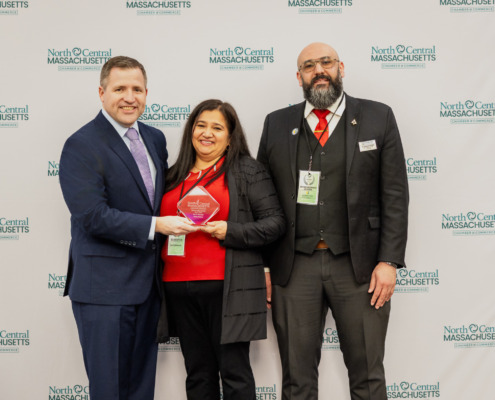

The reception features an open bar and gourmet appetizers.
View
Event
Join us for Connect North Central
Friday, September 25, 2026
8am-9am
View
Event
North Central Golf Tour Championship: Fore the Future
An FLNC Non-Traditional Scholarship Fundraiser
View
Event
Thank you Series Supporting Sponsor empHowered PR
View
Event
Join us for our 11th Annual
Congressional Luncheon
View
Event
Wednesday October 28, 2026
5:00pm - 7:00pm
View
Event
Join us for this in person HR Legal Update
View
Event
November 19, 2026
7:15am - 9:00am
View
Event
Chamber members are provided with the opportunity to engage with the Mayors of Fitchburg, Gardner, and Leominster who provide updates on projects and other things happening in their Cities. These events are by invitation only, please contact Travis Condon for more details.
View
Event
Bull Run Restaurant
215 Great Rd. Shirly, MA
View
Event
Join us for our last Connect North Central of the year!
Friday, December 11, 2026
8am-9am
View
Event
Chamber members are provided with the opportunity to engage with the Mayors of Fitchburg, Gardner, and Leominster who provide updates on projects and other things happening in their Cities. These events are by invitation only, please contact Travis Condon for more details.
View
Event
Learn how to get your garden ready for the colder weather with Ingrid Wheeler, local gardener and landscape designer, on Thursday, September 17, 2020, at 7:00 PM in a special Virtual Workshop!
Whether you are an experienced gardener, or this is your first year with a quarantine garden, there is lots to learn! Topics discussed may include:
Please register at https://tinyurl.com/fplgarden
This is a free program. For information about this or other Library programs call 978-829-1780 or visit our website: www.FitchburgPublicLibrary.org.
PRINCETON, MA, August 17, 2020 – NEADS World Class Service Dogs invites the public to join us in person on Saturday, August 22 from 10am-2pm for the Dog Days of Summer Shop Sale. We’re taking everything outside for a safe, socially distanced shopping experience.
Shoppers can get the best deals of the summer on apparel, gifts, and goodies from the NEADS Shop (shop.neads.org).
We’re planning a safe, socially distanced shopping experience with virus prevention protocols in place including: mandatory masks worn by staff and customers; spaced out tables and tents; Service Dogs and Service Dogs in Training only (no pets).

About NEADS Inc.
NEADS Inc. is a 501(c)(3) nonprofit organization located in Princeton, Massachusetts. Established in 1976, NEADS offers the widest array of Service Dog programs in the industry, including Service Dogs for adults and children with a physical disability, Service Dogs for veterans, Service Dogs for Hearing, and Service Dogs for children with autism or other developmental disabilities. NEADS dogs are also partnered with professionals in classroom, therapy, hospital, ministry, and courthouse settings. For more information, please visit neads.org.
PRINCETON, Ma. – Wachusett Mountain Ski Area is pleased to announce that Charles Adams, former assistant general manager at Boston’s TD Garden, has joined the resort management team as new Food & Beverage Director.
Adams brings more than 15 years of experience and leadership in a variety of food service operations at major sporting venues. He helped lead TD Garden through the completion of its recent $100m expansion and renovation project. Working for the Delaware North Company, Adams assisted in the overall leadership of all food, beverage and retail sales at The Garden. Prior to moving to Massachusetts, he served in a variety of key food service management roles for Levy Restaurants at several iconic sports stadiums and arenas and major sporting events in the south. His background includes Director of Operations for the University of Alabama; Assistant Director of Operations at Mercedes Benz Stadium; Assistant Director of Operations at The Georgia Dome; and Catering Supervisor at Turner Field.
At Wachusett, Adams will oversee all Food & Beverage operations including the Main Food Court Cafeteria; Coppertop Lounge & T-Bar; Black Diamond Restaurant; Balance Rock Coffee Company; and O’Brien’s Deck Bar & Grill. He will also manage all of Wachusett’s private event catering including weddings, corporate outings, private functions, meetings and sales of Wachusett’s private Mountain Suite Slope Skyboxes.
“We are very happy to have Charles join our team,” said Wachusett President Jeff Crowley. “With his extensive background managing food & beverage operations at such major venues, we’re very excited about the new opportunities this will create here at Wachusett. We have had a wonderful F&B Operation for years, we hoping he can help us maintain or take the food service to yet another level.” Wachusett is already well known for its quality food service, often recognized in the SKI Magazine annual reader survey for providing some of the best “on-mountain” food among all Eastern US Ski Resorts.
Currently, Adams is overseeing the new summer operations of O’Brien’s Deck Bar & Grill outdoor restaurant open weekends and select Thursdays and Fridays through September 27. “Charles has been instrumental in reopening O’Brien’s outdoor restaurant this summer while complying with the COVID protocol standards set by CDC & Westminster Board of Health,” added Crowley. “He looks forward to working with the local and state governing bodies and will be very helpful in us managing the new COVID 19 protocols we will be implementing this winter.”
Wachusett Also Promotes New Executive Chef
PRINCETON, Ma. – Charles Adams, Wachusett Mountain’s new food and beverage director, is also pleased to announce the promotion of Cassandra Koranda as the resort’s new Executive Chef.
“Cassie has long been part of the Wachusett family,” said Wachusett vice president Carolyn Stimpson. “She started working here along with her mother at age 15 and we’re thrilled to see her bring her culinary skills to a new level for our team.”
Koranda has been working as Wachusett Mountain’s Sous Chef for the past two years and previously as Kitchen Manager at the Blueprint American Bar & Grill in Westminster. A top graduate of the Bay Path Regional Vocational School Culinary Arts Program, she found her love for cooking at an early age working for her parent’s restaurant in Worcester. Prior to returning to her roots in central Massachusetts, she managed two restaurants on the Camp Pendleton Marine Base in California where she fed thousands of Marines daily.
As Executive Chef, she will supervise kitchen operations and oversee the menus for Wachusett’s Main Food Court Cafeteria; Black Diamond Restaurant; Balance Rock Coffee Company; and O’Brien’s Deck Bar & Grill. She will also be responsible for all of Wachusett’s private event catering. You can see her cooking up some Wachusett specialties at www.wachusett.com/The-Mountain/Media-Center/Video-Gallery.aspx

When the workday ends and the lights go down, Custom Cleaning Service of Peabody, Inc. gets to work. “We operate as our clients’ silent partner after business hours,” says Adam Paicos, of Templeton, who now serves as Director of Operations and oversees the company’s expansion into North Central MA. “We are not often seen, but we ensure facilities are clean, secure, and ready for business each day while serving as the eyes and ears for our clients when they are not on site.”

Discover local business stories through our Inside North Central Massachusetts Podcast series. Listen as Chamber members share their journeys, insights, and contributions to our thriving regional business community.

Looking for your next opportunity? Explore current job openings from employers across North Central Massachusetts on our Jobs Board. Whether you’re starting a new career or making a change, you’ll find a variety of local positions available to help you take the next step.
CapEx Facility Services & Construction · Leominster, MA
TaraVista Behavioral Health Center · Harvard, MA
DRS Power Technology, Inc. · Fitchburg, MA
AIS · Leominster, MA