E-Newsletter
An Electronic Publication of the North Central Massachusetts Chamber of Commerce

Inside this edition, you’ll discover the latest Chamber initiatives and success stories from across our region. From economic development projects and upcoming networking events to policy updates and workforce training opportunities, we’re keeping you connected to what matters most for your business and North Central Massachusetts.
The North Central Massachusetts Chamber of Commerce is here to help – with trusted resources, a strong business network, and a support system to keep your business and the region moving forward
Article Source: State House News Service
Author: Matt Murphy
Many senators were back on Beacon Hill this week to debate an annual state budget, and Gov. Charlie Baker snuck away to Tennessee to reacquaint himself with his fellow Republican governors and national donors.
Masks for vaccinated Bay Staters came down on Saturday, gathering limits are going away and Baker declared the pandemic “pretty much over.” And on Cape Cod, businesses are preparing for an onslaught of pent up tourism activity – just be sure to bring your CDC vaccination card if you want to party, officials cautioned.
“Thanks to the people in Massachusetts who’ve made enormous sacrifices over the course of the past year to get us to this point, brighter days are very much upon us,” Baker said Friday at the State House.
Just not this Memorial Day weekend, when it’s supposed to rain and rain and rain some more.
But the shockwaves rippling through Massachusetts politics this week actually emanated from Easton, a small town, seldom in the headlines, about 30 miles south of Boston where the goings on – or more precisely the goings of two prominent Democratic women – had the palace intrigued.
We’ll start with Auditor Suzanne Bump, who has called everywhere from Braintree to Great Barrington and Boston home. But when she ran statewide and won her third term as state auditor in 2018, she did so from Easton.
Turns out that was the last time, at least for now, that her name will be on a ballot.
Bump announced that she would not seek reelection to a fourth term next year, potentially ending an electoral career that started in the 1980s when she was elected to the House of Representatives. And while she’s the first of the six statewide office holders to make clear their 2022 intentions, she might be the only one heading for the door.
“I want to create the opportunity for another leader who shares my commitment to making government work better and building the public trust to pursue this mission. The public deserves to choose from a wide field, and this announcement will help make that possible,” Bump said.
The Democrat, who also served in former Gov. Deval Patrick’s Cabinet as labor secretary, said she wasn’t leaving to run for higher office, like, say, governor, and had no future plans she was ready to announce. She was just moving on to something new.
Openings like this one are rare, and Bump’s decision wasn’t public for even 12 hours before Governor’s Councilor Eileen Duff announced that she was in the race, with a roster of supporters lining up behind her candidacy. Clearly, she wasn’t blindsided by the news.
Transportation advocate and former Boston 2024 olympic bid opponent Chris Dempsey strongly hinted that he had interest in running, and state Sen. Diana DiZoglio didn’t say no when asked. Others, including maybe a couple of mayors, are also taking a look, Democrats and Republicans said.
Bump still has another 19 months on the job, but her fellow Easton Democrat, the newly minted House Majority Leader Claire Cronin, could be gone long before then. Cronin remained quiet this week as House colleagues buzzed about the possibility that President Joe Biden could be getting ready to name one their own ambassador to Ireland.
The talk was fueled by an unconfirmed report on the website IrishCentral that Cronin was the White House’s pick, and one Beacon Hill player told the News Service it was true that the White House was calling around to vet the senior Democrat.
Cronin was the Biden campaign’s top surrogate in Massachusetts, where the president scored an important and symbolic win in the primaries in March, and if she is picked for the overseas posting her departure will trigger a special election and an opening in the number two post in House leadership.
Insiders say Speaker Pro Tempore Kate Hogan or Assistant Majority Leader Michael Moran would both make sense for the promotion.
While Bump decided three terms is enough, everyone continues to wonder whether Baker wants a third term and people close to the Republican said his short trip to the Republican Governors Association meetings in Nashville midweek suggest to them he’s ready to run.
Baker said he and Lt. Gov. Karyn Polito would discuss their futures with their families, and if he does run, it seems like Democrats won’t have the video clips or soundbites of him getting grilled over his management of the Holyoke Soldiers’ Home to use in the campaign.
Several lawmakers and gubernatorial candidate Ben Downing said Baker should be called to testify before the Legislature after last week’s damning report in the Boston Globe and the release this week of a legislative investigation into the COVID-19 outbreak that killed at least 76 veterans at the home.
The reports both found fault with Baker and Health and Human Services Secretary Marylou Sudders’s oversight of former Superintendent Bennett Walsh, who faces criminal charges and whose shortcomings as a leader were known to the administration prior to COVID-19. The Globe painted Walsh as a politically protected appointee.
Baker said Friday he forgot that he had spoken to Walsh prior to his swearing in, but that the interview was brief and represented his only familiarity with the candidate, who came recommended by the Soldiers’ Home board. The meeting was in contradiction to the governor’s previous statements about never having met Walsh prior to his appointment.
Still, House Speaker Ron Mariano said he thought it would be redundant to reopen the investigation that just concluded by calling Baker to testify, and Senate President Karen Spilka said she expected the administration to be “forthcoming” with answers to questions lawmakers and investigators might have, but stopped there.
Baker said he looks forward to working with the Legislature to implement management and oversight reforms for the veterans’ home, which are being drafted by Rep. Linda Dean Campbell and Sen. Michael Rush.
And in the meantime, he signed the $600 million financing plan to build a new Holyoke Soldiers’ Home and possible satellite facilities, but vetoed a provision that would have required a project labor agreement to use union workers.
Mariano’s comments on the status of the Holyoke investigation came the same day he put his foot in his mouth while trying to help a member of his caucus by endorsing Rep. Jon Santiago for mayor of Boston. Mariano joked during the press conference in the South End that he was “afraid my car’s gonna get stolen.”
The quip wound up overshadowing whatever boost Santiago hoped to get from the endorsement, and Mariano apologized for what he described as a “poorly delivered attempt [at] humor.”
Apparently, the Quincy Democrat was calling back to a story he had shared with Santiago and others privately about how much the neighborhood had changed since his car did get stolen in the 1960s while he was a student at nearby Northeastern University.
All of this played out over the course of the week as the Senate operated methodically in the background to comb through over 900 amendments and to pass a $47.7 billion budget for fiscal 2022 on Thursday afternoon.
Over three days, the Senate added $63.7 million in spending through amendments and 83 new policy sections, including a prohibition on government entities using non-disclosure agreements in employment contracts or settlements.
The Senate, like the House, put off for now decisions on how to spend the estimated $5.3 billion in federal relief funds coming to Massachusetts and the two branches are now set up for what could be tough negotiations over the film tax credit and whether to increase fees on Uber and Lyft rides.
Senate leaders also held off on making a call in the budget on which pandemic-era policies, like the allowance for restaurants to sell to-go cocktails, should stay or go when the public health emergency lifts on June 15.
Like the question of how to spend federal relief dollars, those decisions are also TBD.
STORY OF THE WEEK: Bump’s out, Baker’s schmoozing in Nashville and Democrats are at odds over how to hold the governor accountable for the tragedy in Holykoke. Yup, the pandemic is ending.
SONG OF THE WEEK: Because if you thought to yourself at any point this week, “I can’t believe the news today,” you weren’t alone.
For many local small businesses, the past year and a half have been one of the unprecedented challenges. With many states lifting Covid restrictions, and the vaccine administered at a fast pace, re-opening is the next thing on the horizon. Business planning can be challenging enough in the best of times, and this year is far from the best. Therefore, creating a post-covid business plan, one that’s realistic and achievable, can help you define your business goals over the next year, and give you measurable metrics to analyze the success of your business.
Creating goals starts with defining them. Three key questions can help you create the best business plan, not just post-Covid, but in the future, as well.
Businesses aren’t just vendors of goods or providers of services. Successful businesses identify a need their customers have and position themselves as the answer to meeting it. So, what need do you meet? Understanding this will help you know how you make your money, and can help you with marketing initiatives, too, as you’ll be able to present your business in a way that appeals to your target customers.
Appealing to your target customers can be difficult if you haven’t defined who your target customer is. Focus on what type of person will patronize your business, including age, gender, and income, and education levels. Then, you can get a better picture of what this type of person needs, and how you provide it.
Understanding how you changed your operating model during the pandemic can give you insight into how your customers will buy from you afterward. Did you start a home delivery service, or offer virtual consulting fr a service business? Many of your customers may appreciate the convenience of these services, and they could be a vital part of your business moving forward.
Predicting whether your customers will continue their pandemic methods of consuming goods and services can be tricky. You may wish to send out a survey to your customer base, asking them if they preferred your pre-pandemic business model or the altered, more virtual one. Responding to their needs and presenting your business in the way that your customers wish to shop gives you a goal for your business.
Your target customer’s needs may have changed, too. Perhaps they’re working from home and they like the convenience of home-delivered goods and virtual services. Or, they may be tired of being at home, in welcome the chance to shop in person again.
The Chamber can be a strong resource for your business. It’s an organization with a mission to help local businesses in the community grow and thrive. From helping you find the right employees to hosting business showcases, the Chamber is on your side, as a business owner. If you haven’t stopped by your local office, take the time to introduce yourself and tell your representatives a little about your business, your goals, and ask what kind of programs you can participate in to help raise your visibility in the community.
Article Source: State House News Service
The Baker-Polito Administration today announced that work search requirements will be reinstated for all regular Unemployment Insurance (UI) claimants effective the week of June 15, 2021. This requirement applies to UI claimants receiving Pandemic Emergency Unemployment Compensation (PEUC) and those on Extended Benefits (EB). Massachusetts temporarily suspended these work-search requirements in March 2020, following updated federal guidance at the outset of the pandemic.
The Commonwealth is set to lift all COVID-19 restrictions and complete the reopening process on May 29, 2021. The statewide COVID-19 state of emergency will terminate on June 15, 2021. With more than 200,000 jobs at Massachusetts employers advertised in the MassHire JobQuest, claimants are encouraged to learn more about finding employment opportunities through tools like the MassHire Career Centers.
The reinstatement of the work search requirement for UI claimants means that beginning with the benefit week of June 13, 2021 through June 19, 2021, claimants must attest each week that they are making at least three work-search activities per week and provide proof of work search activity to the Department of Unemployment Assistance (DUA) if requested. These requirements will be necessary to maintain eligibility for UI benefits. Examples of valid work-search activities include, but are not limited to:
Completing a job application in person or online with employers who reasonably may be expected to have an opening for suitable work.
Registering for work and reemployment services with a local Mass Hire Career Center
Using other job search activities, such as reviewing job listings on the internet, newspapers or professional journals, contacting professional associations, and networking with colleagues or friends.
Most claimants will be entitled to continue to receive partial or reduced UI benefits—and the full amount of the special COVID-related $300 weekly stipend offered through the Federal Pandemic Unemployment Compensation (FPUC) program—even as they return to employment. Claimants who report wages from new employment will have their regular UI weekly benefit proportionately reduced to offset new wages, but in most circumstances claimants will remain eligible for the $300 weekly stipend until their regular wages exceed 133 percent of their regular weekly benefit amount (calculated without including the $300 weekly stipend). The Federal Pandemic Unemployment Compensation (FPUC) program will end in the first week of September.
Under the work search requirements, claimants will need to keep a detailed written log of their work search activities. Claimants may also be called upon to attend a Career Center related activity and will be required to bring printed completed copies of their work search activity logs. Claimants may also be asked to provide their work search information to DUA upon request and must keep proof of their work search documents for one year after they stop requesting benefits. Claimants should not mail the work search logs to DUA unless requested.
Massachusetts is set to complete its reopening process on May 29, 2021, when all COVID-19 restrictions will be lifted. Massachusetts remains a national leader in vaccinations and is on-track to fully vaccinate more than 4 million people by the first week of June, and the Commonwealth recently launched a new program to make it easier for employers to help get their workers vaccinated. As of April 2021, there were nearly 200,000 job-postings across Massachusetts, the highest that figure has ever been in history.
Effective the week of June 15, regular UI claimants will not be able to cite COVID-related reasons to waive work search requirements and must accept suitable employment, if offered. Refusing work because a UI claimant would rather collect more money in unemployment benefits is not reasonable in any circumstances and is considered fraud. Employers may report any furloughed employees who refuse to come back to work by emailing .
Claimants who need assistance looking for their next job are encouraged to contact their local MassHire Career Center. MassHire Career Centers offer unemployed workers a wide array of reemployment services and tools that will assist them in preparing for their next employment opportunity. Claimants can contact a MassHire Career Center nearest them by visiting the Career Center website or calling their local Career Center. Claimants can locate a Career Center near their home by using the MassHire Career Center locator here. More than 200,000 jobs at Massachusetts employers are advertised in the MassHire JobQuest. Click here to look for jobs.
Employer Resources:
WorkShare
If an employer had furloughed workers during the pandemic and wants to call them back, the employer may want to consider using the Commonwealth’s WorkShare program. Workshare helps employers bring employees back part-time while allowing them to maintain the additional $300 a week in federal UI benefits as well as continuing to subsidize a portion of their wages. For more information on WorkShare go to https://www.mass.gov/workshare-for-employers or call (617) 626-6877.
Virtual Career Fairs
Employers may also contact their local MassHire Career Center to set up a free virtual recruitment event to assist with reaching out to unemployed individuals in their area. Employers can contact their local MassHire center to discuss their options here.
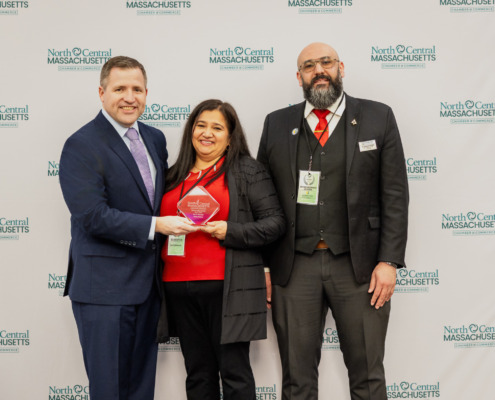

The reception features an open bar and gourmet appetizers.
View
Event
Join us for Connect North Central
Friday, September 25, 2026
8am-9am
View
Event
North Central Golf Tour Championship: Fore the Future
An FLNC Non-Traditional Scholarship Fundraiser
View
Event
Thank you Series Supporting Sponsor empHowered PR
View
Event
Join us for our 11th Annual
Congressional Luncheon
View
Event
Wednesday October 28, 2026
5:00pm - 7:00pm
View
Event
Join us for this in person HR Legal Update
View
Event
November 19, 2026
7:15am - 9:00am
View
Event
Chamber members are provided with the opportunity to engage with the Mayors of Fitchburg, Gardner, and Leominster who provide updates on projects and other things happening in their Cities. These events are by invitation only, please contact Travis Condon for more details.
View
Event
Bull Run Restaurant
215 Great Rd. Shirly, MA
View
Event
Join us for our last Connect North Central of the year!
Friday, December 11, 2026
8am-9am
View
Event
Chamber members are provided with the opportunity to engage with the Mayors of Fitchburg, Gardner, and Leominster who provide updates on projects and other things happening in their Cities. These events are by invitation only, please contact Travis Condon for more details.
View
Event
LEOMINSTER, Mass – In an extraordinary year of challenge due to the pandemic, Fidelity Bank donated nearly $450,000 to more than 200 worthy organizations, events, and causes in several Central and Eastern Massachusetts communities in 2020 through its LifeDesign Community Dividend, which is money the bank sets aside for this purpose each year.
The pandemic was a major focus of 2020 donations, with Fidelity Bank donating more than $100,000 to help various organizations support basic needs early in the pandemic through its Caring for Our Communities COVID-19 Response Grants and more than $50,000 in additional holiday support given to more than a dozen Massachusetts food pantries to help people affected by the pandemic.
“Local nonprofits, organizations and small businesses have done heroic work helping our communities get through this difficult time,” says Fidelity Bank Chairman & CEO Edward F. Manzi, Jr. “The LifeDesign Community Dividend allowed us to show our care and compassion for those in need during the pandemic.”
Other organizations receiving contributions in 2020 included The SHINE Initiative, which Fidelity Bank founded in 2004 with input from its employees to combat discrimination and destigmatize mental health conditions in children and young adults, as well as Greater Worcester Community Foundation, Needham Community Council, Quinsigamond Community College Foundation, City of Leominster Fund, March of Dimes, Heywood Healthcare, YWCA of Central Massachusetts, Hanover Theatre, and several causes promoted through Fidelity Bank’s weekly Caring Casual Fridays.
Fidelity Bank has given out approximately 2.5 million dollars since the program was renamed in 2013.
About Fidelity Bank:
Founded in 1888, Fidelity Bank is one of the strongest independent community banks in Central and Eastern Massachusetts. Fidelity Bank’s unique LifeDesign approach to banking provides the care and clarity needed to make informed decisions with confidence. The Bank offers a range of personal and business banking solutions to clients in 14 full-service banking centers in Leominster, Worcester, Fitchburg, Needham, Gardner, Stow, Shirley, Barre, Millbury, Paxton, Princeton, and Winchendon. The Bank has consistently earned a “5 Star” rating from BauerFinancial, Inc., the nation’s leading independent bank rating and research firm. In 2020 Fidelity Bank was voted Worcester Telegram & Gazette Best Financial Services in Central Massachusetts and was named to the Boston Globe’s Top Places to Work list for the sixth time. As of December 31, 2020, the bank had total assets of approximately $1.1 billion. For more information, visit www.fidelitybankonline.com or www.facebook.com/fidelitybankma
Leominster, MA – Leominster Credit Union (LCU) has partnered with Fitchburg High School to supplement their math classes with a Financial Literacy section regarding personal finance. The personal finance course includes units on checking, savings, managing credit, types of credit, saving for college, budgeting and much more! The classes run for 40 minutes and are taught rotating both in-person and virtually, engaging with over 100 students. The classes are taught by LCU employees Brittany Haley, Waldemar Agostini and Daisy Casiano in conjunction with Katie Najjar.
“At LCU we hope to continue to foster this new relationship with Fitchburg High School, faculty and students and in the future hope to expand this curriculum to additional schools within our community. We want to provide financial education to students and families to improve their skills, boost their confidence and help them achieve success,” said Katie Najjar, SVP Retail, Leominster Credit Union.
“Introducing financial literacy has been a welcomed opportunity for Fitchburg High School students. Students need to be versed in the core curriculum and practical everyday life skills such as being financially literate. Learning about budgeting, money, and finances can impact student futures and quality of life. We are happy to work with LCU in offering these options for our students,” stated Josie D’Elia, Fitchburg High School, Guidance Counselor.
Join us for a virtual Puppet Storytime on Tuesday, April 20, 2021, at 10:00 AM! Through Me to You Puppetry invites you to join Newton and his puppet friends for some storytime fun! Newton and his friends take turns reading stories and singing songs with the kids. At the end of the show, the kids are invited to “unmute” and say hi to Newton. This program is geared to ages 3 to 6, but all are welcome. Register to receive the Zoom link!
Register at https://tinyurl.com/jr6c66h3 to be sent the Zoom link.
This is a free program. For information about this or other Library programs call 978-829-1780 or visit our website: www.FitchburgPublicLibrary.org.

When the workday ends and the lights go down, Custom Cleaning Service of Peabody, Inc. gets to work. “We operate as our clients’ silent partner after business hours,” says Adam Paicos, of Templeton, who now serves as Director of Operations and oversees the company’s expansion into North Central MA. “We are not often seen, but we ensure facilities are clean, secure, and ready for business each day while serving as the eyes and ears for our clients when they are not on site.”

Discover local business stories through our Inside North Central Massachusetts Podcast series. Listen as Chamber members share their journeys, insights, and contributions to our thriving regional business community.

Looking for your next opportunity? Explore current job openings from employers across North Central Massachusetts on our Jobs Board. Whether you’re starting a new career or making a change, you’ll find a variety of local positions available to help you take the next step.
CapEx Facility Services & Construction · Leominster, MA
TaraVista Behavioral Health Center · Harvard, MA
DRS Power Technology, Inc. · Fitchburg, MA
AIS · Leominster, MA