E-Newsletter
An Electronic Publication of the North Central Massachusetts Chamber of Commerce

Inside this edition, you’ll discover the latest Chamber initiatives and success stories from across our region. From economic development projects and upcoming networking events to policy updates and workforce training opportunities, we’re keeping you connected to what matters most for your business and North Central Massachusetts.
The North Central Massachusetts Chamber of Commerce is here to help – with trusted resources, a strong business network, and a support system to keep your business and the region moving forward

Headquartered in Fitchburg, RMI was established in 1995 as a PEO and full-service HR out servicing firm. Its experts offer a wide range of HR services including payroll processing and taxes, compliance guidance and paperwork, workers’ comp insurance and safety management, HR and personnel administration, and benefits administration. Since its founding, RMI has grown into one of the largest Hispanic-owned businesses in the nation. It operates today in thirty-nine states and has over 6,000 employees.
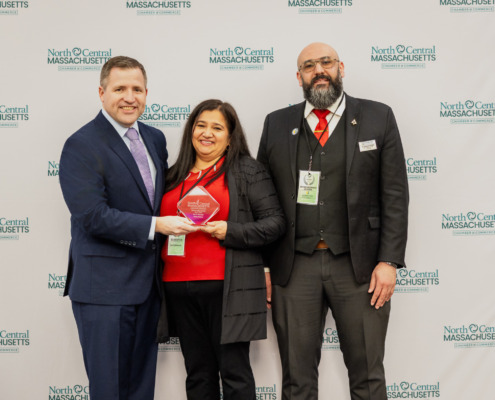
Lopez grew up in the family owned business, starting out as its first employee when she was just 15. She started in payroll and went on to work in every department within the company and eventually managed the sales and product development department before being promoted to President of the company in 2017.
She succeeds David A. Duval, president and founder of Protective Services, Inc. who now moves to the position of Immediate Past Chair of the Board of Directors.
“It is an honor and privilege to have been elected Chair of this dynamic and respected organization that plays such an important role in North Central Massachusetts,” expressed Ms. Lopez, “I am excited to continue David Duval’s efforts and make sure the Chamber remains a strong resource for the local business community.”
In the same election, Christopher McCarthy, president & COO of Fidelity Bank in Leominster was elected Vice-Chair and director Cheryl Molebash, general manager of Dixie Consumer Products in Leominster was elected to the position of Treasurer. Board members elected for a new three-year term were Allie Catlin, co-owner of Smith’s Country Cheese in Winchendon; Rodrigo Souza, owner of Comeketo Brazilian Steakhouse in Leominster; and John Zarrella president of Research Results, Inc. in Fitchburg.
As business owners, we understand what overwork feels like. We throw ourselves into growing and promoting our businesses, we devote ourselves to our customers and clients — and yes, we end up exhausted.
That tired feeling that weighs you down might come from any of several sources. Once you understand why you’re so tired, you can start to make some changes to give you the energy you need to run your business. Take a look at some of the sources of exhaustion as well as some tips to boost your energy so you can accomplish what you set out to do.
When we’re honest without ourselves, we can usually pinpoint the reasons we’re tired. But sometimes they’re not so obvious. Generally, that fatigue you feel boils down to one of three reasons:
Are you eating well, sleeping well, taking time for yourself? As entrepreneurs, sometimes we don’t even know the answer to those questions — but the answers can have a profound effect on our energy level. Maybe you’re giving yourself a boost with sweet snacks, relying on the sugar high to keep you going.
And then there’s caffeine. Yes, that cup of coffee in the morning gets you going — but if you’re drinking more four cups a day (that’s the equivalent of two energy drinks, by the way), the crash you feel when the caffeine wears off can be exhausting.
How about your sleep habits? Do you stay up scrolling through social media and realize you’re going to bed an hour (or two) later than you should? If you don’t practice good sleep hygiene, you can’t expect to arrive at your office with the energy you want.
You might be proud of how many hours you work per week to keep your business thriving — but those long hours are the primary cause of your exhaustion. And when you don’t give your body time to unwind, it forgets how to do relax. How many nights have you spent staring at the ceiling in an ending cycle of stress as you review everything that went wrong yesterday and all the things that might go wrong tomorrow.
Stress affects your body’s hormones in a negative way, so the problem feeds on itself. When you’re stressed, your body produces cortisol, often known as the “stress hormone” — and its presence in your system keeps you awake, which makes you more exhausted, which makes you more stressed — and the vicious cycle continues.
Of course, the workplace isn’t the only source of stress. If your relationships or home life causes stress, or if your personal to-do list is piling up, you’ll find yourself surrounded by negative emotions in all directions.
We talked about cortisol, the stress hormone, above. But other hormonal imbalances can also make you fatigued and irritable. Estrogen, progesterone, melatonin and thyroid imbalances should all be treated by a physician. Various auto-immune diseases, such as lupus, fibromyalgia, Lyme disease, and Hashimoto’s thyroiditis, can all affect your energy level. Once you’ve made the appropriate lifestyle changes, if you’re still feeling regular exhaustion, don’t try to diagnose yourself, but head to your doctor’s office for diagnosis and treatment.
Fortunately, there are proactive steps you can take to end fatigue and regain energy. Take a look at some small things you can do to boost your energy levels.
Every business needs a website — even businesses that only operate in the local area. But what do you do if you’ve recently started your business and you don’t have the money to hire a web designer? Many business owners consider designing a site on their own, but is that really your best option?
If you don’t need an elaborate site, you could build one using one of the many online site builders — such as Squarespace, Weebly, or Wix. These sites have drag-and-drop builders that make designing a site so simple a toddler could do it. If you decide to go this route, you should purchase a domain name from a domain registrar company such GoDaddy or Namecheap and purchase the monthly package that gets rid of the site’s branding. This way, your website looks completely professional.
Keep in mind, when you use an online site builder to create your website, you’re required to pay a monthly hosting fee to keep the site up and running. It could cost you anywhere from $18 to $40 per month, and you can’t create really intricate websites using a site builder. You create your website by simply altering a template. So if you want a more elaborate website for your business it’s not a good option for you.
A self-hosted WordPress site is also an option for anyone who wants to design his or her own site. You can purchase tools that make the building process a lot easier — such as Divi or Beaver Builder — for a one-time fee. These plug-ins let you use drag-and-drop technology to design your website. You still need to purchase a domain name and you’ll need to pay for monthly hosting — but it’s a lot less expensive.
It’s important to understand that there is a learning curve when using plug-ins that let you build your website like a drag-and-drop site builder would. The good news is, there are plenty of tutorials online — both on the developer’s website and on YouTube — that show you a step-by-step process for creating practically any type of site you want. However, it can be rather time-consuming and you might need to know a little bit of coding to create the site you want, so if you really don’t like technology, a self-hosted WordPress site probably isn’t the right option for you.
The freelance web designer space is a crowded one, which is good news for you. With so much competition online, you can find web designers design complete sites for a few hundred bucks, as well as designers that charge thousands. When choosing your designer there are a few things you should keep in mind:
Cheaper isn’t necessarily better — web designers who charge more are likely more experienced.
Look at the web designer’s portfolio before you sign a contract. If the designer doesn’t have a portfolio, it’s not a good option. Also, it’s important to choose a web designer that has designed websites with similar design elements and features to what you want.
Ask for references, and follow up with them. It’s easy to lie about your experience and quality of work online, so you shouldn’t choose a web designer based solely on his or her portfolio.
When it comes to designing a website there are options available for everyone. It’s up to you to decide what type of website you want and whether you have enough confidence in yourself to get the job done easily.

The reception features an open bar and gourmet appetizers.
View
Event
Join us for Connect North Central
Friday, September 25, 2026
8am-9am
View
Event
North Central Golf Tour Championship: Fore the Future
An FLNC Non-Traditional Scholarship Fundraiser
View
Event
Thank you Series Supporting Sponsor empHowered PR
View
Event
Join us for our 11th Annual
Congressional Luncheon
View
Event
Wednesday October 28, 2026
5:00pm - 7:00pm
View
Event
Join us for this in person HR Legal Update
View
Event
November 19, 2026
7:15am - 9:00am
View
Event
Chamber members are provided with the opportunity to engage with the Mayors of Fitchburg, Gardner, and Leominster who provide updates on projects and other things happening in their Cities. These events are by invitation only, please contact Travis Condon for more details.
View
Event
Bull Run Restaurant
215 Great Rd. Shirly, MA
View
Event
Join us for our last Connect North Central of the year!
Friday, December 11, 2026
8am-9am
View
Event
Chamber members are provided with the opportunity to engage with the Mayors of Fitchburg, Gardner, and Leominster who provide updates on projects and other things happening in their Cities. These events are by invitation only, please contact Travis Condon for more details.
View
Event
Energize yourself on Monday, May 10, 2021 at 7:00 PM, for the rest of the week with this session on Sound Healing and Mindfulness, with Nyell Jeudy of Nyell’s Mindfulness Services.
Using crystal singing bowls, Nyell will guide us through the different frequencies and their benefits, and mindfulness techniques.
How sound healing works: As you strike the bowl or rub the rim with a mallet, the friction that results is what creates the vibrations. We can both hear, and feel, these vibrations. Singing bowls can produce different frequencies, with benefits such as:
Please register at https://tinyurl.com/fplmindfulness with your email address, and we will send you the Zoom link!
This is a free program. For information about this or other Library programs call 978-829-1780 or visit our website: www.FitchburgPublicLibrary.org.
The North Central Community Action Team (NCCAT) and the Leominster Community Action Team (LCAT) is recruiting young leaders ages 16-20 to participate in the 2021 North Central Youth Leadership Academy. The group will be able to share their voice around substance use prevention, engage in programming, and create a social media marketing campaign to decrease youth substance use across the region.
This is a PAID opportunity at $15/ hour starting April 21st and ending June 30th. The group will meet weekly virtually on Wednesday evenings from 6-7PM. The leadership academy will include topics on the following:
On May 7th, 2021 the MassHire North Central Career Center and Commonwealth Corporation will present a Workforce Training Fund informational workshop geared to your business training needs. The Massachusetts Workforce Training Fund is a program that provides matching dollars to eligible businesses who are investing in their staff through training and/or retraining.
The info session will provide an overview of the features and benefits of each Workforce Training Fund grant program, including the amount of available funding, program guidelines, and how to apply for each grant. You will have direct access to Commonwealth Corporation staff to ask any questions you might have about each program. The workshop will be presented virtually via Zoom.
To reserve a seat please use this Event Bright link https://www.eventbrite.com/e/workforce-training-fund-online-info-session-may-7th-10am-tickets-148231838419

When the workday ends and the lights go down, Custom Cleaning Service of Peabody, Inc. gets to work. “We operate as our clients’ silent partner after business hours,” says Adam Paicos, of Templeton, who now serves as Director of Operations and oversees the company’s expansion into North Central MA. “We are not often seen, but we ensure facilities are clean, secure, and ready for business each day while serving as the eyes and ears for our clients when they are not on site.”

Discover local business stories through our Inside North Central Massachusetts Podcast series. Listen as Chamber members share their journeys, insights, and contributions to our thriving regional business community.

Looking for your next opportunity? Explore current job openings from employers across North Central Massachusetts on our Jobs Board. Whether you’re starting a new career or making a change, you’ll find a variety of local positions available to help you take the next step.
CapEx Facility Services & Construction · Leominster, MA
TaraVista Behavioral Health Center · Harvard, MA
DRS Power Technology, Inc. · Fitchburg, MA
AIS · Leominster, MA