E-Newsletter
An Electronic Publication of the North Central Massachusetts Chamber of Commerce

Inside this edition, you’ll discover the latest Chamber initiatives and success stories from across our region. From economic development projects and upcoming networking events to policy updates and workforce training opportunities, we’re keeping you connected to what matters most for your business and North Central Massachusetts.
The North Central Massachusetts Chamber of Commerce is here to help – with trusted resources, a strong business network, and a support system to keep your business and the region moving forward
Is your email inbox flooded with messages from big brands, with every message starting off with “In these uncertain times” and ending with “We’re all in this together”? You’re not alone. It seems like every brand wants to reach out to its customers in these (sorry) uncertain times.
But there’s no need to fall into the trap of being predictable and sounding like all the corporate robots filling your inbox. We believe it’s possible to connect to your clients and customers in a meaningful way that’s relational and personal. Take a look at some of our tips for reconnecting with your clients via email, even if you temporarily can’t communicate face to face.
You probably don’t have all the answers to clients’ questions right now. But the more transparent you are, the more likely your customers are to stay connected with your brand. Let them know how your business is affected by the current situation, for starters. But many clients want to know more.
Reach out to tell your customers what you’re doing to protect them, whether it’s by sanitizing your physical location or adding extra online security to protect their data when your employees are working from home. Many customers want to know how you’re supporting your staff during this time, and others want to know what your plans are going forward. If you’ve changed the hours of your customer service center or you’ve opened new web pages to help customers out, let them know. When you’re transparent and clear via email, your clients will know you’re still there for them.
Too many companies are digging too deep into their databases to connect with customers they haven’t had any contact within years. This isn’t the time for that deep dive, which is likely to alienate people and make them think you’re just trying to exploit them. Instead, connect with the customers and clients you have active relationships with, focusing on how you can help meet their current and future needs. Those are the clients who will be most receptive and appreciative to your updates.
You undoubtedly have already established a clear voice when you reach out to customers. Now is the time to take a careful second look at that voice, especially if you tend to add a flash of sarcasm or flippancy to your communications with customers. If your emails make customers feel as if you aren’t taking their concerns and worries seriously, your efforts to reach out could have the opposite effect than the one you’re hoping for.
It’s also not the time to push people to buy things in an overt way, especially when many of your clients or customers may be taking second looks at their own budgets. If you send the inadvertent message that you’re taking advantage of the current situation, you won’t win friends. As you strive to strike a tone that’s supportive without being jarring, you should also avoid making political statements or promises you don’t know if you can keep (such as opening dates).
During a crisis, you have an opportunity to define who you are through your communications with your clients and customers. Honest, transparent communication via email can help you maintain the relationships that will be crucial again in the near future.
The Baker-Polito Administration and the Massachusetts State Lottery announced registration details for the Massachusetts VaxMillions Giveaway, which will begin on July 1.
Massachusetts residents ages 12 and up and who are fully vaccinated prior to each drawing are eligible to enter the giveaway. Residents ages 18 and older who are fully vaccinated prior to each drawing will have the opportunity to enter to win one of five, $1 million cash prizes. Residents between 12-17 years of age who are fully vaccinated prior to each drawing may enter for the chance to win one of five $300,000 scholarship grants.
Beginning Thursday, July 1, eligible residents will be able to enter the giveaway at VaxMillionsGiveaway.com. For residents who do not have access to the internet or require assistance, a call center will be available to assist with registration beginning July 1. The call center can be reached by calling 2-1-1 during the below hours:
Live call center workers will be available in English and Spanish, and 100 additional languages will be available through translators.
VaxMillions Giveaway Drawings will be held once a week for five weeks beginning Monday, July 26 and continuing every Monday through August 23. The first drawing for the giveaway will occur on Monday, July 26, with registration for that week’s drawing closing on Thursday, July 22. Winners will be announced later in the week following each drawing.
Residents are reminded that they have time to get fully vaccinated in order to enter the drawings. An entry before one of the weekly entry deadlines makes you eligible for all of the weekly drawings that take place after you register.
The full schedule of drawing and announcement dates is below. Residents are reminded that some COVID-19 vaccines require two doses, and they must receive all doses before entering the drawing.

Residents must be fully vaccinated before registering, but if they are not vaccinated by the registration date for a certain drawing, they will still have the opportunity to complete vaccination and register for subsequent drawings. Residents will only have to enter once to qualify for all drawings occurring after the date of their registration.
Massachusetts residents 18 years of age and older who have received two doses of the Pfizer or Moderna vaccine, or one dose of the Johnson & Johnson vaccine, will have a chance to win one of five, $1 million cash prizes.
Massachusetts residents between 12 and 17 years of age who have received two doses of the Pfizer COVID-19 vaccine will have a chance to win one of five $300,000 scholarship grants via a 529 College Savings Plan managed by the Massachusetts Educational Financing Authority (MEFA). Funds in a 529 plan can be applied to cover tuition, room and board, and related expenses at any college, university, or technical or trade school or other post-secondary educational institution eligible to participate in a student aid program administered by the U.S. Department of Education. Winners with a qualifying disability may elect instead to receive an equivalent financial contribution to a special needs trust or federally qualified ABLE account to cover qualified expenses.
The Commonwealth launched the Massachusetts VaxMillions giveaway as one of many strategies to increase awareness of the availability and efficacy of the COVID-19 vaccines and encourage residents to get vaccinated to keep themselves, their families and their communities safe.
Only lawful, permanent residents of Massachusetts who are fully vaccinated can enter the drawings. Residents must have received their vaccine doses within Massachusetts. Residents must be fully vaccinated prior to submitting their entry.
There are over 900 vaccination locations across the Commonwealth, with appointments and walk ins widely available. Residents seeking a vaccine can visit mass.gov/COVIDVaccine to find a vaccine location that is convenient for them.
For more information on the Mass VaxMillions Giveaway, visit VaxMillionsGiveaway.com.
Residents can email to report any instances of fraud or suspicious activity associated with the VaxMillions Giveaway Promotion.
The Baker-Polito Administration today will re-file its plan to immediately put to use part of Commonwealth’s direct federal aid from the American Rescue Plan Act (ARPA) to support key priorities including housing and homeownership, economic development and local downtowns, job training and workforce development, health care, and infrastructure. The Administration called on the Legislature to act quickly on the $2.9 billion plan to jump-start the Commonwealth’s economic recovery and support residents hardest-hit by COVID-19, such as lower-wage workers and communities of color.
Governor Charlie Baker today is re-filing the proposal after signing “An Act Relative to Transferring Federal Funds to the Federal COVID-19 Response Fund,” which was on the Governor’s desk.
“We are eager to work with the Legislature to put these funds to work and our $2.9 billion proposal will immediately aid those hardest hit by COVID-19 like communities of color and lower-wage workers,” said Governor Charlie Baker. “This plan addresses homeownership gaps in communities of color, connects workers with in demand job-training, boosts addiction treatment services and invests in local infrastructure. It’s crucial that the Legislature act quickly and not hold up these important investments. Communities of color, the hardest hit areas of the Commonwealth, should not have to wait to have their tax dollars be put to work.”
“Massachusetts’ economic recovery is off to a good start but it’s crucial that we address the disproportionate impacts of the pandemic by taking action to invest these federal relief dollars in priorities like housing, economic development, job training, and addiction treatment,” said Lt. Governor Karyn Polito. “We look forward to working with our colleagues in the Legislature to move quickly in putting these relief dollars to work on behalf of our communities.”
The proposal filed today is the same proposal filed by Governor Baker earlier this month with the Legislature, with an additional $100 million for marine port development to support economic growth.
The Administration’s plan to invest $2.9 billion in federal dollars in these disproportionately impacted communities complements a proposal filed last week for the Commonwealth’s surplus state tax revenue. With May revenues approximately $4 billion over benchmark, the Administration’s proposal for a 2-month Sales Tax Holiday would provide relief for small businesses and residents, especially lower-wage workers who are most impacted by the sales tax.
The $2.915 billion is part of a total of approximately $5.3 billion in direct aid to the Commonwealth from the federal American Rescue Plan Act. These discretionary funds are intended to support urgent COVID-19 response efforts, replace lost revenue, support immediate economic stabilization for households and businesses, and address unequal public health and economic challenges in Massachusetts cities and towns throughout the pandemic. ARPA is also providing a total of $3.4 billion in direct aid for municipalities throughout Massachusetts, as well as substantial funding for key priorities including a total of $1.1 billion for transit. With a focus on increasing capacity for child care and supporting parents as they return to work, the Administration is also proposing to distribute approximately $760 million in additional federal funding to child care providers in Massachusetts over the coming years, and looks forward to working with key stakeholders on the usages of these funds.
The remaining $2 billion in direct federal aid would stay in the Federal COVID-19 Response Fund, and the Administration looks forward to working closely with the Legislature to allocate these resources in a fiscally responsible and compliant manner.
In addition to this discretionary funding, an additional $35.2 billion in other ARPA funding has been directed to the Commonwealth to support additional areas of recovery including direct aid to municipalities, transportation, and child care. This includes approximately $3.4 billion in direct aid to cities, towns, and counties throughout Massachusetts. The plan therefore includes language allowing a local match for numerous programs to better leverage municipal support, optimize the usage of all available revenue, and maximize the impact of this one-time federal funding.
Highlights of the plan include:
Housing
Economic Development
Workforce Development
Health Care
Infrastructure Investment
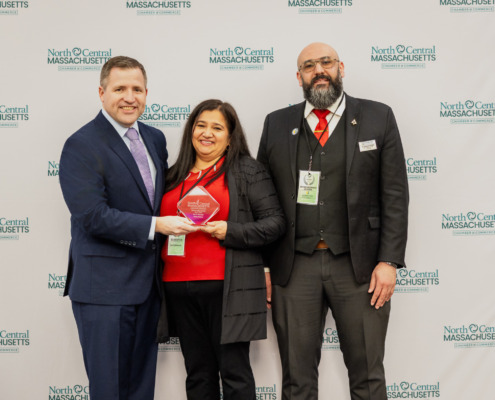

The reception features an open bar and gourmet appetizers.
View
Event
Join us for Connect North Central
Friday, September 25, 2026
8am-9am
View
Event
North Central Golf Tour Championship: Fore the Future
An FLNC Non-Traditional Scholarship Fundraiser
View
Event
Thank you Series Supporting Sponsor empHowered PR
View
Event
Join us for our 11th Annual
Congressional Luncheon
View
Event
Wednesday October 28, 2026
5:00pm - 7:00pm
View
Event
Join us for this in person HR Legal Update
View
Event
November 19, 2026
7:15am - 9:00am
View
Event
Chamber members are provided with the opportunity to engage with the Mayors of Fitchburg, Gardner, and Leominster who provide updates on projects and other things happening in their Cities. These events are by invitation only, please contact Travis Condon for more details.
View
Event
Bull Run Restaurant
215 Great Rd. Shirly, MA
View
Event
Join us for our last Connect North Central of the year!
Friday, December 11, 2026
8am-9am
View
Event
Chamber members are provided with the opportunity to engage with the Mayors of Fitchburg, Gardner, and Leominster who provide updates on projects and other things happening in their Cities. These events are by invitation only, please contact Travis Condon for more details.
View
Event
Masis Staffing Solutions, a nationwide staffing firm headquartered in Worcester, is proud to announce the acquisition of United Personnel Services, a regional staffing agency in Massachusetts and Connecticut.
United Personnel, founded in 1984, provides staffing solutions in the professional, IT, human resource, nonprofit, manufacturing and light industrial sectors. United Personnel has received various awards throughout its history, including: Champions of Hope from the United Way of Pioneer Valley; Clearly-Rated’s Best of Staffing; list of 500 Fastest-Growing Privately Held Companies in America by Inc. Magazine; and is listed as one of Massachusetts’ Top 100 Women-Led Businesses by The Boston Globe and Commonwealth Institute.
United Personnel’s President Tricia Canavan and Chief Financial Officer Dave Mazzucco will join Masis Staffing Solutions’ executive team. Canavan will serve as President of United Personnel/Executive Vice-President, Masis Staffing Solutions; and Mazzucco will serve as Chief Financial Officer.
Canavan, daughter of founders Mary Ellen Scott and the late Jay Canavan, stated, “United and Masis have been collaborating on various projects for over a year. During this time, we have recognized our shared priorities for providing excellence to customers and candidates, while giving back to our communities. We are excited to have the United team join with Masis. We will now be able to work more collaboratively to provide additional value and innovation to clients and employees.”
Matthew Vaccaro, President of Masis Staffing Solutions, noted, “United Personnel is a highly respected organization in the staffing industry. We share the same core values, and Tricia’s leadership and professionalism align with our vision for the future.”
The merger of these two family-owned businesses builds upon the organizations’ respective service lines, geographic reach, and shared focus on utilizing best practices and creating tailored solutions for their clients.
About Masis Staffing Solutions:
Masis Staffing Solutions is a full-service employment provider, delivering customized staffing and recruitment programs to customers in 18 states. Its emphasis on innovation through engineered staffing and robust recruitment solutions creates significant operational results for its clients.
GARDNER, MA – May 18, 2021 – On Friday, May 14, 2021, MWCC welcomed fourteen students to the dental hygiene profession with a socially distant pinning ceremony outside the main entrance of the Gardner campus.
“This is not totally normal, but this is the most normal event that I have been to in about fifteen months. Thank you for this moment,” opened MWCC President James Vander Hooven. “I am so proud of the efforts these students have made over the past two years. It takes an awful lot to choose to pursue a degree in one of the caring fields, to know that you are going to be dedicating your professional careers to helping others. I am eternally grateful that you have chosen this path, and that you chose to do it with Mount Wachusett Community College.”
Cindy Cadoret, Director of Dental Education Programs, and the dental faculty members pinned the fourteen students, all of whom are receiving their Dental Hygiene Associate Degrees on Wednesday, May 19. The students pinned and the annual department awardees are:

Front Row, left to right: Ela Solimeno, Ashley Leone, Beatriz Padilla-Lazarin, Jessica Burgos, Brianna Coggins, Jennifer Burkier, Patricia Bunis, Samantha Bottis. Back Row, left to right: Justin Ward, Courtney Rogers, Ivonne Jimenez, Emily Matusiak, Katherine Piecewicz, Ashely Beauchemin.
Ashley Beauchemin, Ashby
Samantha Bottis, Worcester
Patricia Bunis, Whitinsville
Jessica Burgos, Fitchburg, Hu-Friedy Golden Scaler Award
Jennifer Burkmier, Lowell
Brianna Coggins, Northbridge
Ivonne Jimenez, Clinton
Ashley Leone, Auburn, Dental Hygiene Most Improved Award
Emily Matusiak, Lowell
Beatriz Padilla-Lazarin, Leominster
Katherine Piecewicz, Ayer
Courtney Rogers, Uxbridge, Dental Hygiene Community Service Award
Elzbieta Solimeno, Bolton, Dental Hygiene Curriculum and Alumni Scholarship Award
Justin Ward, Charlemont

Shaddock, a Boston native, served in the 4-101st Airborne and Assault Division which was deployed to Iraq and Kuwait as part of Operation Iraqi Freedom. Following his tour, he struggled with substance abuse and in 2010 entered recovery. As an active member of the Alcoholics Anonymous community, Shaddock has helped many other find sobriety and the commitment to move forward.
During his time at MWCC, Shaddock was an active member of the college Veteran community. As a VA work-study student, he helped other veteran students adjust to college life after their service. His VA support at the college earned him the Peter J. Trainor Leadership Award during the 2019 commencement.
In 2019, while completing his degree at MWCC, Shaddock was diagnosed with Stage 4 prostrate cancer that had spread to his lymph nodes. Since that time, he has undergone surgery, hormone therapy, and radiation treatments while continuing his education at Fitchburg State University. He credits the support from family including his sister Diane Austin, a breast cancer survivor and founder of Coils to Locs which provides wigs to women of color, as well as friends and the AA community with helping him battle both cancer and alcoholism.
“Chris’s infectious personality, positive attitude, and remarkable resilience draws people to him,” noted MWCC President James Vander Hooven. “Chris is always there with a helping hand and a comforting smile. He is the consummate fighter. We are proud to call him one of our own and wish him the best as he continues to fight and change the world for the better.”
Shaddock is currently pursuing a degree in Exercise Science with the goal of earning a Doctorate in Physical Therapy with a specialty in Oncology Physical Therapy, enabling him to use his own personal experience to help others battle cancer.

When the workday ends and the lights go down, Custom Cleaning Service of Peabody, Inc. gets to work. “We operate as our clients’ silent partner after business hours,” says Adam Paicos, of Templeton, who now serves as Director of Operations and oversees the company’s expansion into North Central MA. “We are not often seen, but we ensure facilities are clean, secure, and ready for business each day while serving as the eyes and ears for our clients when they are not on site.”

Discover local business stories through our Inside North Central Massachusetts Podcast series. Listen as Chamber members share their journeys, insights, and contributions to our thriving regional business community.

Looking for your next opportunity? Explore current job openings from employers across North Central Massachusetts on our Jobs Board. Whether you’re starting a new career or making a change, you’ll find a variety of local positions available to help you take the next step.
CapEx Facility Services & Construction · Leominster, MA
TaraVista Behavioral Health Center · Harvard, MA
DRS Power Technology, Inc. · Fitchburg, MA
AIS · Leominster, MA