E-Newsletter
An Electronic Publication of the North Central Massachusetts Chamber of Commerce

Inside this edition, you’ll discover the latest Chamber initiatives and success stories from across our region. From economic development projects and upcoming networking events to policy updates and workforce training opportunities, we’re keeping you connected to what matters most for your business and North Central Massachusetts.
The North Central Massachusetts Chamber of Commerce is here to help – with trusted resources, a strong business network, and a support system to keep your business and the region moving forward
Article Source: State House News Service
Author: Matt Murphy
A deal to raise tax collection estimates by more than $4.2 billion and spend nearly $48.1 billion in fiscal year 2022 came together Thursday with House and Senate lawmakers filing a compromise budget that would also make the state’s controversial film tax credit permanent.
The budget deal, according to House and Senate officials, accounts for surging tax collections over the last six months that have far outpaced the projections agreed to by legislative leaders and the Baker administration at the start of the year.
The expectation of additional tax revenue was used by budget negotiators, in part, to create a $350 million trust fund that could be tapped in future years to help cover the cost of a $1.5 billion school funding reform law passed in 2019, known as the Student Opportunity Act.
The budget filed Thursday evening (H 4002) also reflects the decision of negotiators to cancel a planned draw on the state’s reserves of at least $1.5 billion and proposes to make a supplemental deposit of $250 million into the state’s pension system.
House Ways and Means Chairman Aaron Michlewitz and Senate Ways and Means Chairman Michael Rodrigues announced the compromise Thursday afternoon, and leaders in both branches hope to pass the budget on Friday and send it to Gov. Charlie Baker for his review.
Massachusetts is one of just four states in the country that started its fiscal year on July 1 and does not have an annual budget in place. Though the budget is already eight days late, the Legislature and Gov. Baker put in place a temporary budget totaling $5.4 billion to keep government operations funded through July.
The Legislature and Baker postponed implementation of the seven-year school funding reform law during the COVID-19 pandemic, but the new budget increases Chapter 70 school aid by $219.6 million in fiscal year 2022 to $5.5 billion. The spending puts the state back on track to meet the state’s funding commitment over the next six years, and one budget official said the new trust fund would protect against future setbacks.
In addition to resolving disagreements over spending, leaders for the two branches came to an agreement that would permanently extend the state’s tax credit for film production in Massachusetts, which supporters have defended as a job creator but critics have derided as too expensive.
The compromise plan calls for the January 2023 sunset of the tax credit to be cancelled, but would increase the eligibility threshold for a production company by requiring at least 75 percent of its filming budget to be spent or at least 75 percent of principal photography days to take place in Massachusetts.
The House had voted to simply eliminate the tax credit’s expiration date, while the Senate proposed a four-year extension tied to an increase in the minimum number of filming days from 50 percent, a cap on eligible salaries at $1 million, and a ban on the transfer of credit.
The salary cap and transferability ban were not included in the final compromise.
The compromise budget also scrapped a Senate-backed plan to raise fees on Uber and Lyft rides to generate new money for the municipalities, the MBTA, regional transit authorities and other infrastructure needs.
The House has voted in favor of tiered increases in transportation network companies fees in the past, but they were vetoed by Gov. Baker and the branch did not include the fees as part of its budget proposal this year.
After fearing the worst at the start of the pandemic, legislative budget writers have largely avoided having to deal with the massive tax collection downturn forecast by economists at the start of the pandemic.
Instead, Democratic leaders have had the opposite challenge – how to allocate billions in unbudgeted revenues.
After agreeing in January to an estimate of $30.12 billion in taxes, Michlewitz and Rodrigues agreed in the budget filed Thursday to increase the tax revenue projections for fiscal 2022 to $34.35 billion, a whopping $4.23 billion increase.
The new projection reflects what House and Senate budget official described as an increase of $362 million, or about 1 percent, above preliminary tax estimates for fiscal 2021 of roughly $34 billion. The Department of Revenue has not yet released final tax revenue figures for fiscal 2021, but lawmakers are expecting a sizable surplus to spend after leaders verbally rejected Baker’s call for a two-month sales tax holiday.
The new flexibility in the fiscal 2022 budget allowed negotiators to fund accounts across the board at the higher level of what was recommended by either the House or Senate, adding roughly $300 million in additional spending added to the $47.7 billion budgets passed by both branches this spring.
That step led to larger bottom lines for higher education, nursing homes, local health departments, mental health programs and early educator salaries.
The conference committee also agreed to boost funding for some accounts beyond what had been proposed previously, including an additional $17 million for the Workforce Competitive Trust Fund, $18 million for career-technical institutes, and $9.5 million for one-stop career centers.
House Speaker Ron Mariano’s initiative to incentivize training for jobs in the offshore wind industry also got included with a boost from $10 million to $13 million, and a new cyber security consortium will work community colleges and state universities to create careers opportunities in cyber security.
Additionally, the compromise bill, according to officials, would cancel a planned withdrawal of at least $1.5 billion from the state’s “rainy day” fund, and projects a deposit into the reserve account of more than $1.1 billion in capital gains taxes that would drive the balance of the emergency fund to $5.8 billion by the end of fiscal year 2022.
Other highlights of the compromise budget include one-time raises for sheriffs of about $20,000, the extension of an historic rehabilitation tax credit, a new tax credit for the hiring of disabled workers and the conversion of a child care tax deduction into a refundable credit that would allow more low-income families to qualify.
The final compromise also dropped a provision described in a letter last week by 40 House lawmakers as an “anti-worker” measure added to the Senate budget that would have reversed the state’s law requiring triple damages in wage and hour lawsuits.
When you think about banks, many people don’t realize the connections banks like Berkshire have to their local communities. Established 175 years ago in Pittsfield, MA, Berkshire has maintained its presence as a community bank for people of all backgrounds. While communities may have changed over the years, the purpose-driven mission of Berkshire has grown stronger.
“At Berkshire, we want everyone to have access to a bank, including those who have been traditionally underserved and underbanked,” said Paul Kelly, Regional President of Berkshire Bank. “Community banks, like Berkshire, have important roles in addressing disparities in the community and fueling economic activity.”
“Consumers and businesses from underrepresented and under-resourced communities have been hit particularly hard by the COVID 19 health crisis and because many lack a primary banking relationship, they frequently must resort to expensive payday lenders and check cashing services for assistance,” stated Kelly.
That’s where a bank like Berkshire has been able to step in and assist the community. Recently, Berkshire Bank launched a product called My Freedom Checking. This product, according to a press release, has no charges for overdrafts or monthly maintenance fees. In addition, it offers free Mobile Banking with Mobile Deposit and access to Berkshire Bank’s Greenpath Financial Wellness programs along with several other benefits that make banking easier and more accessible. The account recently received national certification from the Cities for Financial Empowerment Fund through its BankOn program recognizing the account for its transparency, accessibility and affordability.
While demographics vary across communities, underbanked individuals face many barriers to a traditional banking relationship. Many feel they don’t have enough money to keep an account with a traditional financial institution, while some don’t trust banks. Others find it inconvenient to use a bank because of their location or hours.
“Because of these barriers, many underbanked individuals and small businesses turn to money order, check cashing, and payday loan companies – expensive options that aren’t an ideal substitute for real banking services,” said Kelly.
Berkshire’s MyFreedom checking account is just one of the products offered to residents in the North Central Chamber community. They also have a new socially responsible check cashing service to help customers, non-customers, and the underbanked, called MyCheck. This service offers anyone the ability to cash checks for a fraction of local check-cashing costs at any one of its branches or at a Berkshire Bank MyTeller location, an ATM with person-to-person interaction.
Berkshire Bank’s My Banker is another unique service for greater Worcester residents that can offer personalized banking services without maintaining a high balance at the bank. In addition, local My Bankers like Erin Thomason and Linda Petrarca can provide free financial counseling services to help customers navigate their financial lives. Recently the bank collaborated with the Worcester Public Library to develop and offer a financial literacy program to community residents who may not have access to this type of resource.
“With services like these and our MyBanker staff, we are working to bring more equitable banking services to all communities in the Worcester region, close the wealth gap, and get individuals into mainstream banking,” said Kelly.
Berkshire Bank plans to continue to support the local North Central Chamber community and the Greater Worcester communities through various means, including the above-enhanced banking solutions and financial literacy programs. For more on the services in this story or to learn about Berkshire Bank’s philanthropic programs, visit berkshirebank.com.

The North Central Massachusetts Chamber of Commerce was named a finalist for the prestigious 2021 Chamber of the Year award, presented by the Alexandria, VA -based Association of Chamber of Commerce Executives (ACCE).
The North Central Massachusetts Chamber is one of four finalists in its category – along with chambers in Cumming, GA; Leesburg, VA; and Tuscaloosa, AL.
The award is the most prestigious and competitive recognition presented annually by the Association of Chamber of Commerce Executives (ACCE). ACCE is an association of more than 9,000 professionals from 1,600 chambers of commerce.
The Chamber of the Year award recognizes the leadership role chambers have in their communities. Those honored with the Chamber of the Year designation have demonstrated organizational strength and made an impact on key community priorities, such as education, transportation, economic development and quality of life.
“This year’s finalists are among the most impactful organizations within the industry,” said ACCE President & CEO Sheree Anne Kelly. “Following a tumultuous year, these chambers emerged as community champions, providing catalytic leadership to address their region’s greatest challenges and opportunities for prosperity.”
Chamber of the Year winners will be announced by ACCE on Tuesday, July 20, 2021.
“We are tremendously honored to be named a finalist for this national award. This is a collective achievement and a tribute to the innovation and passion of our members and the many business leaders that support our mission and work so hard to build a stronger economy and quality of life in the communities that we call home here in North Central Massachusetts,” said Roy M. Nascimento, President & CEO of the North Central Massachusetts Chamber of Commerce. “I want to thank our staff, board leaders and all of our members for their support and commitment to the important work we do collaboratively to advance North Central Massachusetts.”
Chambers of commerce interested in competing for the award first must qualify by participating in a vigorous multi-stage process. Organizations entering the Chamber of the Year competition must meet minimum thresholds around membership performance and financial management.
Chambers compete based on meeting key performance criteria on the ACCE Annual Operations Survey. Qualifying chambers enter the competition with a written application addressing all aspects of organizational operation and programmatic work. Applications are scored by peer chamber executives to determine finalists. Winners are selected from finalists based on an interview before a panel of experienced chamber professionals. To ensure the fairest competition, applicants are grouped into four categories based on annual revenue, membership, area population and other factors.
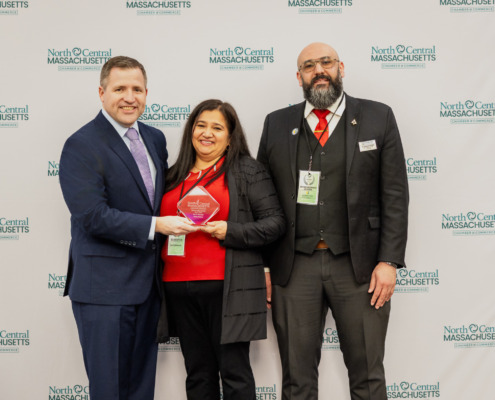

The reception features an open bar and gourmet appetizers.
View
Event
Join us for Connect North Central
Friday, September 25, 2026
8am-9am
View
Event
North Central Golf Tour Championship: Fore the Future
An FLNC Non-Traditional Scholarship Fundraiser
View
Event
Thank you Series Supporting Sponsor empHowered PR
View
Event
Join us for our 11th Annual
Congressional Luncheon
View
Event
Wednesday October 28, 2026
5:00pm - 7:00pm
View
Event
Join us for this in person HR Legal Update
View
Event
November 19, 2026
7:15am - 9:00am
View
Event
Chamber members are provided with the opportunity to engage with the Mayors of Fitchburg, Gardner, and Leominster who provide updates on projects and other things happening in their Cities. These events are by invitation only, please contact Travis Condon for more details.
View
Event
Bull Run Restaurant
215 Great Rd. Shirly, MA
View
Event
Join us for our last Connect North Central of the year!
Friday, December 11, 2026
8am-9am
View
Event
Chamber members are provided with the opportunity to engage with the Mayors of Fitchburg, Gardner, and Leominster who provide updates on projects and other things happening in their Cities. These events are by invitation only, please contact Travis Condon for more details.
View
Event
Silva brings extensive experience, impressive results to drive Fidelity Bank’s LifeDesign approach
(Leominster, Mass.) Fidelity Bank today announced the appointment of Joseph Silva to Senior Vice President, Chief Commercial Banking Officer, effective immediately. In this role, he will lead all aspects of Commercial Banking and Cash Management sales with a focus on growing the business while also embracing Fidelity Bank’s LifeDesign approach. He succeeds Barry Bliss, Chief Commercial Banking Officer, who recently announced his retirement forthcoming in August.
“Joe has extensive experience in credit, lending and business development, as well as leading teams toward exceptional results in client-focused growth,” said Christopher W. McCarthy, President & COO. “He is a positive, collaborative and innovative leader, making him a terrific match for our LifeDesign approach to banking.”
Silva joins Fidelity Bank from Pawtucket Credit Union, where he served as Head of Commercial Lending for the past nine years. Prior to Pawtucket Credit Union, he spent five years at Bank Rhode Island.
“Fidelity Bank has a strong reputation of understanding the complexities of today’s business environment by offering sound solutions to empower business owners and their companies,” said Silva. “As leader of the Commercial Banking teams, I’m committed to continuing the strong tradition of helping commercial clients realize their financial hopes and dreams.”
Silva received a bachelor’s degree in Interpersonal Communications from the University of Rhode Island and is also a graduate of the Bank Leadership Program from the Darden School at the University of Virginia.
He will be relocating to Massachusetts in the coming months with his wife, Saovala, and family.
The Fitchburg Housing Authority, the Awarding Authority, invites written quotes from Contractors for the Canton Valley (705-2) Development for the Fitchburg Housing Authority in Fitchburg Massachusetts, in accordance with the documents prepared by Next Phase Studios.
The Project consists of: Canton Valley Envelope and Lighting, #097124 – Envelope, lighting, ADA conversion and site work project at the Canton Valley Development in Fitchburg, MA. Scope of work to include membrane roof replacement for all (8) residential buildings and Community Building, exterior door replacement, selective window replacement at residential units, wood siding removal and replacement at (3) residential buildings (5 previously replaced). Renovation of three existing units to be ADA accessible and provide ADA accessible kitchen in the Community Building. Sidewalks to be removed and replaced and new ADA compliant ramps to be installed.
Filed Sub Bid Categories: Miscellaneous Metals, Roofing and Flashing, Plumbing, HVAC, and Electrical
The work is estimated to cost $ 1,517,067.00
Quotes are subject to M.G.L. c.149 §44A (2)(B) & to state prevailing wage rates as required by M.G.L. c.149
Written Quotes will be received until 11:00 a.m., Wednesday July 7, 2021. Sub Bid deadline is Wednesday, June 23, 2021 at 11:00 am.
All Quotes should be submitted electronically to: www.biddocsonline.com and received no later than the date & time specified above.
Contract Documents will be available digitally at:
During bidding, the job site will be available for inspection between 1:00 PM and 2:00 PM on Wednesday, June 16, 2021. Please wear a face mask during site visit. Location is Canton Valley State Public Housing Development located at 42 Valley Street, Fitchburg, MA 01420. Email: to schedule.
At Orangetheory Fitness, we believe the benefits of exercise extend well beyond the studio. We embrace the idea that a healthy lifestyle can drastically improve workplace performance; increased productivity, reduced absenteeism and relieve stress. We are committed to building relationships with businesses who share our beliefs.
We are running the best promotions Orangetheory has ever run – 1 Month Free and up to $50 off a heart rate monitor for new members.
We can customize a program for your team including but not limited to:
– A corporate discount on monthly memberships
– A 1-hour fitness FLEX YOUR COMPETITIVE class, exclusively for your employees at your studio
– A 1-hour LEARN & BURN team-building class at your location
– An idea of your choosing- we welcome customizing a program that supports your mission and values
Let’s all run, row, lift and sweat our way to improved morale with the help of certified coaches that tailor your workout to your own fitness level.

When the workday ends and the lights go down, Custom Cleaning Service of Peabody, Inc. gets to work. “We operate as our clients’ silent partner after business hours,” says Adam Paicos, of Templeton, who now serves as Director of Operations and oversees the company’s expansion into North Central MA. “We are not often seen, but we ensure facilities are clean, secure, and ready for business each day while serving as the eyes and ears for our clients when they are not on site.”

Discover local business stories through our Inside North Central Massachusetts Podcast series. Listen as Chamber members share their journeys, insights, and contributions to our thriving regional business community.

Looking for your next opportunity? Explore current job openings from employers across North Central Massachusetts on our Jobs Board. Whether you’re starting a new career or making a change, you’ll find a variety of local positions available to help you take the next step.
CapEx Facility Services & Construction · Leominster, MA
TaraVista Behavioral Health Center · Harvard, MA
DRS Power Technology, Inc. · Fitchburg, MA
AIS · Leominster, MA