Amazon is the largest online store and hosts products from some of the biggest brands in the world. They are also known for large inventories and discounts, so competing based on price can be a tall order for local startups. Interestingly, about 50% of the products you encounter at Amazon in the United States are listed by small-to-medium businesses (SMBs) and not Amazon itself. So is Amazon a competitor, or is it a marketplace?
In addition to setting up your business on Amazon, there are several ways a local business can compete and establish its market. Here are five:
Offering Personalized Services
Local businesses have the advantage of offering one-on-one customized services, something that’s not available for Amazon customers. As a small business, you can focus on customer support to learn more about your clients and customize your services to their needs. There are various ways to create an impression of personalized services, from greeting customers by their names and following up on big sales to analyzing each feedback.
Introduce A Loyalty Plan
A loyalty program is designed to reward repeat customers and a perfect way to get repeat business income. If you lack one, you should create a loyalty program that allows regular customers to receive personalized treatment, discounts and better offers. Make sure your customers learn about the loyalty program during their first visit or interaction with your business. Amazon has deals and redeemable points, shipping discounts and other incentives, so make sure your loyalty program is attractive enough to retain customers.
Increase Brand Awareness and Online Presence
To become successful, people need to know about your business, so it is vital to work on the brand. Invest in SEO, set up your website and get on Amazon if your business model can align with the store. Make sure you optimize the business for local customers and take advantage of social media marketing. Increasing brand presence locally will provide the perfect canvas for exploring markets beyond the borders.
Market for Mobile
Most people start their searches online through their mobile phones and modern devices. In recent times, mobile games, operating systems and other applications have become a platform for advertising. Companies like Amazon market for everyone, especially mobile users. However, as a local business, you have the advantage of knowing and understanding your immediate customers. You know the right language to use for marketing and platforms local communities use to access information. Mobile devices also offer a chance to connect offline shopping experiences.
Set Up Your Amazon Business
Amazon boasts the inherent advantages of a global brand and is essentially a marketplace where customers can find any product. As a local business, you can take advantage of the existing logistics frameworks and reputation to list your products on the platform. Local customers that prefer to shop from Amazon will still be able to find your products and business. However, this requires meeting all Amazon requirements and optimizing your business to appear at the top of both Amazon and Google search results.
Amazon relies on small and medium businesses (like yours) in all categories and, in 2019, the number of SMB accounts in the US Amazon store increased by 133% to 1.1 million. For local businesses, the challenge is to create more perks and personalized services while leveraging social media, mobile marketing and local SEO.
The North Central Massachusetts Development Corporation (NCMDC) approved two loans totaling $30,000 to 290 Auto Body Inc. and American Transport.
290 Auto Body Inc., owned and operated by Justin E Forkuo on 1 Stowell Ave in Worcester, is an auto body collision repair shop that specializes in all aspects of vehicle services. They offer dent and scratch repair, insurance claim handling, collision or/and mechanical work. Their loan for $20,000 was used as working capital to continue operating during the pandemic. For more information visit their website at www.290autobody.com.
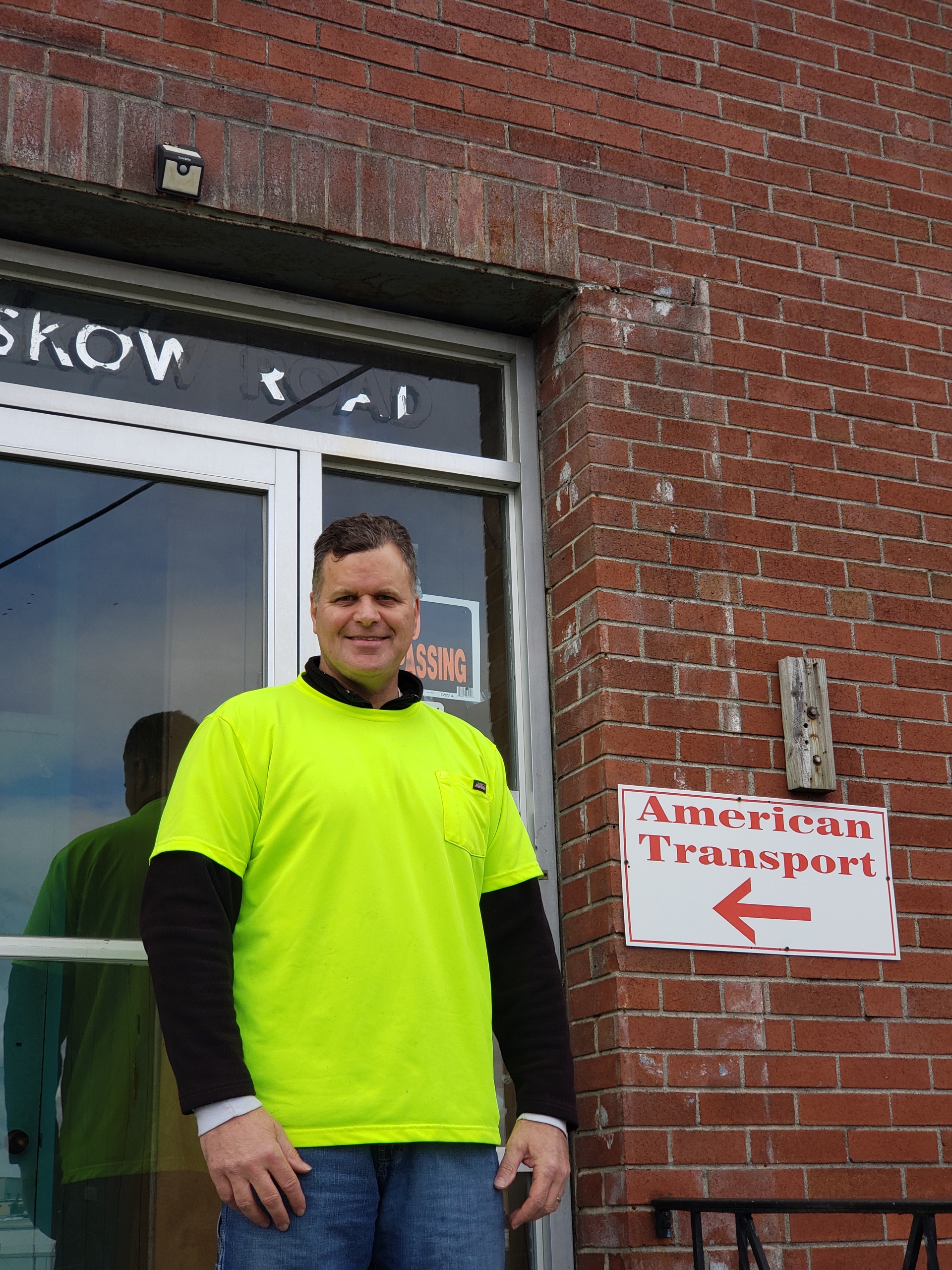
American Transport received a $10,000 working capital loan due to the coronavirus pandemic disruption. James Belletete started a full-service auto transport focused on delivering fast and reliable vehicle transport solutions between New England and Florida in 2008 and is now a license Auto Broker/Carrier allowing delivery to all 50 states. For more information visit their website at www.newenglandtoflorida.com.
As a microloan lender, NCMDC can provide loans to small businesses up to $150,000 for working capital, equipment, inventory, expansion and working with our banking partners to provide gap financing for the final piece of a project.
About the North Central Massachusetts Development Corporation
The North Central Massachusetts Development Corporation (NCMDC) is a non-profit economic development corporation with the mission of creating jobs and improving the economy. NCMDC is certified by the U.S. Small Business Administration (SBA), and the U.S. Department of the Treasury under the Community Development Financial Institutions (CDFI) Program. The NCMDC works in partnership with local banks, credit unions, chambers of commerce and area nonprofits to support emerging microenterprises, small businesses, and community projects in 76 communities in Worcester, Middlesex and Franklin Counties with loans and business assistance. Since 1996, the NCMDC has granted over $8,000,000 in loans to small businesses to help grow jobs and the economy in the region.
For more information about the NCMDC loan programs, please call 978.353.7607 or visit ChooseNorthCentral.com.
If you are a freelancer, you live by your wits and your talent, which can lead to an exhilarating feeling of self-satisfaction. However, being a solopreneur has its risks and if you get sick or cannot work, you have no sick days or vacation time to rely on for backup income. So, maybe it’s time to branch out and turn your hustle into a business.
By documenting your processes, you can outsource portions of your business, increase productivity and bring home more revenue for less effort. Follow these tips to document what you do, so you can hire other people to help you grow your operations.
What Is Process Documentation?
Process documentation provides a description and instructions on how to carry out business processes. Examples of process documentation include the following:
tutorials
forms
policies
checklists
screenshots
step-by-step instructions
process maps
Process documentation helps you onboard employees or virtual assistants to conduct your freelance activities.
Process Steps
Here are the first steps of documenting processes to help you get started:
Process Name: Choose a descriptive name of the process you’re documenting. You may find it helpful to start on a whiteboard or flipchart.
Process Scope: Choose a logical start and endpoint of the process. If you have several stages or products, for example, you can document each one separately to make it easier to complete your documentation in small sections.
Process Outputs: This identifies the end result of the process. For example, if you are documenting a freelance process, the end result is a product or service ready to deliver to the client. Examples include crafts sold online or social media management services you provide to clients.
Process Inputs: Identify all materials needed to perform the process. For example, you will need boxes, packing material, scissors and labels to prepare products for shipping. If you are updating a client’s website, for another example, you will need internet access, software, development tools and content.
Process Activities: Write down or video record all the activities involved in completing the process. Examples of process activities include:
Sign paperwork
Approve request
Ship product
Notify user
You can use sticky notes and a tabletop to visualize this and provide flexibility during the organization stage.
Process Organization: Organize all the activities that you brainstormed into logical categories. At this time, you may want to break the items up into separate processes. Within each process, put the process flow into order. Add key decision points and possible outcomes to develop a complete picture of the process.
Process Review: Look at the process flow to determine whether you have left any steps out.
Process Roles: Assign roles representing who will complete each activity step.
Transcribe Process: Use swim lane flowcharting to create a visual workflow diagram.
Final Review: Determine which activities and roles you can outsource for each activity.
If you conduct your freelance work online, documenting each process helps you prepare job descriptions and outsource different activities that involve digital delivery. One of the most efficient ways to begin is by recording yourself on video performing the work you want to outsource. Consider downloading a screen-recording software like TechSmith Capture (Mac or Windows).
When you document your business processes, you make it possible to grow your freelance hustle into a business that can grow beyond just your own capacity.
In some ways, Heywood Hospital is a traditional hospital providing emergency care, surgeries and inpatient care.
Heywood is a non-profit community-owned hospital licensed for 134 bed hospital, located in Gardner. The medical staff includes 200 active, courtesy, and consulting physicians in primary care and a multitude of specialties.
But what makes the hospital unique is its commitment to ensuring the health of the community in and outside its walls, said Winfield Brown, president and chief executive officer of Heywood Healthcare.
“It goes beyond doctor’s appointments, tests and procedures,’’ Brown said. “We focus on the social determinants of health and how do we set up our communities to be more healthy. What are we doing for kids, what are the things getting in the way of health care access and looking at the most vulnerable.’’
Dawn Casavant, vice president of external affairs and philanthropy, said Heywood has programs that meet people where they are – at school or a community setting, for example.
“What makes us unique is the level of community partnerships and collaborations we have to address the needs that are often unmet and prevalent in our community,’’ Casavant said.
Some of those needs address childhood trauma, food insecurity or behavioral health, she said.
The hospital itself also has a special program to address needs specific to North Central Massachusetts such as an inpatient psychiatric unit and a geriatric psychiatric unit.
And of course the hospital is dealing with the ongoing COVID-19 pandemic, treating patients and providing free testing. In November 2020, the hospital tested 6,600 individuals. On average the hospital has been testing 200 people a day seven days a week by appointment only.
The pandemic has also led to an increase in the need for behavioral health and addiction services, they said. And it’s also created a need to remind the community to maintain regular preventative care such as mammograms, colonoscopies, immunizations and well-child visits.
Looking toward the future, the hospital will continue to expand its primary and specialty care into the community but will also be making improvements on campus.
The hospital is in the midst of two major projects – one that will make the hospital more energy efficient and another that will improve its surgical space. The project calls for six new operating rooms, which will provide state-of-the-art equipment and the space to accommodate growth in areas such as orthopedics, general surgery, gastroenterology, plastics, geriatrics and weight loss surgery.
Brown said the hospital takes great prides in its focus on quality and safety.
Heywood also recently received ‘A’ in the fall 2020 Leapfrog Hospital Safety Grade, a distinction recognizing its achievements protecting patients from harm and providing safer health care.
“This should reassure the community that we provide exceptional care close to home,’’ Brown said.
Heywood Hospital is part of Heywood Healthcare, an independent community-owned healthcare system dedicated to providing quality healthcare services to the residents of North Central Massachusetts. It also includes Athol Hospital, Heywood Medical Group, Heywood Rehabilitation Center, Murdock School-based Health Center, The Quabbin Retreat, and the Winchendon Health Center.
Heywood Hospital is located at 242 Green St. in Gardner. It can be reached at 978.632.3420 and www.Heywood.org.
Article Source: State House News Service
Article By: Matt Murphy
Out with the Old, In with the Older
JAN. 8, 2021…..All-nighters aren’t just for college kids anymore.
Despite everyone’s most fervent wishes, simply watching the ball drop on New Year’s Eve Thursday didn’t end the madness of 2020. And midnight wound up looking like an early bedtime for the week that was about to unfold.
The first full week of 2021 started innocently enough.
On Sunday night, MassGOP Chairman Jim Lyons eked out a victory by three votes over Rep. Shawn Dooley to maintain control of the state party, and legislative negotiators announced they had struck a deal on a climate change bill to set a statewide target of net-zero emissions by 2050 and to authorize even more offshore wind.
But by the end of the week, democracy was under attack, 12 more days of the Trump administration was being talked about like too great a risk to take, Boston Mayor Marty Walsh was checking Amtrak schedules to D.C., and the promise of the COVID-19 vaccine was getting showered by the cold reality of continued viral spread.
Welcome to 2021.
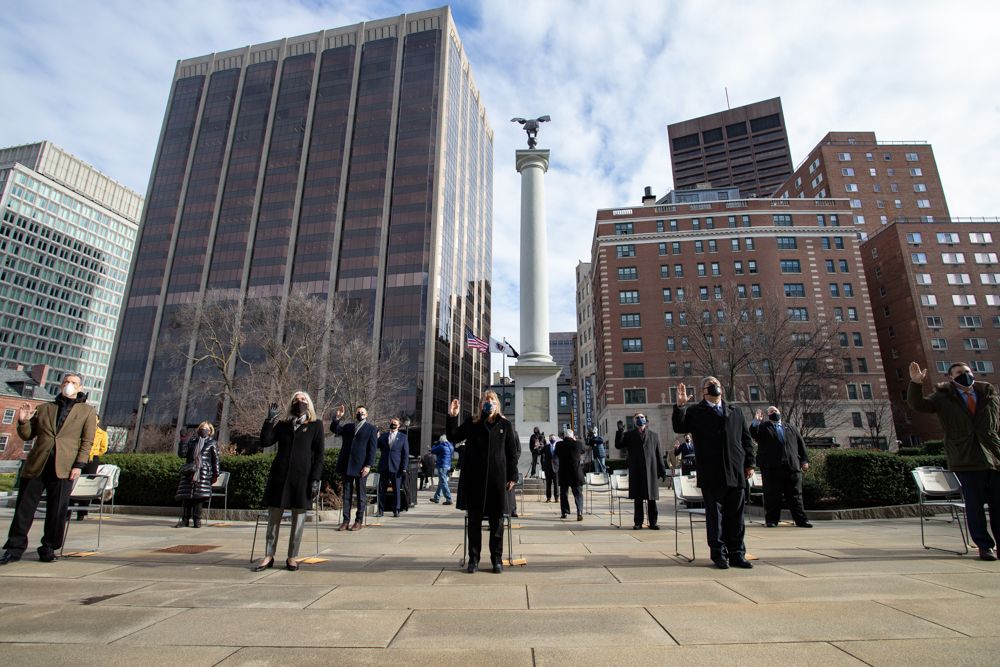
In another sign of the way COVID-19 has impacted major events over the past year, the Senate swore in a group of senators Wednesday in Ashburton Park outside the State House. [Sam Doran/SHNS]
The Legislature came to work Monday and passed the climate bill, set a special election date to replace former Speaker Robert DeLeo on March 30 and went home around dinner time to prepare for the last day of session.
It was always going to be a long night on Tuesday, with major economic development and transportation financing legislation still up in the air. But it’s unlikely anyone had 4:34 a.m. in their virtual office pool as the time the final gavel would fall.
Not even five extra months to finish their work could help lawmakers save themselves from the last-minute rush, and though they went home tired, they also went home having accomplished most of the big ticket items on their to-do list.
The House and Senate managed to send to Gov. Charlie Baker a $16.5 billion transportation bond bill that the governor said was needed to access federal funding and get ready for the spring construction season. They also agreed to a $626 million jobs bill full of grant and loan programs to help small businesses, restaurants, artists and other industries crushed by the pandemic.
The notable piece missing from the economic development bill was a House-backed plan to legalize sports betting in Massachusetts.
Gov. Baker supports the idea. He even filed his own bill this session. But Speaker Ron Mariano said he didn’t have a dance partner in the Senate, where leaders would not entertain the idea of tacking the gambling expansion onto the jobs bill, or debate it separately.
“If we could, we’d have a deal,” Mariano told Bloomberg radio Tuesday evening. Mariano said he wants to come back to the issue early this year.
By the time everyone’s head hit the pillow, the Legislature had also passed campus sexual assault prevention and craft beer distribution bills, approved of a commission to examine changing the state seal and sent Baker a bill intended to reduce racial inequities in maternal health.
The one piece that pulled up lame before it got to the finish line was a cap on unemployment insurance rate increases in 2021, but there’s still time for the Legislature to do that before first quarter bills come due. In fact, it might just give the new Legislature something to vote on to start the new session.
The hardest thing to do Wednesday should have been getting out of bed. But on a day when new and returning lawmakers took their oaths to start a new session on Beacon Hill and Senate President Karen Spilka and Mariano were reelected to their leadership posts, riots stoked by the president of the United States on Twitter erupted on Capitol Hill.
A mob, fueled by unproven claims of election fraud repeated by the president and his allies, broke into the Capitol. They were intent on disrupting the certification by Congress of the Electoral College vote that would give President-elect Joe Biden the victory.
But Congress returned to work that night and certified the Electoral College vote at around 3:45 a.m.
The fact that Congress fulfilled its Constitutional obligation despite the chaos of the day was the one bright spot, according to Gov. Baker, who the next day said he was sickened by what he watched on TV.
Baker, a Republican, joined the chorus of Democrats, including every member of Congress from Massachusetts, in calling for Trump to be removed from office. No more waiting until Jan. 20 for President-elect Joe Biden to be inaugurated. Let Vice President Mike Pence oversee the transition, the governor said.
Trump’s future hangs in the balance, but as he prepares to leave Washington, Mayor Walsh is ready to move in.
People around City Hall and the mayor have been downplaying the Walsh-to-Washington speculation for weeks, insisting that the mayor was gearing up for reelection and maybe not even interested in a Biden administration post.
Maybe that’s exactly what people tell reporters to throw them off the scent. Or maybe they didn’t think it would happen, at the end of the day. But it did.
Biden officially introduced Walsh as his nominee for labor secretary on Friday, after joking a day earlier amid reports that Walsh had been chosen that he was still looking for an Irishman to round out his Cabinet.
Needless to say, Walsh’s decision to trade the Charles for the Potomac has completely upended the race for mayor. City Council President Kim Janey is now preparing to become the first Black woman mayor in the city’s history, and Councilors Michelle Wu and Andrea Campbell – who were already running for mayor – are preparing for company on the trail.
Janey will be watched closely for signals that she might get in the race, while Councilor Annissa Essaibi George is now taking a look. The off-cycle municipal election also means that State House denizens could have a free run at the seat if they want it, and the North End’s Aaron Michlewitz, who chaired the House Ways and Means Committee last session, is kicking the tires, according to sources.
Reports also suggest that the South End’s Rep. Jon Santiago and others are also thinking about it.
While it will take some time for the mayoral chess game to play out, COVID-19 is still here. Right now.
Gov. Baker this week announced that business restrictions put in place on Dec. 26, including 25 percent capacity limits in many businesses, would be extended at least two weeks until Jan. 24, and new pool testing would be made available to K-12 school students and personnel.
The administration is also ready to give hospitals facing capacity constraints leeway from nurse staffing-level mandates in ICUs to free up more beds. Hospitalizations are up 145 percent since Thanksgiving.
Vaccines already deployed in hospitals and nursing homes will become available to first responders beginning Monday, when another week begins.
But until then, in the words of Speaker Mariano, who was caught on a hot mic as he gaveled the first session of the 192nd General Court to a close, let’s “get the hell outta here.”
Managing a business website can feel like a second job. However, it’s more important than ever that your business has a digital presence that speaks directly to the problems your customers want to solve through your products and services. With the pandemic still slowing the pace of business for most of the country, now is the time to update your online presence.
Optimize Your Website for Mobile
Studies show that mobile is making up more and more of the online landscape, both in terms of web content and user searches. The most important statistic to know here is that 53% of mobile users will leave a website that doesn’t load within three seconds. When you are optimizing your website for mobile users, speed and usability are the most important. Content needs to adjust smoothly to smaller screens, and it needs to load quickly. You can increase loading speed through a number of steps, such as:
Changing the presentation of high-bandwidth content such as images and videos
Using a reliable web host
Choosing a suitable WordPress theme
Create a Google My Business Listing
If you’ve ever searched for a business and seen the helpful listing on the right side of the screen, that’s a Google My Business listing. By creating your own, you will make your website much more visible and easier to find for online shoppers. What’s more, they’ll also be able to find the most important information about your business in one place.
A Google My Business listing contains delivery/pickup options, hours, contact information, and all-important trust-building testimonials. It also gives you a set of tools to manage and monitor your online presence. It shouldn’t surprise you that most members of the Chamber have a Google My Business listing, and you should too.
Invest in Local Digital Advertising
Digital advertising can take various forms. Targeting social and search engines with pay-per-click (PPC) and search engine optimization (SEO) are increasingly important. These techniques are quite different from each other, but they each operate by targeting certain strings of keywords. By tailoring the keywords to local communities, your business will have an easier time reaching potential customers.
A PPC ad campaign works similarly to other types of advertising in that you pay a small fee for each click the ad delivers to your website. On the other hand, SEO might seem a bit more novel. By writing keyword-rich content that conforms to SEO guidelines, you’ll rank closer to the top spot in relevant Google searches. Web users rarely look beyond the first page, so a high search engine ranking is a powerful competitive advantage. You can learn and write SEO on your own but hiring a professional copywriter will be more convenient and effective.
Run a Business Social Media Account
Setting up an Instagram and Facebook account for your business can go a long way in building your brand. While Facebook has the greatest outreach, Instagram emphasizes visually engaging content and has far greater rates of response. While you should use both, one is likely to be a better fit for your business overall.
By boosting your visibility in search engines and maintaining a mobile-friendly web presence, your business will cope much better with the rigors of the COVID-era economy.
Stay tuned! The North Central Massachusetts Chamber of Commerce is launching a new podcast series this winter season. The podcast series will feature conversations from the Chamber’s ongoing live web chat series with community and business leaders, plus additional content that is relevant to our members and communities.
“We want to be seen as a resource for crucial information pertaining to our members and the communities of North Central Massachusetts,” said Roy Nascimento, President & CEO of the Chamber. “The way the public consumes information is constantly changing, and we are excited to utilize the skills of our team members to break into this medium.”
“We recognize that our members are often very busy, and while we wish they could attend every event we host, we know that isn’t always feasible,” said Kathleen Deal, Events & Programs Manager at the Chamber, “This will give members the flexibility to keep up to date with issues that impact them while juggling their day to day responsibilities.”
Kat Deal and Travis Condon, Public Affairs Manager at the Chamber and a former radio host, will produce the podcasts. For more information on the podcast and to listen to episodes, head to: Inside North Central Massachusetts Podcast
Applications for the 2021 scholarship program through the North Central Massachusetts Chamber Foundation will be accepted starting February 1, 2021. Students interested in applying for a scholarship through the Chamber’s Foundation should contact their high school guidance department to submit an application. Each year, the Chamber Foundation distributes approximately 25 scholarships to local high-achieving high school students in North Central Massachusetts. A limited number of applicants are submitted by each school in the Chamber’s service area each year and for consideration by a committee of Chamber members. Deadline for applications is Monday, March 1, 2021.
Since the establishment of its scholarship program, the North Central Massachusetts Chamber Foundation has awarded over a million dollars in scholarships. Many of these awards are made possible through contributions from members of the Chamber and proceeds from the Chamber’s Scholarship fundraiser. Scholarships endowed through the Chamber Foundation are often named in honor of prominent members of the North Central Massachusetts business community whose philanthropy and commitment to the community have helped shape North Central Massachusetts.
The Chamber’s Foundation is a 501 (c) 3 non-profit organization focused on assisting in the betterment of the region through charitable activities. Funds raised by the Foundation are utilized primarily for education/workforce development initiatives and charitable activities in North Central Massachusetts, including scholarships to eligible applicants pursuing education and grants to support economic and community development projects.
For more information on the North Central Massachusetts Chamber Foundation’s scholarship program or a list of the named scholarships, please visit northcentralmass.com or call 978.353.7600 ext. 225.
It’s that time of year when the Wachusett Mountain Ski Area in Princeton opens for the season. In fact, this year, Wachusett was the first mountain to open for skiing in the Northeast, a milestone Wachusett President Jeff Crowley attributes to his all-star snowmaking team.
Crowley, whose family operates the ski area, said he knows customers are extra excited to hit the slopes this year as recreational activities are limited due to the COVID-19 pandemic.
“It’s so rewarding to hear people thank you,’’ Crowley said. “They are so appreciative of the fact that we’re open. We went the extra mile to open early.’’
In a typical year, the property is more than a ski area hosting festivals, weddings, corporate events and more. And while the ski area may be going back to the basics this year by focusing on what it does best, the experience will undoubtedly be different.
“The ski business is not for the faint of heart — insurance, power, weather — and now you put the pandemic on top of that it’s that much more complicated,’’ Crowley said.
As an outdoor sport, Crowley knows there will be high demand for skiing and boarding this year. But they have to balance that demand with safety protocols to keep staff and customers safe.
Among the changes: new signage, capacity limits, booting up atvehicles, outside food service, base lodge use limits, and the addition of outdoor heaters and seating.
“It’s incumbent on all of us here, rangers, lift employees, ski patrol, to keep a watchful eye so everyone stays at a safe distance,’’ Crowley said. “People are just looking for recreation. The good thing is with our year of experience and our ability to deal with crowds, we feel confident.’’
Crowley said he and his brother, David, and sister, Carolyn, are carrying out the vision their father, Ralph Sr. had for the ski area. As kids, Crowley said his dad would take them skiing in northern New England, but it was a hike and not practical on a regular basis.
“He realized this is a jewel of Massachusetts,’’ he said. “His goal was to create high-quality recreation close to the metropolitan area.’’
Thanks to the advancement in grooming and snowmaking and investment in high-speed lifts, Wachusett now provides top-notch snow surface close to home.In fact, Wachusett ranked 9th in Ski magazine’s reader survey for Best Resorts in the East 2021.
In addition to providing a unique local ski and boarding experience, Crowley said his family’s passion and commitment to providing quality customer service, resonates with the public.
“The neat thing is that little Wachusett just cracked the top 10 ski areas in the East,’’ he said. “We were able to beat a lot of the big boys up north.’’
Wachusett Mountain Ski Area is located at 499 Mountain Road in Princeton. The ski area can be reached at 978.464.2300 and www.wachusett.com.
JAN. 6, 2021…..House and Senate Democrats forged a late-night compromise on a $16.5 billion transportation bond bill, salvaging consensus in the dying moments of the lawmaking session on a multi-year plan to pay for infrastructure improvements while also raising fees on ride-hailing services.
A final compromise between House and Senate leaders emerged shortly after midnight Wednesday after months of private negotiations, leaving members only a few hours to read the updated version of the 63-page bill (H 5248) before approving it 146-0 in the House and 39-1 in the Senate. Sen. Ryan Fattman, a Sutton Republican, cast the lone dissenting vote around 3:20 a.m.
The bill now on Gov. Charlie Baker’s desk authorizes billions of dollars in bonds for highway and bridge maintenance, train modernization, and major capital projects such as a Red Line-Blue Line Connector, the extension of commuter rail service to the South Coast, and the approaches to the two Cape Cod bridges.
In a surprise move, the bill calls for increases to the flat per-ride fees charged on app-based services such as Uber and Lyft, a measure the branches addressed in separate legislation but not in either versions of their bond bills.
Another measure requires the MBTA to implement a low-income fare program, which has long been a priority of transit advocates, and those who fail to pay T fares would no longer be subject to arrest.
“The COVID-19 pandemic has created really unprecedented changes to the ways we commute, but this does not mean the ills of our transportation system do not persist,” said Sen. Joseph Boncore, who co-chairs the Transportation Committee and led the Senate’s negotiations. “Massachusetts needs a new deal on transportation, but included in this bill is a strong foundation to continue that conversation.”
With their late-night vote, legislators punctuated the end of the 2020-2021 session by returning to a topic that had dominated debate on Beacon Hill early last year. Still virtually untouched, though, is a related package of tax and fee increases that cleared the House in the spring but died in the Senate without a vote.
Baker filed his original $18 billion transportation bond proposal in July 2019. Governors tend to seek the borrowing authorizations in multi-year increments, and Baker cautioned Monday that the long delay from lawmakers imperiled the upcoming construction season.
“We literally are almost out of transportation bond authority, and we need that bill for the spring construction and summer construction season, and we also need it to sign multi-year agreements that involve federal reimbursement,” Baker said. “You have to actually demonstrate to the feds that you have the authorization to pay for a federally supported project, which in many cases take a couple of years to actually have the feds sign off and say, ‘yes, you can spend the money.'”
Several provisions Baker sought in his first draft of the bill did not make it into the version on his desk, such as a tax credit for employers who encourage working from home.
The bill lands in a vastly different climate than when Baker first proposed it. Commuting patterns evolved significantly during the pandemic, with ridership on public transit cratering — and a massive budget headache erupting at the T as a result — and some employers indicating they may keep remote work options in place for the foreseeable future.
The House approved its $18 billion bond bill in March, one day after it authorized a package of tax and fee increases — including the first state gas tax increase in seven years — that Democratic leaders said could raise as much as $600 million annually to invest in crumbling infrastructure and aging public transit.
In the Senate, however, the revenue bill faltered without a vote as lawmakers bristled at the idea of hiking taxes during a pandemic-fueled recession, frustrating House leaders who felt they had taken a tough vote.
One major element from the House’s tax package, ride-hailing fee increases, made it into the borrowing bill.
Under the compromise bond bill, the assessments charged for trips on platforms such as Uber and Lyft would increase from $0.20 per ride of any type to $0.40 per shared ride, $1.20 per non-shared ride, and $2.20 per non-shared ride in a luxury vehicle.
Boncore said on the Senate floor that the increases are intended to “change commuter behavior by incentivizing commuters to request a shared ride for a lower fee or use public transit.”
Negotiators spliced that language into the compromise even though neither underlying bond bill tackled transportation network company, or TNC, fees. The House included similar increases in its tax bill, while the Senate adopted an amendment containing a new fee structure to its version of the fiscal year 2021 budget.
Baker previously suggested raising the fees on the companies to $1 per ride, warning that their growing presence on Massachusetts roadways contributed to worsening traffic. It is not clear if he will view the Legislature’s proposed hikes, which are likely to generate pushback from the companies, as excessive.
The bill would create a commission to study congestion pricing, a strategy that would alter tolls at different times to incentivize off-peak travel, and it would create violations for drivers who park their vehicles in designated bus lanes.
Several other notable provisions approved in either the House or Senate bills did not make it into the final compromise, including authorization for cities and towns to pursue their own revenue-raising regional ballot initiatives and “value capture” models to collect funds from real estate development near highways or transit.
Unlike the original House bill, which called for adding two members to the MBTA Fiscal and Management Control Board, the conference committee’s proposal does not expand the T’s oversight panel.
Baker now has 10 days to decide the bill’s fate, which, in a reflection of the pandemic’s unprecedented upheaval, will play out entirely during the brand-new lawmaking session that begins Wednesday.
John Pourbaix, executive director of the Construction Industries of Massachusetts group, said the bill’s success will help keep workers who might have faced steep cuts afloat.
“Passage of this bill allows MassDOT and the MBTA to continue procuring the vast list of capital projects which will preserve thousands of jobs for the hard working men and women in the transportation construction industry and, in turn, will help the state’s economic recovery and improve public safety,” Pourbaix said.