The measures outlined below with go into effect at 12:01 a.m. on Sunday, December 13. The entire Commonwealth will move to Phase 3, Step 1 of the Reopening Plan. In addition, the following updates to capacity limits will go into effect:
Outdoor gatherings at event venues and public spaces to 50 people
Outdoor Theaters and Performance Venues to 25% and no more than 50 people
Close Indoor Theaters and Performance Venues and a few smaller indoor recreation businesses like roller rinks and trampoline parks
Reduce capacity from 50% to 40% for several industry sectors noted below:
Arcades/Indoor and Outdoor Recreational Businesses
Driving and Flight Schools
Gyms/Health Clubs
Libraries
Museums
Retail
Offices
Places of Worship
Lodging (common areas)
Golf
Movie theaters (no more than 50 people per theater)
Restaurants and Event Venues Protocols Updates
The following updates will be made to restaurant and event venue protocols with regard to face coverings, seating, and performances:
Wear masks at all times except when eating and drinking
Seat no more than six per table and encourage customers to only dine with same household
Put a 90-minute time limit on tables
Prohibit all musical performances at restaurants
Close food court seating
Workplaces and Fitness Centers Protocols Updates
The following updates will be made to the Office Spaces and Fitness Centers protocols with regard to face coverings:
Require mask wearing in offices when not in your own workspace and alone
Require mask wearing at all times in gyms
Encourage teleworking
All updates to sector specific guidance can be found on www.mass.gov/reopening later this week.
Article Source: State House News Service
Article By: Matt Murphy
The First One Can Be the Hardest
DEC. 4, 2020…..The lame duck logjam broke open this week, and from it spilled the possibility that compromise, in these blustery days of December, might be at least a fraction as contagious as COVID-19.
With daily cases of the deadly coronavirus reaching new heights and hospital beds getting filled at a troubling pace, the Legislature began to showcase why it was, exactly, that they voted back in July to ignore decades of precedent and extend its session by not one or two but more than five months.
The first domino to fall was perhaps the hardest to tip over, despite all the wind at its back in July. As real gusts whipped up and down the coast on Monday, House and Senate Democrats struck a deal to reform how police in Massachusetts must conduct themselves on the job, and how the police will be policed moving forward.
The compromise bill, sparked by the death of George Floyd and the ensuing protests over police violence against Black people, would create a new Peace Officer Standards and Training Commission to certify all law enforcement in Massachusetts, and to decertify police that violate their duty to serve and protect.
The bill would limit the use of chokeholds and no-knock warrants, and strip police officers of their qualified immunity protection from civil lawsuits if their certification gets revoked for misconduct.
But this bill was no slam dunk with lawmakers, and Gov. Charlie Baker remains a powerful wildcard. Not a single Republican backed the policing reform bill, and Speaker Robert DeLeo could not whip a veto-proof majority, with the 92-67 vote in the House a nailbiter by Beacon Hill standards.
The margins put Baker in the unusual position of actually having considerable leverage as he weighs how to approach the issue over the coming days and weeks. On the one hand, Baker wants a new POST Commission with the authority to certify and decertify police, and legislative leaders know that.
But because of the complexity of the legislation and its attempts to take on issues like qualified immunity, Democratic leaders may be forced to negotiate amendments with the governor unless they’re willing to risk a veto that would push off action to next year.
The annual state budget is a different breed of bill, and was the second box to get checked this week.
Unlike the more than four months it took to negotiate a compromise policing bill, it took almost a month to the day for the House and Senate to move the fiscal 2021 from a House Ways and Means draft, released two days after the election, to a final budget on its way to the governor’s desk.
Of course, that budget is still five months late by non-pandemic standards. But who’s counting anymore, except maybe the bond rating agencies.
The final budget now in Baker’s hands for review proposes to spend more than $46.2 billion in a year during which lawmakers have been girding for the financial worst, but not yet seeing it. Revenues continue to outperform 2019 in spite of the pandemic, and rather than make real tough choices about where to spend, the conference committee simply upped its draw on reserves by $200 million to $1.7 billion, using about 48 percent of the “rainy day” account.
How that will be received by Baker, who recommended using considerably less in reserves, remains to be seen, as does his reaction to a controversial expansion of abortion access that would make abortions after 24 weeks legal in cases of diagnosed fatal fetal anomalies.
Other policy changes included in the budget include an acceleration of sales tax collections opposed by retailers and other small businesses and the authorized use of ignition interlock devices for first-time drunk driving offenders.
But along with developments on the legislative front, there was also “light at the end of the tunnel” in the fight against COVID-19 as Gov. Baker said he expects the first doses of the Pfizer vaccine to begin arriving in Massachusetts by mid-December.
The state expects 300,000 doses to arrive by the end of the year, with health care workers, residents of long-term care facilities and seniors or those with underlying health conditions expected to be among the first to get access.
The full plan for vaccine distribution is expected to be detailed by the administration next week after it was submitted to the Centers for Disease Control this week for review, but Baker said it could be April before the general public can start rolling up their sleeves for the shot.
“It would probably be Q2 before just Joe Q or Jane Q Citizen would have access to a vaccine,” Baker said.
But the vaccine can’t arrive fast enough. The second surge is worsening, and there are signs that the fears harbored by public health officials over Thanksgiving travel and gatherings may be coming to life.
Boston Mayor Marty Walsh had thought the infection rate in his city might be trending in the right direction until early this week when the data began to point to a surge within the surge.
“It could be the first signs of what the Thanksgiving holiday brought,” Walsh said Tuesday, detailing how Boston had clocked 407 new cases on the day, or more than twice the daily average.
Statewide records would also continue to fall throughout the week, with Thursday’s 6,477 new reported cases the most of any time during the pandemic, and statewide hospital capacity dipping below 25 percent. Baker went to Worcester to mark the readiness of the first field hospital to open since the spring at the DCU Center, and said another one is being prepped for Lowell. The state is also thinking about how to fortify outdoor testing sites against a New England winter.
But despite the gathering storm, Baker dismissed as “rumor mongering” another statewide lockdown and he said at this point he has no plans for further restrictions or forced business closures.
In fact, the Cannabis Control Commission greenlighted a completely new business this week – recreational marijuana home delivery. The CCC risked a lawsuit by saying yes to two new types of licenses for either dispensaries to deliver their product, or for independent business owners to buy direct from wholesalers and venture out on their own.
The one service that likely won’t be able to escape shutdowns is public transit.
The MassINC Polling Institute released the findings of a new poll Thursday showing, unsurprisingly, that people don’t like the idea of drastic service reductions to balance the transit agency’s books.
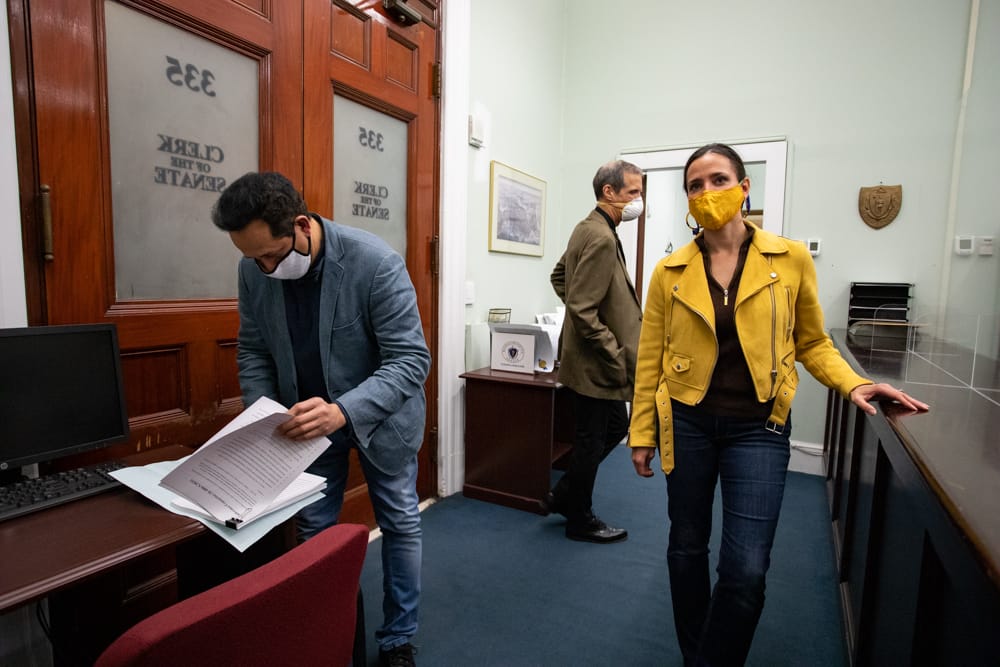
Rep. Carlos Gonzalez reviewed the official copy of the compromise policing reform bill, joined by fellow conferees Sen. Will Brownsberger and Sen. Sonia Chang-Diaz, before filing the legislation in the Senate clerk’s office Monday afternoon. [Sam Doran/SHNS]
The survey also found people don’t believe the T will ever restore the cuts if and when its finances improve. Well, that got under the skin of the Baker administration, which criticized the pollster for not asking people how they would propose to pay for transit that’s not being used, and insisted the cuts were temporary.
But the 66 percent of people saying the state should just tap its budget for more money weren’t alone in thinking the MBTA should reconsider its plan. The MBTA Advisory Board said the agency was being unnecessarily cautious in its budget projections for next year, and could eliminate the need for widespread service cuts with just a little positive thinking.
The advisory board’s own budget analysis suggested the financial hole facing the T could be 20 percent smaller than the worst-case scenario being planned for, negating the need to end weekend commuter rail service or cut 25 bus routes and all ferry services.
“The Advisory Board’s view is that risk of permanent loss of ridership, increased congestion, and other negative effects of service cuts to people and communities is too high a price to pay right now, just as a vaccine is on the horizon,” the board wrote.
MBTA officials, however, are forging ahead with their plan and a vote on Dec. 14, and alternatives don’t seem to be in their line of vision.
“The vast majority of MBTA service will continue, the proposed service changes are not permanent, and the MBTA will periodically realign service as feasible to match current and future ridership patterns when durable revenue is available for pay for such service,” MBTA General Manager Steve Poftak said in a statement.
If your website analytics have been stagnant for a while, you may be wondering what you can do to boost your traffic. Is it time to give your website a new look? We believe in supporting local businesses, so we’ve put some thought into the matter. Take a look at 3 tips for determining whether it’s time to update the look of your site.
Update When Customers Show Signs of Disinterest
Take a look at your bounce rate — That’s the metric that measures how many people visit your site but leave without making any purchase. Maybe your site looks tired or is hard to navigate, and that’s causing potential customers to bounce away from it. Pay special attention to complaints from customers, whether by email, phone or on your social media platforms, that your site is less than functional or that it looks out of date.
Update When You Feel the Heat From Your Competitors
Updating your website is a signal to your customers that you’re staying on the cutting edge of your field. If you’re in a heated competition for customers, the look of your website can send a message that you’re the company they want to deal with. Imagine visiting a site that has outdated content, no new news, and a tired look. Wouldn’t you click and go elsewhere? Don’t give your customers a chance to do that.
Update to Go Mobile
Increasingly, customers are accessing the internet via their mobile devices, and they may become frustrated if your website is hard to navigate because it hasn’t been optimized for mobile. If so, you need to add responsive design to your site, or adjust your current responsive design so it pairs with current technology. Depending on how your site is coded, you may need a full redesign, rather than just giving the existing material a fresh appearance.
We encourage you to keep your website active and up-to-date so that customers throughout our community can direct their business your way.
Three new apple trees were planted this Fall at the Johnny Appleseed Visitors Center on Route 2 in Lancaster! Special thanks to MassDOT for providing the new trees to replace ones damaged earlier this year.
The Johnny Appleseed Visitors Center, considered by many the gateway to North Central Massachusetts, opened in 1997 as a way to welcome people traveling through the region and give them a place to stop, stretch their legs, and learn more about the twenty-seven communities of North Central Massachusetts. The center has an impressive collection of unique items that showcase the region, including 91 apple trees on its premises to highlight the region’s strong agricultural heritage and connection to apples. The center has been highlighted in the media, including WCVB’s Chronicle and the BBC.
The Johnny Appleseed Visitors Center is open every day from 9am-5pm and also features a popular gift shop that carries many local products including jams, jellies, honey, maple syrup, fudge, chocolates, cheese, sparkling cider, donuts and that local icon of American kitsch – the pink plastic flamingo! Visitors to the center can also find a wide selection of books highlighting the history of the region, plus good-quality logo merchandise and souvenir items.
This year has placed unimaginable challenges on the North Central Massachusetts small business community. The COVID-19 pandemic created an unprecedented wave of disruption to our local economy which many are predicting will permanently alter how we make things, buy things and even where we work. The Chamber has always been a strong advocate for buying local and other initiatives that help to strengthen our local communities and contribute to the economic sustainability of the region. Our efforts to support local businesses take on a new significance this year, and we know that shopping local is going to be more important than ever before this holiday season. The small businesses that help define our local communities continue to face hardships as the pandemic goes on, and it threatens to exacerbate the trend towards online shopping and consolidation among many of these industries. However, there could also be opportunities for our local businesses and the regional economy as supply chain disruptions exposed by the pandemic may encourage consumers and businesses to look to local suppliers and local businesses to help them fulfill their needs.
Since the pandemic began, the Chamber has been focused on providing guidance, resources and a support system to help businesses get through the crisis. Recognizing the importance, the Chamber has developed several marketing campaigns to support small businesses and encourage consumers to shop, eat and visit locally. We have developed new locally focused content, new messaging and we are utilizing digital and social media channels to promote, connect and engage with consumers.The Chamber has also been utilizing its “Gift Local” gift card initiative to encourage shopping local. With nearly 50 businesses currently participating, consumers are given a choice when deciding on where and how they want to spend their money.
“Our restaurants, hotels and local retailers are among the hardest hit by the pandemic. These businesses are finding innovative ways to adapt, transform and survive,” said Roy M. Nascimento, President & CEO of the North Central Massachusetts Chamber of Commerce. “We want to encourage people to support local businesses whenever they can. These business owners are working hard to keep their doors open, create jobs, and fill needs in our community and deserve our support”
The state has also stepped up with a new awareness campaign entitled “My Local MA” to encourage consumers to support local businesses. The Chamber has embraced the effort and is supporting the campaign.
“The My Local MA campaign reminds Massachusetts residents that where they shop, dine and travel matters,” said Keiko Matsudo Orrall, executive director of the Massachusetts Office of Travel and Tourism. “Supporting My Local MA strengthens community pride and helps keep our economy running. Spending locally keeps people employed and keeps Main Streets and small businesses thriving in our 351 cities and towns. We want people to stay safe and put their money where their heart is — right here in Massachusetts.”
Why is this important? A recent survey conducted by the Chamber shows that 64% of the small businesses reported losses when compared to 2019, with nearly 27% reporting losses of 50% or more. Nearly 60% also reported that they expect it will be more than six months before their operations return to normal. Twenty-five percent of respondents also estimated they could stay operational on current cash flow and reserves for just six months or less.The survey also showed that marketing to reach their customers was the most requested resource when asked what resources, beyond financial assistance, would be most helpful.
It’s no secret that local small businesses have a tremendous impact on our local economy. When you buy goods and services from local businesses and merchants, the money you spend stays in our communities.National research shows that for every $100 spent at a locally owned business, $48 stays in our cities and towns.That’s compared to only $14 of $100 that is spent at a chain and just $1 when spent at large e-commerce retailers.Those dollars support the essential services that we all rely on, including police, fire, schools, streets and more.
Local and independent small businesses are also more likely to give back to the community, create more jobs and opportunities, and support other area small businesses. They are often the first to step up when teams need sponsors and fundraisers need venues or goods.Small businesses also work hard to keep your trust each and every day, providing unparalleled products and services.All of this helps to strengthen our communities and contributes to our quality of life.
With the holiday season before us, there is no doubt that consumers are all thinking about shopping and the gifts they want to buy for the people in their lives. With busy schedules and the pandemic, it’s easy to consider turning to the internet to get shopping done. But that type of shopping has consequences on the local community. This winter is expected to be a difficult one for many small businesses, the Chamber will be encouraging everyone to consider local businesses when making their buying decision. Not only does this support local businesses, but it has profound rewards for the community.
How to Grow When It’s Slow: Increase Productivity Right Now
“Imagine –” suggests business expert Cameron Herold, “If you train your employees on interviewing, train them on effective meetings, train them on an email management, train them on time management, or if you could really work on skill development right now – you can come out of this stronger.”
Cameron Herold is a top business consultant, best-selling author, and speaker. We caught up with him via a recent podcast interview he did for Real Estate Rockstars Radio. He’s the mastermind behind hundreds of companies’ exponential growth and teaches today’s most dynamic business leaders.
Periods of slow growth come with great challenges both for businesses and consumers. However, you can take advantage of such times to improve efficiency and increase productivity. Cameron has some great advice for business owners in his interview, and we put together some recommendations inspired by Cameron.
Clean up your business systems – and your work space
Most businesses will focus only on sales and marketing to survive hard times. You can also use this time to work on your standard operating procedure to ensure it meets your current and future needs. Slow growth periods are ideal times to purge and clean your warehouse, offices, desks, filing systems, and other important areas of the business. Cleaning the workplace will go a long way in creating a better work environment and improving efficiency.
Training and skills development
Considering the busy schedules that characterize modern workplaces, employers have little or no time to train their employees. When it is slow, you can use this time for training and skills development. Train employees in critical areas like interviewing, effective meetings, time management, and email management. Skills development will also help to address weaknesses and strengthen skills, allowing you to bring employees to a level where they can work without constant help and supervision. In a nutshell, training and skills development will contribute to improved employee performance.
Take advantage of technology
Periods of slow growth can allow businesses to make the most of existing and new technology. As more employees work and communicate remotely, they will save significant commuting time and be less distracted when handling projects. Businesses can maximize technology to increase productivity by setting up efficient communication channels and empowering all employees to work remotely. Teleconferencing and working from home are quickly becoming the new normal, a factor that could affect the organizational structure of many companies.
Explore alternative work sites
Changes such as teleconferencing and working remotely will have a significant impact on office leasing. There will be cases where staff members are unable to make it to the corporate office, and working from home is not an option. This situation may force businesses to identify alternative working sites such as sterilized co-working spaces. Choosing a great facility will allow you to carry on with your activities despite the disruption caused by issues such as infectious epidemics. Employees can remain productive in emergency situations.
Proactive employee support
When your employees work remotely, your physical office will be set-up into numerous virtual offices. Maintaining proper communication between managers and employees will require that you give your staff the necessary support. Through observations and conversations, you will be able to identify and understand any signs of agony. These include low morale, low work productivity, and anxiety relating to the slow-growth period. Addressing employee concerns will help in increasing productivity to ensure your business survives the tough times.
For information about how to become a better business owner or operator, check out the Second In Command Podcast at CameronHerold.com/podcast.
And stay tuned for the next article in the 6-part series How to Grow When It’s Slow on the topic of building culture in a remote working environment.
Since the pandemic started, the North Central Massachusetts Chamber of Commerce has been focused on providing strong leadership and as much assistance as possible to help local businesses and our communities weather this crisis.
The Chamber believes that economic recovery must start locally. Therefore, we are encouraging the public and business leaders to shop, eat, visit and support local small businesses whenever possible. Our small businesses are crucial to our economy and the fabric of our communities. The public’s generosity and support of our local small businesses will not only directly help the employees at these locations, but also indirectly help our local economy continue until this crisis has passed.
The Chamber’s Gift Local gift card is one great way to help local small businesses who are among the most impacted by the COVID-19 pandemic. The Gift Local gift card works just like a traditional gift card, except that it is tailored to be redeemable at participating restaurants and merchants in North Central Massachusetts. The Gift Local gift card is an effort by the Chamber to encourage consumers to shop local and help keep local dollars circulating in the region.
Gift Local gift cards can be purchased at the Chamber office, at the Johnny Appleseed Visitor Center in Lancaster or by phone or email by contacting the Chamber. Click here for a flyer with details on the Gift Local gift cards or here for an order form.
We truly hope that you will consider it as an option for this holiday season. Due to the current pandemic and to encourage support of local businesses, we have waived the purchase fee for buyers and all fees for participating merchants. 100% of the proceeds go to support small businesses. You can also find more information on Gift Local gift cards and their redeemable locations at www.NorthCentralMass.com or www.GiftLocal.net.
Please feel free to contact the Chamber with any questions.
Happy Thanksgiving from all of us here at the North Central Massachusetts Chamber of Commerce, Visit North Central Massachusetts & North Central Massachusetts Development Corporation!
The North Central Massachusetts Chamber of Commerce will be closed for the holiday and reopening on Monday, November 30, 2020 for our normal office hours.
Storytelling is a major buzzword in the marketing industry these days, and it is an aspect of promoting your business that you cannot afford to ignore. Rather than focusing your marketing efforts on promoting your products or services, the new business model requires telling the story of your brand to help your customers feel connected to and engaged with your business. Follow these tips to do it right.
Stay True to Your Core
When coming up with your “brand story,” it is important to stay true to the foundation of your business. For example, if your company manufactures reusable water bottles, you wouldn’t want your brand to be associated with anything that is disposable in nature. Instead, you would want to tell a story that coincides with sustainable values. Viewers these days are becoming more and more discerning in terms of the brands they choose to patronize, and they will immediately identify anything disingenuous.
Tug at the Heartstrings
Emotions are incredibly powerful when it comes to influencing consumer behavior, and your brand can use this fact to its advantage. People love seeing stories of triumph over adversity, personal growth and achievement, and giving back to the community, so try to incorporate these or similar storylines into your brand storytelling. Of course, any content you produce should still align with your company goals at the same time as telling your story.
Generate Excitement
The primary goal of brand storytelling is to get prospective customers excited about your brand. Whether you do this through associating with popular local events or by offering frequent promotions and discounts, the goal is to keep your customer base interested in your offerings and excited about buying from your company rather than your competitors. Aim for a high energy level in your marketing materials and branded content online so that your customers are excited to share your content with their friends and followers, helping to expand your reach even further.
Tie in Your Company’s Offerings
At the end of the day, the ultimate purpose of brand storytelling is to attract new customers, and you can’t accomplish this without letting people know what your company has to offer. With any content you create, whether it be blog posts, social media posts, advertisements or videos, there should almost always be an element that speaks specifically to your company’s products or services. Without this critical aspect, your audience won’t know why your brand is sharing its story. You need to help them make the connection between the story and your offerings.
Overall, brand storytelling is about more than just selling products; it is about helping your customers to feel more connected to your business, increasing the likelihood that they will continue to buy your products or services in the future. Keep this end goal in mind at all times to help guide you in creating your brand story. With a bit of creativity and effort, you’ll draw in customers and establish dedicated brand loyalty, setting your business up for ongoing success in the future.
These three words are always something kept in mind with the team members at Enterprise Bank. There are approximately 555 employees at the bank, who are purpose-driven, and care for their families and customers, catering to small and large businesses.
“I get excited when I come to work,” said Tracy Lafleur, Branch Relationship Manager and Vice President at Enterprise Bank in Fitchburg, MA. “When a customer calls, we pick up the phone and they’re speaking to an actual person; we feel valued by that as well.”
The bank’s website says, “In the late 1980s, Massachusetts faced a severe economic downturn. As George Duncan watched his city struggle, he joined other visionaries to help influence the recovery. Together, they imagined a new kind of independent, innovative bank – one that would value the entrepreneurial spirit and stimulate the economy by helping to create new businesses, meaningful jobs, vibrant communities, and a dynamic work environment for employees. This vision became Enterprise Bank.”
Enterprise Bank was started about 32 years ago in Lowell, MA in 1989 and mushroomed out from there, currently with 25 branches in operation. In 1995, the Leominster branch was the fourth branch to open, and Fitchburg branch was opened 16 years ago.
“We continue to stay rooted in values, caring, and trust and relationship, all rooted in the culture that has made us successful. We continue to grow through technology and evolve to meet customers’ needs,” said Jack Clancy, CEO of Enterprise Bank.
While preparing for the “new normal,” Enterprise Bank has helped local businesses and customers through the COVID-19 pandemic through over 2,800 PPP loans, which accounts for approximately $510 million in PPP loans.
“We reached out proactively and became one of the top PPP lenders in the country,” said Clancy, “which goes back to our dedicated team members having so much passion and caring. It’s been a monumental effort on their part since April.”
Internally, Clancy and Lafleur both prioritized not only providing PPP loans, but also protecting the safety of their team members and customers.
“We had a pandemic preparedness plan in place long before COVID,” said Clancy. “At first, we thought we were wasting our time with it, but it really helped us. People are starving for human relationships, and we devote every resource possible to make sure we have the right protocol and precautions, but also increasing digital usage and making sure that we are progressive.”
On the branch side, Lafleur said that the team members are constantly receiving updates and being informed on everything going on if there are any changes.
“[Enterprise Bank] helped a lot of small and big businesses, and we are able to get them through keeping their businesses,” said Lafleur. “We have people thanking us up and down, because our team members took extra calls and were working hard. Just the feeling of helping customers save their businesses is amazing.”
In fact, Lafleur has been a chamber ambassador for about two years, and loves being able to go out to visit chamber members.
“The [North Central Massachusetts Chamber of Commerce] cares and is very easy and outgoing,” she said. “The networking is great and you meet at a lot people, just like here at Enterprise Bank.”
The Enterprise Bank Fitchburg branch is located at 420 John Fitch Highway, and has a family atmosphere where everyone is welcomed and treated like family. Find out more information about the entrepreneurial bank at www.enterprisebanking.com.