E-Newsletter
An Electronic Publication of the North Central Massachusetts Chamber of Commerce

Inside this edition, you’ll discover the latest Chamber initiatives and success stories from across our region. From economic development projects and upcoming networking events to policy updates and workforce training opportunities, we’re keeping you connected to what matters most for your business and North Central Massachusetts.
The North Central Massachusetts Chamber of Commerce is here to help – with trusted resources, a strong business network, and a support system to keep your business and the region moving forward
New program directs $50 million toward businesses reaching underserved markets, minority-, women-, and veteran-owned businesses, and $25 million for businesses that did not qualify for prior MGCC aid
Today, the Baker-Polito Administration announced the launch of a new $75 million grant program to support Massachusetts small businesses impacted by the COVID-19 pandemic. The new program is part of the plan to spend $4 billion in American Rescue Plan funding that was signed into law by Governor Charlie Baker in December 2021. The new program is modeled after Massachusetts Growth Capital Corporation’s (MGCC) successful COVID-19 small business relief program. Under that effort, which became the biggest state-sponsored business relief program in the nation, MGCC oversaw the distribution of approximately $705 million to over 15,000 small businesses across Massachusetts. Today’s announcement was made at Luanda Restaurant and Lounge in Brockton, a family-owned business that received financial support through MGCC’s prior COVID relief grant program.
“We have been proud to support small businesses in every corner of the Commonwealth through the MGCC small business program during the pandemic, but we know that some challenges remain for many businesses,” said Governor Charlie Baker. “With the launch of this new effort, we can build on MGCC’s successful work and direct important federal funding to those businesses with the greatest need quickly and effectively.”
“Restaurants like Luanda are fundamental to the character of our neighborhoods, main streets and downtowns in every city and town in Massachusetts,” said Lt. Governor Karyn Polito. “This new initiative will ensure that businesses that need help the most will be able to take advantage of additional opportunities.”
The $75 million will be focused on small businesses that employ between two and 50 people, with $25 million directed toward businesses that did not qualify for previous MGCC grants because of a lack of revenue loss in 2020; and $50 million directed to businesses that reach underserved markets and historically underrepresented groups, or are minority-, women-, or veteran-owned businesses, or are owned by individuals with disabilities or who identify as a member of the LGBTQ+ community.
Under both categories, grants will range from $10,000 to $75,000, and will be capped at the lesser of $75,000 or three months of operating expenses. Grant funding can be used for employee and benefit costs, mortgage interest, rent, utilities, and interest on debt.
“The challenges faced by Massachusetts’ small businesses during COVID have been enormous, but in my district and across the state I have seen so many entrepreneurs and innovators respond with incredible perseverance and grace. Small businesses are the backbone of our economy, and they deserve our support,” said Senate President Karen E. Spilka. “Today’s grants represent a choice by the Legislature to center small businesses in our effort for an equitable recovery. I am grateful to the Massachusetts Growth Capital Corporation for their work to distribute these funds to so many deserving businesses and I am thankful to all of the small businesses who have done so much for Massachusetts.”
“I am pleased to hear that the small business grant program, created through the Legislature’s ARPA bill, is now accepting applications, and will soon be distributing these funds to our small businesses,” said Speaker of the House Ronald J. Mariano. “Delivering on the Legislature’s intent to pass a bill truly focused on equity, a significant portion of the funds from the small business program will specifically target minority-owned, women-owned, and veteran-owned small businesses, as well as small businesses that didn’t receive previous grants during the pandemic. Small businesses are oftentimes the backbone of our communities and local economies, and I look forward to seeing these investments remain a priority for the House of Representatives moving forward.”
“When help was needed the most during the pandemic, the Massachusetts Growth Capital Corporation scaled up a nation-leading program to support our small businesses and the families and entrepreneurs behind them,” said Housing and Economic Development Secretary Mike Kennealy. “I’m grateful to the MGCC team for once again stepping up to direct vital funding to the neighborhoods and communities that continue to face challenges created by this unprecedented public health crisis.”
“MGCC is pleased to be an instrument of recovery for the smallest of businesses throughout Massachusetts most affected by COVID-19 with these two new grants programs,” said Lawrence Andrews, CEO and President of MGCC. “The Baker-Polito Administration and the Legislature recognize that certain communities have been disproportionately impacted by the pandemic, and the goal of this funding will bring relief and stability to additional businesses throughout the Commonwealth.”
In addition to prioritizing applications from businesses that did not qualify for prior aid and businesses owned by individuals from historically underserved populations or operate in underserved markets, eligible businesses must currently be in operation and based in Massachusetts. Applicants must also demonstrate that business revenues for 2020 were between $40,000 and $2.5 million.
Learn more at EmpoweringSmallBusiness.org.
State House News Service
Author: Chris Lisinski
Massachusetts will steer another $101 million toward its COVID-19 response under a spending bill Gov. Charlie Baker signed over the weekend that also shifts the statewide primary election date up to Sept. 6.
Baker on Saturday approved all of the spending on COVID-19 emergency paid sick leave, rapid tests, high-quality masks and vaccine access that lawmakers included in the supplemental budget (H 4430). He vetoed two outside policy sections and returned another two, including an attempt by the Legislature to codify a vaccine equity plan, with amendments.
The new law calls for $76 million in direct state spending aimed at boosting access to masks, COVID-19 vaccines and rapid tests, particularly for schools, congregate care facilities and homeless shelters. It also allots another $25 million in available federal funds to the state’s COVID emergency paid sick leave program.
Baker struck down two outside sections that he said together would have required the state Department of Public Health to “issue and post guidance on mask usage and testing, quarantining, and isolation periods related to COVID-19 within 30 days.”
The department already works to publish up-to-date guidance, Baker said, arguing the additional language in the bill would “serve no purpose if signed into law.”
One section Baker returned to lawmakers with an amendment called for the secretary of health and human services to craft and implement a COVID-19 vaccination equity plan with a goal of eliminating disparities in vaccination rates within 120 days.
Baker’s amendment strikes the 120-day target, a change that he said would “reflect the continuing challenge faced by nearly every country in the world and every state in the country of achieving total vaccine equity.”
The Republican governor defended his administration’s work to make vaccines are available and accessible across Massachusetts, recounting steps the administration took such as prioritizing 20 hard-hit cities and towns — in which 12 have rates of residents with one vaccine dose above the national average, according to Baker — and steering additional funding to community organizations.
“Our administration is committed to continuing our efforts to reduce disparities in vaccination rates in Massachusetts,” Baker wrote. “But the challenge of eliminating disparities in vaccination rates altogether is a project that will require us all to work beyond the 120 day deadline envisioned by the language of this section.”
Baker added that he plans to comply with other language in the bill requiring the administration to file a vaccination equity plan within 30 days and regular progress reports every 60 days.
The other amendment Baker offered deals with public employees who come out of retirement to resume working for their former employer. Lawmakers proposed extending a pandemic-era waiver on earnings and hours caps for those workers through the rest of the year, and Baker instead suggested linking the extension to the public health emergency so it is “tied to a specific time period where a heightened response may be necessary.”
Lawmakers can choose to override Baker’s vetoes with a two-thirds vote in either chamber, where Democrats hold supermajorities.
In addition to his vetoes and amendments, Baker wrote that he “disapprove(s) language” requiring masks, testing and vaccines to be made available by Feb. 28. He called it “simply unrealistic” to expect to hit those deadlines in two and a half weeks.
The mid-year spending bill also officially sets the statewide primary election for Sept. 6, two weeks earlier than the default date under existing state law.
Changing the primary date has evolved into a biennial tradition in Massachusetts, and Secretary of State William Galvin had warned that the original Sept. 20 date for this cycle would not provide him enough time to make ballots ready for military and overseas voters.
Galvin announced on Sunday that nomination papers would become available to candidates starting at 10 a.m. Monday, a day ahead of the codified deadline he faces.
Depending on the office sought, candidates must collect between 150 and 10,000 signatures from registered voters.
Those running for district and county offices have until May 3 to submit signatures to local registrars for certification, then until May 31 to submit certified signatures to Galvin’s Elections Division. Party candidates seeking statewide office or Congress must file signatures locally by May 10 and with Galvin by June 7, while non-party statewide and congressional candidates have until Aug. 2 to provide signatures to local officials and until Aug. 30 to hand them to the secretary’s office.
The new law also extends several pandemic-era policies — including remote open meeting law flexibility, remote notarization authorization, flexibility for municipalities to lower town meeting quorums and allowance of remote reverse mortgage counseling — until July 15.
Assisted living facilities could waive certain staffing and training requirements until that date. The bill would also temporarily revive through the end of February liability protection measures for health care workers in situations where patient care may have been impacted by COVID-19.
Other sections would revive an early education and care review commission and give it a March 1 deadline and extend the deadline for a state seal and motto commission to finish its work from July 31 to Dec. 31. 2022.
The legislation also includes language regarding overpayments made by the state unemployment insurance system during the pandemic upheaval. It would require the Department of Unemployment Assistance to submit a detailed report by March 1 estimating how many people received overpayments and how much the department paid in excess.
Under the law, DUA could also reconsider determinations or redeterminations that resulted in overpayments one year after the date of the original decision. The department would need to launch a $1 million public awareness campaign to inform recipients of overpaid benefits that they have more time to appeal their cases.
The Massachusetts Medical Society applauded Baker’s signature of the supplemental budget, praising in particular “the focus on health equity throughout the law.”
“Citing the pivotal role of education in children’s mental, physical and emotional development, the Medical Society has long advocated for safe in-person learning, and we are incredibly pleased that funding is allocated for high-quality masks for school children and increased access to COVID-19 testing, especially in early education and childcare settings,” said Mass. Medical Society President Dr. Carole Allen. “The Massachusetts Medical Society is grateful for the inclusion of liability protections that protect providers and patients alike when care is rendered under unusual and extreme circumstances. These protections are crucial as physicians and health care teams remain resolute in their commitment to help our patients safely through the pandemic to what we all hope will be healthier times.”
Baker still has not acted on two other local land bills affecting Savoy and Northampton nor on legislation allowing emergency medical personnel to treat and transport police dogs injured in the line of duty (S 2573).
The governor said last week he intends to approve that bill, referred to by supporters as “Nero’s Law,” and convene a formal signing ceremony.
Funding to support specialty business started during pandemic
The North Central Massachusetts Development Corporation (NCMDC), the economic development arm of the North Central Massachusetts Chamber of Commerce recently approved a $15,000 loan to Pawsitive Identity K9 Services in Hubbardston. Owned by Thomas and Nina Welch, Pawsitive Identity K9 Services works directly with hotels and apartment complexes to identify bedbugs and collaborates with pest control companies for remediation. The loan will support the purchase, certification and training of dogs to detect bedbugs and support local pest control companies.
Tom Welch was a K9 officer for 21 years with the Worcester County Sheriff Department, where he trained and worked with several dogs during his career. When Tom retired from his K9 duties, a local pest control company recruited him to work with the company-owned dog that specialized in detecting bedbugs. At the onset of the pandemic, the company eliminated the bedbug detecting part of the business but offered Tom the company dog. Soon thereafter, Tom started his own business during the pandemic with the help of his wife, Nina, and together, they have steadily expanded their customer base.
“Nina and I started Pawsitive Identity K9 Services during the pandemic and this loan facilitated the purchase of a new dog, Charlie, to complement the work of current K9 Kirby,” said Tom Welch. “Kirby is getting older, and Charlie was recently acquired with the loan funds, which will also be used to train and certify Charlie and allow us to prepare for Kirby’s eventual retirement.”
“Thanks to the financial assistance and support from the North Central Massachusetts Development Corporation, we have fulfilled a dream to open our own business and deliver an important service to our local community,” Welch said. For more information visit https://www.facebook.com/pawsitiveidentityK9.
As a microloan lender, NCMDC can provide loans to small businesses up to $250,000 for working capital, real estate, equipment, inventory, expansion and working with our banking partners to provide gap financing for the final piece of a project.
For more information about the NCMDC loan programs, please call 978.353.7607 or visit NorthCentralMass.com or ChooseNorthCentral.com.
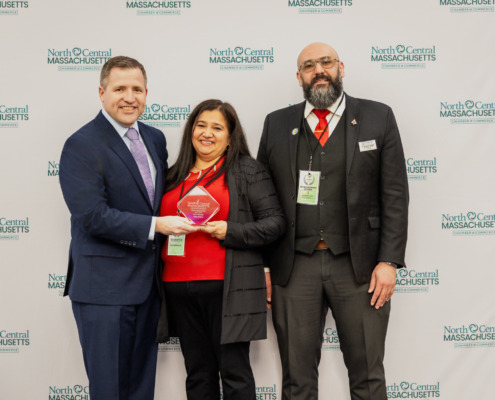

Chamber members are provided with the opportunity to engage with the Mayors of Fitchburg, Gardner, and Leominster who provide updates on projects and other things happening in their Cities. These events are by invitation only, please contact Travis Condon for more details.
View
Event
Bull Run Restaurant215 Great Rd. Shirly, MA
View
Event
Join us for our last Connect North Central of the year!
Friday, December 11, 2026
8am-9am
View
Event
January 14, 20277:15am - 9:00am
View
Event
Erin Logan | NBC 10 Reporter
View
Event
Chamber members are provided with the opportunity to engage with the Mayors of Fitchburg, Gardner, and Leominster who provide updates on projects and other things happening in their Cities. These events are by invitation only, please contact Travis Condon for more details.
View
Event
Silva promoted following record-breaking commercial sales with the bank’s LifeDesign approach

Silva began working at Fidelity Bank in May 2021 as Senior Vice President, Chief Commercial Banking Officer, where he led all aspects of Commercial Banking and Cash Management sales with a focus on growing the business while also embracing Fidelity Bank’s LifeDesign approach to banking.
“In his first year with Fidelity Bank, Joe has led record-breaking growth in commercial loans and makes him the perfect leader for all of our lending programs moving forward,” said Christopher W. McCarthy, President & COO. “Joe embodies our LifeDesign approach to banking in all that he does and has experienced much success in helping our business clients realize growth and success while achieving their financial goals.”
Silva received a bachelor’s degree in Interpersonal Communications from the University of Rhode Island and is also a graduate of the Bank Leadership Program from the Darden School at the University of Virginia.
United Way of North Central Massachusetts (UWNCM) is pleased to announce our newest initiative, Board Connection, which will be kicking off in October with an in-person event. This initiative is designed to help bridge the gap between non-profit organizations and professionals residing in our shared communities by helping to connect qualified individuals with openings on various boards (Board of Directors, Advisory Boards, Committees, etc.).
We invite you and your associates to attend this event free of charge on October 12, 2022, from 5:30 – 7:30 pm at Great Wolf Lodge in Fitchburg. The event will include an educational panel highlighting what it means to serve on a board, a resource fair featuring over 40 agencies with open board seats, light refreshments, and a wine/beer cash bar. Registration can be completed by emailing Lisa Normandin at . We hope you will join us in this great opportunity to learn how you can become more involved in your community.

GARDNER, MA – September 1, 2022 – Mount Wachusett Community College held a pinning for its Dental Assisting program graduates on Friday, August 26, 2022.
“I would like to take the opportunity to congratulate each of you and thank you for choosing the Mount for your education,” noted MWCC President James Vander Hooven. “Tonight is just the beginning of your next journey, as you enter this field, a caring field I ask you to stay in touch with us and with each other. We look forward to your continued success.”
Students were welcomed by Dental Education Program Director Cynthia Cadoret, and were pinned by faculty members Kristen Columbus, Nicole Galloway, Kaitlyn Geise, and Kelly Jancaitis.
The Dental Assisting Certificate is one of three dental education options at Mount Wachusett Community College. MWCC also offers a two-year Dental Hygiene Associate Degree and a new Dental Radiology Certification program.
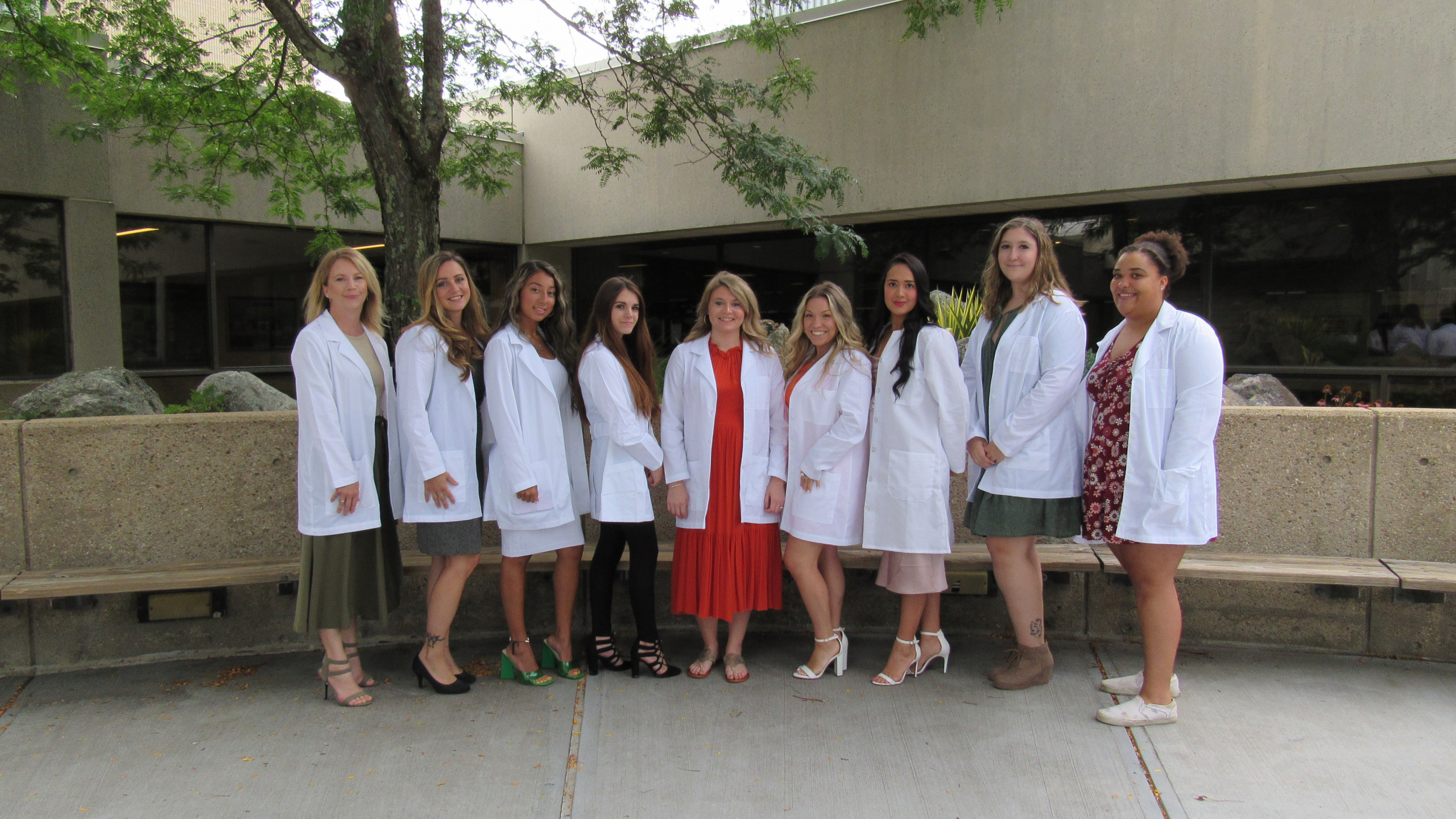
Photo caption left to right: Christina Raisdanaee, Stephanie Constant, Xenia Rodriguez, Mary Miller, Alyssa Patnaude, Olivia Olmeda, Abigial Sarante, Sophia Wenning, Sky Hutchful
The students who earned their Dental Assisting Certificate are:
Stephanie Constant – Leominster, MA
Sky Hutchful – Fitchburg, MA
Mary Miller – Gardner, MA
Olivia Olmeda – West Townsend, MA
Alyssa Patnaude – Keene, NH
Christina Raisdanaee – Leominster, MA
Xenia Rodriguez – Fitchburg, MA
Abigail Sarante – Leominster, MA
Sophia Wenning – Leominster, MA
To learn more about the Dental Education Programs offered at Mount Wachusett Community College, please visit mwcc.edu.

When the workday ends and the lights go down, Custom Cleaning Service of Peabody, Inc. gets to work. “We operate as our clients’ silent partner after business hours,” says Adam Paicos, of Templeton, who now serves as Director of Operations and oversees the company’s expansion into North Central MA. “We are not often seen, but we ensure facilities are clean, secure, and ready for business each day while serving as the eyes and ears for our clients when they are not on site.”

Discover local business stories through our Inside North Central Massachusetts Podcast series. Listen as Chamber members share their journeys, insights, and contributions to our thriving regional business community.

Looking for your next opportunity? Explore current job openings from employers across North Central Massachusetts on our Jobs Board. Whether you’re starting a new career or making a change, you’ll find a variety of local positions available to help you take the next step.
CapEx Facility Services & Construction · Leominster, MA
TaraVista Behavioral Health Center · Harvard, MA
DRS Power Technology, Inc. · Fitchburg, MA
AIS · Leominster, MA