E-Newsletter
An Electronic Publication of the North Central Massachusetts Chamber of Commerce

Inside this edition, you’ll discover the latest Chamber initiatives and success stories from across our region. From economic development projects and upcoming networking events to policy updates and workforce training opportunities, we’re keeping you connected to what matters most for your business and North Central Massachusetts.
The North Central Massachusetts Chamber of Commerce is here to help – with trusted resources, a strong business network, and a support system to keep your business and the region moving forward
An essential skill for any entrepreneur the ability to create meaningful connections via networking, also called network development. Creating connections with customers both old and new is important but creating a network of other entrepreneurs and business owners provides value customers can’t provide. Typically this comes in the form of insights and ideas from various industry experts looking to exchange tips and advice.
In it’s simplest form, networking is defined as making social connections with a business objective. If your goal is to receive more value than you give in the process, your efforts will have only short term rewards. With that in mind, go about your network development with long-term goals of giving more than you receive.
At this juncture, you may be wondering how you can go about network development. Every year, businesses across the world come together in different forums. Some of the participants of these events is a group of highly-skilled entrepreneurs with a common idea. They aim to generate, share, and develop ideas as well as meet potential investors and industry experts. The entrepreneurs want to add the right people around them and form meaningful relationships.
For most people, networking is talking to friends and family members as part of their social network. Networking as a business has a more focused approach on finding like minded individuals even if the company they represent is in a different industry. Creating a network with as many points of view as possible is ideal in helping find solutions to future problems. If an entrepreneur has never looked into creating a network, we’ve put together some tactics to help them approach networking and how to leverage it.
Network development doesn’t always start in-person, but it sure can kick off your efforts with some big wins. Find events that will attract your peers in your area. Call us at the Chamber for suggestions.
For networking in the digital realm, social media has become a powerful tool for entrepreneurs to make connections. Depending on a brand’s identity and target demographic, different platforms will produce better results than others.
Social media sites such as Facebook, Twitter and Instagram are great at connecting business owners together. If you’re looking for something a bit more professional and targeted than a Facebook group, the reigning king to beat for networking as an entrepreneur is LinkedIn, a social media platform created specifically for businesses to interact. Direct communication between entrepreneurs is as easy as searching for others in your industry to get started.
The first point we want to point out isn’t about how to bolster business using a network but instead how to maintain motivation. Networking builds relationships that often turn into friendships which is important to help balance the grind needed to be successful and avoid burnout.
These friends are also the ones that may present the most opportunity. An opportunity can come in the form of new sales avenues, investment options, joint ventures and customer or client leads. Depending on the industry, qualified referrals may also come down the funnel which turns into easy conversions later on. Having access to a network of entrepreneurs and their clients comes with increased visibility, especially when communication between business owners happens publicly online or in-person.
When a network is established and leaned into, entrepreneurs can surround themselves with positive influences and even find mentors eager to share their knowledge with fresh minds. The more information gathered, the more confidence an owner has in executing business plans and decisions. We’re excited to see new entrepreneurs attending networking events within our community and how they’ll use them to expand their business.
Today the Baker-Polito Administration announced an order was placed with iHealth to supply the state with 26 million rapid antigen tests over the next 3 months. The tests will be prioritized to support K-12 schools and childcare settings. The agreement allows for shipments of tests to arrive on a rolling basis in the Commonwealth, but the Administration warns that the timing and shipment amounts will vary depending on international shipping and production variables.
The Baker-Polito Administration also released a public health advisory this week to advise all residents on when to seek tests for COVID-19. The advisory advises all residents to seek COVID-19 tests when exhibiting COVID symptoms, or five days following a known close contact with someone diagnosed with COVID pursuant to MA DPH quarantine and isolation protocols, updated as of December 29 in accordance with the new CDC guidance.
The new isolation protocols do not require a COVID-19 test to exit isolation after having COVID. This general rule also applies to childcare and K-12. Additional information on testing protocols for specific situations in childcare can be found here and for K-12 can be found here.
The new quarantine protocols recommend, but do not require, all exposed individuals get a test five days after exposure. Exposed individuals do not need to quarantine in the following circumstances:
DPH advises that a positive COVID-19 rapid antigen does not need to be confirmed with a PCR test.
DPH recommends individuals that have COVID symptoms and test negative with a rapid antigen test should isolate and either repeat an antigen test or get a PCR test in 24-48 hours if they continue to exhibit symptoms. Additionally, DPH does not advise employers, or schools and childcare, to require a test as a condition of returning to work or school.
View the public health advisory here.
Vaccination and getting a booster remain the best possible protection against COVID. There are almost 1,000 locations in the Commonwealth for residents to receive a COVID-19 vaccine or booster. Visit VaxFinder.mass.gov to book an appointment.
Massachusetts National Guard
Governor Baker also today activated 500 additional members of the Massachusetts National Guard to support the state’s health care system. This order expands the National Guard activation of 500 members announced on December 21 to support non-clinical functions in the Commonwealth’s hospitals. Prioritized uses for the newly activated 500 members will be to provide additional non-clinical staffing at community hospitals and high-volume emergency departments, public hospitals, skilled nursing facilities and dialysis centers. These guard personnel will be deployed beginning the week of January 17.
“My Vax Records” Provides New Option to Access Vaccine History and QR Code to Verify COVID-19 Vaccination
The Baker-Polito Administration today announced a tool that gives residents a new way to access their COVID-19 digital vaccine card and vaccination history. The new tool, called My Vax Records, allows people who received their vaccination in Massachusetts to access their own vaccination history and generate a COVID-19 digital vaccine card, which would contain similar vaccination information to a paper CDC card. The COVID-19 digital vaccine cards produced by the system utilize the SMART Health Card platform and generate a QR code that can be used to verify vaccination. The Administration is not requiring residents to show proof of vaccination to enter any venue, but this tool will help residents who would like to access and produce a digital copy of their record.
Access the new tool at MyVaxRecords.Mass.Gov.
How It Works: The new tool is easy to use: a person enters their name, date of birth, and mobile phone number or email associated with their vaccine record. After creating a 4-digit PIN, the user receives a link to their vaccine record that will open upon re-entry of the PIN.
The electronic record shows the same information as a paper CDC vaccine card: name, date of birth, date of vaccinations, and vaccine manufacturer. It also includes a QR code that makes these same details readable by a QR scanner, including smartphone apps. Once the SMART Health Card is received, users are able to save the QR code to their phone, such as the Apple Wallet, screenshot the information and save it to their phone’s photos, or print out a copy for a paper record. The system follows national standards for security and privacy.
This system provides an optional way that residents can access their vaccination information and a COVID-19 digital vaccine card. This will provide residents with another tool to provide proof of COVID-19 vaccination, should it be requested by businesses, local governments, or other entities.
The system leverages the Massachusetts Immunization Information System (MIIS), the official database used by health care providers across the state to record vaccination information. The system relies on hundreds of providers inputting demographic and health information. Some users may not be able to immediately find their record, or may find an incomplete record. Residents whose record cannot be found or is incomplete can either contact their health care provider or contact the MIIS team to update their records. Learn more about the tool and view frequently-asked-questions at www.mass.gov/myvaxrecord.
Massachusetts has worked with VCI,™ a voluntary coalition of public and private organizations which developed the open-source SMART Health Card Framework in use by other states. The VCI coalition is dedicated to improving privacy and security of patient information, making medical records portable and reducing healthcare fraud.
My Vax Records is just one way residents can obtain their COVID vaccination record. Pharmacies that administered the COVID vaccine and many health care providers also are making SMART Health Cards available, or are providing additional options. Learn more.
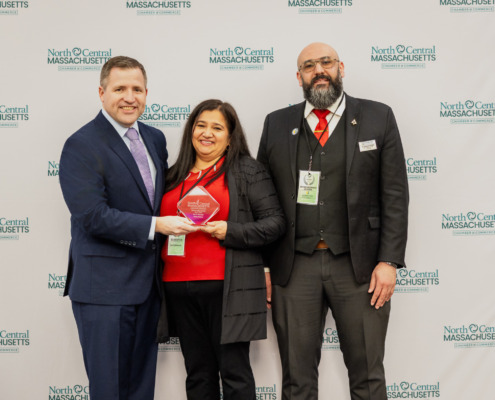

The reception features an open bar and gourmet appetizers.
View
Event
Join us for Connect North Central
Friday, September 25, 2026
8am-9am
View
Event
North Central Golf Tour Championship: Fore the Future
An FLNC Non-Traditional Scholarship Fundraiser
View
Event
Thank you Series Supporting Sponsor empHowered PR
View
Event
Join us for our 11th Annual
Congressional Luncheon
View
Event
Wednesday October 28, 2026
5:00pm - 7:00pm
View
Event
Join us for this in person HR Legal Update
View
Event
November 19, 2026
7:15am - 9:00am
View
Event
Chamber members are provided with the opportunity to engage with the Mayors of Fitchburg, Gardner, and Leominster who provide updates on projects and other things happening in their Cities. These events are by invitation only, please contact Travis Condon for more details.
View
Event
Bull Run Restaurant
215 Great Rd. Shirly, MA
View
Event
Join us for our last Connect North Central of the year!
Friday, December 11, 2026
8am-9am
View
Event
Chamber members are provided with the opportunity to engage with the Mayors of Fitchburg, Gardner, and Leominster who provide updates on projects and other things happening in their Cities. These events are by invitation only, please contact Travis Condon for more details.
View
Event
Workers Credit Union donated more than $400,000 to 175 charitable organizations in 2021. This year they are launching a new program called “Workers Kindness,” which gives its members a voice in how some of that money is allocated each quarter. “There is no one better to determine where we should donate than our members living in the communities we serve,” says Workers Credit Union President and CEO Doug Petersen. “This program ensures our giving is aligned with the causes that are important to them.”
Under the Workers Kindness program, each quarter members receive a voting call to action via email, online/mobile banking, and web alerts. By clicking on the survey link, members can “vote their kindness” from a slate of pre-selected charities and nominate organizations for inclusion on future ballots. Early reaction to the program has been strong with thousands of members responding. Donations will be made to the organizations that are proportional to the support they receive from members.
This program reflects Workers Credit Union’s overall commitment to charitable giving and improving the lives of both its members and their communities. Workers Credit Union staff devoted more than 2,000 hours to volunteering in 2021. The credit union also returned $2.2 million to its members through its Workers GiveBack program, now in its ninth year and having returned more than $25 million to members.
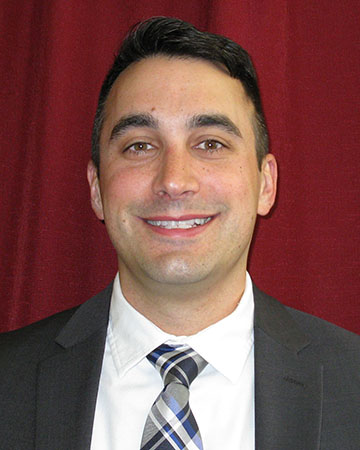
The year 2021 was an historic year for Fidelity Bank as annual results exceeded expectations including strong growth in commercial loans and deposits. The bank remained focused on its LifeDesign Banking approach of helping clients get where they want to be by providing the clarity, confidence, and care needed to make informed decisions about their financial future. Fidelity Bank shared its 2021 financial data and community growth at the Fidelity Bank Mutual Holding Company annual meeting on April 19.
The community bank, with headquarters in Leominster and 13 full-service offices, grew by 9.8 percent reaching total assets of $1.2 billion as of December 31, 2021, which is up from $1.1 billion as of December 31, 2020.
“As we recognize the strongest year in our 133-year history, we are grateful to those who have trusted us to guide them toward financial success,” said Ed Manzi, Chairman and CEO, Fidelity Bank. “Our results are a true testament to the commitment of our colleagues who provide service with care and develop innovative products to respond to the evolving needs of our clients.”
Highlights of Fidelity Bank’s Community Growth include:
Bank officials also announced the election of six new corporators of Fidelity Mutual Holding Company.
They are Melane Bisbas, Winfield Brown, Jody Guetter, Michael O’Neal, Roseanne Timmerman, and Jonathan Vitale, who will all serve a ten-year term. Matthew Campobasso, Janet Chambers, John Flick and Ronald J. (Joe) Salois were re-elected to serve a ten-year term as corporators of Fidelity Mutual Holding Company. Sheila Harrity, Scott Howard, and Mark Puccio resigned as corporators. Winfield Brown and Mary Ritter were elected to serve a one-year term as directors of Fidelity Mutual Holding Company. Brian Cirelli, Patricia Leonhardt and Ronald Marchetti were re-elected as directors of Fidelity Mutual Holding Company for a three-year term, and Maureen Marshall was re-elected as a director of Fidelity Mutual Holding Company for a one-year term. Alvin Collins was elected to Clerk of Fidelity Mutual Holding Company for a one-year term, and Judy Khallady was elected to Assistant Clerk of Fidelity Mutual Holding Company for one-year term.
Treating people with care and respect has always been a guiding principle at Fidelity Bank. Expanding on last year’s creation of the Fidelity Bank Inclusion and Diversity Advisory Board, the bank developed inclusion and diversity targets for client acquisition and colleague hiring and created a Vendor Management Policy to ensure inclusion and diversity among companies with whom the bank does business.
In 2021, Fidelity Bank continued to support the communities through its Community Dividend Program by supporting more than 220 causes totaling more than $400,000. Organizations receiving contributions in 2021 included Indian Hill Music of Littleton (soon to be Groton Hill Music Center when the organization opens its new home in Groton) to support outreach programs and provide scholarships for students at public schools across Fidelity Bank’s service area as well as Entrepreneurship for All, Inc., Black Box Theatre, Heywood Healthcare, Reliant Foundation, WooSox Foundation, March of Dimes Foundation, Needham Community Council, NewVue Communities, Inc., The Shine Initiative and the Worcester County Food Bank to name a few, as well as several causes promoted through Fidelity Bank’s weekly Caring Casual Fridays. Fidelity Bank has given out approximately $2.75 million since the program was renamed in 2013.
Click here to view Fidelity Bank’s 2021 Annual Report.
When the workday ends and the lights go down, Custom Cleaning Service of Peabody, Inc. gets to work. “We operate as our clients’ silent partner after business hours,” says Adam Paicos, of Templeton, who now serves as Director of Operations and oversees the company’s expansion into North Central MA. “We are not often seen, but we ensure facilities are clean, secure, and ready for business each day while serving as the eyes and ears for our clients when they are not on site.”

Discover local business stories through our Inside North Central Massachusetts Podcast series. Listen as Chamber members share their journeys, insights, and contributions to our thriving regional business community.

Looking for your next opportunity? Explore current job openings from employers across North Central Massachusetts on our Jobs Board. Whether you’re starting a new career or making a change, you’ll find a variety of local positions available to help you take the next step.
CapEx Facility Services & Construction · Leominster, MA
TaraVista Behavioral Health Center · Harvard, MA
DRS Power Technology, Inc. · Fitchburg, MA
AIS · Leominster, MA