E-Newsletter
An Electronic Publication of the North Central Massachusetts Chamber of Commerce

Inside this edition, you’ll discover the latest Chamber initiatives and success stories from across our region. From economic development projects and upcoming networking events to policy updates and workforce training opportunities, we’re keeping you connected to what matters most for your business and North Central Massachusetts.
The North Central Massachusetts Chamber of Commerce is here to help – with trusted resources, a strong business network, and a support system to keep your business and the region moving forward
Article Source: State House News Service
Article By: Matt Murphy
JAN. 8, 2021…..All-nighters aren’t just for college kids anymore.
Despite everyone’s most fervent wishes, simply watching the ball drop on New Year’s Eve Thursday didn’t end the madness of 2020. And midnight wound up looking like an early bedtime for the week that was about to unfold.
The first full week of 2021 started innocently enough.
On Sunday night, MassGOP Chairman Jim Lyons eked out a victory by three votes over Rep. Shawn Dooley to maintain control of the state party, and legislative negotiators announced they had struck a deal on a climate change bill to set a statewide target of net-zero emissions by 2050 and to authorize even more offshore wind.
But by the end of the week, democracy was under attack, 12 more days of the Trump administration was being talked about like too great a risk to take, Boston Mayor Marty Walsh was checking Amtrak schedules to D.C., and the promise of the COVID-19 vaccine was getting showered by the cold reality of continued viral spread.
Welcome to 2021.
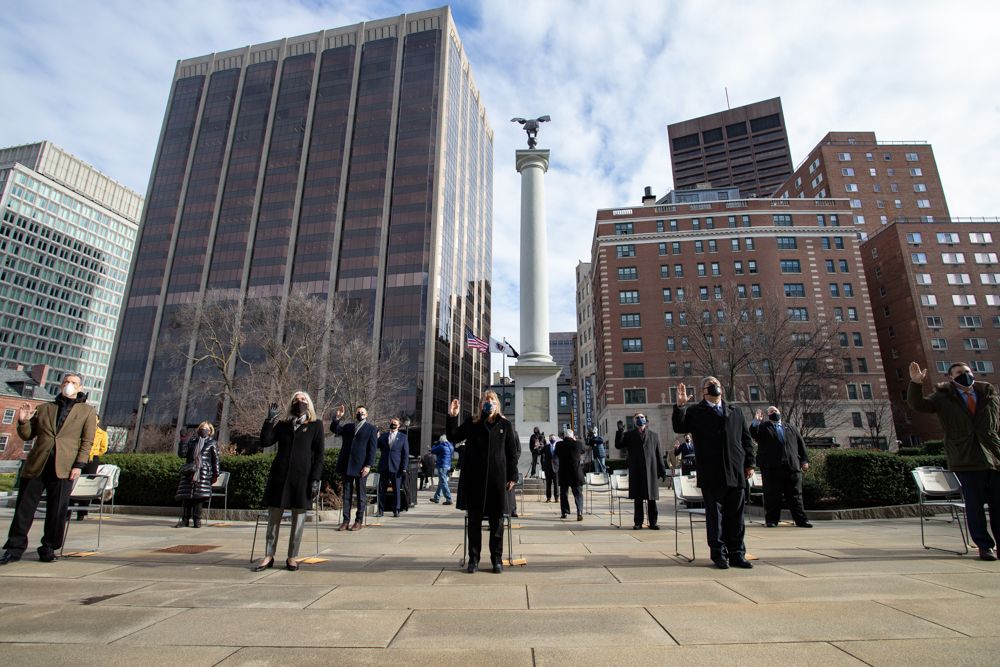
In another sign of the way COVID-19 has impacted major events over the past year, the Senate swore in a group of senators Wednesday in Ashburton Park outside the State House. [Sam Doran/SHNS]
It was always going to be a long night on Tuesday, with major economic development and transportation financing legislation still up in the air. But it’s unlikely anyone had 4:34 a.m. in their virtual office pool as the time the final gavel would fall.
Not even five extra months to finish their work could help lawmakers save themselves from the last-minute rush, and though they went home tired, they also went home having accomplished most of the big ticket items on their to-do list.
The House and Senate managed to send to Gov. Charlie Baker a $16.5 billion transportation bond bill that the governor said was needed to access federal funding and get ready for the spring construction season. They also agreed to a $626 million jobs bill full of grant and loan programs to help small businesses, restaurants, artists and other industries crushed by the pandemic.
The notable piece missing from the economic development bill was a House-backed plan to legalize sports betting in Massachusetts.
Gov. Baker supports the idea. He even filed his own bill this session. But Speaker Ron Mariano said he didn’t have a dance partner in the Senate, where leaders would not entertain the idea of tacking the gambling expansion onto the jobs bill, or debate it separately.
“If we could, we’d have a deal,” Mariano told Bloomberg radio Tuesday evening. Mariano said he wants to come back to the issue early this year.
By the time everyone’s head hit the pillow, the Legislature had also passed campus sexual assault prevention and craft beer distribution bills, approved of a commission to examine changing the state seal and sent Baker a bill intended to reduce racial inequities in maternal health.
The one piece that pulled up lame before it got to the finish line was a cap on unemployment insurance rate increases in 2021, but there’s still time for the Legislature to do that before first quarter bills come due. In fact, it might just give the new Legislature something to vote on to start the new session.
The hardest thing to do Wednesday should have been getting out of bed. But on a day when new and returning lawmakers took their oaths to start a new session on Beacon Hill and Senate President Karen Spilka and Mariano were reelected to their leadership posts, riots stoked by the president of the United States on Twitter erupted on Capitol Hill.
A mob, fueled by unproven claims of election fraud repeated by the president and his allies, broke into the Capitol. They were intent on disrupting the certification by Congress of the Electoral College vote that would give President-elect Joe Biden the victory.
But Congress returned to work that night and certified the Electoral College vote at around 3:45 a.m.
The fact that Congress fulfilled its Constitutional obligation despite the chaos of the day was the one bright spot, according to Gov. Baker, who the next day said he was sickened by what he watched on TV.
Baker, a Republican, joined the chorus of Democrats, including every member of Congress from Massachusetts, in calling for Trump to be removed from office. No more waiting until Jan. 20 for President-elect Joe Biden to be inaugurated. Let Vice President Mike Pence oversee the transition, the governor said.
Trump’s future hangs in the balance, but as he prepares to leave Washington, Mayor Walsh is ready to move in.
People around City Hall and the mayor have been downplaying the Walsh-to-Washington speculation for weeks, insisting that the mayor was gearing up for reelection and maybe not even interested in a Biden administration post.
Maybe that’s exactly what people tell reporters to throw them off the scent. Or maybe they didn’t think it would happen, at the end of the day. But it did.
Biden officially introduced Walsh as his nominee for labor secretary on Friday, after joking a day earlier amid reports that Walsh had been chosen that he was still looking for an Irishman to round out his Cabinet.
Needless to say, Walsh’s decision to trade the Charles for the Potomac has completely upended the race for mayor. City Council President Kim Janey is now preparing to become the first Black woman mayor in the city’s history, and Councilors Michelle Wu and Andrea Campbell – who were already running for mayor – are preparing for company on the trail.
Janey will be watched closely for signals that she might get in the race, while Councilor Annissa Essaibi George is now taking a look. The off-cycle municipal election also means that State House denizens could have a free run at the seat if they want it, and the North End’s Aaron Michlewitz, who chaired the House Ways and Means Committee last session, is kicking the tires, according to sources.
Reports also suggest that the South End’s Rep. Jon Santiago and others are also thinking about it.
While it will take some time for the mayoral chess game to play out, COVID-19 is still here. Right now.
Gov. Baker this week announced that business restrictions put in place on Dec. 26, including 25 percent capacity limits in many businesses, would be extended at least two weeks until Jan. 24, and new pool testing would be made available to K-12 school students and personnel.
The administration is also ready to give hospitals facing capacity constraints leeway from nurse staffing-level mandates in ICUs to free up more beds. Hospitalizations are up 145 percent since Thanksgiving.
Vaccines already deployed in hospitals and nursing homes will become available to first responders beginning Monday, when another week begins.
But until then, in the words of Speaker Mariano, who was caught on a hot mic as he gaveled the first session of the 192nd General Court to a close, let’s “get the hell outta here.”
Managing a business website can feel like a second job. However, it’s more important than ever that your business has a digital presence that speaks directly to the problems your customers want to solve through your products and services. With the pandemic still slowing the pace of business for most of the country, now is the time to update your online presence.
Optimize Your Website for Mobile
Studies show that mobile is making up more and more of the online landscape, both in terms of web content and user searches. The most important statistic to know here is that 53% of mobile users will leave a website that doesn’t load within three seconds. When you are optimizing your website for mobile users, speed and usability are the most important. Content needs to adjust smoothly to smaller screens, and it needs to load quickly. You can increase loading speed through a number of steps, such as:
Create a Google My Business Listing
If you’ve ever searched for a business and seen the helpful listing on the right side of the screen, that’s a Google My Business listing. By creating your own, you will make your website much more visible and easier to find for online shoppers. What’s more, they’ll also be able to find the most important information about your business in one place.
A Google My Business listing contains delivery/pickup options, hours, contact information, and all-important trust-building testimonials. It also gives you a set of tools to manage and monitor your online presence. It shouldn’t surprise you that most members of the Chamber have a Google My Business listing, and you should too.
Invest in Local Digital Advertising
Digital advertising can take various forms. Targeting social and search engines with pay-per-click (PPC) and search engine optimization (SEO) are increasingly important. These techniques are quite different from each other, but they each operate by targeting certain strings of keywords. By tailoring the keywords to local communities, your business will have an easier time reaching potential customers.
A PPC ad campaign works similarly to other types of advertising in that you pay a small fee for each click the ad delivers to your website. On the other hand, SEO might seem a bit more novel. By writing keyword-rich content that conforms to SEO guidelines, you’ll rank closer to the top spot in relevant Google searches. Web users rarely look beyond the first page, so a high search engine ranking is a powerful competitive advantage. You can learn and write SEO on your own but hiring a professional copywriter will be more convenient and effective.
Run a Business Social Media Account
Setting up an Instagram and Facebook account for your business can go a long way in building your brand. While Facebook has the greatest outreach, Instagram emphasizes visually engaging content and has far greater rates of response. While you should use both, one is likely to be a better fit for your business overall.
By boosting your visibility in search engines and maintaining a mobile-friendly web presence, your business will cope much better with the rigors of the COVID-era economy.
Stay tuned! The North Central Massachusetts Chamber of Commerce is launching a new podcast series this winter season. The podcast series will feature conversations from the Chamber’s ongoing live web chat series with community and business leaders, plus additional content that is relevant to our members and communities.
“We want to be seen as a resource for crucial information pertaining to our members and the communities of North Central Massachusetts,” said Roy Nascimento, President & CEO of the Chamber. “The way the public consumes information is constantly changing, and we are excited to utilize the skills of our team members to break into this medium.”
“We recognize that our members are often very busy, and while we wish they could attend every event we host, we know that isn’t always feasible,” said Kathleen Deal, Events & Programs Manager at the Chamber, “This will give members the flexibility to keep up to date with issues that impact them while juggling their day to day responsibilities.”
Kat Deal and Travis Condon, Public Affairs Manager at the Chamber and a former radio host, will produce the podcasts. For more information on the podcast and to listen to episodes, head to: Inside North Central Massachusetts Podcast
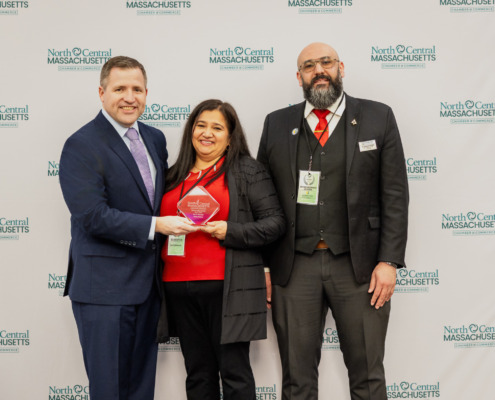

The reception features an open bar and gourmet appetizers.
View
Event
Join us for Connect North Central
Friday, September 25, 2026
8am-9am
View
Event
North Central Golf Tour Championship: Fore the Future
An FLNC Non-Traditional Scholarship Fundraiser
View
Event
Thank you Series Supporting Sponsor empHowered PR
View
Event
Join us for our 11th Annual
Congressional Luncheon
View
Event
Wednesday October 28, 2026
5:00pm - 7:00pm
View
Event
Join us for this in person HR Legal Update
View
Event
November 19, 2026
7:15am - 9:00am
View
Event
Chamber members are provided with the opportunity to engage with the Mayors of Fitchburg, Gardner, and Leominster who provide updates on projects and other things happening in their Cities. These events are by invitation only, please contact Travis Condon for more details.
View
Event
Bull Run Restaurant
215 Great Rd. Shirly, MA
View
Event
Join us for our last Connect North Central of the year!
Friday, December 11, 2026
8am-9am
View
Event
Chamber members are provided with the opportunity to engage with the Mayors of Fitchburg, Gardner, and Leominster who provide updates on projects and other things happening in their Cities. These events are by invitation only, please contact Travis Condon for more details.
View
Event

When the workday ends and the lights go down, Custom Cleaning Service of Peabody, Inc. gets to work. “We operate as our clients’ silent partner after business hours,” says Adam Paicos, of Templeton, who now serves as Director of Operations and oversees the company’s expansion into North Central MA. “We are not often seen, but we ensure facilities are clean, secure, and ready for business each day while serving as the eyes and ears for our clients when they are not on site.”

Discover local business stories through our Inside North Central Massachusetts Podcast series. Listen as Chamber members share their journeys, insights, and contributions to our thriving regional business community.

Looking for your next opportunity? Explore current job openings from employers across North Central Massachusetts on our Jobs Board. Whether you’re starting a new career or making a change, you’ll find a variety of local positions available to help you take the next step.
CapEx Facility Services & Construction · Leominster, MA
TaraVista Behavioral Health Center · Harvard, MA
DRS Power Technology, Inc. · Fitchburg, MA
AIS · Leominster, MA