E-Newsletter
An Electronic Publication of the North Central Massachusetts Chamber of Commerce

Inside this edition, you’ll discover the latest Chamber initiatives and success stories from across our region. From economic development projects and upcoming networking events to policy updates and workforce training opportunities, we’re keeping you connected to what matters most for your business and North Central Massachusetts.
The North Central Massachusetts Chamber of Commerce is here to help – with trusted resources, a strong business network, and a support system to keep your business and the region moving forward
Governor Maura Healey has requested a Major Disaster Declaration from President Biden to support the ongoing recovery of Massachusetts communities impacted by severe weather and flooding in September. If granted, this declaration would secure access to federal assistance programs for Bristol, Hampden, and Worcester counties.
The storm that began on September 11 caused extensive flooding across the state and required evacuations, sheltering, water rescues, and construction of temporary roadways to allow residents and first responders access to homes.
“I saw first-hand the devastating impacts our communities experienced from the September storms. The extraordinarily heavy rainfall flooded thousands of homes and businesses, destroyed infrastructure, and required a significant public safety response,” said Governor Healey. “I’m requesting federal assistance to support our ongoing recovery efforts as communities and residents continue to rebuild.”
“Some cities and towns experienced more than seven inches of rain in a very short time,” said Lt. Governor Kim Driscoll. “A major disaster declaration is critical to helping our communities and residents gain access to federal assistance as they face an extensive recovery.”
Under the Robert T. Stafford Disaster Relief and Emergency Assistance Act, the President can declare a major disaster for any natural event they determine has caused damage that exceeds the combined capabilities of state and local governments to respond. A major disaster declaration provides federal assistance for individuals and public infrastructure through FEMA’s Public Assistance and Individual Assistance programs, as well as hazard mitigation assistance, which provides funding for eligible mitigation measures that reduce disaster losses.
Following a disaster, the Massachusetts Emergency Management Agency (MEMA) works directly with counterparts at FEMA Region 1 and impacted cities and towns to assess potentially reimbursable damages caused by, and costs related to, the disaster. Once these assessments are complete, FEMA validates whether the state and impacted counties have reached the required federal damage thresholds for a Major Disaster Declaration.
“Beginning on September 11, MEMA staff responded to Attleboro, North Attleboro, Lancaster, Leominster, Princeton, Springfield, and Sterling to support community response and recovery activities. I want to thank all of the state and municipal agencies, volunteers, and non-governmental organizations who worked together to respond to the storm, as well as the Healey-Driscoll Administration for their leadership,” said MEMA Director Dawn Brantley. “FEMA has been an excellent partner through the process of conducting joint preliminary damage assessments, and MEMA recognizes the commitment of the communities that dedicated significant time and attention to this endeavor while also facing the challenges of recovery.”
In response to the severe weather impacts, Governor Healey directed the execution of the State Comprehensive Emergency Management Plan, activation of the state’s Regional Emergency Operations Centers, and declared a State of Emergency on September 12, 2023. The administration also developed a website to centralize available resources for residents, businesses, and communities, which is continually updated.
Chamber of Commerce | North Central Massachusetts | North Central Massachusetts Chamber | Massachusetts Economy | Government Affairs | State House News Service | Healey-Driscoll Administration
Source: State House News Service
Author: Colin A. Young
The broad goal of the economic development plan the Healey administration put forward this week is to build upon the state’s strong points to keep Massachusetts an ideal place to live, raise a family and grow a business well into the future.
But another aspiration was revealed Wednesday when Economic Development Secretary Yvonne Hao detailed the plan for lawmakers — for Massachusetts to join the small club of states that have a gross domestic product of $1 trillion or more.
The plan’s vision matches up traditional economic development topics like talent attraction and retention, boosting housing production, making public transportation more reliable, and streamlining access to state resources with Healey’s specific emphasis on values like inclusion as well as state policies around reproductive and civil rights. It aims to “lengthen our lead” in sectors like life sciences, health care, and advanced manufacturing, while also seizing opportunities to become new leaders in climate tech and tourism.

Photo Credit: State House News Service
“This is the way we become more than a trillion,” Hao said in response to a question from Sen. Barry Finegold, co-chair of the Joint Committee on Economic Development and Emerging Technologies. She added, “The majority of our economy is aligned around industries that are growing — health care is growing, life sciences is growing, climate tech is growing, advanced manufacturing is growing, AI is growing, robotics are growing. So we have a ton of tailwinds in growth sectors and so we just need to make sure that we continue to lengthen our lead and continue to invest and continue to implement all of these initiatives here. Those sectors are growing already. If we can just continue to — not even just hold our share, but even increase our share, we’re going to become a trillion dollar GDP.”
GDP measures the market value of the goods and services produced in a state. Massachusetts had a GDP of $691.46 billion in 2022, according to the U.S. Dept. of Commerce’s Bureau of Economic Analysis. Only five states had a GDP equal to or greater than $1 trillion last year: California, Texas, New York, Florida and Illinois.
The discussion of a $1 trillion GDP as a goal for Massachusetts spurred Sen. Liz Miranda to highlight that using GDP as a measurement has “fostered a fixation on growing the pie that sometimes ignores” that economic growth is not spread evenly across the state but often concentrated in a select few areas.
Massachusetts is the most educated and wealthiest state in the country, the administration’s economic development plan says, but it is also the third-most unequal of the states, based on 2022’s Gini coefficient, a common measure of inequality that economists rely upon.
Miranda said she was “really feeling like we can’t totally evaluate the effectiveness of our economic development policies without a consistent, high-quality measure of how economic growth is distributed in the commonwealth, particularly across geographic and non-geographic communities who have historically been in lowest percentiles and living in the margins.”
“I know it’s incredibly important, we want to grow to a trillion. But how do we actually measure that so we actually know the truth about how it’s being distributed across the commonwealth?” Miranda asked Hao.
The secretary said she sees there being two ways to achieve equality: “We can be more equal but have everything stay the same. Or the real way to get equity, I think, is to continue to grow and have everyone lift up and to close the gap.”
“And so I think we need to measure multiple metrics. So looking at GDP overall is important, looking at GDP growth is important. But looking at the gap, and closing the gap, is really important. And so the Gini coefficient is a number that I pay a lot of attention to. I’m a former economist, and it is the universal way to look at income inequality. In our state, we want to look at Gini coefficient by different areas — by race, but also by region. Our gap in race is quite dramatic. So if you look at kind of average income by race, it’s a $20,000-$30,000 difference. It’s also equally dramatic by region. Western Mass. versus Eastern Mass., even amongst people of the same race, is $20,000 or $30,000. And so we have a lot of work to do on thinking about income inequality.”
Chamber of Commerce | North Central Massachusetts | North Central Massachusetts Chamber | Massachusetts Economy | Government Affairs | State House News Service | Healey-Driscoll Administration
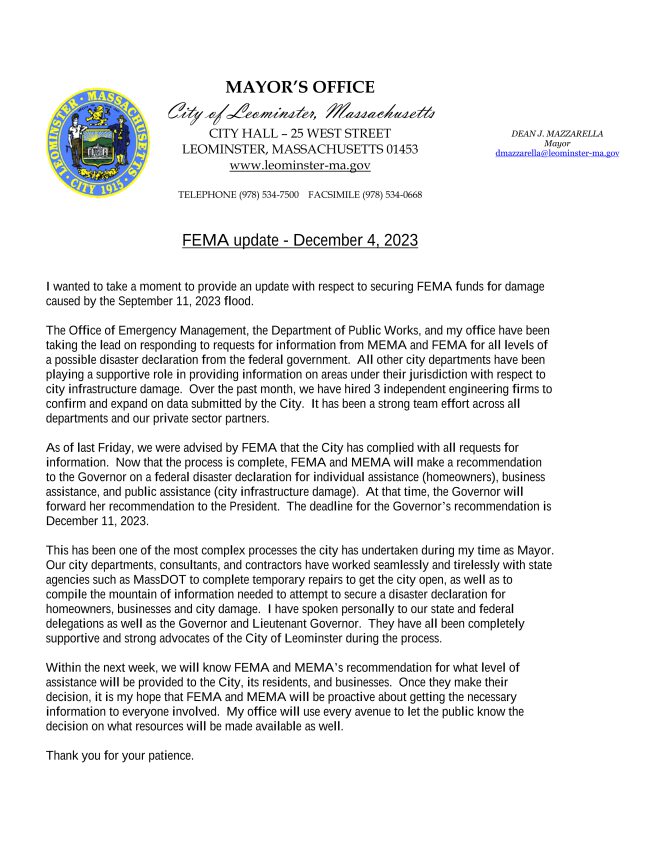
Chamber of Commerce | North Central Massachusetts | North Central Massachusetts Chamber | Government Affairs | Leominster City Hall | FEMA Update
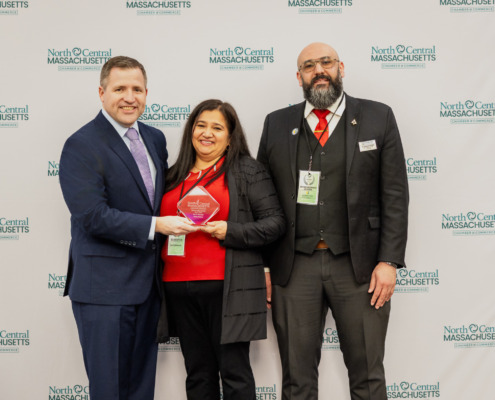

The reception features an open bar and gourmet appetizers.
View
Event
Join us for Connect North Central
Friday, September 25, 2026
8am-9am
View
Event
North Central Golf Tour Championship: Fore the Future
An FLNC Non-Traditional Scholarship Fundraiser
View
Event
Thank you Series Supporting Sponsor empHowered PR
View
Event
Join us for our 11th Annual
Congressional Luncheon
View
Event
Wednesday October 28, 2026
5:00pm - 7:00pm
View
Event
Join us for this in person HR Legal Update
View
Event
November 19, 2026
7:15am - 9:00am
View
Event
Chamber members are provided with the opportunity to engage with the Mayors of Fitchburg, Gardner, and Leominster who provide updates on projects and other things happening in their Cities. These events are by invitation only, please contact Travis Condon for more details.
View
Event
Bull Run Restaurant
215 Great Rd. Shirly, MA
View
Event
Join us for our last Connect North Central of the year!
Friday, December 11, 2026
8am-9am
View
Event
Chamber members are provided with the opportunity to engage with the Mayors of Fitchburg, Gardner, and Leominster who provide updates on projects and other things happening in their Cities. These events are by invitation only, please contact Travis Condon for more details.
View
Event
Global insurance brokerage Hub International out of Massachusetts has developed a presentation on how clinical informatics can optimize your company’s benefits plan.
Tools like clinical informatics are revolutionizing the way organizations approach health plan management. By leveraging advanced data analytics and clinical expertise, you can move beyond reactive strategies and proactively anticipate and mitigate risks before they escalate, which helps you make better informed decisions for better outcomes.
Click here to learn more!
Do you have any old technology lying around (tech, batteries, printer, phone, Smart Watch and more)? Bring them to Staples in Leominster and recycle them for FREE with the Staples Recycle Every Day Program! Visit Staples on 114 Water Tower Plaza in Leominster today to take advantage of this free service.

Here’s what you can recycle at Staples in Leominster, MA

When the workday ends and the lights go down, Custom Cleaning Service of Peabody, Inc. gets to work. “We operate as our clients’ silent partner after business hours,” says Adam Paicos, of Templeton, who now serves as Director of Operations and oversees the company’s expansion into North Central MA. “We are not often seen, but we ensure facilities are clean, secure, and ready for business each day while serving as the eyes and ears for our clients when they are not on site.”

Discover local business stories through our Inside North Central Massachusetts Podcast series. Listen as Chamber members share their journeys, insights, and contributions to our thriving regional business community.

Looking for your next opportunity? Explore current job openings from employers across North Central Massachusetts on our Jobs Board. Whether you’re starting a new career or making a change, you’ll find a variety of local positions available to help you take the next step.
CapEx Facility Services & Construction · Leominster, MA
TaraVista Behavioral Health Center · Harvard, MA
DRS Power Technology, Inc. · Fitchburg, MA
AIS · Leominster, MA