E-Newsletter
An Electronic Publication of the North Central Massachusetts Chamber of Commerce

Inside this edition, you’ll discover the latest Chamber initiatives and success stories from across our region. From economic development projects and upcoming networking events to policy updates and workforce training opportunities, we’re keeping you connected to what matters most for your business and North Central Massachusetts.
The North Central Massachusetts Chamber of Commerce is here to help – with trusted resources, a strong business network, and a support system to keep your business and the region moving forward
Source: State House News Service
Author(s): Sam Drysdale, Alison Kuznitz (State House News Service)
The two top Democrats in the Legislature hesitated Monday to get behind proposals from Gov. Maura Healey regarding raising local taxes and draining one-time funds to pay for emergency shelter.
Beacon Hill’s “Big Three,” Gov. Maura Healey, House Speaker Ron Mariano and Senate President Karen Spilka, met in-person Monday for the first time in over two months, for what used to be a semi-regular leadership meeting. Healey later this week plans to unveil her fiscal year 2025 budget, and the busiest stretch of the legislative calendar is underway as lawmakers face a July 31 deadline to get their big priorities done this year.
Healey unveiled a proposal to give municipalities the ability to raise certain taxes on Friday, a day after she said she would not raise broad-based state taxes. The announcement was met with a mixed reception.
Some local leaders are excited about the prospect of another tool in their toolkit to raise revenue, while Republicans and right-leaning nonprofit groups have criticized the move as a “backdoor method” to raise taxes.
The so-called Municipal Empowerment Act would enable cities and towns to raise the maximum local option tax on hotels, motels and other rentals from 6 percent to 7 percent of the price of a room, and to 7.5 percent in Boston. The local option meals tax could increase from 0.75 percent to 1 percent, and a new local option vehicle surcharge plan would give town officials the option to add an additional 5 percent fee onto vehicles registered in their communities.
“Massachusetts is an expensive place as it is and this will make the Bay State less competitive. This action, if passed through the legislature, will result in companies looking at less expensive options to host their conventions and conferences. Tax increases hurt our communities and make our state less affordable,” GOP Chairwoman Amy Carnevale said in a statement Friday.
Healey pushed back Monday against the idea that introducing the bill went against her word to not seek a state tax hike, as well as her plan to make the state more affordable.
“We are not raising taxes. What we did with the municipal bill, I think it’s being filed right now, is simply convened a series of meetings with local officials from around the state over the last several months. And it was based on those conversations, what we’re hearing from local officials about what they needed to do, what they want to do in their communities,” Healey said.
She emphasized that her bill would not universally raise taxes, but it just creates an opt-in for communities.
“We’re not imposing this. This is just an example of giving local communities the option to do what they think is in the best interest of their community, and for some of your Cape Cod communities, we heard that raising a meals tax, raising a hotel tax that will be primarily paid by tourists is something that they may want to consider and do. Other towns may feel differently,” Healey said.
Easthampton Mayor Nicole LaChapelle, incoming president of the Massachusetts Mayors Association, was one among many local officials who commended the move.
“We must be nimble and flexible, but most importantly, we must be efficient because municipal budgets are small and tight. The efforts here by the Healey-Driscoll Administration help us enhance and balance the needs of our residents and the changing financial landscape municipalities experience,” LaChappelle said in a statement.
Mariano and Spilka, however, gave the proposal a lukewarm reception Monday.
Mariano, who last week strongly rejected the idea of raising state taxes to pay for increased spending, said he had not yet read the governor’s new bill. Healey filed the bill later Monday afternoon.
“A lot depends. A lot depends,” he said. “I haven’t read the bill. Some of them, there may be a need. There may have been a long time before anyone has looked at them. So we’ll evaluate them as they come in,” Mariano said.
He continued, “They will be evaluated to see what they have, what impact they have on our competitiveness, which is one of the reasons why we don’t want to raise taxes.”
Spilka also said the Senate would be taking “a good look at it.”
She said she heard “mixed feelings” about the bill at the Massachusetts Municipal Association’s annual meeting, where Healey and Lt. Gov. Kim Driscoll unveiled the proposal, and would “certainly want to hear from different stakeholders, as well as other senators.”
The municipal tax option bill was not the only Healey proposal that legislative leaders held back on giving an opinion on.
Both Mariano and Spilka said they would need to see the details of a plan the administration floated last month to drain a $700 million account of one-time money to pay for the ongoing family shelter crisis.
In a report to lawmakers in December, the Healey administration proposed covering funding deficiencies for a projected $932 million in emergency shelter funding by tapping into the Transitional Escrow Fund that former Gov. Charlie Baker and the Legislature set up in 2021 to stash surplus revenue.
Lawmakers and Healey appropriated $325 million to the shelter system when they completed the fiscal 2024 budget late last summer. Just a few months later, as an influx of immigrants has strained the system and brought its occupancy to record highs, the administration is now estimating the tab will approach $1 billion both this fiscal year and in fiscal 2025.
The administration suggested spending down the one-time transitional escrow fund in December, but Mariano said he is waiting for an official legislative proposal out of the governor’s office to consider it. In mid-December the governor said her team would be filing a supplemental budget seeking more funding for the shelter system “in the coming weeks.” That bill has not yet been filed.
“I’m going to wait to see what’s put in front of me as far as the request goes before I start figuring out how to pay for it. We want to see what the bill is,” Mariano said.
He added, “We’re a long way from making a decision.”
Also asked about using the $700 million reserve to pay for the family shelters, Spilka called on help from Washington, D.C., saying if Congress “comes through and gives us some funding, there may not be the need for that.”
As Massachusetts continues to grapple with the flood of new arrivals straining the state’s emergency shelter system, both Healey and Spilka again called for federal immigration reform and funding.
Healey acknowledged that migrants sleeping at Logan Airport are a consequence of the system hitting capacity, even as the administration has also opened up overflow sites to accommodate eligible families on the waitlist. The governor praised airport staff and State Police dealing with migrants there.
“While we’ve seen numbers there, we haven’t had incidents,” Healey said. “We continue to place people in overflow sites and other housing scenarios around the state thanks to the work of many community partners, including what we opened up through United Way.”
Healey had sharpened her rhetoric on the migrant crisis during her State of the Commonwealth address last week, as she called on Congress to fix the border. The governor on Monday noted President Joe Biden’s supplemental budget request, filed in October, contains financial support and border reform policies.
“I can tell you that the governors are working bipartisan on this. We need D.C. to act – we need Congress to act,” Healey said. “The path is there in terms of what needs to be done to fix the border situation, to change some of the asylum processes and get much-needed funding to interior states who have had to shoulder the burden for our problem that is geopolitical and is not the state’s making.”
Healey added, “And that’s going to be my continued demand to Congress and to the federal government, that we need help here.”
Spilka said that immigration is a federal problem that Congress needs to address. Asked whether she recommended that Congress tighten the border or if she was looking for only more funding, Spilka told reporters, “I think primarily funding.”
“Finally getting federal immigration reform, that will help not only Massachusetts but all states experiencing this,” Spilka said. “It’s up to Congress to figure out what kind of reform, what kind of immigration policy the country should have. That is a specific policy that is left to the federal government and it’s time that they take some action on it.”
Chamber of Commerce | North Central Massachusetts | North Central Massachusetts Chamber | Massachusetts Economy | Government Affairs | State House News Service | Healey-Driscoll Administration
Governor Maura Healey today laid out her administration’s agenda to make early education and child care more affordable and accessible for all families across Massachusetts. The Governor will highlight these programs in her State of the Commonwealth address tomorrow and propose the funding in her Fiscal Year 2025 budget next week.
The “Gateway to Pre-K” agenda includes four key components:
“Our ‘Gateway to Pre-K’ agenda will fundamentally transform the early education system in Massachusetts. We’re lowering costs for families to enroll their children in child care and Pre-K and ensuring our hardworking providers have the support they need to deliver high-quality care,” said Governor Maura Healey. “Far too many parents are being held back from returning to the workforce because of the daunting cost of child care, and providers are facing the difficult decision between continuing in the profession they love or leaving for a higher-paid career. Our budget proposal will help to relieve those pressures by expanding high-quality Pre-K access, delivering more financial assistance to thousands more families, and sustaining our historic investments in C3 grants to providers.”
“As Governor Healey and I travel around the state, we hear about the high cost of child care and the impact that is having on families and business. We have made many positive strides in year one, and we are taking even bigger and bolder action in the next few years so that regardless of zip code or economic background, our youngest learners can access the high-quality education they need to succeed in school and beyond, while also supporting our local economy and communities,” said Lieutenant Governor Kim Driscoll.
“Governor Healey gets it: child care is the key to unlocking Massachusetts’ economic potential,” said Democratic Whip Katherine Clark. “Federal pandemic relief funding proved that with public investment and a commitment to working families, we can expand access to care, cut costs for parents, and enable businesses to thrive. I am grateful to Governor Healey for taking on this urgent challenge and for being my partner in the fight for affordable, accessible care. As Massachusetts takes this step forward, I will continue pushing in Washington for the resources and solutions we need to ensure our early education and care system truly works for working families.”
The Department of Early Education and Care (EEC) currently administers the Commonwealth Preschool Partnership Initiative (CPPI), which establishes a district–wide preschool program across classes in public and community-based early education and care programs. As a result, every 4-year-old receives equitable access to high quality preschool, while ensuring families have multiple provider options to choose from. This levels the playing field for kindergarten readiness across the district, establishing coordinated curriculum and similar goals regardless of where a child is enrolled. CPPI funding also provides scholarships to participating families to enroll at no or low cost and enables full day/full year services through the mix of public and community classrooms. Further, CPPI promotes equitable access to special education to ensure full inclusion of children with disabilities through the least restrictive settings.
CPPI is currently in 12 Gateway Cities (Brockton, Fall River, Haverhill, Holyoke, Lawrence, Lowell, Lynn, Malden, New Bedford, Salem, Springfield and Westfield). Through investments in the FY25 budget, the administration is proposing to expand CPPI into the 14 remaining Gateway Cities over the next two years.
Governor Healey announced her Gateway to Pre-K agenda in Malden, an example of a Gateway City that has benefited from CPPI, providing access to high quality preschool through multiple partners: Malden Public Schools, Malden Early Education and Learning Program, Cheverus Catholic School, Little Love Bugs Daycare, My Best Friends Child Care, and Malden YMCA. Through CPPI, Malden has standardized the use of a high-quality preschool curriculum that integrates evidence-based practices in early literacy, as well as coordinates and intentionally aligns policies, assessments, and professional development. Although the CPPI program is relatively new, Malden leaders have already noticed the significant impact.
“CPPI has made a meaningful difference in our district – developing partnerships between school districts and local early education programs provides an equal playing field so that every preschooler in our community is on the same plan and has access to the same resources and materials. I am excited to see this program expand into more programs and communities, and I want to thank Governor Healey and the Administration for making this important announcement in our community,” said Malden Mayor Gary Christenson.
“We all in Malden Public Schools love this program because we see it is going to have a big trajectory, big picture for students from prekindergarten to grade 12 to be ready for what every they want to do in life. It also allows our teachers and the community-based teachers to share in best practices and professional development, furthering their impact and sense of community,” said Malden Public Schools Superintendent Ligia Noriega-Murphy.
Massachusetts’ child care financial assistance programs help families pay for early education and care programs by covering all or a percentage of the cost of care based on their income. Current initial eligibility is at or below 50 percent SMI, meaning families earning less than $49,467 annually for a family of two and $61,106 for a family of three. Federal rules allow states to go up to 85 percent SMI. By increasing eligibility to 85 percent SMI, more low-and moderate-income families, including staff working in education and care programs, get help paying for care. That means families earning less than annually $84,094 for a family of two and $103,880 for a family of three will now be eligible for help paying for care.
C3 has been a game changer for child care programs and families, helping to not only keep over 7,000 programs open, but also supporting over 42,000 educators. C3 enables programs to better recruit and retain their staff, increase compensation, and invest in high-quality initiatives so that costs aren’t passed onto parents. The C3 program was initially supported primarily by federal dollars, but as those funds were set to expire, Governor Healey last year proposed continuing the funding with 100 percent state dollars for the first time. This proposal was supported by the Legislature and signed into law by Governor Healey. The investment helped to stabilize the early education system and contributed to 7 percent increase in the number of child care programs, adding more than 10,600 child care slots across the state. Continuing C3 will enable programs to remain open and continue supporting system-wide growth through investments in workforce, quality, and affordability.
“Within my first week in this administration, Governor Healey and Lt. Governor Driscoll let me know that they were looking for a solution for the challenges facing our child care system. Our bold new early education agenda goes further than providing a solution, it spells out our plan for fundamental transformation,” said Secretary of Education Dr. Patrick Tutwiler. “We know that child care and preschool are critical for the success of our early learners, and provide an essential backbone to our economy by supporting working parents. Our ‘Gateway to Pre-K’ approach is more of an educational prerogative—it’s an economic imperative.”
“Early education is foundational to closing the opportunity gap in Massachusetts – bringing economic equity and mobility to families as well as educational opportunities to their children. Access to affordable child care is also an engine of the state’s economy, enabling families of all income levels to participate in our workforce,” said Early Education and Care Commissioner Amy Kershaw. “I am grateful to Governor Healey and Lt. Governor Driscoll for these bold actions and look forward to working in partnership with the Legislature and our diverse network of early education programs, educators, families, and business leaders to move these efforts forward to build an affordable, equitable, and high-quality early education system for all Massachusetts families.”
Governor Healey also signed an Executive Order directing her administration to take a whole of government approach to child care, which impacts all aspects of life in Massachusetts. It will bring together teams from housing, child care, education, economic development, workforce development, health care and human services to work in partnership with the business community to develop new, and innovative strategies to expand access, build new facilities and reduce costs for families. State agencies will pay particular attention to the need for workforce training and apprenticeships, and will review employer tax credits or other incentives for offering or assisting with employee child care.
“Child care solutions are a critical enabler for economic growth in Massachusetts,” said Secretary of Economic Development Yvonne Hao. “The Gateway to Pre-K initiative will empower members of our workforce and businesses across the state and make Massachusetts more competitive, affordable, and equitable.”
“Accessible, affordable, and quality child care is a critical infrastructure for Massachusetts workers and families,”said Secretary of Labor and Workforce Development Lauren Jones. “As an economic imperative, I look forward to working collaboratively with government, business, and community partners to build a strong pipeline of early childhood educators, and strengthen child care as a valuable support for attracting and retaining workers representing businesses and industries statewide.”
This multi-pronged new child care initiative builds on the significant progress that was made during the Healey-Driscoll administration’s first year in office, including the hallmark budget proposal to invest an historic $475 million in state dollars to continue C3 grants when federal funds were sunsetting and reforming the state’s child care financial assistance programs to make them simpler, easier, and to lower costs for families. These new transformative initiatives also build on the administration’s significant provider rate increases and changes approved just last week.
Read today’s executive order.
Statements of Support:
State Senator Robyn Kennedy (D-First Worcester):
“Every child in our Commonwealth should be able to begin their academic career with quality early education and every caregiver should have access to affordable child care. I am grateful for Governor Healey’s leadership in enhancing our potential to reach this goal by investing in our early education and care providers and expanding eligibility. I look forward to continuing to work in partnership with my colleagues in the Legislature and the Healey/Driscoll Administration to ensure every child has the necessary tools to achieve lifelong academic success.”
State Senator Patrcia Jehlen (D-Middlesex):
“Excellent care for our youngest residents is crucial for them, their families, and our economy. I’m grateful to Gov. Healey and Lt. Gov. Driscoll for prioritizing this. And I’m grateful to the activists and voters who passed the Fair Share Amendment which makes this increased funding possible.”
State Representative Steve Ultrino (D-Malden), Vice-Chair – Joint Committee on Education:
“I am extremely excited to hear about the Governor’s continued commitment to early childhood and her understanding on how important early childhood education is for the children of our commonwealth. This investment is crucial in helping to make Massachusetts continue to be a welcoming place to raise a family and sustain economic success.”
Paul Belsito, Chair, Board of Early Education and Care:
“The Board of Early Education and Care has been working diligently over the past year with the Healey-Driscoll Administration on equitably supporting families to afford and access high-quality early education and care across Massachusetts. I am grateful for Governor Healey’s bold, significant budget proposal that will expand access to high-quality pre-k, increase financial assistance eligibility for thousands of families, and continue the critical C3 grant program. As a Commonwealth, we continue to take huge steps forward in addressing the needs of children, families, and programs.”
Maria Gonzalez Moeller, CEO of The Community Group and Vice-Chair of the Board of Early Education and Care:
“Governor Healey’s announcement highlights early education and care as an important part of our state infrastructure and as an economic catalyst for our state, our communities, our employers and our families. The collaboration and partnerships resulting from these initiatives will translate into innovative practices for the field of early education and care, and will accelerate progress on child care affordability and accessibility for families. Child care impacts parents’ ability to work, to thrive emotionally and financially, and, long term, to contribute to the economic stability of their communities and our state. Moreover, early education and care programs help to support the healthy development and academic success of the children in our care. I can’t think of a more insightful investment on behalf of our state, with significant short term and long term returns.”
Amy O’Leary, Executive Director, Strategies for Children:
“Today marks a transformative step that builds on decades of progress and a strong foundation for children, families and educators across the Commonwealth. This work demands a multi-sector approach and we are excited to see this comprehensive proposal that goes beyond traditional boundaries at the state and local level – incorporating education, workforce development and economic development. The plans announced by Governor Healey will provide significant financial relief to families in the middle class, while also emphasizing our commitment to equity and opportunity for all. The current Commonwealth Preschool Partnership Initiative communities are leading the way in preschool expansion through a mixed delivery system recognizing the strengths of family child care programs, center-based programs and school districts. By fostering local partnerships and encouraging collaboration, we can create a seamless and inclusive early educational experience for every child. We are grateful to Governor Healey, Lt. Governor Driscoll, Secretary Tutwiler, and Commissioner Kershaw for their leadership. We look forward to working in partnership with members of the Healey-Driscoll Administration and the Legislature to reframe how we think about and support early childhood in this state and continue to invest the resources needed for implementation.”
JD Chesloff, President & CEO, Massachusetts Business Roundtable:
“Accessible, affordable, high-quality child care is essential to a thriving economy, providing a necessary support for parents – mostly women – to actively participate in the workforce. For a state experiencing a talent crunch, it also provides employers with access to people who have otherwise been disconnected from the workforce by high costs and the inability to find quality care for their children. The proposals offered by Governor Healey are an extraordinary and bold set of investments, providing an “all of government” approach that shows a deep commitment to children, families, and early childhood educators across the Commonwealth. The Roundtable commends the Healey-Driscoll administration for these actions, building upon the recent momentum of our public leaders in the Administration and Legislature to prioritize this issue and recognize child care as an essential economic development and workforce development strategy that fuels the state’s economy.”
Lisa Murray, Massachusetts President at Citizens, Chair of Massachusetts Business Roundtable:
“We commend Governor Healey and Lieutenant Driscoll’s leadership on early education and child care. At Citizens, we are committed to helping build the workforce of the future and understand that access to affordable early child care is essential to keeping working families here in Massachusetts. We are proud to support these new initiatives that will provide critical financial relief for families and will expand the pipeline for early childhood educators.”
Tom Weber, Executive Director of the Massachusetts Business Coalition for Early Childhood Education and Eastern Bank Foundation Fellow:
“Governor Healey’s proposals for child care are transformational and achievable, with powerful benefits for all Massachusetts families and the entire economy. Child care is vital infrastructure, supporting education, community development, workforce development, and economic development. We look forward to working with the Healey-Driscoll Administration and our dedicated Legislature to achieve a world-class child care system that will support the success of every Massachusetts child, family, community, and business.”
David Foley, President, SEIU Local 509:
“As the largest union representing early educators in Massachusetts, we celebrate Governor Healey’s commitment to improving our child care system. This investment would be a substantial step forward in addressing the urgent needs of families seeking care as well as the educators who provide it. It is exciting to note that this proposal would significantly expand access to vouchers, moving us closer to a more equitable process for families in their search for child care. We are also thrilled to see that this investment includes continued C3 grant funding, a crucial resource that educators rely on to continue serving our communities. We are committed to advocating for the legislature to see this through to ensure that families and educators are receiving the support they need and deserve.”
William J. Eddy, Executive Director of Massachusetts Association of Early Education & Care:
“Today’s announcement reflects the strong commitment of the Healey-Driscoll Administration to expanding access to high-quality early education for Massachusetts working families while prioritizing our most at-risk children. Early education programs across Massachusetts appreciate the Governor’s efforts and look forward to working with the Administration on shared goals.”
Lauren Kennedy, Co-President and Chief Strategy Officer, Neighborhood Villages:
“Today’s actions by the Healey-Driscoll administration are major steps forward in making our early education and care system more affordable and accessible for all. We want to particularly commend the administration’s commitment to improving access to child care financial assistance for families, as well as the continuation of direct-to-provider operations grants, which are essential to sector stability and achieving a high-quality, accessible child care system. Neighborhood Villages applauds the Healy-Driscoll administration’s leadership and is proud to be part of a state that is leading the way on investing in early education as education.”
Deb Fastino, Executive Director of the Coalition for Social Justice, Director of the 170+ member Common Start Coalition:
“The bold actions described by Governor Healey today will help solidify and build on the progress Massachusetts has made in recent years, and move us a big step closer to the transformed early education and child care system Massachusetts families need. Ensuring that more Massachusetts families have access to affordable, high-quality early education and child care will dramatically improve racial and gender equity in Massachusetts, and make our state more competitive and affordable for families and businesses. We look forward to working with the Healey-Driscoll administration, the House, and the Senate to deliver on our shared vision of a child care system that provides all children with an equal start in life, strengthens our economy, and meets the needs of working parents and the 21st century workforce.”
Kate-Marie Roycroft, CEO, Alliance of Massachusetts YMCAs:
“The Massachusetts YMCAs are honored to support the initiatives around early education that the Healey-Driscoll Administration has announced. We appreciate the steady partnership from the Healey-Driscoll Administration in tackling issues like operational support for early education and out-of-school time providers. We also applaud their dedication to increasing the income level when a family can qualify for a subsidy, making it easier for more families to access affordable early education. Their continuous commitment to supporting and improving the early education and out-of-school time system in Massachusetts will positively impact the families we serve, the educators and staff in our programs, and the children we teach.”
Michelle Haimowitz, Executive Director, Massachusetts Head Start Association:
“The pandemic unearthed challenges that had been forming for years in early education: our teachers and workforce deserve higher wages and a strengthened pipeline, and all vulnerable families deserve access to the highest-quality comprehensive early childhood programs. Head Start programs support our state’s most vulnerable young families, including those experiencing homelessness and trauma. We are appreciative of the priority that the Healey-Driscoll administration is placing on early education and look forward to working with them in support of Head Start families and educators.”
Jenn Aldworth, Executive Director, Massachusetts Alliance of Boys & Girls Clubs:
“We are thankful to Governor Maura Healey, Lieutenant Governor Kim Driscoll, and Secretary Pat Tutwiler for today’s important announcement regarding their continued commitment to early education and child care affordability and accessibility. We are grateful the Administration and their colleagues in the legislature for their continued support of C3 funding, it is because of this support that the Massachusetts Alliance of Boys & Girls Clubs, comprised of 40 organizations with 64 sites, continues making a difference in the lives of over 75,000 youth daily. We commend the Governor for issuing an Executive Order, creating a Task Force that will elevate the importance of Child-Care and how it impacts other segments and industries.”
Kate Warren Barnes, Vice President, Policy & Government Relations, Jumpstart for Young Children:
“Every child deserves the opportunity to learn, grow, and thrive and Jumpstart for Young Children applauds the Healey-Driscoll administration for their ongoing commitment to building a stronger, more equitable tomorrow for every child and family in Massachusetts. With this announcement, the Healey-Driscoll administration has shown a continued commitment to investing in our children’s future by prioritizing early care and education, universal pre-K, and providing crucial family financial assistance. These investments in early care and education will help ensure that Jumpstart can continue to provide our evidence-based curriculum in preschools across the state while also developing and expanding the early care and education workforce.”
Ari Taylor, Malden Ward 5 City Councilor:
“Providing all children the same accessibility to high quality child care starting in Pre-k provides a foundation for creating a more equitable Commonwealth. I am thrilled to see this as a priority for Massachusetts families.”
Ryan O’Malley, Malden Ward 4 City Councilor:
“I would like to thank Governor Healey and her administration for recognizing the early childhood education needs of working families in gateway cities. The economic health of Massachusetts is inextricably tied to the quality of education available in bellwether communities like Malden. This proposal is a needed step towards reimagining education funding in the Commonwealth.”
Sharyn Rose-Zeiberg, Malden Ward 8 School Committee:
“The importance of early education in children’s development has long been recognized. However, too many families have faced roadblocks to gaining access to affordable, high quality early education, preschool and care. I am excited and encouraged by the Governor’s plans to address the needs of our State’s families.”
Kerry Bryant, Communications Professional from Melrose:
“Access to early education has not only provided my children with a strong foundation for learning and vital social skills, it has also enabled me to pursue meaningful career opportunities. I am a better parent and a better professional because I am confident in the skilled early educators who provide a safe and nurturing environment for my children, and that’s something every family in the Commonwealth deserves.”
Chamber of Commerce | North Central Massachusetts | Healey-Driscoll Administration |Massachusetts Education Investments | Massachusetts Education System
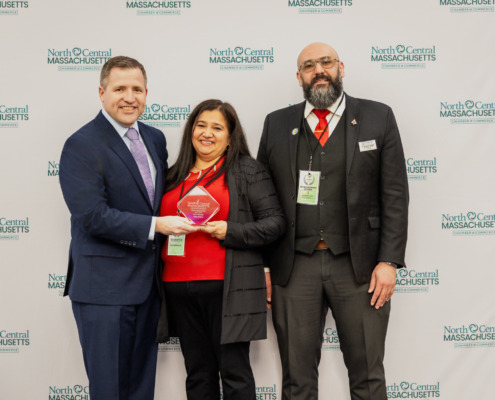

Chamber members are provided with the opportunity to engage with the Mayors of Fitchburg, Gardner, and Leominster who provide updates on projects and other things happening in their Cities. These events are by invitation only, please contact Travis Condon for more details.
View
Event
Bull Run Restaurant215 Great Rd. Shirly, MA
View
Event
Join us for our last Connect North Central of the year!
Friday, December 11, 2026
8am-9am
View
Event
January 14, 20277:15am - 9:00am
View
Event
Erin Logan | NBC 10 Reporter
View
Event
Chamber members are provided with the opportunity to engage with the Mayors of Fitchburg, Gardner, and Leominster who provide updates on projects and other things happening in their Cities. These events are by invitation only, please contact Travis Condon for more details.
View
Event
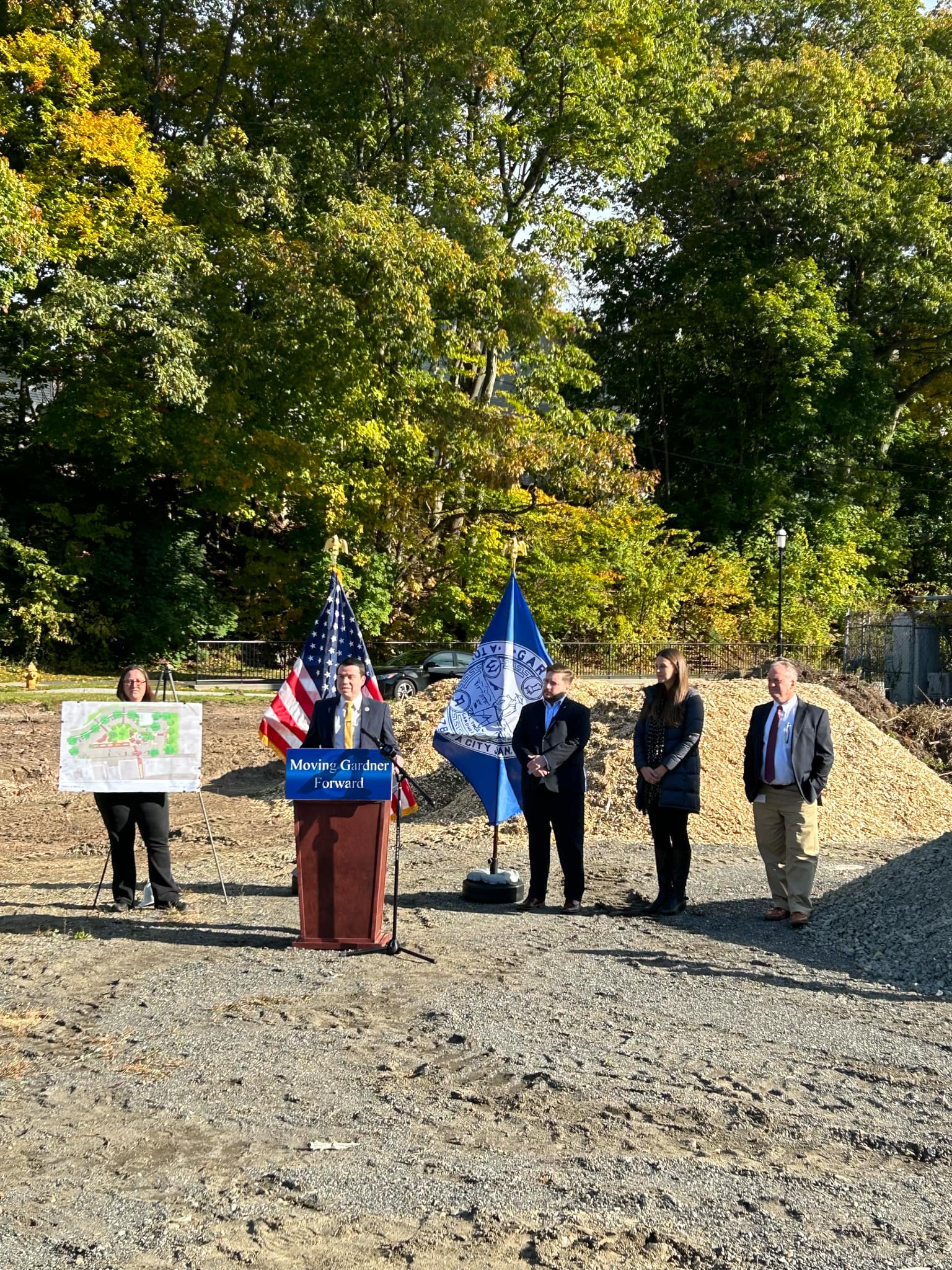
Mayor Nicholson Speaks at Ground Breaking.
On Thursday, October 17, 2024, Gardner Mayor Michael Nicholson, State Representative Jon Zlotnik, City Council President Elizabeth Kazinskas, the Gardner Redevelopment Authority, and officials from the City officially broke ground on the Rear Main Street Revitalization Project in Downtown Gardner.
“This project will be huge for downtown Gardner,” said Gardner Mayor Michael Nicholson. “This almost doubles our parking capacity in the area and creates new amenities for our residents and visitors to the Downtown. With the anticipated housing production we anticipate in the area, and the large number of new businesses opening up in Gardner, this furthers the goals we have of creating a strong and vibrant community.”
The funding for this project comes from the Commonwealth’s MassWorks Grant program that was awarded in 2021 and will be used to construct a new event plaza, food truck parking area, 100 + space unmetered parking lot, and improvements and lighting to the alleyways in the area. This will also allow for rear access to several of the buildings on Main Street and add new
entry ways connecting Main Street to the Rear Main Street – Derby Drive area.
“This project has been many years in the making and still requires more work to bring over the finish line, but today represents another major step in what is a long-term plan to improve downtown Gardner,” said State Representative Jon Zlotnik, who played an integral role in obtaining this funding for the City. “This is a milestone that could not have been reached without City-State cooperation, obviously substantial funding from the State along with interest from private developers. We’re very excited, with this groundbreaking today, to be able to see the fruition of so much work by so many people to redevelop this section of downtown.”
Over the last five years, the City has invested millions of dollars into revitalizing the downtown to breathe new life into the area. From improvements to roadways, sidewalk and lighting replacements, recreational facilities, building renovations, and other projects.
“Phase 2 of the Rear Main St. project opens our community to more vibrance and connection through infrastructure,” said City Council President Elizabeth Kazinskas. “ I am proud that Gardner has grown immensely in the last few years in this exact way. City Councillors are charged with considering a significant investment for a project like this, typically through matching city funds that are related to state and other grants. Representative Zlotnik, Mayor Nicholson, and Director Beauregard have helped meet our taxpayers’ investment through their work on this, and multiple projects like it that benefit our citizens. I am excited for the completion of Phase 2 and couldn’t be happier that it has begun.”
“As the City Councilor for Ward 4 for 7 terms, I am thrilled to be able to witness the revitalization of Rear Main Street come to light,” said City Councilor Karen Harden. “This initiative shows significant growth and new opportunities for the City of Gardner, and I am really looking forward to the positive impact that it will have on our community.”
This project comes as the second phase of the Rear Main Street Revitalization Project. Beginning in 2015, the City of Gardner worked to obtain the properties along Rear Main Street, leading to the construction of the new street on Derby Drive in 2018. Phase 3 of the project is expected into include additional infrastructure upgrades and an apartment complex housing development.
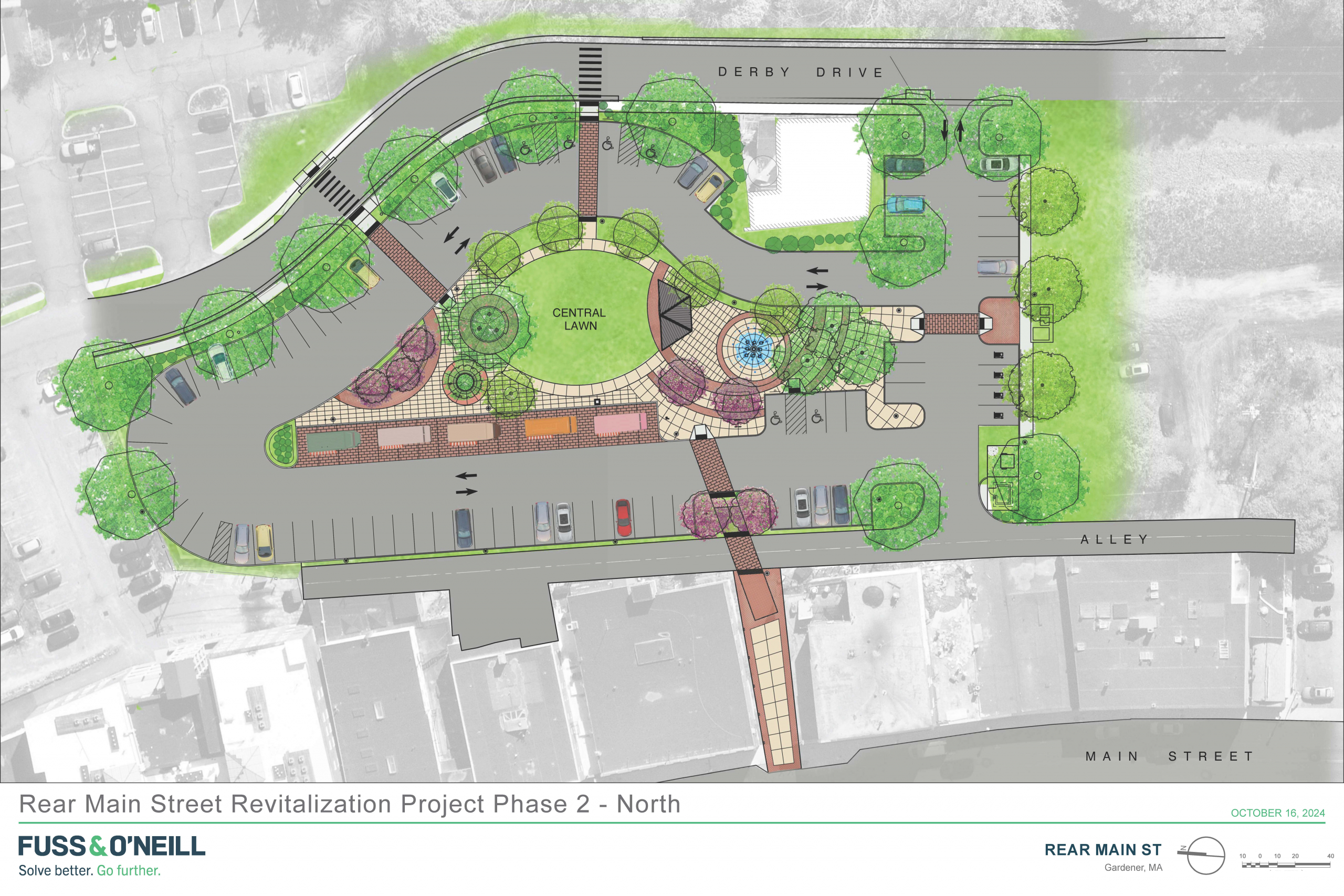
Commenting on the project reaching this milestone, Trevor Beauregard, Director of Community Development and Planning and Executive Director of the Gardner Redevelopment Authority stated, “This project represents the continued partnership between the Commonwealth of Massachusetts, City of Gardner, and the Gardner Redevelopment Authority, with the creation of much needed parking and outdoor amenities in the downtown area to support the public and private investment taking place in our City.” Speaking at the groundbreaking ceremony, Director Beauregard also credited his predecessor, the late Mr. Robert Hubbard, and the late City Councilor Ronald Cormier, who served as Chair of the Gardner Redevelopment Authority for their visions for this project since the concept began in 2006.
“This is a real turning point for Downtown Gardner and the benefits this project will bring to the community are tremendous,” said City Councilor Paul Tassone, who also serves as the Chair of the Gardner Redevelopment Authority. “The Rear Main Street Revitalization Project has been a long time coming and is one of the largest investments the City has made in the downtown area. I would like to thank all of our community partners who made this project possible. Together we’re working to build a stronger community for everyone who lives here”
Construction on Phase 2 of the project is anticipated to last until summer of 2025.
“I’m very proud of the work that we have been able to accomplish in Gardner to revitalize our downtown, invest in our infrastructure, and grow our business community across the City,” concluded Mayor Mike Nicholson. “I’d like to thank our state officials for their continued partnership with Gardner and I look forward to seeing how this project improves the City for years to come.”
As part of ongoing efforts to revitalize Fitchburg and its Main Street, the City desires to create vibrant public spaces that encourage people to congregate and linger in downtown. The City of Fitchburg recognizes downtown lacks public seating and seeks to commission an art installation that would imbed art in the form of permanent seating. The selected artist must have the ability to design, fabricate and install seating that will be located along Main Street. The ideal proposal will include at least two but as many as four seating pieces that encourage people to gather in groups.
Background and Recent efforts:
Fitchburg’s downtown has a long history of supporting public art, with numerous monuments and sculptures in public spaces including the Upper Common and Monument Park. Not only can public art spur economic development as a magnet for growth, it has also been demonstrated to provide important benefits to residents including improved public safety and wellbeing and giving and opportunity for self-expression to historically excluded residents. In recent years, the City has further embraced a wider range of public art as a type of place making, and has strategically set aside funding through its Community Development Block Grant program and other sources, to create public art in downtown, recently through a number of murals. Fitchburg’s downtown will also be the focus of a cultural district currently in the planning phase; and to that end, the City is encouraging arts and culture based businesses to cluster in downtown.
In recent years, several arts and culture initiatives have taken root in the downtown. The Community applied for and received a Creative Cities grant through MassDevelopment and the Barr foundation, this initiative is about to enter its 3rd year and works to foster leadership and partnership in creative for-profit and non-profit activities. Fitchburg Arts Community in currently under construction at the former BF Brown school, bringing 68 units of artist preference housing to the area, and numerous arts organizations are located, or are soon to locate in the downtown including the Fitchburg Art Museum, the Fitchburg Cultural Alliance, the Boulder Art Gallery, Stratton Players, New Players Theater Guild, the Gallery Marque, and Coffee Corp. Numerous festivals are also hosting in the downtown area throughout the year, including Civic Days, the Lights festival, River City Rhythm & Rock Festival, the Forge In, the Brewers Festival, Juneteenth, and the Latino Cultural Festival.
The City seeks to further diversify its public art by creating three dimensional art that the public can directly interact with as seating. Based on feedback from the community and in an effort to plan for a future cultural district designation a request for artistic downtown public seating has been created. This artistic public seating should be highly visible, attractive and engaging, and create a space comfortable for residents and visitors to sit and engage with each other, take pictures, eat outside, and leave a positive impression. This is a collaboration between the city of Fitchburg, the Creative Cities partnership and Intown Fitchburg.
Please see the full call here for more information about the call and how to submit a response.
The Fitchburg Public Library building project, a transformative effort that will create a community resource and destination for the next several decades, commemorated the beginning of the renovation and construction of the library building, located at 610 Main Street, Fitchburg, with a celebratory groundbreaking earlier today.
The ceremony featured remarks from several elected officials and guests, including U.S. Congresswoman Lori Trahan, Massachusetts State Senator John Cronin, Massachusetts State Representative Michael Kushmerek, Fitchburg Mayor Samantha Squailia, and Fitchburg City Council President Anthony Zarella, as well as Massachusetts Board of Library Commissioner George Comeau, Fitchburg Public Library Director Deb Hinkle, and Honorary Co-Chair of the Offering a World of Learning (OWL) Capital Campaign Bob Antonucci. Matt Bruun, chair, Library Trustees, served as master of ceremonies.
“Today is a wonderful day for the City of Fitchburg,” said Hinkle. “As we formally recognize the groundbreaking of this historic project, the future is bright for our library and our community. The new, state-of-the-art library will dramatically improve the space for our children to learn, and our community to engage, create and study. It will truly offer a world of learning for all!”
The project encompasses two major changes, including the renovation of the existing Wallace Library, which was first built in 1967, and the creation of an entirely new children’s space and community learning center. The library will offer a new community room, a variety of meeting and conference spaces, a learning computer lab, a Makerspace, improved access to the library collection, and various seating areas throughout the building to study and engage.
“Our library stands as a cornerstone of education, supporting skill development and sparking a lifelong interest of reading and learning for our children. It serves as a true community hub where everyone is welcome, and we are committed to investing in this essential resource for future generations,” said Mayor Squailia. “While today marks the start of construction, this project is the result of years of collaboration between the city of Fitchburg, the MBLC, our dedicated library staff, and the many supporters of our public library over the years. Together, we have added a new exciting chapter for our community, and I can’t wait to see how this story unfolds.”
Foundational support from the project is provided through a variety of funds, including a $12.5 million total grant award from the MBLC through the Massachusetts Public Library Construction Program. Additional funding is from a combination of the City of Fitchburg’s American Rescue Plan Act funding, which will provide $12 million, and the City of Fitchburg will provide $12 million as part of the city’s capital budget of which the library is included. These commitments cover more than 90 percent of the total project cost, while the remaining $3.5 million will come from private sources through the OWL Capital Campaign.
In addition to the formal speaking event, a traditional groundbreaking ceremony with elected officials, and business and community leaders, as well as members of the Library Trustees and the OWL Capital Campaign Committee, was held.
To learn more about the building project, please visit; https://www.fitchburgma.gov/1028/Building-Project.

When the workday ends and the lights go down, Custom Cleaning Service of Peabody, Inc. gets to work. “We operate as our clients’ silent partner after business hours,” says Adam Paicos, of Templeton, who now serves as Director of Operations and oversees the company’s expansion into North Central MA. “We are not often seen, but we ensure facilities are clean, secure, and ready for business each day while serving as the eyes and ears for our clients when they are not on site.”

Discover local business stories through our Inside North Central Massachusetts Podcast series. Listen as Chamber members share their journeys, insights, and contributions to our thriving regional business community.

Looking for your next opportunity? Explore current job openings from employers across North Central Massachusetts on our Jobs Board. Whether you’re starting a new career or making a change, you’ll find a variety of local positions available to help you take the next step.
CapEx Facility Services & Construction · Leominster, MA
TaraVista Behavioral Health Center · Harvard, MA
DRS Power Technology, Inc. · Fitchburg, MA
AIS · Leominster, MA