E-Newsletter
An Electronic Publication of the North Central Massachusetts Chamber of Commerce

Inside this edition, you’ll discover the latest Chamber initiatives and success stories from across our region. From economic development projects and upcoming networking events to policy updates and workforce training opportunities, we’re keeping you connected to what matters most for your business and North Central Massachusetts.
The North Central Massachusetts Chamber of Commerce is here to help – with trusted resources, a strong business network, and a support system to keep your business and the region moving forward
Fuente del artículo: State House News Service
Author: Matt Murphy
For years, with both Democrats and Republicans in the corner office, the leadership of the Legislature has basically been able to do what it wants.
Speakers and Senate presidents – always Democrats – have controlled enough votes to set the agenda, override vetoes and ignore or compromise with the governor as they see fit. The difference between then and now? They didn’t always talk about it.
Increasingly, however, House and Senate lawmakers are not only frustrated with Gov. Charlie Baker over the things they can’t control, but they’re willing to say it publicly. Lawmakers have been clashing with Baker and his administration on everything from the distribution of vaccines to climate legislation and the return to in-person learning for thousands of young students (though Baker has largely gotten his way on schools).
This week there was more tension over the administration’s urgent request made in February to quickly authorize $400 million in borrowing for the construction of a new Holyoke Soldiers’ Home, and the administration’s plans for billions in discretionary federal relief funding from the “American Rescue Plan.”
“I don’t want to feel like the red-headed stepchild as a member of the Legislature and being left out of this, and I’m sure my colleagues don’t want to feel [that way] about it. And I don’t think we’re going to anymore, hopefully,” said Rep. John Barrett, a former mayor who has been in the executive’s shoes.
Barrett’s commentary was directed at Administration and Finance Secretary Michael Heffernan at an oversight hearing where legislators were demanding to play more of a role in how the federal relief funding gets spent.
Heffernan wouldn’t say, exactly, whether Baker plans to file a budget bill proposing how to spend the relief money, but that’s one way the governor could give back a bit of agency to the Legislature.
Speaker Ron Mariano and Senate President Karen Spilka also came out jointly to say that they would insist municipal employees, including teachers, can take advantage of a proposed COVID-19 paid leave program that is still under negotiation.
The governor supports the creation of the new leave program, but Baker returned the bill last week with several amendments, including one supported by the Massachusetts Municipal Association to eliminate a mandate on cities and towns to offer their workers up to a week of paid-time off to recover from COVID-19, care for a family member or to get vaccinated.
The program, as recommended by Baker, would cover most other employers and state government, but the administration said municipal workforces tend to be “highly unionized” with strong leave benefits already in place.
Speaking of taking time during work hours to get vaccinated, Gov. Baker rolled up his right sleeve on Tuesday and got a dose of Pfizer at the Hynes Convention Center.
“I’m happy to report I feel good,” the 64-year-old said the next day from Revere, where he was touring a different vaccination clinic.
Massachusetts passed a milestone this week with more than 1.5 million people fully vaccinated with either two doses of the Pfizer or Moderna vaccine, or one dose of the Johnson & Johnson vaccine. By the end of the week, the total was actually up above 1.6 million.
But the spread of new variants continues to compete with the vaccine for control of the pandemic’s trajectory, and the number of communities in the high-risk category climbed by 22 this week to 77.
With so many people vaccinated and the general, healthy public a little over a week away from becoming eligible, Baker got asked about the concept of vaccine passes – a digital tool that New York launched and other states are considering to make business reopenings easier.
Madison Square Garden is among the early adopters, but Baker said, “No, no, no,” about plans for something similar in Massachusetts. It wasn’t a no, never. But more of a no, not now.
“I want to vaccinate people. Let’s get people vaccinated,” Baker said. “I think having a conversation about creating a barrier before people have even had an opportunity to be eligible to be vaccinated, let’s focus on getting people vaccinated.”
More than half of the 1.5 million residents who preregistered for a vaccine have been contacted already with a chance to book an appointment, but for the 700,000 people still waiting more locations are being added to the system.
Baker said that two regional collaboratives with vaccine sites in Northampton, Amherst and Marshfield were being added this week to the preregistration system that already connects people with seven mass vaccination sites, and more regional sites would be added this month.
With all the focus on the pandemic and figuring how to get shots in people’s arms, it’s easy to forget sometimes that next year is a gubernatorial election year and under different circumstances Baker might be getting asked daily about his plans.
Harvard professor and political theorist Danielle Allen seems to be inching closer to a run as she announced a beefed up staff with Liberty Square Group and media consultant Josh Wolf among those climbing on board. Wolf ran Steve Grossman’s 2014 campaign for governor.
Meanwhile, declared Democratic candidate Ben Downing overcame some technical glitches to roll out his climate agenda, which includes Massachusetts becoming a 100 percent clean energy state by 2040, or 10 years earlier than Baker and the Legislature set the goal to achieve net-zero carbon emissions.
The jockeying comes as the Democratic Governors Association took an interest this week in Baker’s underwhelming fundraising in March, and really for the whole first quarter, suggesting the incumbent with enduring but diminished popularity may be vulnerable.
Baker raised just $25,456 in March and $102,687 over the first three months of the year, but Lt. Gov. Karyn Polito was more active on the fundraising front and most people assume that if he does decide to run Baker will be able to crank up the money operation quickly.
“The governor and lieutenant governor are focused on managing the pandemic response, not electoral politics,” Baker’s campaign committee spokesman Jim Conroy said.
Next week attention will also turn to managing the state’s finances when the House is expected to release its version of the fiscal 2022 budget. This week’s continuation of strong tax collections in March gave budget writers more reasons to be optimistic about the future.
One additional expense the Legislature will have to plan for, however, is added expenses in the MassHealth program. Over the past year, the MassHealth caseload has increased to more than 2 million individuals, and President Joe Biden’s decision to extend the COVID-19 emergency through 2021 means the state can’t comb its rolls and kick out people who might no longer be eligible.
Secretary Marylou Sudders told the Ways and Means Committees this week that MassHealth’s budget – already the largest slice of the overall pie – might end up being $1.4 billion higher than in the governor’s budget. The Massachusetts Taxpayers Foundation, however, predicted the increased expenses will be more than offset by the enhanced reimbursements the feds are making for Medicaid.
There will undoubtedly be more budgetary surprises in the months to come as the coronavirus and economy continue down their unpredictable paths, but Boston Mayor Kim Janey caught very few people, if anyone, off guard this week when she announced that she would, in fact, seek the job on a more permanent basis.
Janey entering the mayoral contest boosts the field to six serious contenders for City Hall, and the Roxbury resident used perhaps her biggest advantage in the race – the fact that people call her mayor right now – to get out into the city and sell an agenda that included using federal stimulus funding to make buses free in Boston.
Many state and local officials have warned about using relief funding for services that won’t be affordable once the federal aid dries up, but Janey said she was eyeing a pilot to start.
“I understand that there are challenges which is why I hope — at the state level as well as the city level — I am looking at that federal money and I hope our state partners are as well,” she said.
Planning on relocating your business?
Whether you’re relocating your business to our region from another county or state, or you’re simply setting up shop in a different location in our community, moving your business can been downright stressful.
Here’s our top tips for avoiding headaches when moving your business:
Start Planning Early
While it might seem obvious, many ‘hiccups’ that happen during a business relocation can be easily prevented by planning well in advance.
If you’re company is relatively tech-savvy, consider using a cloud-based project planning tool such as Wrike o Zoho to identify everything you need to do to prepare for your move, delegate tasks, and track progress towards moving day.
Remember to list out all the suppliers you use, including utility companies, telecommunications, and even your coffee delivery service – they’ll all need to be contacted well in advance to ensure your services are transferred to your new address so you won’t be left without internet service, heat, or insurance coverage after you move.
Tell Your Clients, Suppliers, and Prospects
Unless your business is entirely online, it’s important to communicate your moving plans with your clients, customers, and suppliers using all your regular communication channels.
For example, if your business is active on social media, be sure to post updates both before, and after your moving day, and add a prominent banner to your website with the same info. Include a flyer with your new address along with any regular mail-outs (such as monthly invoices), post signage at your current location, and update your phone message to remind callers that you’ll be moving.
If you have a bricks-and-mortar location, try to make arrangements to leave information with your new address posted at the office, store, or shop you’re moving from for at least a few months, otherwise, clients may find you missing and mistakenly assume you’ve closed up permanently.
Hire Professional Movers
If your business assets consist of more than just a few laptop computers, hiring a professional moving company to do the heavy lifting is well worth the investment.
Not only will the right moving company take the worry out of moving your physical assets, but having dedicated movers means you won’t be asking your staff to take on the job of lifting and loading boxes, desks, and other big items.
Inform Government Agencies
Keep local, state, and federal agencies such as the IRS appraised as to your location, and your planned move to avoid major headaches and legal expenses.
If you’re moving within the same state you won’t need to change your IRS employer ID number, but you will need to update your address with the feds. You may also need to contact the Secretary of State and the State Department of Revenue, and any permits and business licenses need to be changed at the County offices.
Inspect Everything
Make arrangements to inspect your new location long before the movers arrive – that way you’ll have the chance to identify any deficiencies that could interfere with your operations. If you’re ending a lease, complete a walk-through with the property manager to identify any damage that needs to be repaired, and be sure to get the damage reports in writing.
Fuente del artículo: State House News Service
Author: Michael P. Norton

[Associated Industries of Massachusetts]
Business confidence in Massachusetts surged to an outright enthusiastic level in March, buoyed by COVID-19 vaccination progress and the final passage of a $1.9 trillion federal spending law.
The Associated Industries of Massachusetts’ monthly confidence index shot up by 4.5 points last month, capping a gain of 11.6 points since December. At 60.9 on a scale of 0 to 100, the index now rests comfortably in positive territory heading into the spring, marking a complete reversal from a year ago.
While the state’s unemployment rate remains elevated at 7.1 percent, employers in recent months have continued to add jobs and appear more bullish about economic and vaccination prospects than they are bearish about the ongoing uptick in virus cases, according to the survey of about 140 employers.
AIM’s employer confidence index in March 2020 took its largest monthly tumble in its 30-year history. Since then, it has risen by nearly 21 points and the business trade group pointed to more recent good news — Friday’s report that U.S. employers added 916,000 jobs during March, nearly double February’s gain.
In a statement, AIM President John Regan said the business group was also encouraged that Democratic legislative leaders are not pursuing tax increases this year and recently agreed with Gov. Charlie Baker to a new law reducing the size of unemployment insurance taxes stemming from last year’s historic job losses.
The latest confidence index reading caps a wild swing and puts the index within 8 points of surpassing its all-time high of 68.5, which was hit twice in 1997-98. The index sank to its all-time low not during the pandemic, but in February 2009 as part of the Great Recession.
Michael Goodman, a public policy professor at UMass Dartmouth, said the rising employer confidence also reflects the warmer weather that’s approaching and the loosening of pandemic-related travel and business restrictions “notwithstanding some of the troubling signs of rising infection rates.”
While employers are encouraged that drags on the economy seem to be receding, Goodman identified as risks “anything that might interfere with the rollout of vaccinations” and/or the emergence of coronavirus variants that might be resistant to existing vaccines.
AIM’s Future Index, which measures economic projections six months from now, last month reached its highest level since May 2018 at 64.8, up 3.8 points from February.
Employer optimism may be moderated due to the recent Johnson & Johnson vaccine manufacturing problem and the resumption of COVID-19 lockdowns in European countries, according to Nada Sanders, a supply chain management professor at Northeastern University and member of AIM’s Board of Economic Advisers.
“There are areas of the supply chain that were woefully unprepared for COVID-19,” Sanders said. “Retailers and suppliers, for example, built a supply chain system that was too complex, in which the slightest crack down the line created a large ripple effect. Companies are now addressing those weaknesses but the events of the past week, including the backup of the Suez Canal, may give employers pause.”
State officials plan to release March jobs and unemployment rate data on Friday, April 16. Also on next week’s calendar: the likely release of a House Ways and Means Committee rewrite of Gov. Charlie Baker’s $45.6 billion fiscal 2022 budget. Baker’s budget called for a slight drop in overall state spending.
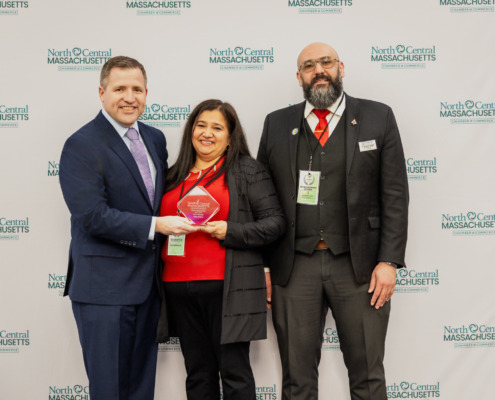

Chamber members are provided with the opportunity to engage with the Mayors of Fitchburg, Gardner, and Leominster who provide updates on projects and other things happening in their Cities. These events are by invitation only, please contact Travis Condon for more details.
View
Event
Bull Run Restaurant215 Great Rd. Shirly, MA
View
Event
Join us for our last Connect North Central of the year!
Friday, December 11, 2026
8am-9am
View
Event
January 14, 20277:15am - 9:00am
View
Event
Erin Logan | NBC 10 Reporter
View
Event
Chamber members are provided with the opportunity to engage with the Mayors of Fitchburg, Gardner, and Leominster who provide updates on projects and other things happening in their Cities. These events are by invitation only, please contact Travis Condon for more details.
View
Event

“We would like to thank our wonderful employees and Board of Directors for their support, generosity and kindness during this difficult year. We know that with this $15,000 donation, the United Way of North Central Massachusetts will be able to help so many individuals and families in our communities,” stated Barbara Mahoney, President & CEO, Leominster Credit Union.
The United Way of North Central Massachusetts has continued to work tirelessly to improve the lives in the communities in which we work, live, and serve by providing services focused on health, education, and financial wellness.
“On behalf of those we serve, I’d like to thank the Leominster Credit Union team for their continued support and partnership. As the need for food, heat, and housing support increases due to the recent pandemic, we need all hands-on deck to support those most impacted. The financial support from LCU will go a long way in our work to support our friends and neighbors in need and is just one of many ways LCU continues to demonstrate a clear commitment to our community,” said Kory Eng, President & CEO, United Way of North Central Massachusetts.
For more information about the United Way of North Central Massachusetts and how to donate, please visit https://uwncm.org/.
FITCHBURG, Ma., November 30 – Workers Credit Union has received the 2020 Spirit of North Central Award for Corporate Leadership of the United Way annual campaign. During the United Way’s Annual Meeting held earlier this fall, Workers was honored along with three other local businesses.
The award recognizes corporate partners that embody an overall spirit of giving through contributions of time, leadership and resources in support of United Way of North Central Massachusetts’ work. The recipients demonstrated excellence during a particularly challenging time through robust volunteerism and participation in the United Way workplace campaign. Each year, Workers Credit Union employees participate in the United Way in a variety of ways: payroll contribution, Day of Caring volunteerism, and employee-led fundraisers throughout the year.
“Receiving this award from the United Way is a testament to our employees’ dedication to the community and the overall culture here at Workers Credit Union. Each year, we are able to collectively donate thousands of dollars to support the important work of the United Way and help build a stronger North Central Massachusetts. I am proud to work with such caring people,” said Doug Petersen, president and CEO of Workers Credit Union.
“It’s more important than ever to support our local organizations to ensure they can continue to provide relief to the community,” said Tim Smith, Chief Financial Officer of Workers Credit Union and Vice Chairman of the Board at the United Way North Central Massachusetts. “We hope other businesses will join us in sponsoring the United Way for the 2020-2021 campaign year.”
Donations toward the United Way of North Central Massachusetts can be made at www.uwncm.org.
Workers Credit Union, a $2 billion federally-chartered credit union headquartered in Fitchburg, MA, is a member-owned financial institution with full banking services to meet a lifetime of financial needs, including the Workers Way™ and the GiveBack program. With branches in Athol, Chelmsford, Fitchburg, Gardner, Groton, Hudson, Lancaster, Leominster, Lunenburg, Orange, Townsend, Westford and Worcester as well as online, mobile, telephone, and video-teller banking, Workers proudly serves more than 106,000 members.

When the workday ends and the lights go down, Custom Cleaning Service of Peabody, Inc. gets to work. “We operate as our clients’ silent partner after business hours,” says Adam Paicos, of Templeton, who now serves as Director of Operations and oversees the company’s expansion into North Central MA. “We are not often seen, but we ensure facilities are clean, secure, and ready for business each day while serving as the eyes and ears for our clients when they are not on site.”

Discover local business stories through our Inside North Central Massachusetts Podcast series. Listen as Chamber members share their journeys, insights, and contributions to our thriving regional business community.

Looking for your next opportunity? Explore current job openings from employers across North Central Massachusetts on our Jobs Board. Whether you’re starting a new career or making a change, you’ll find a variety of local positions available to help you take the next step.
CapEx Facility Services & Construction · Leominster, MA
TaraVista Behavioral Health Center · Harvard, MA
DRS Power Technology, Inc. · Fitchburg, MA
AIS · Leominster, MA