E-Newsletter
An Electronic Publication of the North Central Massachusetts Chamber of Commerce

Inside this edition, you’ll discover the latest Chamber initiatives and success stories from across our region. From economic development projects and upcoming networking events to policy updates and workforce training opportunities, we’re keeping you connected to what matters most for your business and North Central Massachusetts.
The North Central Massachusetts Chamber of Commerce is here to help – with trusted resources, a strong business network, and a support system to keep your business and the region moving forward
Governor Baker signed legislation (“An Act financing a program for improvements to the Unemployment Insurance Trust Fund and providing relief to employers and workers in the Commonwealth”) that provides relief for employers and employees across the Commonwealth.
This bill will freeze the unemployment insurance (UI) experience rate schedule for employers in 2021 and 2022 and thereby prevent a more significant tax schedule increase. The bill also ensures that loans forgiven as part of the Paycheck Protection Program, as well as Economic Injury Disaster Loan (EIDL) advances, are excluded from taxable income for individual taxpayers. Please note this applies only to the 2020 taxable year. The bill also requires that employers provide a week of paid sick leave to employees that have become ill with COVID, are caring for a family member that has become ill with COVID, is receiving an immunization, or has to isolate due to COVID exposure, or is caring for a family member in quarantine. The Governor did propose two clarifying amendments on this topic for consideration by the legislature. Please find the bill text here.
Fuente del artículo: State House News Service
Author: Matt Murphy
If Massachusetts used to run on Dunkin’, it now runs on Pfizer, and Moderna, and Johnson & Johnson.
The state’s long-term prognosis remains inextricably wrapped up in the ability of state and federal government, pharmacies and health care providers to administer as many shots as possible as fast as possible.
But even as vaccine supply grows and the number of Massachusetts residents fully vaccinated eclipsed 1.37 million this week, the coronavirus appears to be catching up in the arms race against the vaccine and a lot is riding on who wins out.
“Right now I’m scared,” said Centers for Disease Control and Prevention Director Rochelle Walensky, describing her sense of “impending doom” about the rise in cases in states like Michigan and New York and, yes, Massachusetts.
Walensky’s emotional plea for vigilance came the day before she came back to Massachusetts, where she lived and worked before joining the Biden administration, to tour the new FEMA-supported mass vaccination site at the Hynes Convention Center. The Hynes site replaced Fenway Park, where baseball returned on Friday, and FEMA’s involvement means there will be enough vaccine to administer 7,000 doses a day at the Back Bay center, up from the 1,000 shots a day the state was doing alone.
The state next week will use some of the additional FEMA supply to deploy mobile vaccination units in Chelsea, Revere, Boston, New Bedford and Fall River.
But even Baker acknowledged this week that the positive trends that led him to open up venues like Fenway for limited spectators were going in the wrong direction.
The seven-day average of new COVID-19 cases detected daily was up 29 percent on March 30 from March 8 to 1,888, schools reported their highest ever weekly caseload of 1,045, and the number of communities in the high risk category increased for the third straight week to 55. Almost half of the new cases were recorded in residents under 30, many of whom have to wait a few more weeks to become vaccine eligible.
“I think it’s fair to say that no one can let their guard down with respect to this virus,” Baker said.
The good news is that the administration is expecting a major influx of Johnson & Johnson vaccine next week – more than 100,000 doses – and does not believe the mixup at the Baltimore manufacturing facility that spoiled 15 million doses will impact that delivery.
Baker has gotten beaten up by legislative Democrats in recent weeks for his handling of the pandemic, and in particular the vaccine rollout, but Walensky was unwilling to second guess the Republican, at least to his face, and most Massachusetts residents, according to a new poll, are willing to cut him some slack.
The newest Boston Globe/Suffolk poll found that 71 percent of residents approved of the governor’s handling of the pandemic. He got lower numbers for his vaccine effort – 58 percent approved – but 67 percent said they support the job Baker is doing overall.
So as the first fundraising quarter came to a close this week, Baker, the polling suggests, remains in the catbird seat should he choose to seek a third term.
Ben Downing, so far the most prominent Democrat in the 2022 race for governor, reported raising $227,712 in the eight weeks since he entered the race on Feb. 8. This week he picked the issue of colleges withholding transcripts from students for unpaid bills to go after Baker for underfunding higher education.
Another potential gubernatorial contender in 2022 also had college students on her mind this week. Attorney General Maura Healey hosted U.S. Sen. Elizabeth Warren and U.S. Rep. Ayanna Pressley to help call on President Joe Biden to use his executive authority to forgive up to $50,000 in student loan debt for federal student borrowers.
Biden’s chief of staff told POLITICO the president was undecided on what to do with respect to student debt, despite Biden previously saying he thought Congress, not the White House, should act. “Well that’s great,” Pressley said in response.
The next generation of student borrowers also found out this week that they won’t have to pass the MCAS exam in order to graduate in 2022 under a plan put forward by Education Commissioner Jeff Riley that would scale back the state’s standardized testing program during the pandemic. It didn’t go far enough for the Massachusetts Teachers Association and other critics who would like to see MCAS postponed completely this spring until next year.
While Biden waits for more legal guidance on his authority to address student debt, his administration – including Labor Secretary Marty Walsh – was busy rolling out and beginning to sell a more than $2 trillion infrastructure package.
U.S. Rep. Stephen Lynch said that given the clout of the Massachusetts delegation and the seats it holds on the Transportation Committee, a package that large could be a feeding frenzy for Massachusetts road, bridge and rail projects.
Any infrastructure funding would come in addition to billions of dollars on its way from the “American Rescue Plan,” which lawmakers began to pick apart this week. The House Committee on Federal Stimulus and Census Oversight held its first oversight hearing this week where Bharat Ramamurti, deputy director of the National Economic Council, said details about how state and local governments can spend the money will come by early May.
That committee will be back at it next week with Administration and Finance Secretary Michael Heffernan expected to testify.
But with the exeception of hearings like this, the process of committees reviewing the thousands of bills filed by lawmakers on Beacon Hill this year has been slow to start, with most pieces of legislation still waiting to be assigned.
In contrast, the Legislature has picked up its oversight game.
There have been stimulus oversight hearings and two explorations of the COVID-19 vaccine rollout. The special oversight committee probing the early pandemic outbreak of COVID-19 at the Holyoke Soldiers’ Home is seeking to extend its investigation and has invited former Veterans’ Services Secretary Francisco Urena to testify next week.
And now the Committee on Children, Families and Persons with Disabilities says it will hold an oversight hearing into a troubling report from Child Advocate Maria Mossaides that found the Department of Children and Families missed the signs of abuse and neglect that led to the Oct. death of 14-year-old David Almond in Fall River.
That’s not to say the Legislature has been completely dormant, and House and Senate leaders may want to act quickly on Baker’s proposed amendments to a COVID-19 sick leave program that the governor returned at the same time he signed a tax relief bill for businesses and those who were unemployed over the past year. The new law offers tax breaks on unemployment benefits and limits rate increases on employers for unemployment insurance, but Baker recommended a few modifications to the sick leave program before he’s ready to sign off on that too.
“Providing paid sick leave is crucial to protecting our workforce and preventing the further spread of COVID-19. The House and the Senate will continue to prioritize this issue and will work together to review the amendments and return the bill back to the Governor’s desk,” two spokespeople for Speaker Ron Mariano and Senate President Karen Spilka said in a statement.
While it’s not a legislative oversight committee, the new Peace Officer Standards and Training (POST) Commission will have oversight of police officers around the state, and the law enforcement community learned this week who will sit in those nine seats.
Former Massachusetts Superior Court Judge Margaret Hinkle was tapped by Baker to chair the commission, and Baker and Healey filled in the remaining seats in accordance with the landmark reform law passed in the aftermath of the killing of George Floyd.
Incidentally, the commission took shape the same week that former Minneapolis police officer Derek Chauvin went on trial for Floyd’s murder.
In an effort to gain an accurate assessment of COVID-19’s ongoing impact to businesses in North Central Massachusetts, the North Central Massachusetts Chamber of Commerce is conducting this new survey. This is the third in a series of surveys conducted since the onset of the pandemic to capture fresh data and evaluate the impact of the pandemic over time. The first two surveys were very helpful to our response to the pandemic. The Chamber is partnering with the MassHire North Central Massachusetts Workforce Board, Montachusett Regional Planning Commission, NewVue Communities and many of the cities and towns in the region on the distribution of this survey. Please take a moment to complete the survey. The survey is estimated to take between six to ten minutes to complete. All information will be reported in general terms and individual business information will remain confidential.
Please feel free to contact the Chamber at 978.353.7600 or via email at with any questions or concerns.
Thank you in advance for your participation.



Thank you to the following communities and organizations for helping to distribute the survey to businesses and organizations:
City of Gardner Town of Harvard
City of Fitchburg Town of Westminster
City of Leominster Town of Lancaster
Town of Clinton Town of Barre
Devens Community Orange Community
Pepperell Community Town of Winchendon
Town of Athol Town of Townsend
Town of Ayer Making Opportunities Count
Town of Lunenburg Center for Women & Enterprise
Enterprise Bank Fitchburg Redevelopment Authority
Reimagine North of Main Town of Ashby
Town of Templeton
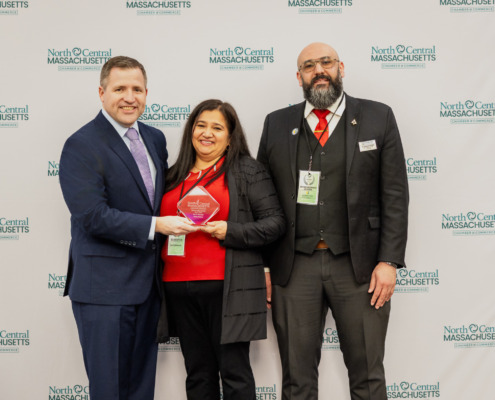

The reception features an open bar and gourmet appetizers.
View
Event
Join us for Connect North Central
Friday, September 25, 2026
8am-9am
View
Event
North Central Golf Tour Championship: Fore the Future
An FLNC Non-Traditional Scholarship Fundraiser
View
Event
Thank you Series Supporting Sponsor empHowered PR
View
Event
Join us for our 11th Annual
Congressional Luncheon
View
Event
Wednesday October 28, 2026
5:00pm - 7:00pm
View
Event
Join us for this in person HR Legal Update
View
Event
November 19, 2026
7:15am - 9:00am
View
Event
Chamber members are provided with the opportunity to engage with the Mayors of Fitchburg, Gardner, and Leominster who provide updates on projects and other things happening in their Cities. These events are by invitation only, please contact Travis Condon for more details.
View
Event
Bull Run Restaurant
215 Great Rd. Shirly, MA
View
Event
Join us for our last Connect North Central of the year!
Friday, December 11, 2026
8am-9am
View
Event
Chamber members are provided with the opportunity to engage with the Mayors of Fitchburg, Gardner, and Leominster who provide updates on projects and other things happening in their Cities. These events are by invitation only, please contact Travis Condon for more details.
View
Event
Local company QB1 Mentality and American Football for African Mission (AFFAM) are excited to announce a partnership that will be pivotal for quarterback development in Africa. This venture will give opportunities to deserving youth athletes that were not possible prior.
Technology is playing an increasingly critical role in every aspect of business in the current landscape. This partnership brings together deep skills in quarterback development and technology in hopes to create a new avenue of success for our friends in Africa.
“Partnering with AFFAM to help expand the game of football and develop quarterback play in Africa is a dream come true,” said Christian Lopez, CEO of QB1 Mentality and quarterback/defensive back coach at Leominster High School. “Together, working as one team, we will unlock the full potential of as many quarterbacks as possible, while assisting them on the best path for their success.”
QB1 Mentality and the AFFAM are both very excited for this new journey and to expand more opportunities to young athletes.

place in the “Granola” category at the 2020 Artisan Flave Awards. Organized by the International Flavor Awards LLC, the competition included specialty, craft-made artisan granola
companies from around the world. Golden Girl Granola’s Forest Maple flavor received excellent reviews on an international stage to become a Flave Award winner. Last year Golden Girl Granola’s Chocolate Decadence was the third-place winner among the world’s best.
The Flave Awards is an annual premiere culinary competition providing small to medium sized businesses an opportunity to showcase their original products and be recognized for their talents. As an organization, the International Flavor Awards provides impartial and knowledgeable judging of food and beverage products throughout a variety of genres and themes. Businesses from Europe, Australia, North and South America submitted their products in the international competition. Those who receive awards set themselves apart by being known as a “Flave Award Winner.”
“We are honored to receive this award and recognition for our Forest Maple granola.” said Deborah O’Kelly, owner of Golden Girl Granola. “The Flave Awards is a great competition that features some of the best artisan food products in the world. We are thrilled that our granola is once again recognized for its quality.”
About Golden Girl Granola:
Golden Girl Granola™ is a family-owned and -operated business located in Shirley, Massachusetts that produces a branded line of gourmet granola products superior in taste and made from the highest-quality ingredients. Golden Girl Granola is a “Healthy Snack” alternative for health-conscious consumers who appreciate good taste. Flavors include Forest Maple, Creative Cranberry, Bluesberry, Chocolate Decadence, Original, Home Sweet Honey, and Truly Tropical. Golden Girl Granola offers the complete line nationwide for chain supermarkets, independent supermarkets, gourmet food stores, club stores and convenience stores.

When the workday ends and the lights go down, Custom Cleaning Service of Peabody, Inc. gets to work. “We operate as our clients’ silent partner after business hours,” says Adam Paicos, of Templeton, who now serves as Director of Operations and oversees the company’s expansion into North Central MA. “We are not often seen, but we ensure facilities are clean, secure, and ready for business each day while serving as the eyes and ears for our clients when they are not on site.”

Discover local business stories through our Inside North Central Massachusetts Podcast series. Listen as Chamber members share their journeys, insights, and contributions to our thriving regional business community.

Looking for your next opportunity? Explore current job openings from employers across North Central Massachusetts on our Jobs Board. Whether you’re starting a new career or making a change, you’ll find a variety of local positions available to help you take the next step.
CapEx Facility Services & Construction · Leominster, MA
TaraVista Behavioral Health Center · Harvard, MA
DRS Power Technology, Inc. · Fitchburg, MA
AIS · Leominster, MA