E-Newsletter
An Electronic Publication of the North Central Massachusetts Chamber of Commerce

Inside this edition, you’ll discover the latest Chamber initiatives and success stories from across our region. From economic development projects and upcoming networking events to policy updates and workforce training opportunities, we’re keeping you connected to what matters most for your business and North Central Massachusetts.
The North Central Massachusetts Chamber of Commerce is here to help – with trusted resources, a strong business network, and a support system to keep your business and the region moving forward
You want to grow your local business and treat your employees and customers right. But sometimes it’s hard to keep your mind focused on what you know you should be doing. We understand how easy it is to fall into doubt, worry, or even mental paralysis, especially when everything around you feels wrong somehow.
But we believe in you and in your business. That’s why we’ve put together this list of tips to help you keep your mindset in the right place and stay focused on the things that matter most right now. Take a look.
If your mental intake is focused on doom, gloom, and uncertainty, your mindset isn’t going to be a healthy one. Instead, give yourself permission to step away from current news, and open your mind to healthier input. That might be anything from funny YouTube videos to a chapter of a novel you’ve been meaning to read for years. You’ll return to your tasks with a healthier mindset and renewed energy.
Thinking about others and what they need is a sure-fire way to get your mindset right. Whether it’s overtipping your food delivery person with a kind note, checking in with the cleaning staff at your business to make sure they’re okay, or driving by a child’s house to wave them a happy birthday, you’ll feel stronger when you express generosity and thoughtfulness to others.
It’s easy to think of your mind as something separate from your body, but times of crisis make it clear how very interconnected they are. Stop every hour to spend 30 seconds breathing deeply. Even if you can’t go to the gym, take a walk or do some light exercises at home. While a little comfort food is understandable, don’t neglect the veggies and fruits that give you the vitamins and nutrients you need to stay healthy. And allow yourself to go to bed a bit earlier or sleep in a bit later to help boost your immune system as well as your mindset.
Some people use lists to stay in control of their world — and it’s also a good way to keep your mind focused. More broadly, it can also be helpful to write down how you’re feeling in a time when everything feels a bit off. Write down the best and worst-case scenarios to keep your mind from spinning in circles, or start a journal to chronicle what you’re going through. Often the act of writing something down on paper (or on a screen) can help you purge the associated feelings and get your mind back in gear.
When you adjust your mindset by focusing outward rather than on what seems wrong, you improve not only your own sense of focus but also your relationships with those around you. Bypassing the negative messages that sometimes seem to assault your mind to focus on the positive instead can help you face whatever comes next with hope and determination.
More than a year into the COVID-19 pandemic that has wreaked havoc on a national, statewide and local scale, some economic forecasters say there is a light at the end of the tunnel.
Speaking at the 9ta annual Economic Forecast sponsored by the North Central Massachusetts Chamber of Commerce, Dr. Bo Zhao, a senior economist with the Federal Reserve Bank of Boston, said he is hopeful that continued public health measures, and a robust vaccine rollout will help spur an economic revitalization.
“Despite high uncertainty ahead, there are several reasons for cautious optimism about the medium-term economic outlook, including effective vaccines, favorable financial conditions, rising asset prices and a resilient housing market,’’ Zhao said.
Simon Anderson, an international futurist speaker, highlighted segments of the economy that he thinks will see significant growth post-pandemic, including local experiences and products like outdoor recreation, farms, restaurants, and breweries, all of which could be a boon for North Central Massachusetts.
“People are going to want to go to the apple orchards, get some freshly made cider, pick some apples, go to a craft brewery, just be with some friends in person, go to a restaurant, shop at a local store in their neighborhood,’’ Anderson said. “I think this is going to drive up demand for local experience, which is going to be just great for small businesses.’’

Click to enlarge
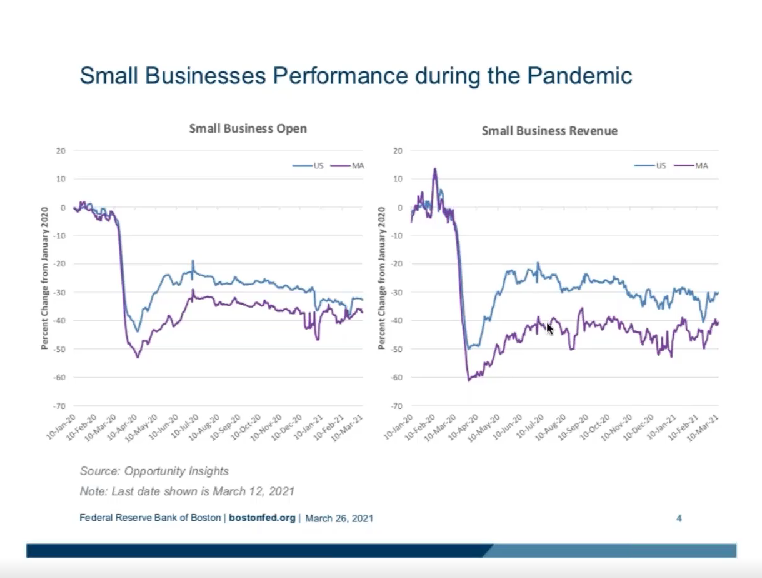
That demand cannot come soon enough for local business hit hardest by the pandemic. Zhao said in Greater Worcester, only trade/transportation/utilities maintained a similar level of employment during the pandemic.
Leisure and hospitality, which includes restaurants, movies and hotels, had the largest one-year drop in job loss among all sectors at 24.5 percent. He said those types of jobs cannot be done remotely and were most impacted by government restrictions.
But there are positive signs, Anderson said, such as the number of applications for new restaurants.
According to the National Restaurant Association, COVID forced the closure of 110,000 eateries, representing 1 in 6 establishments in the United States. But in just the first two months of 2021, 50,000 new applications for food establishments were submitted for new restaurants, Anderson said.
“Those new businesses will be so much more adaptive and ready for challenges because of what they’ve seen and been through,’’ Anderson said.
This year’s Economic Forecast, held virtually due to the ongoing pandemic, is held annually to give the community and business leaders a look into the economic future of the region. Video of the webinar is available for replay on the chamber’s website.
Chamber President and Chief Executive Officer Roy Nascimento welcomed attendees to the webinar, which he said is traditionally one of the signature business events of the year.
As March 2021 marked the one-year point of the pandemic, Nascimento said it remains critically important for the business community to stay informed and connected.
Since the start of the pandemic, the chamber has held over 100 online programs designed to inform, educate and connect members.
Friday’s webinar was intended to provide insight into the economy and what post-COVID life will look like. Lauren Howe, principal and owner of empHowered PR LLC in Leominster, served as master of ceremonies, introducing the speakers and reading questions from attendees submitted online.
Click to enlarge
Anderson highlighted segments of the economy that could see significant growth post-pandemic. One of his key “Emerging Opportunities’’ focused on how businesses could capitalize on the shift to remote to build their business and benefit consumers.
Telehealth, Anderson said, has been a true success story for patients and doctors alike.
“You have a lot of people now that can access their health care via zoom, via Facetime or online,’’ he said. “That’s a really incredibly positive trend because a lot of people have transportation challenges and mobility challenges and miss appointments for their doctor because they can’t get there.’’
Anderson said the shift to telehealth and also remote education would have taken a lot longer if it wasn’t forced.
“It was very difficult in the beginning, but I think we will see a lot of positive outcomes going forward,’’ he said.
Anderson said e-commerce has been another bright spot that will continue to grow. In 2020, there was a 45 percent increase in e-commerce compared to the traditional 15 percent spike.
Retailers have adapted through curbside and delivery, allowing them to expand their customer base.
“Even though we were hit so hard with this pandemic with a lot of small businesses especially, I truly believe we are going to come back a lot stronger,’’ Anderson said.
And with more people working from home and traveling less, there will be more demand for local experiences and products, Anderson said. Another benefit of people working from home is that local businesses will be able to cast a wider net for employees who may not want to commute or move to the region.

Click to enlarge
Other emerging opportunities, according to Anderson, are the electrification of transportation; advancements in automation; and blockchain tech and digital currency.
According to Zhao, another positive has been the housing market.
He said historically low interest rates, a strong stock market and low supply created an upward pressure in the market.
The Chamber will be holding its annual Real Estate Summit on May 18 this year. This event, a collaboration between the Chamber and the North Central Massachusetts Association of Realtors, will provide an in-depth look at the real estate market in the region.
All in all, after a decline in 2020, the U.S. economy is expected to have a strong recovery in 2021, Zhao said. Unemployment projections also show positive trends, he said, however they could still remain higher than pre-pandemic levels.
He is also hopeful that the recovery from this crisis will be faster than previous downturns because it has been driven by a public health crisis and not economic triggers.
“People should feel cautiously optimistic, but we have to keep in mind that this is a brand-new virus and there is still a lot of uncertainty,’’ Zhao said.
To learn more about the North Central Massachusetts Chamber of Commerce, please visit www.NorthCentralMass.com or contact the Chamber at 978.353.7600.

Fuente del artículo: State House News Service
Author: Matt Murphy
The Democratic sharks are circling, sensing vulnerability in a Republican governor with few teammates to protect his flank. But even if Gov. Charlie Baker looks like easy prey to some in a state like Massachusetts, Democrats on Beacon Hill are unpracticed hunters.
“We know he’s a RINO anyway,” joked Sen. Nick Collins during his resurrection of the South Boston St. Patrick’s Day breakfast last Sunday, alluding to the fact that Baker is actually more popular with Democratic voters than Republicans.
Collins brought back the breakfast after a one-year COVID-19 hiatus at a time when his own political ambitions for City Hall, still shrouded in mystery, were ripe for roasting. And while it may have been even less clear if the attempts at jokes landed in the virtual realm, the live-streamed, green-themed breakfast jump-started a week during which good-natured ribbing would quickly give way to intentional and, at times, pointed jabs.
The Committee on COVID-19 and Emergency Preparedness and Management held its second oversight hearing on Tuesday with a clear objective — challenge Baker’s decision not to rely more on local boards of health for vaccination distribution.
Even as Massachusetts has climbed the state rankings for shots administered, the choice to administer many of those shots at mass vaccination sites instead of through local clinics and municipal public health infrastructure is the hill some in the legislature have chosen to plant their flag.
Democrats accused him of throwing out the playbook right before the big game, and spending millions on private-run facilities when that money could have been used to scale up locally-run clinics.
Baker stood his ground, suggesting he is acting off the same script being used by the BIden administration and pointing out how privately operated mass vaccination sites aren’t even the largest distributors of vaccines in Massachusetts. Hospitals are.
The governor said local disaster plans weren’t developed to deliver a vaccine of limited quantity with very specific cold-storage requirements and a short shelf life. And he and Health and Human Services Secretary Marylou Sudders said that while some local health agencies, like the ones invited to testify, may have been equipped to administer COVID-19 shots, hundreds of other boards of health were not and made that clear when they didn’t raise their hands to help vaccinate their own first responders or the 75+ population.
The defense didn’t sit well with Baker’s critics on the committee: “What we’re getting from you is, ‘You’re all wrong, we’re doing great, please, we don’t want to hear it anymore.’ And I find that hard to take,” said an exasperated Sen. Cindy Friedman.
For much of the hour, lawmakers monologued and Baker scribbled notes off screen. Some shots landed and others missed the mark, like when Baker had to explain that he didn’t control how many doses go to retail pharmacies.
And at the end of a long day, it was unclear if any progress had been made: “The stark differences between the testimony received demands that we dig deeper and understand better why decades of public investment in emergency preparedness have been shelved in favor of another approach, hastily constructed during a global pandemic,” Driscoll and Comerford said in a post-hearing statement.
While the theme of the hearing was to dunk on mass vaccination sites, the idea of a federally supported site, and the thousands of extra does that come with it, was one that seemed to hold some interest for Democrats.
Rep. William Driscoll appeared very curious to know when exactly the state had applied for one of these FEMA run sites, which was announced in February when the delegation sent a letter of support to the Biden administration.
On Friday, the White House and Baker announced that the newest state-run mass vaccination site at the Hynes Convention Center would be supported with an additional 6,000 doses a day from the federal government, raising the daily capacity of the site to 7,000.
The FEMA sponsorship of the Hynes was one of several good-news announcements about supply this week that also brought word of 40,000 additional doses of the one-shot Johnson & Johnson vaccine. The J&J increase prompted Baker to launch a locally-supported vaccination program to reach homebound residents.
Everyone agrees the faster the vaccine arrives and gets put into arms, the sooner the state can emerge from the year-long pandemic. That’s why Baker’s hiring of McKinsey & Co. to write a report about the “future-of-work” has generated so much interest.
But Attorney General Maura Healey’s interest in the report this week had nothing to do with her curiosity to learn what the global consulting firm recommends. Healey, who is being watched like a hawk for hints at her political future, went after Baker for hiring McKinsey after her office and others around the country reached a settlement with the firm last month for $573 million over its role in helping Purdue Pharma “turbocharge” opioid sales to turn a profit.
The “future-of-work” contract is one of many the firm holds with the state, and Healey called it “outrageous” that Massachusetts would continue to give them business. One of her opening salvos in the 2022 gubernatorial campaign? Maybe. But even a visit by the attorney general to a picket line in Worcester these days is cause for speculation.
Before Boston voters even get to 2022, they will have to choose a new mayor in the fall and it won’t be Marty Walsh … Labor Secretary Marty Walsh.
Wheeling his suitcase through Logan Airport and clutching a cup of Doughboy Donuts coffee, Walsh left Boston for Washington, D.C. on Tuesday, the morning after the U.S. Senate confirmed his nomination to lead the Labor Department. He officially resigned as mayor at 9 p.m. on March 22, handing the reins of the city over to Kim Janey, the former City Council president who became the first woman and Black resident of Boston to be able to call themselves mayor.
Whether Janey will seek extend her historic elevation as mayor beyond the next eight months remains to be seen, but given the current field it would appear the long-running hold on the office by Irish and Italian men will soon be broken.
Janey takes over a city where the school department was granted a waiver by Education Commissioner Jeff Riley to delay its return to in-person learning for K-8 students until April 26. Boston was one of at least 60 districts given a reprieve from the April 5 deadline to bring elementary students back to the classroom.
House Speaker Ron Mariano told the Greater Boston Chamber of Commerce that the waiver process was important because ultimately it should be the local districts deciding when it’s safe to return to school.
The speaker has largely sided with the teachers’ unions in their dispute with Baker over classroom safety. But overall, Mariano said the governor has worked “very effectively” with the Legislature through the pandemic, and used his executive powers “extremely well” apart from some well documented “hiccups” with the vaccine rollout.
Baker even put his name this week on a game-changing climate bill that will put Massachusetts on the path to net-zero carbon emissions by 2050 after working with lawmakers to make small but important adjustments.
The new climate law also directs another massive 2,400-megawatt procurement of offshore wind power. And that was actually what Mariano wanted to talk to the GBCC about.
The speaker announced that the forthcoming House budget proposal would direct $10 million through the Clean Energy Center to train workers for careers in offshore wind, and he promised to pursue a “large-scale” bonding effort to secure the South Coast’s position as the regional hub of the offshore wind industry.
Mariano also said he wasn’t in any rush to return to debate over raising taxes to pay for transportation, at least not until the pandemic aftershocks subside and leaders can take stock of the MBTA and its new needs.
Besides, he said, there’s $1 billion coming to Massachusetts from the “American Rescue Plan” for public transit and $4.5 billion more in direct aid for state government that changes the calculations.
Walsh’s Dorchester successor in the House, Rep. Dan Hunt, will lead a hearing next week to dive into the pot of gold that is the latest stimulus package, and already Baker has committed $100 million to Chelsea, Everett, Randolph and Methuen where leaders have said federal funding formulas shortchanged those hard-hit cities because of their size.
House and Senate leaders have said they want to exert more control over how this newest round of stimulus gets spent, but Mariano said he agrees that those communities should be supported, and believes there may be more cities and towns deserving.
With unemployment ticking down to 7.1 percent, the House and Senate also agreed that workers unemployed over the last year are deserving of a new tax deduction on their first $10,200 in unemployment benefits.
The more expensive Senate version of the tax break was part of a bill that will limit the hit to businesses of unemployment insurance rate hikes this year and extend additional COVID-19 sick leave to Massachusetts workers.
The legislation was enacted Thursday, along with a piece of the joint rules setting up committees like the Joint Bonding Committee so that a $400 million borrowing bill to rebuild the Holyoke Soldiers’ Home can be advanced.
And while there were few objections to substance, Sen. Diana DiZoglio and Sen. John Keenan again had a few concerns with process.
“State House News knew before the members of this body knew what we were going to be doing,” said a miffed Sen. DiZoglio.
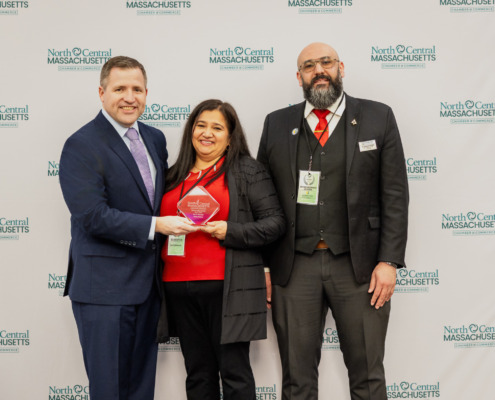

The reception features an open bar and gourmet appetizers.
View
Event
Join us for Connect North Central
Friday, September 25, 2026
8am-9am
View
Event
North Central Golf Tour Championship: Fore the Future
An FLNC Non-Traditional Scholarship Fundraiser
View
Event
Thank you Series Supporting Sponsor empHowered PR
View
Event
Join us for our 11th Annual
Congressional Luncheon
View
Event
Wednesday October 28, 2026
5:00pm - 7:00pm
View
Event
Join us for this in person HR Legal Update
View
Event
November 19, 2026
7:15am - 9:00am
View
Event
Chamber members are provided with the opportunity to engage with the Mayors of Fitchburg, Gardner, and Leominster who provide updates on projects and other things happening in their Cities. These events are by invitation only, please contact Travis Condon for more details.
View
Event
Bull Run Restaurant
215 Great Rd. Shirly, MA
View
Event
Join us for our last Connect North Central of the year!
Friday, December 11, 2026
8am-9am
View
Event
Chamber members are provided with the opportunity to engage with the Mayors of Fitchburg, Gardner, and Leominster who provide updates on projects and other things happening in their Cities. These events are by invitation only, please contact Travis Condon for more details.
View
Event
COVID-themed phishing attacks are up 3,000% from early March to early June 2020
Join us for a FREE webinar via Cisco Webex.
Thursday, October 29 | 8:30am
Am I at risk? The short answer is yes, no one is safe from attackers. Cyber threats are on the rise. Small businesses
are at just as much risk as large organizations. We will have a conversation about why small businesses are at risk and what you can do to help reduce the risk of a cyber-attack.
Topics will include:
Current Trends
Phishing
Office 365 & Associated Risks
Technology Vendor Selections
Importance of Internal Policy & Procedures
Moderated by Brad Kirlin, SVP Chief Technology Officer
Registration Link: fidelitybankonline.com/cyber
For questions, contact Sherri Pitcher: Banking LifeDesign®
Office Space available for Lease! Fitchburg. Second floor office space available for lease. 1,498.00/month. This includes heat/electric, lot maintenance. Bright, window lit offices, glass walls separating office areas, high ceiling, private bathroom, kitchenette area, onsite parking. Main entrance as well as private staircase entrance. Conveniently located 1-mile off of Rte. 2. Recently renovated in 2019. Please contact Kim for more details or a walk through to see the unit! 978-833-1887. . See link for more details. https://www.loopnet.com/Listing/619-South-St-Fitchburg-MA/21235415/

“We are honored to receive this recognition, which is the product of the hard work and dedication shown by our physicians and nurses at the LaChance Maternity Center. We are very fortunate to have such a compassionate, talented and driven team of providers within our community.” said Win Brown, President & CEO of Heywood Healthcare.
“Best Maternity Care Hospitals showcases an elite group of hospitals from across the country” said Nancy Cooper, Global Editor in Chief of Newsweek. “These facilities stand out for the care they provide to women and families, and for giving babies a strong start to life. Particularly in these uncertain times, we are honored to share this list of top-ranked facilities with Newsweek’s readership.”
Hospitals named as a Best Maternity Care Hospital have fully met The Leapfrog Group’s standards for maternity care on evidence-based, nationally standardized metrics. This includes lower rates of early elective delivery, NTSV C-section, and episiotomy, as well as compliance with process measures including newborn bilirubin screening prior to discharge and blood clot prevention techniques for mothers delivering via C-section.
Heywood Hospital was one of fewer than 250 to receive the prestigious accolade. The full list of recipients appears in the July 24 edition of Newsweek, available online and at newsstands nationwide.
About Heywood Healthcare
Heywood Healthcare is an independent, community-owned healthcare system serving north central Massachusetts and southern New Hampshire. It is comprised of Heywood Hospital; Athol Hospital, a 25-bed not-for-profit, Critical Access Hospital in Athol, MA; Heywood Medical Group, with primary care physicians and specialists located throughout the region; and the Quabbin Retreat, our premier destination for treatment of mental health and substance misuse.
The organization includes six satellite facilities in MA: Heywood Rehabilitation Center & Heywood Urgent Care in Gardner, Winchendon Health Center & Murdock School-based Health Center in Winchendon, Tully Family Medicine and Walk-In in Athol; and West River Health Center in Orange. The organization also includes the Heywood Healthcare Charitable Foundation. For more information, visit www.heywood.org.
About Heywood Hospital
A member of the Heywood Healthcare system, Heywood Hospital is a 134-bed acute care community-owned non-profit hospital in Gardner, MA, providing a broad range of high quality medical, orthopedic, bariatric, surgical, obstetrical, pediatric and behavioral health services on an inpatient and outpatient basis. The hospital’s Centers of Excellence include the Watkins Center for Emergency and Acute Care; the LaChance Maternity Center; the Diabetes Center and the Heywood Heart and Vascular Center.

When the workday ends and the lights go down, Custom Cleaning Service of Peabody, Inc. gets to work. “We operate as our clients’ silent partner after business hours,” says Adam Paicos, of Templeton, who now serves as Director of Operations and oversees the company’s expansion into North Central MA. “We are not often seen, but we ensure facilities are clean, secure, and ready for business each day while serving as the eyes and ears for our clients when they are not on site.”

Discover local business stories through our Inside North Central Massachusetts Podcast series. Listen as Chamber members share their journeys, insights, and contributions to our thriving regional business community.

Looking for your next opportunity? Explore current job openings from employers across North Central Massachusetts on our Jobs Board. Whether you’re starting a new career or making a change, you’ll find a variety of local positions available to help you take the next step.
CapEx Facility Services & Construction · Leominster, MA
TaraVista Behavioral Health Center · Harvard, MA
DRS Power Technology, Inc. · Fitchburg, MA
AIS · Leominster, MA