E-Newsletter
An Electronic Publication of the North Central Massachusetts Chamber of Commerce

Inside this edition, you’ll discover the latest Chamber initiatives and success stories from across our region. From economic development projects and upcoming networking events to policy updates and workforce training opportunities, we’re keeping you connected to what matters most for your business and North Central Massachusetts.
The North Central Massachusetts Chamber of Commerce is here to help – with trusted resources, a strong business network, and a support system to keep your business and the region moving forward
Fuente del artículo: State House News Service
Author: Matt Murphy
Nine Congressional seats. Nine thousand four hundred seats for fans at Fenway Park. Two hundred seats at an indoor wedding. Zero masks when alone outdoors.
The last week of April, which also happened to be House budget debate week, was all about counting. Whether it was to add up the spending on a priority line-item, calculate capacity limits under Gov. Charlie Baker’s new reopening schedule or just plain count people, it seemed everyone had their abacus out.
The U.S. Census Bureau said it had counted 7,029,917 people living in Massachusetts last year, amounting to a growth rate of 7.4 percent over the last decade that mirrored the national average and eclipsed even the rosiest of projections for the Bay State.
The total ensured that unlike 10 years ago the state would keep its full slate of representation in Congress, and the Senate’s top redistricting Democrat said it should also mean no incumbent-against-incumbent “drama” this time around.
Of course, the extent of the drama to come with the decennial redrawing of the state and national political boundaries won’t be fully understood until later this summer when the Census shares actual town-by-town and precinct-by-precinct data.
But for now it’s fun to speculate. Like will U.S. Rep. Ayanna Pressley’s 7th Congressional District shed the neighborhoods of Allston and Brighton to meet the new size requirement and stay majority-minority? Will Fall River stay divided between the 9th Congressional District and the 4th Congressional District?
There was less guess work involved in following the House budget debate, which showcased lawmakers engaging in the methodical, if at times boring, process of sifting through over 1,150 amendments to add close to $60 million in spending to what became a $47.7 billion budget proposal for fiscal 2022.
There was very, very little drama involved in this week’s deliberation as the House used seven bulk amendments to categorize and dispense with hundreds of amendments at a time, mostly with unanimous agreement. At least publicly.
Earmarks made a big comeback after being curtailed in the fiscal 2021 pandemic budget, with the Massachusetts Taxpayers Foundation counting 590 spending earmarks that accounted for the bulk of the added spending. There was money added for UMass Boston to study anti-Asian racism and for colleges and high schools to let students get a jump start on earning university credits. There were pay raises for sheriffs and the House moved to protect the controversial film tax credit by eliminating its 2022 sunset clause.
The film tax credit is one new House Speaker Ron Mariano has defended at every turn over the years, and creates an element of conflict to watch between the House and the Senate, where Ways and Means Chairman Michael Rodrigues is on record as not being the biggest fan of the program that he views as too expensive.
Rodrigues, it turns out, is also not a champion for project labor agreements on public construction projects, which require union and non-union contracts to have collectively bargained labor agreements in place for all workers.
The Westport Democrat said he believes the contract clauses, known as PLAs, stifle competition, but he was overruled by his Senate colleagues who put a PLA back into the $400 million bond bill to finance the construction of a new Holyoke Soldiers’ Home. To address other critics worried a PLA would freeze out minority- and women-owned construction and design firms that may not be unionized, the Senate’s bill would create a committee to enforce diversity goals on the project.
The bill now goes back to the House and the Legislature is on the clock to get the financing in place so that the state can complete design work and meet the application deadline for federal funding of Aug. 1, which also happens to be the date Baker has circled on the calendar for the full reopening of the economy.
Baker on Tuesday laid out his full timeline to lift all remaining business restrictions, starting May 10 when he said large venues like Fenway and the TD Garden can increase their capacity from 12 percent to 25 percent. In keeping with guidance from the Centers for Disease Control, he also said masks will no longer be required outdoors beginning Friday, today, unless you are in a crowd or can’t social distance from others.
Memorial Day will bring more relaxed rules when gathering limits will increase to 200 people indoors and 250 outdoors, street festivals, parades and agricultural festivals will be allowed at half capacity and bars, beer gardens and wineries can reopen under restaurant rules.
Adhering to the schedule will require the continued reduction of new cases and hospitalizations, and more people getting vaccinated, Baker said. And the state on Friday surpassed 6 million doses administered and 2.5 million people fully vaccinated.
Baker said he did not envision requiring state employees to be vaccinated to return to work and would leave it to individual businesses to decide how to approach vaccinations with their own employees, but many colleges, including the University of Massachusetts, are making a shot mandatory to return to campus in the fall.
The timeline was welcome news for many eager to put pandemic life behind them, but it was still not fast enough for some in the business lobby, who have watched neighbors like Rhode Island, Connecticut and even New York City set more aggressive reopening schedules based on the positive infection trends.
“The real-world impact of waiting until the end of the summer for a full reopening will mean job loss and a slower recovery for many small businesses,” said NFIB State Director Christopher Carlozzi.
Baker said there’s a possibility he will move faster to lift restrictions if the public health data allows, but some Democrats like Rep. William Driscoll, the co-chair of the COVID-19 oversight committee, expressed frustration that Baker won’t be more clear about the data points he uses to make decisions like that.
All-in-all, however, Democrats on Beacon Hill were willing to give Baker’s late-stage reopening plan a chance.
“I can say that we are at a point now where I want to be cautiously optimistic — but at the same time we must continue to remain diligent, and we must take further action to address all the systemic issues that made the pandemic so bad in the first place,” Rep. Mike Connolly, of Cambridge, said.
The reopening plan was paired on Tuesday with the Department of Elementary and Secondary Education’s decision to require all high schools to return to full-time, in-person learning by May 17.
And then Baker went to get his second vaccine dose.
The shot left Baker feeling “crummy” the next day, as he experienced some of the side effects many have had with their second dose, but he returned to action Thursday and Friday with two public appearances and a plan to spend $70 million on summer school to help students catch up on learning they missed during pandemic.
“By the end of the day, I felt better, and now, two weeks from now, I will be part of the fully vaccinated part of the commonwealth and I urge everybody in Massachusetts to go get vaccinated,” Baker said.

SBA Administrator Isabella Casillas Guzman today announced the U.S. Small Business Administration will begin registrations on Friday, April 30, 2021, at 9 a.m. EDT and open applications on Monday, May 3, 2021, at noon EDT for the Restaurant Revitalization Fund. The online application will remain open to any eligible establishment until all funds are exhausted.
“Restaurants are the core of our neighborhoods and propel economic activity on main streets across the nation. They are among the businesses that have been hardest hit and need support to survive this pandemic. We want restaurants to know that help is here,” said Administrator Guzman. “The SBA has focused on the marketplace realities of our food and beverage businesses in designing the Restaurant Revitalization Fund to meet businesses where they are. And we are committed to equity to ensure our smaller and underserved businesses, which have suffered the most, can access this critical relief, recover, and grow more resilient.”
Established under the American Rescue Plan, and signed into law by President Joe Biden on March 11, 2021, the Restaurant Revitalization Fund provides a total of $28.6 billion in direct relief funds to restaurants and other hard-hit food establishments that have experienced economic distress and significant operational losses due to the COVID-19 pandemic. This program will provide restaurants with funding equal to their pandemic-related revenue loss up to $10 million per business and no more than $5 million per physical location. Funds must be used for allowable expenses by March 11, 2023.
“Recognizing the great urgency to help restaurants keep their doors open – and with a clear mandate from Congress – the SBA worked at a breakneck speed and is excited to launch this program,” said Patrick Kelley, SBA Associate Administrator, Office of Capital Access. “From day one, we engaged with diverse stakeholders in the food industry community to make sure we built and delivered the program equitably, quickly, and efficiently.”
In preparation, the SBA recommends qualifying applicants familiarize themselves with the application process in advance to ensure a smooth and efficient application experience, specifically by:
For the first 21 days that the program is open, the SBA will prioritize funding applications from businesses owned and controlled by women, veterans, and socially and economically disadvantaged individuals. All eligible applicants are encouraged to submit applications as soon as the portal opens. Following the 21 days, all eligible applications will be funded on a first-come, first-served basis.
Consistent with the legislation and the intent of Congress, the SBA continues to take steps to ensure the equitable distribution of relief, particularly for the smallest businesses, by creating a $9.5 billion set-aside: $5 billion for applicants with 2019 gross receipts of not more than $500,000; $4 billion is set aside for applicants with 2019 gross receipts from $500,001 to $1,500,000; and $500 million for applicants with 2019 gross receipts not more than $50,000.
For more information, visit sba.gov/restaurants or in Spanish at sba.gov/restaurantes.
Today, the Baker-Polito Administration announced that Massachusetts will reopen some outdoor Phase 4, Step 2 industries effective May 10ta and put plans in place for further reopening on May 29ta and August 1para. The Administration continues to take steps to reopen the Commonwealth’s economy with public health metrics continuing to trend in a positive direction. This includes drops in average daily COVID cases and hospitalizations. Massachusetts remains first in the nation for first vaccine doses and total doses administered per capita, among states with more than 5 million people. The Administration will also relax the Face Coverings Order for some outdoor settings, effective April 30ta.
Face Coverings Order:
Effective April 30ta, the Face Coverings Order will be relaxed for some outdoor settings.
Face coverings will only be required outside in public when it is not possible to socially distance, and at other times required by sector-specific guidance.
Face coverings will still be required at all times in indoor public places. Face coverings will also continue to be required at all times at events, whether held indoors or outdoors and whether held in a public space or private home, except for when eating or drinking.
At smaller gatherings in private homes, face coverings are recommended but not required. The $300 fine as an enforcement mechanism will be eliminated.
Phase IV, Step 2 Industries and Gathering Changes:
On March 22, Massachusetts loosened capacity restrictions and advanced to Step 1 of Phase IV of the reopening plan. Since then, case rates dropped by 20%. The positivity rate has dropped to the lowest levels recorded since last summer.
Effective Monday, May 10ta:
Large venues such as indoor and outdoor stadiums, arenas and ballparks currently open as part of Phase 4, Step 1 at 12% will be permitted to increase capacity to 25%.
The Commonwealth will reopen some outdoor Phase 4, Step 2 industries including amusement parks, theme parks and outdoor water parks that will be permitted to operate at a 50% capacity after submitting safety plans to the Department of Public Health.
Road races and other large, outdoor organized amateur or professional group athletic events will be permitted to take place with staggered starts after submitting safety plans to a local board of health or the DPH.
Youth and adult amateur sports tournaments will be allowed for moderate and high risk sports.
Singing will also be permitted indoors with strict distancing requirements at performance venues, restaurants, event venues and other businesses.
Effective May 29ta:
Subject to public health and vaccination data, gathering limits will increase to 200 people indoors and 250 people outdoors for event venues, public settings and private settings.
Subject to public health and vaccination data, additional Phase 4, Step 2 industries will be permitted to open including:
Subject to public health and vaccination data, the restaurant guidance will be updated to eliminate the requirement that food be served with alcohol and to increase the maximum table size to 10.
Effective August 1para:
Subject to public health and vaccination data, remaining industries will be permitted to open including:
All industry restrictions will be lifted at that time, and capacity will increase to 100% for all industries, with businesses encouraged to continue following best practices. The gathering limit will be rescinded.
Depending on vaccine distribution and public health data, the Administration may consider re-evaluating the August 1para date.
The Department of Public Health will also continue to issue guidance as needed, including guidance to still require masks indoors.
For more information, visit mass.gov/reopening.
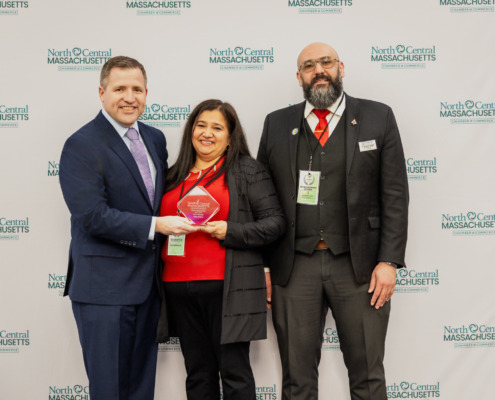

Chamber members are provided with the opportunity to engage with the Mayors of Fitchburg, Gardner, and Leominster who provide updates on projects and other things happening in their Cities. These events are by invitation only, please contact Travis Condon for more details.
View
Event
Bull Run Restaurant215 Great Rd. Shirly, MA
View
Event
Join us for our last Connect North Central of the year!
Friday, December 11, 2026
8am-9am
View
Event
January 14, 20277:15am - 9:00am
View
Event
Erin Logan | NBC 10 Reporter
View
Event
Chamber members are provided with the opportunity to engage with the Mayors of Fitchburg, Gardner, and Leominster who provide updates on projects and other things happening in their Cities. These events are by invitation only, please contact Travis Condon for more details.
View
Event
February 16, 2021 at 10:00 AM at the Youth Library Door
Pick up a bag of Legos and STEM Lego Challenge cards outside the Youth Library door on February 16, 2021, at 10:00 AM for Lego STEM Challenge! Complete a challenge and post of picture of it on the Fitchburg Youth Library Facebook page and you will be entered to win a 2007/2008 United States of America State Coin Collector’s Map complete with coins (quarters) representing each state.
This is a free program. For information about this or other Library programs call 978-829-1780 or visit our website: www.FitchburgPublicLibrary.org.

Fitchburg residents can now access free standardized testing preparation materials with their Fitchburg Public Library card. Mometrix eLibrary provides study guide eBooks, practice tests, and flash cards to help you raise your score. Exams currently covered are: SAT, HiSET, ASVAB, CNA, ATI TEAS, and CDL.
Residents can log in with their library card from our website, fitchburgpubliclibrary.org. Look for the Mometrix link under “eBooks and Digital Resources.”
To sign up for a library card or to learn more, please contact the library at 978-829-1780 or email .

When the workday ends and the lights go down, Custom Cleaning Service of Peabody, Inc. gets to work. “We operate as our clients’ silent partner after business hours,” says Adam Paicos, of Templeton, who now serves as Director of Operations and oversees the company’s expansion into North Central MA. “We are not often seen, but we ensure facilities are clean, secure, and ready for business each day while serving as the eyes and ears for our clients when they are not on site.”

Discover local business stories through our Inside North Central Massachusetts Podcast series. Listen as Chamber members share their journeys, insights, and contributions to our thriving regional business community.

Looking for your next opportunity? Explore current job openings from employers across North Central Massachusetts on our Jobs Board. Whether you’re starting a new career or making a change, you’ll find a variety of local positions available to help you take the next step.
CapEx Facility Services & Construction · Leominster, MA
TaraVista Behavioral Health Center · Harvard, MA
DRS Power Technology, Inc. · Fitchburg, MA
AIS · Leominster, MA