E-Newsletter
An Electronic Publication of the North Central Massachusetts Chamber of Commerce

Inside this edition, you’ll discover the latest Chamber initiatives and success stories from across our region. From economic development projects and upcoming networking events to policy updates and workforce training opportunities, we’re keeping you connected to what matters most for your business and North Central Massachusetts.
The North Central Massachusetts Chamber of Commerce is here to help – with trusted resources, a strong business network, and a support system to keep your business and the region moving forward
All staff in Massachusetts rest homes, assisted living residences and hospice programs and home care workers who provide in-home direct care would need to get vaccinated against COVID-19 in the next two months under an expanded mandate introduced Wednesday by Gov. Charlie Baker’s administration.
The administration announced it would seek to broaden an existing vaccination requirement on certain long-term care staff to include many more caregivers across hundreds of facilities in an effort to “protect older adults against COVID-19,” which continues to spread even as more and more people obtain vaccinations.
Officials said the proposed mandate, which drew praise from affected industry leaders, would apply to workers directly employed by facilities and to contractors who regularly enter facilities. Sixty-two freestanding rest homes, 85 hospice programs and 268 assisted living residences would fall under the new mandate.
The policy is subject to approval from the Public Health Council, which has a meeting scheduled for Sept. 8. The council has consented to numerous pandemic-related proposals introduced by the governor.
Up to 100,000 home care workers will also need to comply with the expanded requirement, according to the Baker administration. That includes individuals providing in-home, direct care employed by a state-contracted or state-subcontracted agency, and it also applies to independent, non-agency home care workers contracted with the state such as personal care attendants in the MassHealth program.
Affected caregivers must get vaccinated by Oct. 31 unless they qualify for a medical or religious exemption, under the proposal.
Tara Gregorio, president of the Massachusetts Senior Care Association that represents long-term care facilities covered by the original mandate and assisted living facilities added under the expanded version, applauded Gov. Baker and his administration for the updated policy.
“The Governor’s action today, further expanding the Covid-19 vaccination mandate to include all eldercare workers, is critically important to ensure the safety and well-being of citizens across the Commonwealth, including our vulnerable skilled nursing facility residents and dedicated staff,” Gregorio said in a statement. “The Governor’s announcement will create parity, transparency, and accountability within the entire health care system, which is ultimately to the benefit of consumers and their caregivers.”
Gregorio added that more than a dozen other states have adopted similar mandates. She also said that a poll of 1,000 registered voters that GS Strategies conducted in May for MSCA found 72 percent of voters “overwhelmingly supported a statewide mandate for all healthcare employees to be vaccinated against COVID-19.”
The new mandate builds on a public health order Department of Public Health Acting Commissioner Margret Cooke issued last month requiring long-term care workers in skilled nursing facilities and soldiers’ homes — which care for older adults who face greater risks of serious illness and death from COVID-19 — to get fully vaccinated by Oct. 10.
Many hospitals are also requiring their workforces to get immunized against COVID-19. Some parts of the health care sector, such as rehabilitation centers, do not fall under either the Baker administration’s original long-term care vaccine mandate or its expanded caretaker mandate.
Massachusetts Health and Hospital Association President and CEO Steve Walsh praised the expanded mandate on Wednesday, referencing the recent increase in COVID-19 case counts and hospitalizations driven by the more infectious Delta variant.
“The threat of COVID-19 has only increased in the past several weeks, and it has never been more important for those treating patients to be protected,” Walsh said in a statement. “Thanks to the policies put in place by the state and our providers, community members can take comfort in knowing that they are receiving the safest care possible — whether they (are) at their local hospital or in other care settings that they rely on for their health and wellbeing.”
Baker last month also issued a vaccine mandate for about 42,000 executive branch workers. Those who do not get vaccinated or secure a medical or religious exemption by Oct. 17 could face consequences including termination.
Demand for restaurant take-out and delivery food has skyrocketed, a trend that’s likely to continue into the foreseeable future. Restaurateurs who want to stay competitive are faced with some tough choices — do they link up with a third-party food delivery service, hire their own delivery driver, or simply say ‘no’ to deliveries altogether?
Third-Party Delivery is Costly
Like any business, on-demand food delivery companies charge a service fee. That fee varies depending on your location, and it can be a percentage of the total bill, a flat rate (‘bag fee’) or a combination of the two. There’s also a tip option customers can select on most food delivery apps, and some services charge extra during busy periods, a practice known as ‘surge pricing’.
The catch is that food delivery apps make money by charging fees to both the consumer and the restaurant. Contrary to what you might expect, restaurant owners also pay commissions on each order, and that can quickly eat into the already-slim profit margins in the industry.
To compensate for the extra operational costs that comes with linking up to a delivery service, many restaurants have a special, higher-priced menu just for their app-based deliveries. While this makes sense from a budget standpoint, it’s a practice that can anger customers who don’t know how popular delivery apps such as Uber Eats, Grubhub and Doordash work.
Quality Can Be Questionable
Some folks who work for food delivery apps do a fantastic job when it comes to delivering your orders quickly and with the level of customer service you’d expect, while others simply don’t.
Using a third-party food delivery service means putting your product into the hands of someone that’s been screened, trained and hired by another company. You give up the usual control you have when you recruit and hire your own delivery staff, and that can be risky.
Using a Delivery Service May Boost Your Business
While there’s a lot of cons when it comes to using a third-party food delivery service, signing up with these app-based businesses can be a smart move in the right circumstances.
Increasingly, consumers are turning to food delivery apps for everything from their working lunches at the office to Friday night meals with friends. Restaurants that sign up with a delivery service often find they’re getting orders from first-time customers, and that can translate into ongoing sales and in-restaurant visits.
Food Delivery Apps Are Cost-Effective for Some Restaurants
Food delivery apps can be a cost-effective way for restaurants to offer deliveries without incurring the costs associated with hiring a dedicated delivery driver. Food delivery services are on-demand and scalable, and that’s idea for restaurants that don’t need a full-time driver.
If you’re a restaurant owner or manager who is considering signing up with a third-party food delivery service, take the time to weigh the pros and cons for your particular situation. As with all business transactions, be sure to read the fine print and ask other restaurateurs about their experiences before deciding if partnering with a delivery app is right for your company.
How To Get Your Mindset Right When Everything Feels Wrong
You want to grow your local business and treat your employees and customers right. But sometimes it’s hard to keep your mind focused on what you know you should be doing. We understand how easy it is to fall into doubt, worry, or even mental paralysis, especially when everything around you feels wrong somehow.
But we believe in you and in your business. That’s why we’ve put together this list of tips to help you keep your mindset in the right place and stay focused on the things that matter most right now. Take a look.
If your mental intake is focused on doom, gloom, and uncertainty, your mindset isn’t going to be a healthy one. Instead, give yourself permission to step away from current news, and open your mind to healthier input. That might be anything from funny YouTube videos to a chapter of a novel you’ve been meaning to read for years. You’ll return to your tasks with a healthier mindset and renewed energy.
Thinking about others and what they need is a sure-fire way to get your mindset right. Whether it’s overtipping your food delivery person with a kind note, checking in with the cleaning staff at your business to make sure they’re okay, or driving by a child’s house to wave them a happy birthday, you’ll feel stronger when you express generosity and thoughtfulness to others.
It’s easy to think of your mind as something separate from your body, but times of crisis make it clear how very interconnected they are. Stop every hour to spend 30 seconds breathing deeply. Even if you can’t go to the gym, take a walk or do some light exercises at home. While a little comfort food is understandable, don’t neglect the veggies and fruits that give you the vitamins and nutrients you need to stay healthy. And allow yourself to go to bed a bit earlier or sleep in a bit later to help boost your immune system as well as your mindset.
Some people use lists to stay in control of their world — and it’s also a good way to keep your mind focused. More broadly, it can also be helpful to write down how you’re feeling in a time when everything feels a bit off. Write down the best and worst-case scenarios to keep your mind from spinning in circles, or start a journal to chronicle what you’re going through. Often the act of writing something down on paper (or on a screen) can help you purge the associated feelings and get your mind back in gear.
When you adjust your mindset by focusing outward rather than on what seems wrong, you improve not only your own sense of focus but also your relationships with those around you. Bypassing the negative messages that sometimes seem to assault your mind to focus on the positive instead can help you face whatever comes next with hope and determination.
Teachers, staff and many students at day care centers and after-school programs will be required to wear masks indoors after Labor Day, but Education Secretary Jim Peyser on Tuesday told the board that licenses early education providers that a vaccine mandate may be out of their control.
The Board of Early Education and Care voted unanimously to align its masking policies for programs under its oversight with those being deployed in K-12 public schools as children across Massachusetts return to in-person learning over the next couple of weeks.
Commissioner Samantha Aigner-Treworgy requested and received the permission to implement the masking policy across the early education sector as COVID-19 cases fueled by the spread of the Delta variant continue to rise, and have been recorded in early education settings.
While the chair of the board said the “best line of defense” remains getting as many teachers and staff as possible vaccinated, Aigner-Treworgy said the decision to return to mask wearing stemmed from the trends in COVID-19 transmission and a desire to be consistent for children who may attend school and after-school programs in various districts.
“With schools reopening in the weeks ahead and the action by (the Department of Elementary and Secondary Education) board, we really are asking you all to come together today to recognize the COVID-19 crisis continues to challenge families and providers,” Aigner-Treworgy said during an emergency board meeting on Tuesday morning.
All employees and children age 5 and older enrolled in state-licensed day care, after-school and out-of-school programs will be required to wear masks indoors beginning Sept. 7, and younger children between the ages of 2 and 5 who can “safely and appropriately wear, remove, and handle face masks” will be “strongly encouraged” to wear one.
El policy applies to adults regardless of vaccination status, and does not have an expiration date. The EEC policy notes that by federal public health order, all children over the age of 2 and staff are required to wear masks on child care transportation.
Gov. Charlie Baker, who held a press conference shortly before the vote, said he agreed with the department’s approach.
“I think they’re viewing that at this point in time as an appropriate measure as, you know, school starts and as people start incorporating more of those early ed programs into their daily lives, I think it makes sense,” Baker said.
The board also voted to give Aigner-Treworgy the authority to relax some of the early education teacher credentialing policies to increase the pipeline of people willing to take jobs in day care and after-school programs.
Aigner-Treworgy said she will present a formal plan to the board at its Sept. 14 meeting, but described the relaxed protocols under consideration as changes that would be temporary and would not detract from the health and safety standards.
“What we’re hearing is that even as people think about compensation and addressing benefits, that it is a hard sell for people to come back into a workforce during a health crisis and be able to play this critical role for the commonwealth, but also accommodate their own needs around child care and their personal needs as they step back into the workforce,” Aigner-Treworgy said.
Education Secretary Jim Peyser told several of the board members that should COVID-19 conditions reach the point where the board wanted to consider a vaccine mandate for early education teachers and staff, an order from the Department of Public Health would probably be required to add the COVID-19 vaccine to the list of required vaccinations.
Peyser said many of these private employers may choose to implement vaccine policies on their own, and EEC Board Chair Nonie Lesaux said “there may be a moment when the data suggests we absolutely owe it to the children.”
“Foremost, we want to encourage vaccine uptake among the adults who are with children, obviously. That is our best line of defense at this moment while our youngest children in particular are not able to be vaccinated,” Lesaux said.
The department does not track the ages of students enrolled in EEC-licensed programs, but Aigner-Treworgy said the majority of enrollees are under 12 and therefore ineligible at this time for a vaccine.
The commission said that over the past two weeks more than 150 towns have reported an instance of COVID-19 in a family care setting, and 1,300 group and center-based programs had had an incident.
Though more than 900 clinics are in operation and early education providers can request an onsite mobile vaccination unit through a state-run portal, Lesaux said conversations with Peyser, Aigner-Treworgy, the Executive Office of Health and Human Services and the Department of Public Health are ongoing about ways to improve vaccination rates among teachers and families with children enrolled in early education programs.
“We’ll keep in touch on that initiative as it further unfolds,” she said.
While teachers unions have expressed interest in a vaccine mandate for school employees, Baker has suggested that those decisions must be made locally where officials are in charge of collective bargaining with teachers and staff.
Aigner-Treworgy said the child care sector is also different because many of the providers are private employers whose businesses operate with the tuition revenues paid by parents.
While officials said 90 percent of early education providers have reopened since the peak of the COVID-19 pandemic, staffing remains a challenge.
Aigner-Treworgy said the department will continue its subsidy policy of paying based on enrollment and not attendance in order to not “penalize” families who choose to keep their children at home at any point due to the pandemic.
The commissioner said 75 percent of providers also applied for grants from the $314 million in American Rescue Plan Act funds designated for Massachusetts early childhood education providers, and those monthly aid payments began arriving for thousands of providers on Monday.
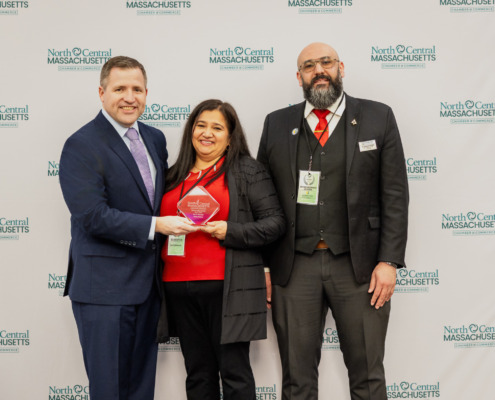

The reception features an open bar and gourmet appetizers.
View
Event
Join us for Connect North Central
Friday, September 25, 2026
8am-9am
View
Event
North Central Golf Tour Championship: Fore the Future
An FLNC Non-Traditional Scholarship Fundraiser
View
Event
Thank you Series Supporting Sponsor empHowered PR
View
Event
Join us for our 11th Annual
Congressional Luncheon
View
Event
Wednesday October 28, 2026
5:00pm - 7:00pm
View
Event
Join us for this in person HR Legal Update
View
Event
November 19, 2026
7:15am - 9:00am
View
Event
Chamber members are provided with the opportunity to engage with the Mayors of Fitchburg, Gardner, and Leominster who provide updates on projects and other things happening in their Cities. These events are by invitation only, please contact Travis Condon for more details.
View
Event
Bull Run Restaurant
215 Great Rd. Shirly, MA
View
Event
Join us for our last Connect North Central of the year!
Friday, December 11, 2026
8am-9am
View
Event
Chamber members are provided with the opportunity to engage with the Mayors of Fitchburg, Gardner, and Leominster who provide updates on projects and other things happening in their Cities. These events are by invitation only, please contact Travis Condon for more details.
View
Event
The North Central Massachusetts Private Well Program is actively seeking homeowners with private
wells in the communities of Berlin, Bolton, Boxborough, Hubbardston, Princeton, and Sterling who are interested in
learning more about the quality of their water, the condition of their wells, and how to remediate contamination of their
wells.
The Private Well Program is a community partnership created by RCAP Solutions, funded by a Synergy Initiative grant
from The Health Foundation of Central Massachusetts to address drinking water issues in the Northern Central
Massachusetts area totaling $629,000 to date. Now in its pilot year, the program is working with local Boards of Health
and other regional and statewide partners to promote better public health and safety for households with private wells.
During the next six months, RCAP Solutions is focusing on the six designated communities to provide complimentary
well assessments and testing to identify contamination and provide public education services to residents. This includes a
limited number of private well assessments, water testing, and additional resources for well owners. The goal of the pilot
program is to assess 40 private wells in each of six the selected towns, for a total of 240 assessments to be completed in
2021.
A second phase of this effort will include public education, advocacy for local and statewide private well regulations that
better protect homeowners and communities and that are on par with regulations for public water systems, and
identification of financial resources for homeowners needing well remediation. Unlike public drinking water systems,
private wells do not have experts regularly checking the water’s source and its quality before it is sent to the tap.
Households that use private wells should take appropriate steps to ensure the safety of their drinking water. Potential
contaminants such as arsenic, radon, and uranium can have both short and long-term health impacts.
The RCAP staff provides homeowners with a free, on-site professional review of their well head and recharge area. The
staff adheres to strict social distancing practices to keep the homeowners feeling comfortable and safe during the
coronavirus pandemic. The assessment concludes with a complimentary water test from a state-certified lab, which
otherwise can be a costly and time-consuming procedure. The water quality analysis tests for the following contaminants:
Arsenic, Chloride, Copper, Fluoride, Hardness, Iron, Lead, Manganese, pH, Sodium, Coliform Bacteria, Nitrate/Nitrite,
Uranium, and Radon. Interested homeowners can visit www.rcapsolutions.org/ma-private-wells for additional information
and to request a well assessment.
“We are thrilled to continue our partnership with The Health Foundation of Central Massachusetts in this important public
health project,” stated Karen A. Koller, President & CEO of RCAP Solutions. “Because there are no state-wide
regulations surrounding private well maintenance, it’s critical that homeowners in North Central Massachusetts, and
across the state, understand the importance of regular assessments and water testing. We are pleased to be able to fulfill
our mission and meet the needs of rural communities by providing this valuable technical assistance to private well
owners.”
Dr. Jan Yost, President & CEO of The Health Foundation of Central Massachusetts, added, “The Foundation is pleased to
continue its support of this important project that seeks to improve private well water quality through increased
knowledge and enhanced local and statewide regulations to protect the public’s health. The project’s pilot this year is an
important step towards ensuring that private well owners have access to clean and safe drinking water free of harmful
contaminants, which is essential to good health.”
RCAP Solutions is working closely with the Montachusett Public Health Network and the Nashoba Associated Boards of
Health to assist communities with promotional efforts and to ensure positive outcomes for homeowners. In addition,
RCAP is collaborating with the Massachusetts Department of Environmental Protection and ongoing efforts to address
per- and polyfluoroalkyl substances (PFAS) in drinking water.
For more information about the North Central Massachusetts Private Well Program, or to request a private well
assessment, please visit: http://www.rcapsolutions.org/ma-private-wells/
About RCAP Solutions, Inc.
RCAP Solutions is a thriving integrated community development corporation working with a multi-faceted suite of
services and opportunities. Established in 1969, RCAP Solutions’ mission is to foster personal and public self-reliance
and improve the quality of life for individuals, families, and the communities in which they live. For more information,
please visit www.rcapsolutions.org.
About The Health Foundation of Central Massachusetts
The Foundation was established in 1999 with the proceeds from the sale of Central Massachusetts Health Care, Inc., a
physician-initiated, not-for-profit HMO. As of March 2021, the Foundation has assets of around $90 million and has
awarded grants totaling approximately $48 million to improve the health of those who live or work in Central
Massachusetts. For further information about the Foundation’s grant programs, please visit the Foundation’s website at
www.hfcm.org.
This spring, the Mount Wachusett Community College Physical Therapist Assistant program students were in danger of a delay in their graduation due to the lack of clinical placement sites. The lack of clinical placement impacted all health students, with the impact on physical therapist assistant students more pronounced due to fewer facilities available in the area.
In early 2021 Margaret Jaillet the Dean of Health Professions, Public Service Program & Social Sciences needed the services of the Care Central VNA for a family member. The visiting physical therapist from Central Care VNA turned out to be a friend and colleague of the Dean, Eileen Hurley.
Following the visit, Jaillet and Hurley were discussing the challenges the pandemic presented, preventing students from completing their clinical rotations. Hurley suggested that the VNA may be able to help.
Within days of that conversation, meetings were taking place and the rehabilitation team and the Director at Care Central VNA, Kristin Mattson, Jennifer Scampini and Lisa Waller, were coordinating with their staff to participate. Numerous Care Central VNA clinicians agreed to mentor students, many agreeing to take concurrent students if needed.
“The Care Central VNA rehabilitation team did a fabulous job and I could not be more appreciative,” commented Jennifer Gentile, Academic Coordinator of Clinical Education at MWCC. “Many students expressed how grateful they were to have this unique educational experience.”
“I was a little hesitant to accept the idea of finishing my clinical experience in the home health environment. My heart was set on a skilled nursing facility experience,” stated PTA student Daniella Caetano. “As I’m reflecting on the past seven weeks, I realized that I’ve grown to absolutely love home health care and I can see myself working in this setting in the future.”
Thanks to the help from the Care Central VNA team, students were able to complete their final clinical rotations and have been awarded their degrees. They will sit for their state licensure exam in October.
“These students can get on with their lives having completed their educational journey and moving onto their career paths,” stated Dean Jaillet.
Students who successfully completed their clinical rotations with the help of Care Central VNA are Younglan Cho of Acton, Alexandra de Melo-Shay of West Boylston, Matthew Robertson of Tewksbury, Ruth Honthumb of North Brookfield, Shannon Caira of Orange, and Daniella Caetano of Leominster.
Aging Services of North Central Massachusetts (ASNCM) was pleased to welcome Secretary Elizabeth Chen of the Executive Office of Elder Affairs to make visits to consumers in their homes.
Secretary Chen was accompanied by Chief Executive Officer, Lori Richardson; Program Specialist, Shane McCormack; and Program Manager, Leeanne Kelly.
“I can tell, from my time spent with Secretary Chen, that the elders of our state are in good hands. She is a kind, down-to-earth, and understanding individual,” said McCormack. “More importantly, the elder we visited truly felt heard by Secretary Chen, as she explained to me afterwards. And that, ultimately, is our goal – to give voices and support to the individualized needs of elders.”
“Aging Services of North Central Massachusetts is a wonderful place to work. You are supported by the agency but also the Executive Office of Elder Affairs. Secretary Chen is well versed in the needs of our consumers, barriers that we are facing as an agency and the importance of what we do every day,” said Kelly.
Lori Richardson stated, “I am grateful to Secretary Chen for her commitment and leadership. The pandemic impacts everyone and has a significant impact on the older adults we serve. Secretary Chen, her team at the Executive Office of Elder Affairs, ASNCM, and the 24 other Aging Service Access Points (ASAPs) that blanket the Commonwealth of Massachusetts continue to work tirelessly to make a positive difference one person at a time. The visits I made with Secretary Chen certainly made a positive difference.”
To learn more about the Aging Services of North Central Massachusetts—including programs and services being offered, ways you can donate or volunteer, or to learn more about this historic rebrand, please visit www.AgingServicesMA.org or contact David Ginisi, Chief Marketing Officer, at (978) 466-1571 or by email at

From left to right: Shane McCormack, ASNCM Program Specialist; Secretary Elizabeth Chen, Executive Office of Elder Affairs; Leeanne Kelly, ASNCM Program Manager; and Lori Richardson, ASNCM Chief Executive Officer.

Ms. Patricia Crawson chatted with Secretary Elizabeth Chen about the support she receives from Shane McCormack of ASNCM.

When the workday ends and the lights go down, Custom Cleaning Service of Peabody, Inc. gets to work. “We operate as our clients’ silent partner after business hours,” says Adam Paicos, of Templeton, who now serves as Director of Operations and oversees the company’s expansion into North Central MA. “We are not often seen, but we ensure facilities are clean, secure, and ready for business each day while serving as the eyes and ears for our clients when they are not on site.”

Discover local business stories through our Inside North Central Massachusetts Podcast series. Listen as Chamber members share their journeys, insights, and contributions to our thriving regional business community.

Looking for your next opportunity? Explore current job openings from employers across North Central Massachusetts on our Jobs Board. Whether you’re starting a new career or making a change, you’ll find a variety of local positions available to help you take the next step.
CapEx Facility Services & Construction · Leominster, MA
TaraVista Behavioral Health Center · Harvard, MA
DRS Power Technology, Inc. · Fitchburg, MA
AIS · Leominster, MA