E-Newsletter
An Electronic Publication of the North Central Massachusetts Chamber of Commerce

Inside this edition, you’ll discover the latest Chamber initiatives and success stories from across our region. From economic development projects and upcoming networking events to policy updates and workforce training opportunities, we’re keeping you connected to what matters most for your business and North Central Massachusetts.
The North Central Massachusetts Chamber of Commerce is here to help – with trusted resources, a strong business network, and a support system to keep your business and the region moving forward
Confidence in the Massachusetts economy dipped slightly in November among employers, the fourth straight monthly decline recorded by Associated Industries of Massachusetts as fears of COVID-19 and continued supply chain disruptions dimmed corporate views.
One economist said the recent passage of legislation to spend $4 billion in American Rescue Plan Act and state surplus money should give the economy some momentum, but AIM CEO John Regan noted that Gov. Charlie Baker’s decision not to seek a third term will inject some uncertainty into the marketplace.
Employers registered a confidence score of 57.9 on AIM’s monthly business confidence index for November, down half a point from October and from 65.6 in July. The index is based on a survey of 140 employers across Massachusetts, with 50 being a neutral score. Since 1991, the index has gone as high as 68.5 and as low as 33.3.
The November index score is the lowest recorded since March, but is still 8.6 points higher than a year ago. The score has taken a recent tumble as a rise in COVID-19 cases, fueled by the Delta variant and now the arrival of the Omicron variant, have increased anxiety over the pandemic, and employers continue to struggle with supply chain delays and labor shortages.
Michael Goodman, a professor of public policy at the University of Massachusetts Dartmouth, said the ARPA spending bill on Gov. Baker’s desk and the new federal infrastructure bill “will add momentum to a state economy that slowed to a 2 percent annual growth rate in the third quarter.”
“In addition to boosting growth in the near term, these federal funds will allow Massachusetts to address longstanding and critical challenges including job training, transportation, housing and education,” Goodman said in a statement.
Regan, however, said the unfolding race for governor in 2022 should be watched closely now that Baker and Lt. Gov. Karyn Polito have decided not to seek reelection and there will be a new governor 13 months from now.
“Any change in the corner officer on Beacon Hill affects the confidence on Massachusetts employers,” Regan said. “Governor Baker and Lt. Governor Karyn Polito will leave a legacy of disciplined fiscal management and policies that have allowed Massachusetts to remain a pre-eminent center of technology and commerce.”
While employer views of the state’s economy remain optimistic, opinions on the U.S. economy turned pessimistic for the first time since January with a score of 48.8. Employers’ confidence in their own companies was essentially flat at 61.1, and the employment index was the only indicator to rise by three-tenths of a point to 56.2.
A regional confidence score for Central Massachusetts came in below the statewide number at 56.3. AIM intends to add regional indexes for Springfield and the North Shore.
Matt Murphy/SHNS

New England power grid operators detailed their forecast for the winter of 2021-22 on Monday, saying they expect to be able to meet the region’s demand for electricity but also describing the issues that make them a bit concerned about reliability should the winter be colder than anticipated. [Screenshot]
ISO-NE expects that demand among the 14 million electric customers in New England will peak this winter at 19,710 megawatts under average winter weather conditions of 10 degrees and as high as 20,349 MW if average temperatures drop below 5 degrees. The winter demand forecast, which is about 2 percent lower than the forecasted peak demand for last winter, is based on a National Oceanic and Atmospheric Administration outlook that projects a milder than average New England winter.
Demand peaked last winter at 18,756 MW on Dec. 17, 2020, and the all-time winter peak demand is 22,818 MW, set on Jan. 15, 2004. The highest peak demand on the grid, regardless of time of year, was 28,130 MW on Aug. 2, 2006.
Gordon van Welie, president and CEO of ISO-NE, said the severity of the cold weather is one of three main variables that could put the region in a more precarious position than in previous winters, along with the global availability and price of oil and liquified natural gas deliveries into New England and constraints on natural gas pipeline capacity at times of simultaneous demand from heating customers and electricity generators.
If those risks come to pass and threaten the reliability of power for the region this winter, van Welie said, it could “force the ISO to take emergency actions up to an including controlled power outages.”
“I’m not saying this to cause undue alarm at this early stage. Rather, by identifying and sharing the conditions under which the power system would be most challenged, we hope to prepare the region,” van Welie said during a briefing with New England reporters Monday afternoon. “If a worst-case scenario develops, the ISO, utilities and government officials will need to act quickly to avoid an overall power system collapse. Steps such as asking for conservation of electricity and natural gas usage throughout the cold snap could help minimize or avoid the possibility of more drastic actions.”
If an emergency situation develops this winter, ISO-NE has a handful of options available before it would have to resort to controlled outages, including importing emergency power from neighboring regions, calling on power system reserves, and urging businesses and residents to voluntarily conserve energy.
Four years ago, amid a brutal cold snap, the New England grid came within days of catastrophe. During a frigid stretch between Christmas 2017 and Jan. 9, 2018, regional power generators burned two million barrels of oil — more than twice the amount of oil they burned during all of 2016 — in order to produce sufficient electricity.
The two-week event “nearly pushed the bulk power system to the brink,” ISO-NE said, but the severity of the situation did not come to light until after the fact.
“There were many sleepless nights during that two-week period … because we realized we were getting close to the edge but we didn’t have an effective way to communicate on how close we were and we didn’t want to panic people,” van Welie said Monday. “As luck would have it, we made it through to the following week when the weather broke and the supply chain could catch up with us. But given how close we came to being literally within two days of an energy deficiency within the region, we said never again will we want to communicate that way.”
After that 2017/18 incident, ISO-NE began preparing and publishing an energy adequacy forecast on a rolling 21-day basis with the aim of identifying potential shortfalls with enough time to take corrective actions. The forecast is based on the weather outlook, projected fuel supply inventories and deliveries, expected production from wind and solar resources, and consumer demand expectations.
“We’re going to give people much more time. Time for us actually to go out and ask for conservation days in advance before we actually get into the energy situation and hopefully be able to head it off,” Vice President of System Operations & Market Administration Peter Brandien said.
Brandien mentioned an August 2020 heatwave that hit California and led the grid operator there to order two days of rolling blackouts and the lessons that ISO-NE learned from that. After the operator began load shedding and was public about the tough situation it was in, he said, it was able to secure about 3,000 MW of additional capacity it had not realized was available.
“And then when people really understood the situation, they got a lot better conservation than they had leading into the event,” Brandien said. “So part of what we’re trying to do here is really educate everybody on where we are, give them a heads up and understand that when we do go out for conservation, we’re going out for conservation to try to keep everybody with electricity.”
In February, millions of electric customers in Texas were without power for days after a series of winter storms brought unusually cold and icy weather to the state and basically froze its natural gas-fired power generators. More than 200 people died during the emergency.
During his briefing with reporters Monday, van Welie stressed that “New England is not Texas” but reiterated his concerns about what could happen if LNG and natural gas supplies are limited and seriously cold weather hits.
“Our system is better winterized, meaning the power plants, transmission lines and other equipment needed to produce and deliver electricity can better withstand cold temperatures,” he said. “However, as I noted earlier, we are concerned about the fragile energy supply chain to the region during extreme weather.”
van Welie also touched briefly on the recent setback, possibly fatal, delivered last month to the New England Clean Energy Connect transmission project in Maine, which was intended to connect Canadian hydropower to the New England grid as a way to relieve the pressure of other fuel sources and fulfill part of a 2016 Massachusetts law.
“Closer ties and stronger connection with Quebec is absolutely part of the solution. We just shouldn’t think that it’s going to solve everything for us,” he said, noting that he expects New England to become a “winter-peaking” power system around 2030 as more homes switch to electric heat and electric vehicles become more widespread.
He added, “With regard to this specific project in Maine, I’m disappointed about the outcome there. If it doesn’t go ahead, I think we will find other paths and I think maybe the one thing we can have to do is recognize that you’re going to have to spend more in order to get these transmission lines sited because part of the objection … is people don’t want to see these lines. And so if you bury them then you remove that objection, but of course you then incur a much higher price tag.”
Colin A. Young/SHNS
Nationwide economic growth in 2022 might slow a bit from the “surprisingly strong 2021 underlying business conditions,” but state and local governments can still expect steady gains in tax revenues and should be able to continue to focus on building up reserves, the economists at Fitch Ratings said.
The credit rating agency published its 2022 outlook for state and local governments last week, predicting that the economy will not grow quite as fast as it has in 2021, but will “remain strong relative to the pre-pandemic trends, supporting steady gains in personal income, consumer spending and tax revenues” for Massachusetts and other states.
“Economic growth above trend and a significant boost in resources from federal stimulus will keep states and local government finances on a positive path in 2022,” Fitch Senior Director Eric Kim said. “Rising inflation and supply constraints will remain challenges.”
The outlook bodes well for the rest of fiscal year 2022, which ends June 30 and is already outpacing expectations for state tax revenue. It also suggests a positive start to fiscal year 2023, which is about to become a focus of attention on Beacon Hill.
State budget writers and Baker administration officials will huddle Dec. 21 to start mapping out what fiscal year 2023 might look like for state tax collections and spending during the annual consensus revenue hearing. The hearing typically includes testimony and projections from a variety of sources, like the Department of Revenue, Mass. Taxpayers Association, the Center for State Policy Analysis at Tufts and the economic analysts at MassBenchmarks.
Trying to forecast economic conditions and tax collections more than a year in advance is always a challenging and risky enterprise, but lawmakers and the executive branch now have to factor in the implications of a pandemic that waxes and wanes, the fundamental changes to the way people work and spend money, and the impacts of historic levels of federal aid.
The dire predictions that state revenue could be short by as much as $8 billion never came to pass and economic performance has greatly outpaced state expectations, at least as measured by tax receipts. Fiscal year 2021, which began about four months into the pandemic and ended as the economy mostly reopened, instead generated a surplus of about $5 billion for state coffers.
Now five months into fiscal year 2022, the Department of Revenue has collected approximately $13.612 billion from residents, workers and businesses — more than $2 billion more than in the same period of fiscal 2021 and $914 million more than what was expected to have been collected at this point in the budget year.
On top of the growth in tax collections, the federal government has sent approximately $113 billion in aid to Massachusetts state government, businesses and residents in response to the COVID-19 pandemic, including $4.8 billion in American Rescue Plan Act funds.
“Enormous federal policy support from the ARPA and widespread, rapid vaccination rollout boosted economic growth in the first half of 2021, and drove strong tax revenue collections,” Fitch said in its 2022 outlook for state and local governments. “While growth slowed in the third quarter, underlying business conditions for state and local governments remain solid. Job growth is picking back up, consumer spending continues to increase well ahead of pre-pandemic levels and household savings are historically high, suggesting ample liquidity.”
That third-quarter slowdown was “surprising,” Fitch said, but was driven by the same factors that remain the key risks for state and local governments going into 2022: supply chain challenges and a renewed COVID-19 surge fueled by a mutated variant of the virus.
“COVID-19 remains influential and unpredictable as transmission rates and hospital caseloads can shift rapidly. This makes the new Omicron variant a potential area of concern as a new pandemic surge could cause another economic setback, complicating governments’ budget outlooks,” Fitch said.
If there are economic or public health setbacks in 2022, Fitch said that states will be able to lean on their remaining pots of federal money to take some pressure off tax collections.
“The largely unspent infusion of federal aid in 2021 provides some fiscal cushion,” the outlook said.
Senate Ways and Means Committee Chairman Michael Rodrigues said last week that about half of Massachusetts’ ARPA money ($2.3 billion) remains in the segregated account the Legislature controls, but that no timeline has been established for taking “another bite at this apple.” ARPA money must be committed by the end of 2024 and spent by the end of 2026.
The credit rating agency also made clear that it will be watching as state governments put their one-time federal stimulus money to use, calling it “a key topic of 2022 state and local legislative sessions.”
“Sustainable deployment will be important to credit quality,” Fitch said. The firm added, “Rating implications will depend on whether governments can avoid fiscal cliffs — budgets built around non-recurring federal aid should be sustainable once it expires — and whether the aid can make material improvements in economic growth potential, such as through repairing or replacing critical infrastructure or acceleration of pandemic recovery.”
Colin A. Young/SHNS
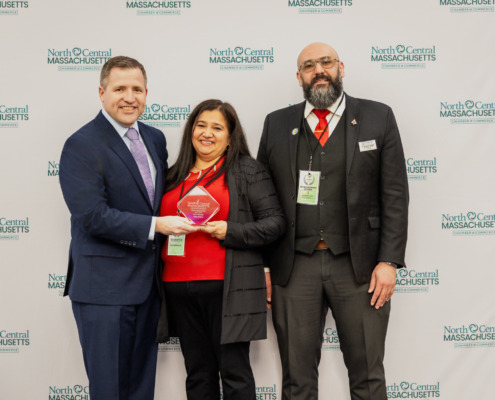

Chamber members are provided with the opportunity to engage with the Mayors of Fitchburg, Gardner, and Leominster who provide updates on projects and other things happening in their Cities. These events are by invitation only, please contact Travis Condon for more details.
View
Event
Bull Run Restaurant215 Great Rd. Shirly, MA
View
Event
Join us for our last Connect North Central of the year!
Friday, December 11, 2026
8am-9am
View
Event
January 14, 20277:15am - 9:00am
View
Event
Erin Logan | NBC 10 Reporter
View
Event
Chamber members are provided with the opportunity to engage with the Mayors of Fitchburg, Gardner, and Leominster who provide updates on projects and other things happening in their Cities. These events are by invitation only, please contact Travis Condon for more details.
View
Event
We are pleased to announce that Stephanie Williams is joining Mount Wachusett Community College in the newly established role of Chief Diversity Executive.
Williams joins MWCC after severing as the Chief Diversity Executive for the City of Worcester where she was responsible for leading the City Manager’s diversity agenda. Prior to joining the City of Worcester, Williams held positions at the Department of Transitional Assistance, Anna Maria College, and Becker College.
“I am looking forward to bringing my experience both in and outside of higher education to MWCC,” Williams shared. “I’ll be working collaboratively with colleagues and students at the college to build upon the work their teams have done and develop something that will be as successful and equitable for everyone.”
Williams holds an MBA from Anna Maria College. She earned her associate degree in liberal studies at Quinsigamond Community College and her bachelor’s degree in psychology from Becker College.
“It is with great pleasure that we announce Ms. Williams has accepted our offer to join the college as our first Chief Diversity Executive,” stated MWCC President James Vander Hooven. “As we progressed through our nationwide search, it became very clear that Stephanie’s experience and passion have prepared her to meet the challenges and opportunities ahead here at the Mount. I would like to thank the search team, The Diversity Equity and Inclusion team, and the students who participated in the search and provided significant feedback throughout.”
As Chief Diversity Executive Williams will report directly to President Vander Hooven and serve as a member of the President’s Leadership Team. The Chief Diversity Executive will provide vision, leadership and oversight to programs, policies, and procedures related to MWCC’s commitment to social justice, equity, diversity, and inclusion and facilitates the integration of equity and cultural appreciation across all aspects of the college.
Financial services leader moving from Leominster in response to growing market needs
Exchange Authority, a leading consultant and facilitator for Section 1031 exchanges and a wholly owned subsidiary of Fidelity Bank, today announced the relocation of its offices from Leominster to Worcester.
All Exchange Authority staff relocated to the Fidelity Bank banking center located at 465 Shrewsbury Street in Worcester, effective February 21, 2022. The organization will continue to offer the same services clients and referral sources have come to know and trust for more than 20 years and will continue to serve all 50 states and the U.S. Virgin Islands.
The move to Worcester comes on the heels of the Exchange Authority experiencing tremendous growth. In 2021, the organization realized a 30 percent increase in total exchanges, and a 48 percent increase in escrow receipts. The $226 million that flowed through the company in 2021 yielded a 37 percent increase in the average daily balance, ending the year with just over $51 million on deposit.
“While the decision to move from Leominster was a difficult one, this move will provide us with the opportunity to be closer to our clients and respond to growing market needs,” said John Peculis, President and CEO, Exchange Authority. “We believe this move better positions us to serve our clients and partners in the financial services industry and also presents the opportunity to work alongside colleagues at the newly-renovated Shrewsbury Street banking center.”
Fidelity Bank recently completed a state-of-the-art renovation at the Shrewsbury Street banking center which included new offices, an enhanced teller pod experience and upgrades with modernized technology.
Clinton Savings Bank (clintonsavings.com) has been selected to participate in the Federal Home Loan Bank of Boston’s Equity Builder Program, which assists local homebuyers with down payment and closing costs as well as homebuyer counseling and rehabilitation assistance. The program provides grants to financial institutions to assist households at or below 80 percent of the area median income. Borrowers are eligible to receive up to $22,000 in assistance on a first come first served basis. Buyers must also complete a homebuyer counseling program. “Homeownership is not easily attainable for many households, so we are pleased to offer this assistance to help individuals and families purchase a home. Homeownership helps build wealth and create financial
stability, and programs that assist homebuyers can be effective in adding to the vibrancy of our communities,” said Debra Colonna, SVP/Retail Lending Officer, Clinton Savings Bank. Clinton Savings Bank is eligible to receive up to $220,000 in 2022 through the Equity Builder Program depending on availability of funds.
To learn more about applying for assistance, please contact:
Elisa Cuddy NMLS #857471
or 978-365-3444
John Ryan NMLS #27261
or 978-365-3489

When the workday ends and the lights go down, Custom Cleaning Service of Peabody, Inc. gets to work. “We operate as our clients’ silent partner after business hours,” says Adam Paicos, of Templeton, who now serves as Director of Operations and oversees the company’s expansion into North Central MA. “We are not often seen, but we ensure facilities are clean, secure, and ready for business each day while serving as the eyes and ears for our clients when they are not on site.”

Discover local business stories through our Inside North Central Massachusetts Podcast series. Listen as Chamber members share their journeys, insights, and contributions to our thriving regional business community.

Looking for your next opportunity? Explore current job openings from employers across North Central Massachusetts on our Jobs Board. Whether you’re starting a new career or making a change, you’ll find a variety of local positions available to help you take the next step.
CapEx Facility Services & Construction · Leominster, MA
TaraVista Behavioral Health Center · Harvard, MA
DRS Power Technology, Inc. · Fitchburg, MA
AIS · Leominster, MA