E-Newsletter
An Electronic Publication of the North Central Massachusetts Chamber of Commerce

Inside this edition, you’ll discover the latest Chamber initiatives and success stories from across our region. From economic development projects and upcoming networking events to policy updates and workforce training opportunities, we’re keeping you connected to what matters most for your business and North Central Massachusetts.
The North Central Massachusetts Chamber of Commerce is here to help – with trusted resources, a strong business network, and a support system to keep your business and the region moving forward
At its December 9, 2025 tax classification hearing, the Lancaster Board of Selectmen voted 2-1 to maintain the town’s single tax rate, rejecting a proposal to shift the tax burden onto the community’s small commercial and industrial base through a split tax rate. The North Central Massachusetts Chamber of Commerce testified in support of the single rate, leveraging the Assessors’ own analysis and regional perspective to demonstrate why tax shifting doesn’t make sense for Lancaster.
Select Board members Jason A. Allison and David R. Carr voted in favor of maintaining the single rate, while Selectman Ralph A. Gifford III voted in opposition. The decision preserves Lancaster’s competitive tax environment and positions the community to attract the commercial and industrial investment that creates jobs and strengthens the overall tax base.
Lancaster’s commercial, industrial, and personal property base represents only 12% of total valuation. With such a small base, any attempt to shift taxes using a split rate would place disproportionate burdens on a small amount of businesses for minimal residential benefit. The town’s Assessors’ own modeling showed that saving residential taxpayers just $500 would require shifting 36% of the tax burden onto just 6% of the base that is commercial (largely small businesses) and 3% that is industrial. This concentration of burden would be economically counterproductive.
Several residents testified in favor of the shift to a split tax rate, arguing it would help reduce residential taxes without impacting businesses. The Chamber’s testimony addressed this misconception directly: tax shifting doesn’t generate new revenue. It simply moves who pays the same total levy. And when businesses facing dramatically higher rates choose to locate in neighboring communities with more favorable tax treatment, residential taxpayers end up bearing an even larger share of the burden.
In our regional experience, split tax rates drive businesses out over the long term, creating a downward spiral where the remaining tax base (both commercial and residential) must absorb the loss. Most communities in North Central Massachusetts maintain single tax rates, and those few that adopted split rates have either moved back to single rates or are actively working to eliminate them.
The North Central Massachusetts Chamber of Commerce was the only chamber of commerce or business organization to testify at the hearing. Chamber President & CEO Roy Nascimento and Director of Public Affairs Travis Condon presented testimony grounded in data, regional experience, and economic reality, not political rhetoric.
This is advocacy in action. The North Central Massachusetts Chamber of Commerce shows up at selectboard meetings, planning board hearings, and legislative sessions to do the work of advocating for our members and communities.
This year alone, Chamber advocacy efforts have included:
Lancaster’s decision to maintain its single tax rate is a win for businesses, residents, and the community’s long-term economic health. We’re grateful the Board carefully considered the data, regional trends, and the potential impacts on the entire community.
The Chamber will continue monitoring tax classification decisions across the region. Tax policy remains one of the most important tools municipal leaders have to either attract or repel business investment, and the Chamber will continue working with communities to advance policies that support economic growth and job creation.
If you’re facing challenges with local regulations, permitting, taxes, or other issues affecting your business, reach out to the North Central Massachusetts Chamber of Commerce. The Chamber may be able to help, whether that means connecting you with resources, working directly with municipal officials, or testifying on policies that impact our members. This is exactly the kind of advocacy work the Chamber does every day.
For more information, contact Travis Condon, Director of Public Affairs at the North Central Massachusetts Chamber of Commerce at 978.353.7600 ext. 224 or via email at .
North Central Massachusetts | Central Massachusetts | Massachusetts | Chamber of Commerce | North Central Massachusetts Chamber | Chamber of Commerce Membership | Chamber of Commerce Member Benefits | Chamber of Commerce near me | Blog
Un resumen de los esfuerzos realizados durante el otoño por el brazo de marketing de destinos de la Cámara, Visit North Central Massachusetts (VNCM).
Como informamos en la edición de otoño, Visit North Central Massachusetts completó nuestra estrategia integral de marketing para el año fiscal 2026 y presentó nuestra solicitud anual de subvención de turismo correspondiente a la Oficina de Viajes y Turismo de Massachusetts (MOTT). Recibimos la notificación del monto de nuestra subvención a fines de octubre; sin embargo, a la fecha de impresión, casi cinco meses transcurridos del año fiscal que comenzó el 1 de julio de 2025, aún no hemos recibido nuestro contrato ni los fondos correspondientes.
Esta demora en la contratación y la asignación de fondos impactó nuestros esfuerzos de marketing durante la temporada de otoño. Nos adaptamos cubriendo algunos costos de publicidad por adelantado mientras esperábamos los fondos de contrapartida del estado y posponiendo estratégicamente otras campañas planificadas. Afortunadamente, nuestra subvención Mass250 nos permitió mantener cierto impulso a través de campañas publicitarias activas que ayudaron a cerrar la brecha creada por la demora en nuestra subvención anual regular de contrapartida del fondo fiduciario de turismo del estado. Seguimos comprometidos a ponernos al día durante los meses de invierno y a posicionarnos sólidamente para las temporadas turísticas de primavera y verano.
Agradecemos la colaboración del estado y esperamos recibir nuestro contrato y financiamiento para poder ejecutar plenamente nuestros esfuerzos de marketing que impulsan el impacto económico para nuestros negocios miembros y comunidades.
El turismo es mucho más que una sola industria; es un catalizador para la vitalidad de la comunidad. Cuando construyes un lugar que la gente quiere visitar, has construido un lugar donde la gente quiere vivir, trabajar e invertir. Cada visitante que atraemos se convierte en un cliente potencial, un futuro residente o inversionista que experimenta los activos únicos de nuestra región y se convierte en un embajador para el centro norte de Massachusetts. Es por eso que nuestros esfuerzos de marketing estratégico no solo generan un impacto económico inmediato, sino que también crean conciencia y prosperidad a largo plazo para nuestras comunidades y miembros.
Durante los primeros cuatro meses del año fiscal 2026 (del 1 de julio al 31 de octubre de 2025), VisitNorthCentral.com, nuestro sitio afiliado de turismo, atrajo a 18 683 usuarios (una disminución de 68,1% en comparación con el mismo período del año fiscal 25) y generó 34 275 visitas a la página (una disminución de 63,6% interanual). Las impresiones ascendieron a 1,012,127 (una disminución de 22.0% en comparación con el mismo período del año fiscal 25). Estas caídas significativas reflejan directamente el impacto del retraso en los fondos de contrapartida del estado, lo que nos impidió lanzar nuestras campañas de publicidad digital previstas al inicio del año fiscal. A medida que recibamos los fondos y pongamos en marcha nuestras iniciativas de mercadotecnia de invierno y primavera, esperamos ver un aumento en la participación digital.
Durante los primeros cuatro meses del año fiscal 2026 (del 1 de julio al 31 de octubre de 2025), mantuvimos una fuerte presencia orgánica en redes sociales, construyendo una comunidad que interactúa activamente con contenido sobre atracciones regionales, eventos y empresas miembros. Nuestro número combinado de seguidores en redes sociales, entre Facebook e Instagram, suma ahora más de 49,000 seguidores.
En Facebook, logramos resultados impresionantes con 885 441 impresiones de publicaciones (un aumento de 137% respecto al año anterior) y un alcance total de 45 173 seguidores (un aumento de 9,4% respecto al año anterior). Las reacciones a las publicaciones aumentaron un 56,1% hasta alcanzar las 2.314, los clics en los enlaces se dispararon un 69,4% hasta los 2.060 y los comentarios casi se duplicaron, con un aumento del 93,1% hasta llegar a 195. En Instagram, las impresiones de las publicaciones alcanzaron las 121 148 (un aumento de 85,41 TP3T respecto al año anterior) con 3 821 seguidores (un aumento de 19,71 TP3T respecto al año anterior). Las veces que se compartieron las publicaciones aumentaron un 24,21 TP3T hasta llegar a 221. Estos sólidos resultados orgánicos en redes sociales demuestran la efectividad de nuestra estrategia de contenido, incluso durante un período en el que los retrasos en el financiamiento limitaron las campañas de publicidad pagada.
A través de nuestra asociación con PlayEasy, la plataforma que conecta a organizadores de deportes juveniles y amateurs con recintos y hoteles regionales, hemos visto una participación continua en noviembre de 2025. El perfil de VNCM recibió 981 visitas con 95 visitantes, los listados de instalaciones generaron 1,586 visitas con 896 visitantes, las páginas de atracciones recibieron 77 visitas con 33 visitantes y los listados de eventos atrajeron 1,227 visitas con 625 visitantes. Esta plataforma especializada de turismo deportivo continúa creando conexiones medibles entre los eventos deportivos y nuestros negocios de hospitalidad miembros.
El Centro de Visitantes Johnny Appleseed recibió 11.842 visitantes en septiembre y 14.575 visitantes en octubre, lo que elevó el total del año calendario 2025 a 105.493 visitantes hasta el 31 de octubre. Estas cifras impresionantes reflejan el papel del centro como puerta de entrada a nuestra región y un punto de contacto clave para presentar a los visitantes las empresas miembro y las atracciones regionales.
Durante el otoño, organizamos nuestra popular serie de eventos Showcase en el Centro de Visitantes, celebraciones de fin de semana con música en vivo, tatuajes de henna, donas de sidra de manzana, alpacas, artesanías hechas a mano, pintura facial y mucho más. Estos eventos familiares, que tuvieron lugar los fines de semana durante agosto, septiembre y octubre, tuvieron una gran asistencia y exhibieron la rica cultura y el espíritu comunitario del centro de Massachusetts. Agradecemos a los consejos culturales locales del centro de Massachusetts por ayudarnos a patrocinar estos eventos.
Según los últimos informes sobre alojamiento de STR y AirDNA correspondientes al período de julio a septiembre de 2025, el mercado hotelero del centro-norte de Massachusetts enfrentó dificultades. En el caso de los hoteles de la región, la ocupación fue de 71,9% (una disminución de 4,3% respecto al mismo período del año anterior), con una tarifa promedio diaria (ADR) de $164,20 (una disminución de 2,21 TP3T) y un ingreso por habitación disponible (RevPAR) de $117,98 (una disminución de 6,41 TP3T). El mercado hotelero generó $14,7 millones en ingresos, lo que representa una disminución de 6,4% respecto al año anterior.
Los alquileres a corto plazo en la región del centro-norte de Massachusetts mostraron una tendencia más positiva, con una ocupación del 58,0% (una disminución de 4,81 TP3T respecto al año anterior), pero con un ADR de $130,72 (un aumento de 9,41 TP3T) y un RevPAR de $75,85 (un aumento de 4,11 TP3T). Los alquileres a corto plazo de la región generaron $1.9 millones en ingresos, lo que representa un aumento de 21.5% respecto al año anterior.
Estas tendencias subrayan la importancia de nuestros esfuerzos de marketing para mantener la participación de los visitantes y apoyar a los negocios de hotelería locales en un entorno desafiante.
La recaudación del impuesto local sobre las comidas, correspondiente al período de julio a septiembre de 2025, ascendió a $723,100, lo que representa un aumento de 46.2% respecto al mismo período del año anterior, mientras que la recaudación del impuesto sobre el alojamiento alcanzó $799,500, con un aumento de 13.7% respecto al mismo período del año anterior. Es muy probable que estos aumentos se deban a que varias comunidades adoptaron impuestos locales opcionales sobre las comidas y aumentaron sus tasas de impuestos sobre el alojamiento en 2025, lo que tiene un impacto significativo en las comparaciones interanuales. Estos ingresos fiscales respaldan directamente los servicios de los gobiernos locales y los monitoreamos como indicadores de los patrones de gasto de los visitantes y del impacto económico del turismo en nuestras comunidades.
Los nuevos datos sobre visitantes, correspondientes al período comprendido entre julio y septiembre de 2025, ofrecen información valiosa sobre quiénes visitan el centro-norte de Massachusetts. Los visitantes nacionales permanecieron un promedio de 1,3 días; de ellos, 66,5% pernoctaron y 44,5% eran visitantes habituales. Los principales estados de origen de los visitantes fueron Massachusetts (15,5%), Connecticut (11,3%), Nueva York (9,7%) y Maine (9,4%). El área metropolitana de Boston-Cambridge-Newton representó 8,1% de los visitantes, seguida por la de Nueva York-Newark-Jersey City (7,3%) y la de Providence-Warwick (6,8%).
Los visitantes internacionales entre enero y septiembre de 2025 se quedaron más tiempo, con un promedio de 2,2 días y 79,6% pernoctando. Canadá lideró los mercados internacionales con una tasa de pernoctación de 81,2%, seguido por Brasil, México y el Reino Unido. Estos perfiles de visitantes nos ayudan a refinar nuestras estrategias de mercadotecnia para llegar a audiencias de alto valor y alinearnos mejor con las prioridades turísticas del estado.
Al adentrarnos en 2026, nos enfocamos en ejecutar el plan de marketing que desarrollamos para el año fiscal 2026, con un énfasis particular en recuperar terreno por la financiación estatal demorada. Nuestras campañas MA250 continúan entregando resultados, mostrando la historia revolucionaria de la región, la escena culinaria, la recreación al aire libre y las comunidades innovadoras a audiencias de toda Nueva Inglaterra.
Las alianzas estratégicas de medios con AAA, Hearst, Boston Magazine, Yankee Magazine, Edible Boston, TripAdvisor y PlayEasy amplificarán nuestras campañas de invierno y primavera. Estamos aprovechando nuestro impulso digital con contenido mejorado para viajes grupales, turismo deportivo y atracciones de temporada.
Norte de Massachusetts Central | Centro de Massachusetts | Massachusetts | Cámara de Comercio | Cámara de Comercio del Norte de Massachusetts Central | Membresía de la Cámara de Comercio | Beneficios de ser miembro de la Cámara de Comercio | Cámara de Comercio cerca de mí | Blog | Actualización de Turismo Invierno 2025
The Chamber’s advocacy work has been in high gear this fall, with efforts spanning local, state, and federal levels to advance policies that strengthen our region’s economy and support our members. This busy period of engagement has been guided by our newly approved FY2026 Public Policy Agenda.
Adopted by the Board of Directors in September, our FY2026 Public Policy Agenda was developed by our member-driven Government Affairs Committee. The agenda maintains core priorities while making strategic adjustments to address emerging regional challenges and opportunities.
Our focus centers on promoting economic competitiveness, advocating for small business, asserting our role as the Commonwealth’s manufacturing hub, and advancing education, transportation infrastructure, and real estate development.
Key priorities include implementing our One North Central regional economic development plan, fighting for regional equity in state investments, supporting our manufacturing sector, and addressing workforce challenges through support for expedited work visas, improved education pathways and reduced employment barriers. We’re also focused on modernizing Route 2, enhancing commuter rail service, and supporting diverse housing and commercial real estate development.
New this year, we’ve added positions on artificial intelligence and support for financial literacy. We continue opposing increases to unemployment insurance taxes and other regulatory burdens that disproportionately impact small businesses. The complete agenda is available at northcentralmass.com.
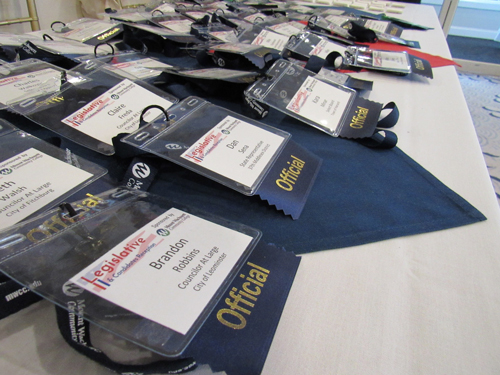
Legislative & Candidates Reception
Our local engagement intensified this fall. Public Affairs Director Travis Condon regularly attends city council meetings in Fitchburg and Leominster to monitor actions affecting members. With 27 communities in our region, we prioritize attendance at other municipal meetings as needed when member interests are at stake.
Chamber President Roy Nascimento testified at two Fitchburg City Council meetings earlier this Fall, successfully advocating for the creation of a tourism destination marketing district to aid in bolstering our growing tourism economy. The adoption of this district by the City of Fitchburg marks the first time a district has been created in Massachusetts outside of Boston. Meanwhile, we’ve been advocating with the Mazzarella administration in Leominster to restore tourism funding after a $15,000 cut this year. Following years of level funding eroded by inflation, this reduction threatens the Johnny Appleseed Visitors Center and sets a dangerous precedent that could undermine our successful regional tourism partnership.
We also met with officials in Lancaster, Winchendon, Ashburnham, Gardner, and Leominster to discuss priorities and collaboration opportunities that strengthen our regional economy.
With the municipal elections wrapped up, we are setting up meetings with new additions to the local city councils to brief them on the Chamber and reaffirm our position as a partner and resource.
Our Beacon Hill efforts centered on several key initiatives. We were disappointed when the Healey administration vetoed regional economic development funding, and we advocated for restoring the modest funding. The decision by the Governor underscores the regional equity challenges we face. We’re grateful to our legislative delegation for their steadfast support in fighting to restore these resources.
We testified supporting legislation for a Region D gaming license that would dedicate revenues to critical transportation infrastructure. This bill has tremendous potential to boost economic development and tourism throughout our region and the Commonwealth.
Working with a coalition of regional tourism groups, we have also been advocating to modernize the Tourism Trust Fund. Legislation filed would direct 2.5% of the state’s room occupancy excise revenue to the fund, which has remained flat for over ten years – effectively a significant cut due to inflation. We are pushing to index the fund to room tax collections, as other states do, ensuring revenue from the lodging industry is reinvested into tourism marketing. This modernization is essential for our region’s competitive position.
Beyond testimony and meetings, we organized several policy-focused events to connect members with elected officials and advance member interests. On September 18, we hosted our “State of the Tri-Cities” breakfast, bringing together members with the Mayors of Fitchburg, Leominster, and Gardner to discuss regional priorities and economic development initiatives affecting our three largest cities.
Our September 25 Legislative and Candidates Reception drew strong attendance from elected officials, municipal candidates, and members. On November 7, we hosted our Congressional Luncheon with our federal delegation to discuss national issues affecting business.
In October, we organized our annual Manufacturing Month bus tour, bringing legislative delegation members, education leaders, and economic development officials into our manufacturing facilities to showcase this vital sector and advocate for supportive policies.
Also in October, we formally joined the Massachusetts Opportunity Alliance alongside chambers and business associations statewide, participating in a briefing on two pro-economy ballot questions that would reduce state taxes.
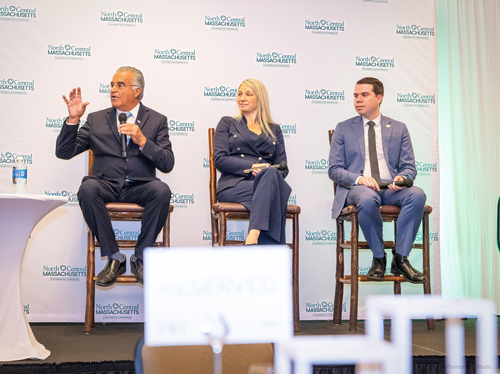
State of the Tri-Cities Breakfast
Chamber President Roy Nascimento connected with top chamber leaders nationwide at the CCC100 meeting this fall, joining discussions with U.S. Chamber of Commerce officials, policy experts, industry leaders, members of Congress, and pollsters on critical issues including artificial intelligence, the economy, childcare, tariffs, and legislative priorities.
The Chamber remains committed to advocating for policies that strengthen North Central Massachusetts’ economic competitiveness, support our members, and ensure our region receives its fair share of investment and opportunity.
For information about the Chamber’s public policy work, contact Public Affairs Director Travis Condon at 978.353.7600, ext. 224, or .
North Central Massachusetts | Central Massachusetts | Massachusetts | Chamber of Commerce | North Central Massachusetts Chamber | Chamber of Commerce Membership | Chamber of Commerce Member Benefits | Chamber of Commerce near me | Blog | Government Affairs Update Winter 2025
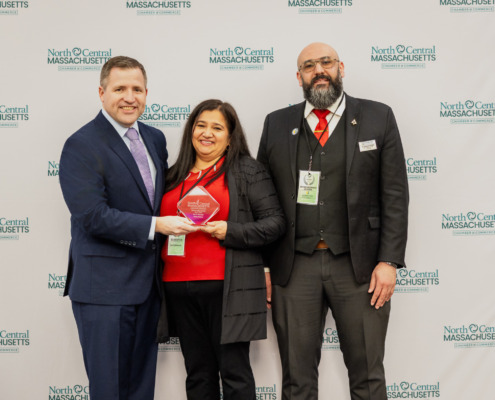

The reception features an open bar and gourmet appetizers.
View
Event
Join us for Connect North Central
Friday, September 25, 2026
8am-9am
View
Event
North Central Golf Tour Championship: Fore the Future
An FLNC Non-Traditional Scholarship Fundraiser
View
Event
Thank you Series Supporting Sponsor empHowered PR
View
Event
Join us for our 11th Annual
Congressional Luncheon
View
Event
Wednesday October 28, 2026
5:00pm - 7:00pm
View
Event
Join us for this in person HR Legal Update
View
Event
November 19, 2026
7:15am - 9:00am
View
Event
Chamber members are provided with the opportunity to engage with the Mayors of Fitchburg, Gardner, and Leominster who provide updates on projects and other things happening in their Cities. These events are by invitation only, please contact Travis Condon for more details.
View
Event
Bull Run Restaurant
215 Great Rd. Shirly, MA
View
Event
Join us for our last Connect North Central of the year!
Friday, December 11, 2026
8am-9am
View
Event
Chamber members are provided with the opportunity to engage with the Mayors of Fitchburg, Gardner, and Leominster who provide updates on projects and other things happening in their Cities. These events are by invitation only, please contact Travis Condon for more details.
View
Event
Dear Chamber Member,
As a Chamber member, you know strong community partnerships fuel business growth. This offer is exclusive to Chamber members and delivers real value. This year, you can build your team’s leadership and productivity skills at no cost to your company!
Leadership Dynamics Inc. Workplace Productivity and Workplace Leadership & Coaching programs prepare your team to lead with clarity, achieve goals, and fuel your success in 2026. The training is hands-on, built for real challenges, and focused on measurable results.
This is a rare chance to strengthen your team and sharpen execution for the new year without touching your budget. Seats for the January cohorts are limited, and the state grant deadline is approaching.
Your 2026 goals need leaders who think clearly, act with purpose, and deliver results. Enroll key team members now in Workplace Productivity y Workplace Leadership & Coaching and secure the talent your organization needs to win.
For more information, contact .
With care,
Paul
Sign-up link: https://www.leadershipdynamicsinc.com/
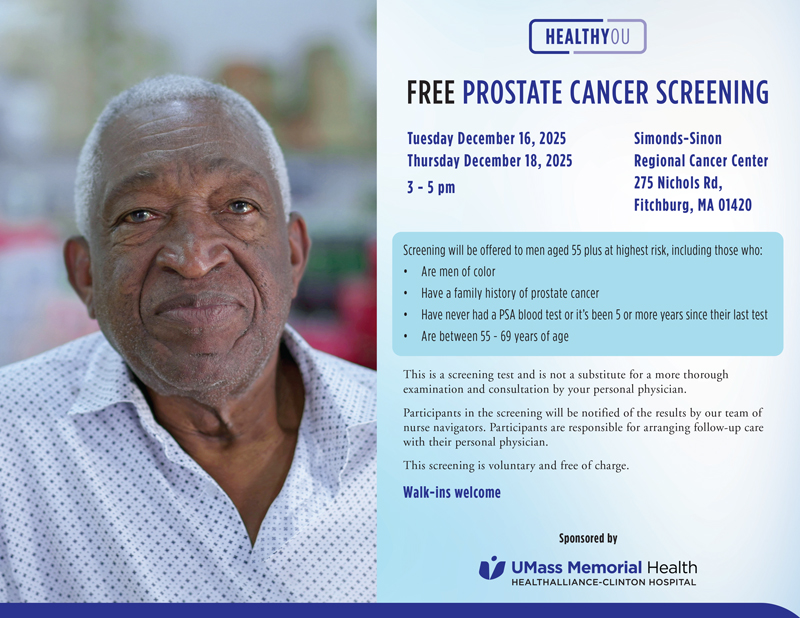
HealthAlliance-Clinton Hospital’s Simon Sinon Cancer Center is pleased to announce a FREE PROSTATE CANCER SCREENING event and invite you to share this opportunity with your clients, patients, and communities.
For men aged 55 and older at highest risk, including those who:
Together, we can support a healthier community for all.
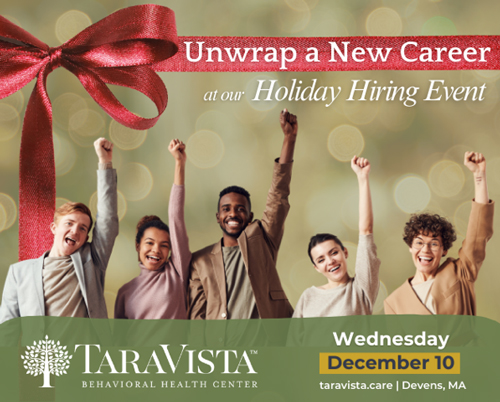
Taravista Behavioral Health Center is hosting a Holiday Hiring Event on December 10 from 4-6:30pm. Join us to explore meaningful careers rooted in hope, healing, and helping people discover their strength and resilience. Bring your resume and your energy — we are offering on-the-spot interviews and same-day offers for qualified candidates. No waiting. No wondering. Just real opportunities. We’re hiring:
– Nurses (LPN & RN)
– Mental Health Counselors
– Social Workers
– Accounting & Operations Professionals
Details and Sign-Up Here: https://www.taravista.care/careers-reimagined/
When the workday ends and the lights go down, Custom Cleaning Service of Peabody, Inc. gets to work. “We operate as our clients’ silent partner after business hours,” says Adam Paicos, of Templeton, who now serves as Director of Operations and oversees the company’s expansion into North Central MA. “We are not often seen, but we ensure facilities are clean, secure, and ready for business each day while serving as the eyes and ears for our clients when they are not on site.”

Discover local business stories through our Inside North Central Massachusetts Podcast series. Listen as Chamber members share their journeys, insights, and contributions to our thriving regional business community.

Looking for your next opportunity? Explore current job openings from employers across North Central Massachusetts on our Jobs Board. Whether you’re starting a new career or making a change, you’ll find a variety of local positions available to help you take the next step.
CapEx Facility Services & Construction · Leominster, MA
TaraVista Behavioral Health Center · Harvard, MA
DRS Power Technology, Inc. · Fitchburg, MA
AIS · Leominster, MA