E-Newsletter
An Electronic Publication of the North Central Massachusetts Chamber of Commerce

Inside this edition, you’ll discover the latest Chamber initiatives and success stories from across our region. From economic development projects and upcoming networking events to policy updates and workforce training opportunities, we’re keeping you connected to what matters most for your business and North Central Massachusetts.
The North Central Massachusetts Chamber of Commerce is here to help – with trusted resources, a strong business network, and a support system to keep your business and the region moving forward
Article Source: The Statehouse News Service
Article Author: Matt Murphy
JULY 31, 2020…..On Beacon Hill, rules are made to be broken, and deadlines set to be missed.
But even by the Legislature’s loose standards, the decision this week to suspend a 25-year-old edict that otherwise would have required the House and Senate to finish their business by Friday at midnight was notable.
Facing backlash in 1995 for voting themselves a raise and passing a capital gains tax cut during a lame-duck session the year before, the Legislature adopted a rule requiring it to wrap up formal legislative business by July 31 in election years.
And the bright line has been relatively sacrosanct ever since.
But in this year of COVID-19, all bets are off — including, maybe, bets on professional sports. But we’ll get to that later.
The House vote on Wednesday to scrap Joint Rule 12A and allow the Legislature to continue meeting for the rest of the year in formal sessions took a lot of the air out of the normally pressure packed final week of session, when frantic sometimes only begins to describe the feeling in the halls.

House Ways and Means Chairman Aaron Michlewitz and House Majority Leader Ron Mariano had a sidebar outside the chamber Tuesday afternoon during a busy week of legislating. The House voted the next day to continue formal sessions past July 31, and the Senate agreed Thursday. [Sam Doran/SHNS]
The extension of the session was actually one of the top priorities of a group of Black staffers at the State House who wrote to Democratic leadership requesting more workplace support for employees of color in the Legislature, better recruitment, and the prioritization of racial justice impacts of bills under consideration.
The letter and organizers of the effort spoke to how Black, Indigenous and People of Color (BIPOC) staffers have felt marginalized on Beacon Hill and subjected to racism in the workplace, and Spilka and DeLeo’s office both said they would meet with the group of about three dozen.
So what does it mean to extend the session?
Well, for starters, it means that there won’t be a repeat of two years ago when talks between the House and Senate over health care legislation collapsed at the eleventh hour on July 31. That could still happen, for any bill, but not until January.
It also means the Legislature has seized back a modicum of power from Gov. Charlie Baker and opened the door to the possibility of back-and-forth with the administration. A veto from the governor would no longer doom a bill because the Legislature couldn’t vote to override. And similarly, if Baker had ideas to amend, for example, the policing bill, there is now time to work through those issues.
But it also means no issue is truly dead for the year, including possible tax hikes that could surface before the election, or even after the Nov. 3 election during a lame-duck session.
Months after Spilka said she was “not certain now is the time to be talking about taxes,” Sen. Adam Hinds acknowledged this week that the Senate is indeed talking about taxes.
“We have reengaged the Senate revenue working group with a new mandate to consider the current reality and to think through a plan to meet potential challenges, depending on federal action and where we stand with the economic recovery and where the pandemic is,” Hinds said.
Don’t think that didn’t go unnoticed by House leaders, who chafed at the way Spilka dismissed this time as not right to consider the new taxes and fees to invest in transportation after House lawmakers took that vote in an election year, but before the pandemic hit.
But speaking of that elusive budget and what will be needed to balance it, Democratic leaders bought themselves some time by essentially seeing Gov. Charlie Baker’s $5.15 billion interim budget for August, and raising him enough cash to cover September and October as well.
Rather than going month-to-month, the Legislature passed a $16.5 billion interim budget that will cover government payroll and services through Oct. 31.
The move, which Baker said he would sign before appropriations run out on Saturday, gives budget officials flexibility to wait to see if Congress comes to the rescue of drowning states with a relief package that could dent or eliminate a looming budget problem expected to be in the billions of dollars.
Even though they can’t predict the pace of the economic recovery, or its slide backward, Baker and the Legislature also announced an agreement this week to level fund local government and school aid in fiscal 2021 (plus $107 million for inflation and other factors).
That agreement will allow cities and towns to better plan their own spending as they think about reopening schools in the fall.
Baker, however, was among the elected officials from Boston to Cape Cod warning that if Bay Staters don’t turn the music down and stop partying so hard this summer, there may not be a reopening of schools or any other businesses this fall. COVID-19 case numbers and the positive test rate have started to tick up ever so slightly, but enough to sound alarm bells.
Rhode Island Gov. Gina Raimondo came right out and said it, as she tightened her state’s gathering size limits: “We’re partying too much,” she said.
Baker wasn’t as direct, but the sentiment was there as he said large parties causing potential “clusters” of infections were forcing his administration to think about its guidance for indoor and outdoor gatherings.
“The bigger issue is honestly the behavior generally at those, which is not socially distant, no masks and in some respects a lack of respect for how this virus works and how it moves from person to person,” Baker said Thursday.
A day later, the administration enlisted the help of Wally the Green Monster to help launch a #MaskUpMA social media campaign to warn against growing complacency. If Wally could also learn how to throw a curveball for strike, that might also help save the summer.
So if Spilka can be taken at her word that she’s not planning to slip, say, an immigration bill onto the fall agenda, what might get done this session?
In addition to a budget, Democrats and Gov. Baker all want to see a police licensing bill with limits on the use of force signed into law.
Negotiations are also underway, or soon to be underway, over a telemedicine bill, a climate action bill to set a goal of net-zero emissions by 2050 and an economic development bill that may or may not legalize sports betting.
Both the House and Senate padded the job stimulus bill with Gov. Baker’s “Housing Choices” zoning reform, but only the House included an expansion of gambling in Massachusetts to seek revenues from bets on professional and college sports.
The bill would put Massachusetts in the company of 22 other states with sports betting, but the House version likely would make the state the first to include a sweetener for team owners by giving a small percentage of the profits to the owner of the venue in Massachusetts where a game or match gets played.
The Senate left sports betting out of its jobs bill, and Senate leaders, including Economic Development Committee Co-Chair Sen. Eric Lesser, had plenty to say about wanting to take up sports betting, perhaps as a standalone bill, and the need to thoroughly study the issue.
But it all sounded a lot like, “Not going to happen this year, sorry.”
The other bills in conference, and which Baker had said repeatedly he’d like to sign before the year is over, include long-term borrowing bills with billions of dollars for transportation and information technology, including support funding for remote learning.
If all this wasn’t enough, Baker took a timeout during his press conference in Andover on the campus of Pfizer, where a potential COVID-19 vaccine is being developed, to warn against planting mysterious seeds that have been arriving in the mail from foreign countries.
“Locusts? What’s next?” Baker muttered.
STORY OF THE WEEK: Keeping the party going on Beacon Hill.
SONG OF THE WEEK: Even if you think you can’t stop partying, Gov. Baker says you should try. Or at least wear a mask.

How to Grow When It’s Slow: Increase Productivity Right Now
“Imagine –” suggests business expert Cameron Herold, “If you train your employees on interviewing, train them on effective meetings, train them on an email management, train them on time management, or if you could really work on skill development right now – you can come out of this stronger.”
Cameron Herold is a top business consultant, best-selling author, and speaker. We caught up with him via a recent podcast interview he did for Real Estate Rockstars Radio. He’s the mastermind behind hundreds of companies’ exponential growth and teaches today’s most dynamic business leaders.
Periods of slow growth come with great challenges both for businesses and consumers. However, you can take advantage of such times to improve efficiency and increase productivity. Cameron has some great advice for business owners in his interview, and we put together some recommendations inspired by Cameron.
Clean up your business systems – and your work space
Most businesses will focus only on sales and marketing to survive hard times. You can also use this time to work on your standard operating procedure to ensure it meets your current and future needs. Slow growth periods are ideal times to purge and clean your warehouse, offices, desks, filing systems, and other important areas of the business. Cleaning the workplace will go a long way in creating a better work environment and improving efficiency.
Training and skills development
Considering the busy schedules that characterize modern workplaces, employers have little or no time to train their employees. When it is slow, you can use this time for training and skills development. Train employees in critical areas like interviewing, effective meetings, time management, and email management. Skills development will also help to address weaknesses and strengthen skills, allowing you to bring employees to a level where they can work without constant help and supervision. In a nutshell, training and skills development will contribute to improved employee performance.
Take advantage of technology
Periods of slow growth can allow businesses to make the most of existing and new technology. As more employees work and communicate remotely, they will save significant commuting time and be less distracted when handling projects. Businesses can maximize technology to increase productivity by setting up efficient communication channels and empowering all employees to work remotely. Teleconferencing and working from home are quickly becoming the new normal, a factor that could affect the organizational structure of many companies.
Explore alternative work sites
Changes such as teleconferencing and working remotely will have a significant impact on office leasing. There will be cases where staff members are unable to make it to the corporate office, and working from home is not an option. This situation may force businesses to identify alternative working sites such as sterilized co-working spaces. Choosing a great facility will allow you to carry on with your activities despite the disruption caused by issues such as infectious epidemics. Employees can remain productive in emergency situations.
Proactive employee support
When your employees work remotely, your physical office will be set-up into numerous virtual offices. Maintaining proper communication between managers and employees will require that you give your staff the necessary support. Through observations and conversations, you will be able to identify and understand any signs of agony. These include low morale, low work productivity, and anxiety relating to the slow-growth period. Addressing employee concerns will help in increasing productivity to ensure your business survives the tough times.
For information about how to become a better business owner or operator, check out the Second In Command Podcast at CameronHerold.com/podcast.
And stay tuned for the next article in the 6-part series How to Grow When It’s Slow on the topic of building culture in a remote working environment.

Berkshire Bank, Fidelity Bank and Digital Federal Credit Union were the founding sponsors of this fund and have each contributed $100,000 to help capitalize the recovery effort. In addition, the NCMDC contributed $100,000 of its own money to the new fund. Workers’ Credit Union and bankHometown have also signed on to support the initiative with contributions of $10,000 and $5,000 respectively.
In addition, the NCMDC also secured a $500,000 loan from the U.S. Small Business Administration to bolster its micro-lending program and expand its lending efforts to support small businesses in the region. The loan must be repaid over a ten-year period. Grant dollars received from the Commonwealth of Massachusetts were also used to help support the SBA’s requirement for matching funds for a Loan Loss Reserve.
“Access to capital is a major issue for many small businesses, who are struggling to survive amid the unprecedented economic disruption caused by the COVID-19 public health crisis,” said Roy M. Nascimento, President & CEO of the North Central Massachusetts Chamber of Commerce. “This infusion of much needed capital will help shore up our lending capacity and allow us to continue to support small businesses who need financing but are unable to secure it through traditional means.”
For more information or to inquire about a loan, please contact Sandie Cataldo, Economic Development Manager at 978.353.7600 or email . Businesses or organizations interested in supporting the new Economic Recovery Fund should contact Roy Nascimento, President & CEO at
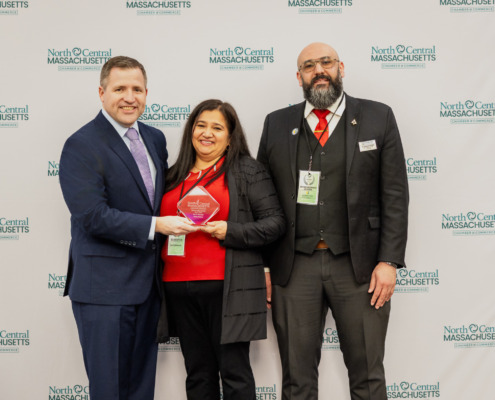

The reception features an open bar and gourmet appetizers.
View
Event
Join us for Connect North Central
Friday, September 25, 2026
8am-9am
View
Event
North Central Golf Tour Championship: Fore the Future
An FLNC Non-Traditional Scholarship Fundraiser
View
Event
Thank you Series Supporting Sponsor empHowered PR
View
Event
Join us for our 11th Annual
Congressional Luncheon
View
Event
Wednesday October 28, 2026
5:00pm - 7:00pm
View
Event
Join us for this in person HR Legal Update
View
Event
November 19, 2026
7:15am - 9:00am
View
Event
Chamber members are provided with the opportunity to engage with the Mayors of Fitchburg, Gardner, and Leominster who provide updates on projects and other things happening in their Cities. These events are by invitation only, please contact Travis Condon for more details.
View
Event
Bull Run Restaurant
215 Great Rd. Shirly, MA
View
Event
Join us for our last Connect North Central of the year!
Friday, December 11, 2026
8am-9am
View
Event
Chamber members are provided with the opportunity to engage with the Mayors of Fitchburg, Gardner, and Leominster who provide updates on projects and other things happening in their Cities. These events are by invitation only, please contact Travis Condon for more details.
View
Event
OXFORD, Massachusetts: Matthew S. Sosik, President and CEO of bankHometown, announced that its 2018 Neighbors Helping Neighbors Campaign has resulted in total donations of $25,000. This is the 15ta year that bankHometown has invited local residents and businesses to help support local food pantries as a way for the bank and its customers to reduce food insecurity in their communities.
Customers of the bank and community members were invited to be a “Hometown Hero” for a $1 donation or a “Hometown Superhero” for a $5 donation. In addition to the in-branch fund drive, bankHometown also invited business customers to support the campaign. bankHometown matched all of the donations dollar for dollar and split the funds among food pantries that serve the areas surrounding each of its thirteen offices in central Massachusetts and northeastern Connecticut. 
“Over the past 15 years, this campaign has evolved into a successful and collaborative effort from customers, community members and our employees, to support local food pantries that need help with inventory during the holidays. We are proud to be an example of Neighbors Helping Neighbors,” said Sosik.
Neighbors Helping Neighbors donations benefit (in MA) the Auburn Youth and Family Services, Inc. Food Pantry (Auburn), CARE Food Pantry (Clinton), Food Share (Southbridge, Charlton & Sturbridge), Ginny’s Helping Hand, Inc. (Leominster), Oxford Ecumenical Food Shelf (Oxford), Salvation Army (Athol), St. Vincent de Paul Food Pantry (Webster); (in CT) Daily Bread (Putnam), Friends of Assisi (Killingly), and Thompson Ecumenical Empowerment Group (TEEG) (Thompson).
To date, more than $167,500 has been distributed through this program.
bankHometown is a member of the Hometown Financial Group. Founded in 1889 as Hometown Bank, bankHometown is headquartered in Oxford, Massachusetts, bankHometown has 13 branches located throughout central Massachusetts and northeastern Connecticut. For more information, please visit www.hometowncoop.com.
Hometown Financial Group, a $2.1 billion mutual holding company headquartered in Easthampton, Massachusetts, is the parent company of bankESB and bankHometown. Both banking franchises offer a complete line of commercial, business, and consumer banking and lending products and services to customers through its 24 branches located throughout western and central Massachusetts and northeastern Connecticut. For more information on Hometown Financial Group please visit www.bankhfg.com.
OXFORD, MA: bankHometown kicked off their 16ta annual pajama drive on November 26ta with a challenge to residents to help support local children in need of new pajamas or slippers.
From now until December 15ta, all 13 bankHometown branches will be accepting pajama donations for children sizes 4T and up, as well as small and medium sizes in men and women. Pajamas must be in complete sets (top and bottom) or an appropriate nightgown. The pajamas and slippers will go to local shelters throughout central Massachusetts and northern Connecticut.
“We believe in giving back to our community all year round, but especially for children during the winter and holiday season,” said Matthew Sosik, President and CEO of bankHometown. “This initiative is to give children in our communities the warmth and comfort they may need during the cold winter nights.”
The pajamas and slippers are sent to local schools in central Massachusetts and northern Connecticut, as well as the TEEG (Thompson Ecumenical Empowerment Group) in Thompson, Connecticut.
bankHometown was founded in 1889 and is headquartered in Oxford, Massachusetts, bankHometown has 13 branches located throughout central Massachusetts and northeastern Connecticut. For more information, please visit www.hometowncoop.com.
Hometown Financial Group (HFG), a $2.1 billion mutual holding company headquartered in Easthampton, Massachusetts, is the parent company of bankESB and bankHometown. Both banking franchises offer a complete line of commercial, business, and consumer products to customers throughout its 24 branches located throughout western and central Massachusetts and northeastern Connecticut. For more information on Hometown Financial Group, please visit www.bankhfg.com.
Wreaths Across America is a nonprofit organization founded to continue and expand the annual wreath laying ceremony at Arlington National Cemetery and other Military Cemeteries.
This year’s ceremony will be held on Saturday, 15 December, 2018, at 10:00 AM.
If you would like to sponsor a wreath to be placed on a veteran’s grave during the wreath ceremony that will be held at the Fort Devens Post Cemetery, please access the Wreaths Across America link above. This link will take you directly to the Wreaths Across America Fort Devens Post Cemetery site.
https://donate.wreathsacrossamerica.org/?pageId=16164&relatedIds=18216,32274
* If Internet Explorer does not work, please try Google Chrome.
The Wreath(s) will then be shipped directly to the Fort Devens Supply Facility (Central Receiving Point) for temporary storage and held there until 15 December, 2018, at which time the Wreath(s) will be transported to the Fort Devens Cemetery for placement on a Veteran’s grave.
All are welcome to attend and participate in the ceremony.
Thank you for your support!

When the workday ends and the lights go down, Custom Cleaning Service of Peabody, Inc. gets to work. “We operate as our clients’ silent partner after business hours,” says Adam Paicos, of Templeton, who now serves as Director of Operations and oversees the company’s expansion into North Central MA. “We are not often seen, but we ensure facilities are clean, secure, and ready for business each day while serving as the eyes and ears for our clients when they are not on site.”

Discover local business stories through our Inside North Central Massachusetts Podcast series. Listen as Chamber members share their journeys, insights, and contributions to our thriving regional business community.

Looking for your next opportunity? Explore current job openings from employers across North Central Massachusetts on our Jobs Board. Whether you’re starting a new career or making a change, you’ll find a variety of local positions available to help you take the next step.
CapEx Facility Services & Construction · Leominster, MA
TaraVista Behavioral Health Center · Harvard, MA
DRS Power Technology, Inc. · Fitchburg, MA
AIS · Leominster, MA