

Resumen Semanal del Servicio de Noticias de la Casa de Estado
Fuente del artículo: State House News Service
Artículo por: Matt Murphy
El primero puede ser el más difícil
4 DE DICIEMBRE DE 2020…. El atasco del "pato cojo" se rompió esta semana, y de él surgió la posibilidad de que el compromiso, en estos ventosos días de diciembre, pudiera ser al menos una fracción tan contagioso como el COVID-19.
Con los casos diarios del mortífero coronavirus alcanzando nuevos máximos y las camas de hospital llenándose a un ritmo preocupante, la Legislatura comenzó a mostrar por qué fue exactamente que votaron en julio para ignorar décadas de precedente y extender su sesión no por uno o dos, sino por más de cinco meses.
La primera ficha de dominó en caer fue quizás la más difícil de volcar, a pesar de todo el viento a su favor en julio. Mientras ráfagas reales soplaban arriba y abajo de la costa el lunes, los demócratas de la Cámara de Representantes y del Senado llegaron a un acuerdo para reformar cómo la policía en Massachusetts debe comportarse en el trabajo y cómo será fiscalizada a partir de ahora.
El proyecto de ley de compromiso, impulsado por la muerte de George Floyd y las consiguientes protestas por la violencia policial contra personas negras, crearía una nueva Comisión de Estándares y Capacitación para Oficiales de Paz para certificar a todas las fuerzas del orden en Massachusetts y para descertificar a los policías que violen su deber de servir y proteger.
El proyecto de ley limitaría el uso de estrangulamientos y órdenes de registro sin previo aviso, y despojaría a los oficiales de policía de su protección de inmunidad calificada contra demandas civiles si su certificación es revocada por mala conducta.
Pero este proyecto de ley no fue pan comido para los legisladores, y el gobernador Charlie Baker sigue siendo un comodín poderoso. Ni un solo republicano respaldó el proyecto de ley de reforma policial, y el presidente Robert DeLeo no pudo conseguir una mayoría a prueba de veto, con una votación de 92-67 en la Cámara que fue muy reñida para los estándares de Beacon Hill.
Los márgenes colocan a Baker en la inusual posición de tener en realidad una considerable influencia mientras sopesa cómo abordar el problema en los próximos días y semanas. Por un lado, Baker quiere una nueva Comisión POST con la autoridad para certificar y descertificar a la policía, y los líderes legislativos lo saben.
But because of the complexity of the legislation and its attempts to take on issues like qualified immunity, Democratic leaders may be forced to negotiate amendments with the governor unless they’re willing to risk a veto that would push off action to next year.
The annual state budget is a different breed of bill, and was the second box to get checked this week.
Unlike the more than four months it took to negotiate a compromise policing bill, it took almost a month to the day for the House and Senate to move the fiscal 2021 from a House Ways and Means draft, released two days after the election, to a final budget on its way to the governor’s desk.
Of course, that budget is still five months late by non-pandemic standards. But who’s counting anymore, except maybe the bond rating agencies.
The final budget now in Baker’s hands for review proposes to spend more than $46.2 billion in a year during which lawmakers have been girding for the financial worst, but not yet seeing it. Revenues continue to outperform 2019 in spite of the pandemic, and rather than make real tough choices about where to spend, the conference committee simply upped its draw on reserves by $200 million to $1.7 billion, using about 48 percent of the “rainy day” account.
How that will be received by Baker, who recommended using considerably less in reserves, remains to be seen, as does his reaction to a controversial expansion of abortion access that would make abortions after 24 weeks legal in cases of diagnosed fatal fetal anomalies.
Other policy changes included in the budget include an acceleration of sales tax collections opposed by retailers and other small businesses and the authorized use of ignition interlock devices for first-time drunk driving offenders.
But along with developments on the legislative front, there was also “light at the end of the tunnel” in the fight against COVID-19 as Gov. Baker said he expects the first doses of the Pfizer vaccine to begin arriving in Massachusetts by mid-December.
The state expects 300,000 doses to arrive by the end of the year, with health care workers, residents of long-term care facilities and seniors or those with underlying health conditions expected to be among the first to get access.
The full plan for vaccine distribution is expected to be detailed by the administration next week after it was submitted to the Centers for Disease Control this week for review, but Baker said it could be April before the general public can start rolling up their sleeves for the shot.
“It would probably be Q2 before just Joe Q or Jane Q Citizen would have access to a vaccine,” Baker said.
But the vaccine can’t arrive fast enough. The second surge is worsening, and there are signs that the fears harbored by public health officials over Thanksgiving travel and gatherings may be coming to life.
Boston Mayor Marty Walsh had thought the infection rate in his city might be trending in the right direction until early this week when the data began to point to a surge within the surge.
“It could be the first signs of what the Thanksgiving holiday brought,” Walsh said Tuesday, detailing how Boston had clocked 407 new cases on the day, or more than twice the daily average.
Statewide records would also continue to fall throughout the week, with Thursday’s 6,477 new reported cases the most of any time during the pandemic, and statewide hospital capacity dipping below 25 percent. Baker went to Worcester to mark the readiness of the first field hospital to open since the spring at the DCU Center, and said another one is being prepped for Lowell. The state is also thinking about how to fortify outdoor testing sites against a New England winter.
But despite the gathering storm, Baker dismissed as “rumor mongering” another statewide lockdown and he said at this point he has no plans for further restrictions or forced business closures.
In fact, the Cannabis Control Commission greenlighted a completely new business this week – recreational marijuana home delivery. The CCC risked a lawsuit by saying yes to two new types of licenses for either dispensaries to deliver their product, or for independent business owners to buy direct from wholesalers and venture out on their own.
The one service that likely won’t be able to escape shutdowns is public transit.
The MassINC Polling Institute released the findings of a new poll Thursday showing, unsurprisingly, that people don’t like the idea of drastic service reductions to balance the transit agency’s books.
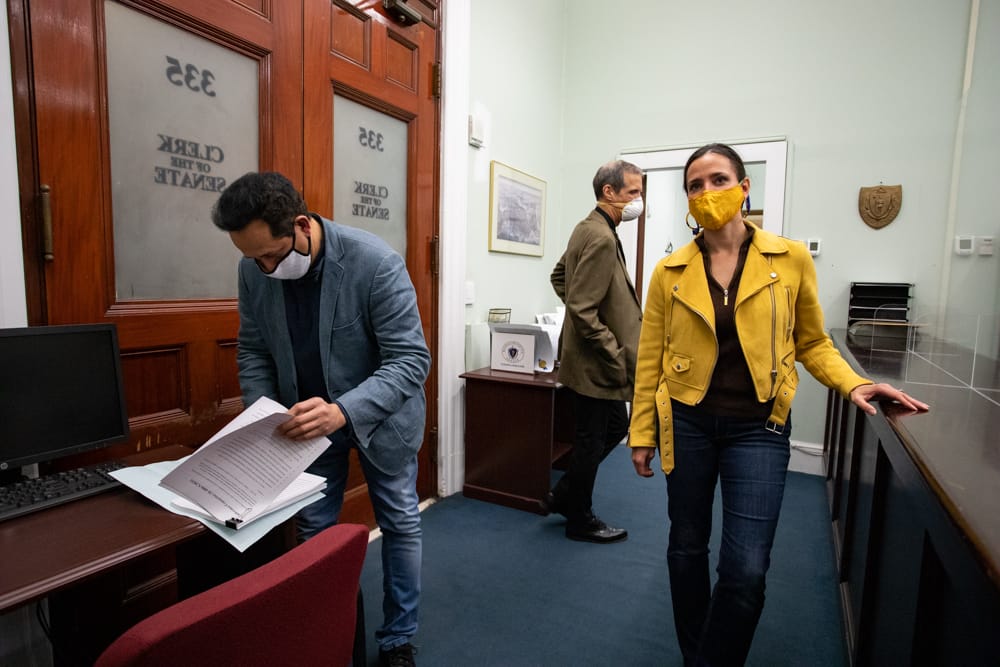
Rep. Carlos Gonzalez reviewed the official copy of the compromise policing reform bill, joined by fellow conferees Sen. Will Brownsberger and Sen. Sonia Chang-Diaz, before filing the legislation in the Senate clerk’s office Monday afternoon. [Sam Doran/SHNS]
But the 66 percent of people saying the state should just tap its budget for more money weren’t alone in thinking the MBTA should reconsider its plan. The MBTA Advisory Board said the agency was being unnecessarily cautious in its budget projections for next year, and could eliminate the need for widespread service cuts with just a little positive thinking.
The advisory board’s own budget analysis suggested the financial hole facing the T could be 20 percent smaller than the worst-case scenario being planned for, negating the need to end weekend commuter rail service or cut 25 bus routes and all ferry services.
“The Advisory Board’s view is that risk of permanent loss of ridership, increased congestion, and other negative effects of service cuts to people and communities is too high a price to pay right now, just as a vaccine is on the horizon,” the board wrote.
MBTA officials, however, are forging ahead with their plan and a vote on Dec. 14, and alternatives don’t seem to be in their line of vision.
“The vast majority of MBTA service will continue, the proposed service changes are not permanent, and the MBTA will periodically realign service as feasible to match current and future ridership patterns when durable revenue is available for pay for such service,” MBTA General Manager Steve Poftak said in a statement.
Whether people believe him is another question.
