E-Newsletter
An Electronic Publication of the North Central Massachusetts Chamber of Commerce

Inside this edition, you’ll discover the latest Chamber initiatives and success stories from across our region. From economic development projects and upcoming networking events to policy updates and workforce training opportunities, we’re keeping you connected to what matters most for your business and North Central Massachusetts.
The North Central Massachusetts Chamber of Commerce is here to help – with trusted resources, a strong business network, and a support system to keep your business and the region moving forward
Fidelity Bank hasn’t let the COVID-19 pandemic stop them from serving customers with care and safety.

Sheila King-Goodwin
While operations may look and feel different now and for the foreseeable future, Sheila King-Goodwin, Senior Vice President and Chief Retail Banking Officer with Fidelity, said the financial institution has learned to adapt quickly.
And she said many of those changes will likely continue as the Massachusetts economy starts to reopen.
“We’re finding new ways to be flexible and innovative so clients can receive a caring service that provides clarity and confidence regarding their banking,’’ she said. “We’re taking a thoughtful but forward-thinking approach to the short term and long term.’’
She said that this may mean continuing to offer drive-up services for client needs like obtaining a new debit card or closing quickly on a loan. It also may mean scheduling more appointments as opposed to walk-ins to enable clients to have a designated time to meet with a Life Design Banker. We’re also finding that many of our clients are using our convenient digital banking services such as mobile and online banking which provides bank access at any time or anywhere.
Gov. Charlie Baker announced a four-phase reopening plan on May 18 that outlined how and when Massachusetts businesses can reopen.
While there is still much uncertainty about the future, local leaders are hopeful.
“I’m cautiously optimistic,’’ said Roy Nascimento, president and chief executive officer of the North Central Massachusetts Chamber of Commerce. “I think the region is well positioned because it has a very diverse regional economy.’’
Nascimento said the chamber has been working to help businesses manage the crisis with guidance, loans, and resources. He said the chamber had already hired a consultant to develop an economic development plan for the region, which will now serve as a blueprint for recovery.
“We’re being proactive and working tirelessly to support our businesses,’’ he said. “Recovery will be front and center to help those hit the hardest.’’
The chamber has formed a committee of 30 business and municipal leaders to help guide the development of the recovery plan.
Nascimento said he’s hopeful the region’s manufacturing and health care base will survive and even thrive as there becomes a greater need for some of the products and services they provide.
The sectors he’s most concerned about are those that have been most devastated by the pandemic – retail, hospitality and tourism.
“Those are the ones I worry about,’’ he said. “Those are the hardest hit and will be the last to recover.’’
The chamber hired RKG Associates, Inc. earlier this year to complete an economic development plan for North Central Massachusetts. And while it will still look at areas of growth for the region, a large component will now focus on recovery.

Eric Halvorsen
RKG had already started work and spent the last few months documenting the existing conditions in the region. This included identifying trends in the different industry sectors, such as which were growing, shrinking and had the potential for expansion; surveying commercial space and lease prices; and analyzing housing stock and prices, said RKG’s Eric Halvorsen.
Upcoming phases of the plan will compare North Central Massachusetts to other regions in the state in areas like housing, schools, safety, transportation, development potential and existing jobs.
The report will also identify strengths, weaknesses, opportunities and threats and try to identify what sectors the region should be trying to attract.
“They want to spend their time and money in a strategic way,’’ Halvorsen said. “We want the rifle shot, not the buck shot.’’
Other aspects of the plan will look at the workforce and determine what skills it must have to meet future job demand.
The plan will also look at some key sites in the region, such parcels of land or areas that could support future development and potential obstacles like zoning or infrastructure. And then outline specific strategies and recommendations.
“The overall goal is to provide the chamber with a roadmap for the next five to 10 years for what they should focus on from an economic development standpoint and how to best use the resources they have to advance economic development goals in the region,’’ Halvorsen said. “To some degree, some of this will pivot more to recovery – how do you ensure you don’t take five steps backwards?’’
The plan is expected to be done this fall.
Halvorsen is hopeful that a good portion of the jobs in North Central Massachusetts may be insulated from the pandemic to some degree. These include manufacturing, health care, social services, and possibly local and state government and education.
One other potential benefit for North Central Massachusetts is its location outside of Boston.
“If more people switch to working from home and don’t need to live so close to Boston, places like Fitchburg that have lower housing costs but access to commuter rail may start to see some activity,’’ he said.
On the flip side, there are also many jobs in restaurants, retail and hospitality, which may be the hardest to get back. Outdoor seating, for example, is a great option but the New England weather makes that challenging in the long term. Those employees also tend to make less, he said.
“The impact is compounded for those employees,’’ he said.

Henry Tessman
The Great Wolf Lodge in Fitchburg is a business that falls into several categories of hard hit industries – entertainment, lodging, retail and food service – making it a challenge to plan for reopening.
The Fitchburg-Boston lodge, one of 18 nationwide, features water parks, an arcade, rock wall, bowling, miniature golf, shops and restaurants, all sectors that have specific reopening guidelines.
But reopening plans are now in full swing, said Henry Tessman, general manager of Great Wolf Lodge New England.
Tessman said lodges throughout the country are working together to develop a reopening playbook. The company has also hired an industrial engineering firm that is assisting to develop policies for physical separation, personal protective equipment and flow patterns.
“We’re working with all directors at all properties and building best practices,’’ he said. “We have multiple states opening so we can see the good, bad and ugly of what states are doing and pull the best practices where we can.’’
Tessman said the Fitchburg location will be among the last in the country to reopen with a tentative target date of late June. Tessman said the lodge falls under Phase 3 of Baker’s reopening plan, similar to that of a casino.
“With the amount of time, money and work everyone’s put into these plans, I feel comfortable we will be in a good spot when we reopen,’’ Tessman said.
Among the changes –all employees will have temperatures checked each day and they will wear masks and gloves. The company is developing training videos for employees that will explain all new protocols.
“When we do open up, we will be very prepared to run what the new normal will be,’’ Tessman said.
Initially, Great Wolf will operate at 25 percent capacity, Tessman said, later ramping up to 50 percent and hopefully 100 percent by the end of September.
He said new technology is being installed in the Waterparks to track the number of people so he will know at all times how many people are in each park.
What the experience will be guests is still under consideration and will be dictated by state and company guidelines, Tessman said. However, the number of people allowed on towers and in pools will be limited. Some areas may be off limits, such as the hot tub.
“The biggest thing we have to focus on is social distancing in the pools, seating areas and towers,’’ he said.
Tessman said they won’t be issuing day passes this summer and the buffet will not be open. New policies will also be in place for payment in the restaurants.
So far, Tessman said bookings show customers are eager to get back.
“We’re seeing very good demand up front,’’ he said. “I think local travel will be quicker to return that cruises or airline travel so we may see better demand than other traditional vacation spots.’’
One area of uncertainty is education. North Central Massachusetts is home to both Fitchburg State University and Mount Wachusett Community College.

Dr. Jim Vander Hooven
MWCC President James Vander Hooven said there is no way to predict if colleges will allow students back on campus and how students will respond to those decisions.
But he said MWCC has and will continue to do everything it can to provide a safe environment for students and staff.
He said the Mount quickly moved all its classes online for the spring semester and continues to hold remote classes for the summer. Plans for summer camps and the fall are still uncertain.
Vander Hooven said many of the Mount’s students have been hit hard by the pandemic.
Many of their students have children at home and work in places like the restaurant industry but were laid off.
“Our students are already challenged in many ways and everywhere we turned, it was another hit for them,’’ he said.
Even in the best case scenario, he said the Mount is not rolling back into normal operation.
“It’s going to be a while before we’re back to our typical normal and we’ll have to redefine our normal,’’ he said.
One of the biggest difficulties facing the school is trying to plan for uncertainty. He said many colleges won’t know for a while whether classes will be held in person.
“We could find out as late as Aug. 1 whether we end up with a bunch of students who decided to come to the Mount or we could be down 15 percent,’’ he said. “I’m not even looking at current enrollment projections because it’s not worth the stress. It’s a great unknown.’’
But he too is confident.
“We’ll get through this,’’ Vander Hooven said. “The community here really has a strong backbone. I’m seeing interconnected communities supporting one another. When you can approach a crisis of this magnitude from that perspective, you have a good shot of getting through it together.’’

Dr. Mark Melnik
In the past, Massachusetts has been able to weather downturns because the state was insulated by some anchor institutions – hospitals and universities, said Mark Melnik, director of economic and public policy research at the UMass Donahue Institute.
But this time, those sectors may be hit, making the state more vulnerable this time around.
In the short term, Melnik said his biggest concerns are retail, tourism, entertainment and restaurants. Those sectors have a high percentage of small businesses that aren’t able to easily weather a downturn.
Unemployment numbers for North Central Massachusetts showed the largest spike in claims from those in the construction, food services and administrative support sectors.
But the manufacturing base in North Central Massachusetts may give the region an advantage, Melnik said.
“They have a really strong manufacturing sector,’’ Melnik said. “It’s one of the most significant manufacturing industries in the state.’’
Melnik said communities can’t sit back but need to be proactive in planning, seeking out state and federal planning dollars and working together.
That’s where the chamber can play a role, Nascimento said.
“We have several advantages that will help us weather this better than other regions,’’ Roy said. “We have a diverse economy, strong partnerships in the business community and with our municipal leaders, and the development of a recovery plan already in the works.’’
Nascimento also said he has confident in the region’s businesses.
“There will be some negative consequences for a while but our business community is resilient and will continue to be creative and adapt,’’ Nascimento said. “We’ve been through recessions before and this will pass over time.’’
In her role at the bank, King-Goodwin deals with many sectors of the economy. And while she acknowledges that there will be significant hardships in the short term, she is hopeful about the future.
“Businesses are redefining their operating model in new and creative ways she said, “It’s certainly causing angst and concern but I do have confidence that looking back, we will find there were innovative ideas that came out of this crisis that makes our businesses and communities better.’’ We were fortunate to support over 400 businesses most recently with needed Paycheck Protection Program funds and this has helped businesses bring employees back to work and provide them the confidence and capital needed to run their businesses.

This new recovery fund will help supplement the NCMDC’s existing efforts to provide emergency support to local businesses. This fund will fill gaps in the existing framework of SBA and other loan resources and provide access to financing to vulnerable and underserved small businesses. Once the immediate crisis has passed, then the remaining funds will be used to support long term efforts that will be needed to help the local economy recover.
Berkshire Bank, Fidelity Bank and Digital Federal Credit Union were the founding sponsors of this fund and have each contributed $100,000 to help capitalize the recovery effort. In addition, the NCMDC contributed $100,000 of its own money to the new fund. Workers’ Credit Union and BankHometown have also signed on to support the initiative with contributions of $10,000 and $5,000 respectively.
“Berkshire Bank believes it is very important to support Central Massachusetts and its smaller businesses. We are so pleased to assist the North Central Massachusetts Chamber of Commerce with its efforts to support small businesses with critical financing and technical assistance during this unprecedented crisis,” said Paul Kelly, Regional President of Berkshire Bank. “We applaud them for always supporting our small business community, especially underserved populations, as they are the economic lifeblood of our community.”
“Small businesses are the backbones of our local cities and towns. DCU is honored to contribute to the NCMDC’s economic recovery fund and help put working capital in the hands of community business owners in need of our support during this unprecedented and challenging time,” said Paul Carey, DCU’s Vice President of Commercial Lending. “DCU is committed to helping impacted local businesses find their financial footing, so that they can continue to make a meaningful difference in the lives of their customers and communities.”
“We are inspired by the way the Chamber and other community organizations are helping our North Central Massachusetts neighbors in need get through this crisis.” said Edward F. Manzi, Jr., Chairman and CEO of Fidelity Bank. “During times like this it is more important than ever for Fidelity Bank to live up to our Caring LifeDesign promise and provide critical support to our community, clients, and colleagues.”
Small businesses and non-profits in the NCMDC’s lending area are eligible for loans of up to $50,000 through the Economic Recovery Fund. To qualify under this program, they must be an existing organization and be able to provide two years of tax returns, as well as demonstrate a direct financial impact from the COVID-19 pandemic on their operations. The loan terms are flexible to fit the situation of the business.
For more information on the Economic Recovery Fund or to inquire about a loan, please contact Sandie Cataldo, Economic Development Manager at 978.353.7600 or email . Businesses or organizations interested in supporting the new Economic Recovery Fund should contact Roy Nascimento, President & CEO at
The North Central Massachusetts Development Corporation (NCMDC) is the non-profit economic development arm of the North Central Massachusetts Chamber of Commerce with the mission of creating jobs and improving the economy. NCMDC is certified by the U.S. Small Business Administration (SBA), and the U.S. Department of the Treasury under the Community Development Financial Institutions (CDFI) Program. The NCMDC works in partnership with local banks, credit unions, chambers of commerce and area nonprofits to support emerging microenterprises, small businesses, and community projects in 76 communities in Worcester, Middlesex and Franklin Counties with loans and business assistance. Since 1996, the NCMDC has granted over $7,000,000 in loans to small businesses to help grow jobs and the economy in the region.
In this new position, Ms. Lee will be responsible for the administration of the diverse portfolio of programs and initiatives of the Chamber’s economic development arm, the North Central Massachusetts Development Corporation.
“We are excited to welcome Bea to our team,” said Roy M. Nascimento, President & CEO of the North Central Massachusetts Chamber of Commerce and the North Central Massachusetts Development Corporation. “Bea will be a great resource to the business community as we look to support new and existing small businesses in the region.”
Bea joins the Chamber from the Panther Group in Boston where she worked as a Client Relationship Manager. In this role she 
The North Central Massachusetts Development Corporation (NCMDC) is a non-profit economic development corporation with the mission of creating jobs and improving the economy. NCMDC is certified by the U.S. Small Business Administration (SBA), and the U.S. Department of the Treasury under the Community Development Financial Institutions (CDFI) Program. The NCMDC works in partnership with local banks, credit unions, chambers of commerce and area nonprofits to support emerging microenterprises, small businesses, and community projects in 76 communities in Worcester, Middlesex and Franklin Counties with loans and business assistance. Since 1996, the NCMDC has granted over $7,000,000 in loans to small businesses to help grow jobs and the economy in the region.
Businesses or community members interested in learning more about the micro-loan program through the North Central Massachusetts Development Corporation can reach Bea at 978.353.7600 ext. 228 or via email at .
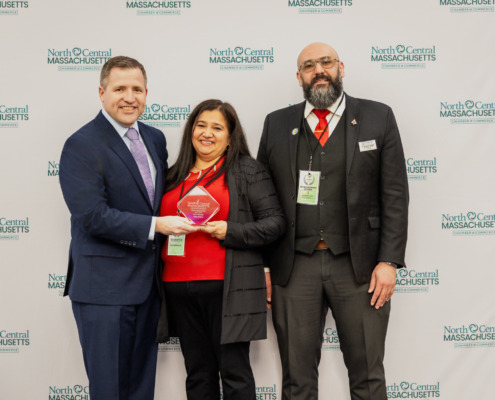

Chamber members are provided with the opportunity to engage with the Mayors of Fitchburg, Gardner, and Leominster who provide updates on projects and other things happening in their Cities. These events are by invitation only, please contact Travis Condon for more details.
View
Event
Bull Run Restaurant215 Great Rd. Shirly, MA
View
Event
Join us for our last Connect North Central of the year!
Friday, December 11, 2026
8am-9am
View
Event
January 14, 20277:15am - 9:00am
View
Event
Erin Logan | NBC 10 Reporter
View
Event
Chamber members are provided with the opportunity to engage with the Mayors of Fitchburg, Gardner, and Leominster who provide updates on projects and other things happening in their Cities. These events are by invitation only, please contact Travis Condon for more details.
View
Event
On October 17, 2018 from 1pm to 3pm, the North Central Career Center and Commonwealth Corporation will present a Workforce Training Fund informational workshop geared to you and your business needs. The Massachusetts Workforce Training Fund is a program that provides matching dollars to eligible businesses who are investing in their staff through training and/or retraining.
The info session will provide an overview of the features and benefits of each Workforce Training Fund grant program, including the amount of available funding, program guidelines, and how to apply for each grant. You will have direct access to Commonwealth Corporation staff to ask any questions you might have about each program.
To reserve a seat please use this Event Bright link https://www.eventbrite.com/e/workforce-training-fund-information-session-leominster-registration-48486184483
Or, for more information contact Scott Percifull at 978-534-1481, X209
|
|
Mia Scheffey creates a picture by intuition. She has no finished image in mind when she begins to paint. She does not simply execute a preconceived idea, following some linear logic. Instead, she builds a painting by making a mark — a brush stroke — that feels right, then in effect allows the picture to “answer” her with another message about which mark, which color, which texture needs to come next. The process can’t be rushed. It is a kind of dialogue, Ms. Scheffey says, a conversation between the painter and the painting.
The Vermont-based abstract expressionist will be the featured artist in a women-only exhibition entitled “Bearing Witness,” organized by the Central Massachusetts Chapter of The Women’s Caucus for Art (WCA) and mounted at Gallery Sitka in Fitchburg, Mass. Helen Obermeyer Simmons, President of the Central Mass. Chapter, explains that the exhibit will focus on the artists’ sharing of experiences (which in some cases were traumatic) as the mainspring for their artwork. “When important events have taken place in my life,” Ms. Obermeyer Simmons says, recalling the death of family members and the birth of her children, “my first response is to make an image.”
Yet the featured artist’s work is non-representational, and hence is not likely to convey anything concrete about her experiences. The work conveys emotion and impressions by way of pure form and color. Mia contends that her paintings take on a life of their own in the midst of creation. There is a tension that builds as the marks create a structure of their own. The artist has learned that mistakes can occur while creating the painting’s energy field. Instinctive and intuitive though it is, the process has its own plan and schedule, so to say, and the “stakes” get higher as the painting nears completion.
“The reason abstract painting is so difficult is that one is not trying to represent anything,” Ms. Scheffey explains. “Instead, one is reaching to articulate something as of yet unknown or unseen to oneself…a memory, a feeling, an experience. So you are always starting from a place of being lost and searching for the way, and you must discover new combinations of line, color and form to search out and express this way.”
The Women’s Caucus for Art is a non-profit organization founded in 1972, dedicated to creating “community through art, education, and social activism,” according to the group’s mission statement. WCA recognizes the contributions of women in the arts, provides women with professional development, supports art activism, and advocates for equity in the arts all over the world. At the international level, WCA is a non-governmental organization of the United Nations and a founding institutional member of The Feminist Art Project.
“Bearing Witness” is an all-women project focusing on the concerns and commitments of women everywhere, employing work in pastel, watercolor, printmaking, photography, fiber art, sculpture and collage from a feminine and feminist perspective. Artists who will participate in the exhibit include WCA members Gail Bloom, C.M. Judge, Helen Obermeyer Simmons, Tamar Russell Brown, owner of Gallery Sitka, Kate Shaffer, Joanne Stowell, Sylvia Vander Sluis, Elsa Voelcker and Susan Wadsworth. Other Gallery Sitka artists will also be represented in this show.
This opening reception will take place on Saturday, Oct. 6, 2 – 4 p.m., at Gallery Sitka West, 454 Main St. in downtown Fitchburg. The exhibition continues at the gallery through Dec. 1. Art lovers are encouraged to go to gallerysitka.com and miascheffey.com for more information.

When the workday ends and the lights go down, Custom Cleaning Service of Peabody, Inc. gets to work. “We operate as our clients’ silent partner after business hours,” says Adam Paicos, of Templeton, who now serves as Director of Operations and oversees the company’s expansion into North Central MA. “We are not often seen, but we ensure facilities are clean, secure, and ready for business each day while serving as the eyes and ears for our clients when they are not on site.”

Discover local business stories through our Inside North Central Massachusetts Podcast series. Listen as Chamber members share their journeys, insights, and contributions to our thriving regional business community.

Looking for your next opportunity? Explore current job openings from employers across North Central Massachusetts on our Jobs Board. Whether you’re starting a new career or making a change, you’ll find a variety of local positions available to help you take the next step.
CapEx Facility Services & Construction · Leominster, MA
TaraVista Behavioral Health Center · Harvard, MA
DRS Power Technology, Inc. · Fitchburg, MA
AIS · Leominster, MA