The boards of the Chamber, the North Central Massachusetts Development Corporation and Visit North Central Massachusetts met earlier this week to begin working on the chamber’s next strategic plan. They reviewed the great progress made on our current strategic plan and discussed a variety of topics that are crucial to supporting our members and keeping our region a vibrant place to live, work and visit.
We would love to hear from you. What can the Chamber and our affiliate organizations do over the next three years to support your organizations and the communities of North Central Massachusetts? Please send us your ideas and share your successes by emailing .
The Baldwinville Station Restaurant is a family-owned and operated breakfast and lunch establishment, which is open 5:30 a.m. to 2:00 p.m. seven days a week and is a popular breakfast spot in Baldwinville.
“When we bought the business four years ago, we concentrated on running the restaurant like we had when we owned Rockin’ Robins on Main Street in Athol,” said Shawn Graham, who has owned the business since 2018. “Thanks to this partnership with Athol Savings Bank and support from the North Central Massachusetts Development Corporation, we’re able to focus on taking care of our loyal customers.”. Visit https://www.baldwinvillestation.com for more information.
Como entidad de microcréditos, NCMDC puede otorgar préstamos a pequeñas empresas de hasta $250,000 para capital de trabajo, bienes inmuebles, equipo, inventario y expansión, además de colaborar con nuestros socios bancarios para proporcionar financiamiento puente para la etapa final de un proyecto.
“When I opened Lyla’s Beauty Bar in December 2019, I needed a loan to help with the startup costs of establishing my new business,” said Surinee Piwchuen, owner, Lyla’s Beauty Bar. “Thanks to my continued relationship with the North Central Massachusetts Development Corporation, I’m now able to expand our services to include body sculpting for customers using a new laser system.”. For more information visit https://lylabeautybar.com.
Como entidad de microcréditos, NCMDC puede otorgar préstamos a pequeñas empresas de hasta $250,000 para capital de trabajo, bienes inmuebles, equipo, inventario y expansión, además de colaborar con nuestros socios bancarios para proporcionar financiamiento puente para la etapa final de un proyecto.
The Leominster DekHockey Center is the oldest Street Hockey/DekHockey Center in North America EST in 1974. The center is a fixture in the local area. It is the Home of Street Hockey and DekHockey. Every year thousands of players play year round at the facility from ages 4 to over 50 years old. Over 3000 players, fans and spectators view the games every week at the facility.
The LDHC is also host to the U.S. Nationals every May & the New England Classic in June, then the Can Am in November. Teams from all areas and age groups come from as far away as California, Bermuda, New Jersey, Pittsburgh, Long Island, Rhode Island, Southern Ontario, Montreal, Nova Scotia and the Chicago region.
For over 44 years, the players and teams from the Leominster area have been among the best in the world with Championships in Pittsburgh, Niagara Falls, Quebec, Las Vegas, Dallas, Florida , Italy &
The LDHC facility is a great site to consider Sponsoring Youth or Adult teams and/or placing signage on one of the rinks and around the property. Over 40,000 cars a day pass by the facility. Our customers are loyal hockey players who have been playing here for a couple of generations, please take advantage helping the youth boys & girls, young adults & families in continuing to enjoy the game of DekHockey.
Bronze Sponsor
$500.00 per year. 1 banner signage.
Silver Sponsor
$1000.00 per year. 2 signage, choice of rinks.
Gold Sponsor 1500.00 per year.
3 banners one on each rink. Also includes your logo and a link to your website on our website and access during 2 weekends a year to display/advertise your products/services.
Platinum Sponsor $2500.00 per year. Includes signage on the West Rink stands (5′ x 15′) viewable from Route 2. Signs on the East Rink & North Rink (5′ x 4′). Also includes your logo and a link to your website on our website and access during 2 weekends a year to display/advertise your products or services.
Signage All signage is the responsibility of the Sponsor.
It is a extra cost approx. $100 per sign (5 x 4)
LDHC will approve and mount all signage to the desired locations.
* Funds for the signage are used to help defray the costs in the youth programs & assist the All Star Travel teams. Funds for the sponsorship in the adult programs are used for the game officials or awards.
Contact 774 364 2658 John Murray Marketing Dir for advertising opportunities.
Just by the nature of its name, ‘Inspire’ Counseling and Support Center, (located at 29 Main St. in Leominster) sounds like the right place to go for individuals in need of a wide range of behavioral health services. It opened its doors in June of 2021, with a leadership team of 9 and 8 onsite full-time employees.
Offering such a wide range of during the heart of the COVID 19 pandemic at a time when more people than ever can use assistance has been especially important, according to Chief Operating Office Jennifer R. Dellasanta.
“We have learned a lot in the past couple of years,” she said. “One of the most important is that people are recognizing more and more the significance of mental wellness. This past 2 years affected everyone and whether someone wants to come in just to vent, a lot of times talking something out to another person just gives us a sense of release, or to gain some guidance on coping skills, or come in for a group to see that they are not alone and there are other support systems out there, is so important and we are here to provide that.”
“We have learned is how to be flexible,” she added, “we offer telehealth because you don’t have to physically be here to get the help you need. Our entire team understands we need to be flexible and that we are here to help. We have become more united than ever and have kept our mission up front, as well as truly being employee centered, so that we have healthy and happy team members so that we can provide the best quality services to others.”
The Center’s mission is to “inspire brighter and healthier lives.” It is part of a network of centers located in five states including Florida, Tennessee, Indiana and Kansas in addition to Massachusetts. As for doing business in North Central Massachusetts, Dellasanta notes: “Most of our team either live in Leominster or somewhere in North Central MA, so we really care about the services we are providing and truly promote our mission. These communities have welcomed us with open arms and we are utilizing their suggestions to give back and provide the services that they need.”
“We did our research before opening up in Leominster, she added, “by talking with community members and other community providers about what the need was in Leominster. We found there were resources lacking for children, adolescents, substance use and mental health. We are open later in the evening until 7pm so that working families and kids in school have a resource to not interrupt their work/school day. We offer both in person and telehealth groups, counseling, case management, family/couples counseling and medication management. We are very involved in supporting the community, because we live here and want to see our community thrive.”
Dellasanta describes Inspire’s workplace culture as “employee centered – meaning we focus on making sure that our mission not only applies to our clients and communities, it also extends to our team. We all need to be more focused on wellness in all areas.”
In promoting the Center’s services, Dellasanta credits their Marketing Director, as well as social media and being “face to face with people to let them know what we are offering and if there are other suggestions that they feel would benefit the community.”
“We pride ourselves on having someone always pick up the phone when you call us, no automated recording, if we are not available and you leave a voicemail someone calls you back within 24 hours,” she added.
Dellasanta credits much of the Center’s success to CEO Melissa Lucas who she says “has been an amazing source of strength for us since she took over and has completely overhauled how we function as a team. We would not have the amazing team we have right now if it were not for her leadership.”
These early career programs help students connect learning to in-demand industry sectors
The Baker-Polito Administration awarded more than $600,000 to 22 school districts to help support Innovation Pathway programs, which provide high school students with opportunities to learn and gain experience in a particular industry through career exploration, technical courses and internships.
Students are also able to enroll in post-secondary courses, at no cost to them, to help them make progress toward industry-recognized credentials. Most Innovation Pathways are in STEM-related fields, including advanced manufacturing, information technology, environmental and life sciences, health care and social assistance, and business and finance.
“These programs provide students with hands-on skills learning and access to opportunities for future success in high-demand fields,” said Governor Charlie Baker. “The expansion of Innovation Pathways will allow more students to gain knowledge and work experiences that prepare them for successful careers before they graduate high school.”
“We remain committed to closing opportunity and workforce gaps for students in communities across the Commonwealth, and Innovation Pathways are another tool we can use to do so,” said Lt. Governor Karyn Polito. “These early career programs and rigorous learning opportunities offer chances for achievement both inside and outside the classroom.”
El Baker-Polito Administration launched these early career programs in 2017 to help students develop knowledge and skills related to a chosen field of study before they graduate high school. To date, 49 high schools across the Commonwealth have designated Innovation Pathways, totaling 121 different programs. Innovation Pathways differ from its sister program – Early College – in that students focus on a specific industry sector, with greater emphasis on career exploration, technical courses, work-based learning experiences and industry-recognized credentials, rather than college credit courses and college planning.
The 22 schools awarded grants today received designation from 2018 through 2020 and will use funding from the state to support work-based learning, industry recognized credential attainment, and dual-enrollment opportunities with partnering colleges and universities.
“When students have a sense of purpose, they become more interested and engaged in their studies, able to easily see how it all fits into their future,” said Secretary of Education James Peyser. “As more students gain skills and knowledge in a particular industry sector, they will have a better sense of what they want to do after they graduate and what additional post-secondary courses and training they will need to ensure their success.”
“Through participation in Innovation Pathways, students are empowered to explore firsthand and take steps toward possible future careers in promising sectors,” said Elementary and Secondary Education Commissioner Jeffrey C. Riley.
The following school districts received awards:
Atlantis Charter School – $41,250
Barnstable Public Schools – $26,576
Berkshire Hills Regional School District – $41,250
Boston Public Schools, Dearborn STEM Academy – $52,250
Burlington Public Schools – $26,575
Dudley Charlton Regional School District – $30,000
Everett Public Schools – $30,000
Gardner Public Schools – $30,000
Hadley Public Schools – $3,000
Haverhill Public Schools – $15,000
Lawrence Public Schools – $15,000
Mashpee Public Schools – $15,000
Nantucket Public Schools – $30,000
Northampton Public Schools – $26,575
Norwood Public Schools – $26,575
Somerset Berkley Regional School District – $30,000
Tewksbury Public Schools – $15,000
Uxbridge Public Schools – $15,000
West Springfield Public Schools – $30,000
Westfield Public Schools – $15,000
Woburn Public Schools – $41,250
Worcester Public Schools – $29,449
Schools that apply for designation for an Innovation Pathways are required to follow five design principles:
Equitable access for all students
Guided academic pathway, which, in the case of Innovation Pathways, must relate to one of five specified broad industry sectors
Enhanced student supports
Relevant connections to career
Deep partnerships between high schools and employers or workforce development boards
When many businesses were forced to cut back or close during the early stages of the COVID Pandemic, Wonder Products, LLC of Sterling was just getting started – opening its doors in 2020.
“The pandemic required you to refocus and reinvent yourself,” notes co-founder Michelle Salas. You either had to jump on the boat or jump off.” Michelle and her partner Nikki Wiita grabbed hold of an idea and built a business around it. Makers of the “Wonder Plunger,” the pair or Moms dove in with a simple mission statement – “Never fear the flush again!”
They introduced a new toilet plunger that, according to their website, is set to revolutionize the look of your bathroom. It’s clean, easy-to-store and colorful options make it a perfect fit in every bathroom. The Wonder Plungers patent pending design includes a one-handed operation. With a single hand, you can easily extend the collapsible pole, making your plunger 16 inches. And when you’re done, with a simple twist, the plunger collapses down to 9.5 inches, making it easy to store anywhere in your bathroom.
“We’re both Moms and we didn’t like the idea of storing the plunger in the bathroom where our kids were walking barefoot,” explained Ms. Salas. “Plungers are gross, dirty and inconvenient to store in the basement – where you have to do the ‘walk of shame downstairs each time you need to use one.”
They primarily promote Wonder Plunger via email and social media advertising including Facebook, Instagram and TikTok. The business has also grown via word of mouth. In addition to being sold on their own website (wonderplunger.com), their product is also available online via Amazon, Home Depot and Walmart.
When asked what separates their product from standard run-of-the-mill plungers, Salas noted three key points of difference. “Our collapsible concept, our aesthetically pleasing colors and our one-handed operational format,” she explained. As their website adds, “Use the Wonder Plunger to loosen that clog and when you’re done, simply put it away with the confidence you’re living a cleaner lifestyle.”
As for starting a business in North Central Massachusetts, Salas said it was important for them to be part of the community and they want to inspire other female-owned companies. “As a new business, we are looking to get more involved in the community, she added.
As a women-owned business, Salas notes Wonder Products is also very family-oriented. “Both our husbands are involved in supporting the company. We are both very driven and motivated. As Moms it was important to create a work/life balance and we wanted to create our own.”
Servicio de Noticias de la Cámara de Representantes
Colin A. Young
Mariano: Baker Tax Breaks Not “Necessary At The Time”
[Coverage Developing] Buoyed by surplus tax collections and federal aid, House leadership unveiled a nearly $50 billion budget for fiscal year 2023 that Speaker Ron Mariano said will reinvest in the state’s lower- and middle-class residents and gird the economy for “tough times” in the future.
The House Ways and Means Committee’s budget recommendation, which totals $49.629 billion and is expected to be debated the week of April 25, would increase spending by $2.015 billion, or 4.23 percent over the current year’s budget, and proposes to spend $1.398 billion, or 2.9 percent, more than Gov. Charlie Baker recommended in his January budget filing.
In addition to the early education and workforce development initiatives that Mariano and Ways and Means Chairman Aaron Michlewitz rolled out Monday, the House budget also boosts local aid, fully funds the next year of the 2019 school finance reform law known as the Student Opportunity Act, eliminates communication costs for incarcerated people and their families, provides free school lunches for another year, and pushes the state’s stabilization fund to an estimated balance of $6.55 billion by the end of next June.
“We are on our way towards filling some of the holes that were created during the pandemic with a $49.6 billion spending package that we think addresses a lot of the needs and it’s based on state tax collections that have been very strong [and] a lot of help from the federal government,” Mariano said Wednesday.
The budget includes $6 billion for Chapter 70 education aid, increases the minimum per-student aid amount from $30 to $60, accelerates by one year the charter school reimbursement process, and increases higher education scholarship funding by more than $25 million. There is also $912 million for early education and child care, $853 million for housing initiatives and $638.4 million for workforce development.
Michlewitz said the budget his committee released “presents the commonwealth with a unique opportunity to invest in the middle class and start to tackle some of the challenges that a post-COVID economy has created.”
The state generated a surplus of more than $5 billion last fiscal year and is already more than $2 billion ahead of expectations this fiscal year. On top of tax revenue, the state still has more than $2 billion of American Rescue Plan Act money to put to use in the coming years and a record amount of money socked away in the stabilization fund.
The state’s strong revenue performance has led to a chorus calling for tax relief for residents who are also dealing with higher prices across the board, but Mariano and Michlewitz made clear Wednesday that they think the money will do more good if the Legislature spends it in a targeted way rather than putting it back into taxpayers’ pockets.
“With growing revenue returns from the state, a record $5.76 billion expected dollars in our rainy day fund by the end of this fiscal year, this once-in-a-generation opportunity allows us to build for a better future, one that is more resilient, more equitable, and more rewarding for all of us in the commonwealth,” Michlewitz said.
Mariano pointed to the House’s funding for early education and child care as the kind of investment that will have an outsized impact on the state’s workforce and economy.
“There are many things that we can spend our money on and we chose to do that because I think these programs in the early childhood and day care support systems are the underpinning of our middle and lower class workforce,” Mariano said. He added, “And I really feel, and thank goodness the chairman agrees, that strengthening these underpinnings is the most important thing we can do right now.”
Mariano had announced Monday that the House budget would not include any of Gov. Charlie Baker’s proposed $700 million worth of tax breaks. Asked Wednesday why the House decided to leave those out, the speaker said, “Well, we felt they weren’t necessary at the time.”
The House budget also looks to bolster the state’s stabilization fund, the savings account that serves as a reserve in case of an economic downturn, with a deposit of at least $785.7 million in fiscal year 2023. Asked why the House is continuing to boost the rainy day fund rather than deploying that money in the annual budget, Mariano suggested darker economic days could be ahead for the Bay State.
“These good times may not roll forever. We want to make sure that we have money in case there is a sudden downturn. You know, we’re on the brink of major confrontations in Europe, the oil production is being cut way down; if I was a economic prognosticator, I would think we were in for some tough times,” the speaker said. “So obviously we wanted to strengthen our ability to pivot if revenues do take a downward plunge.”
Stock market instability. Rising interest rates. Signs of inflation. The Russian invasion of Ukraine.
And a stubborn pandemic which isn’t going away.
“We’ve certainly weathered many storms since our last time together two years ago,” said Ed Manzi, the chairman and chief executive officer at Fidelity Bank, in welcoming remarks. “But just as Fidelity Bank provides clarity, confidence and care for our clients, you have also done the same for your colleagues, friends and neighbors which has made our communities stronger despite the challenges presented before us.”
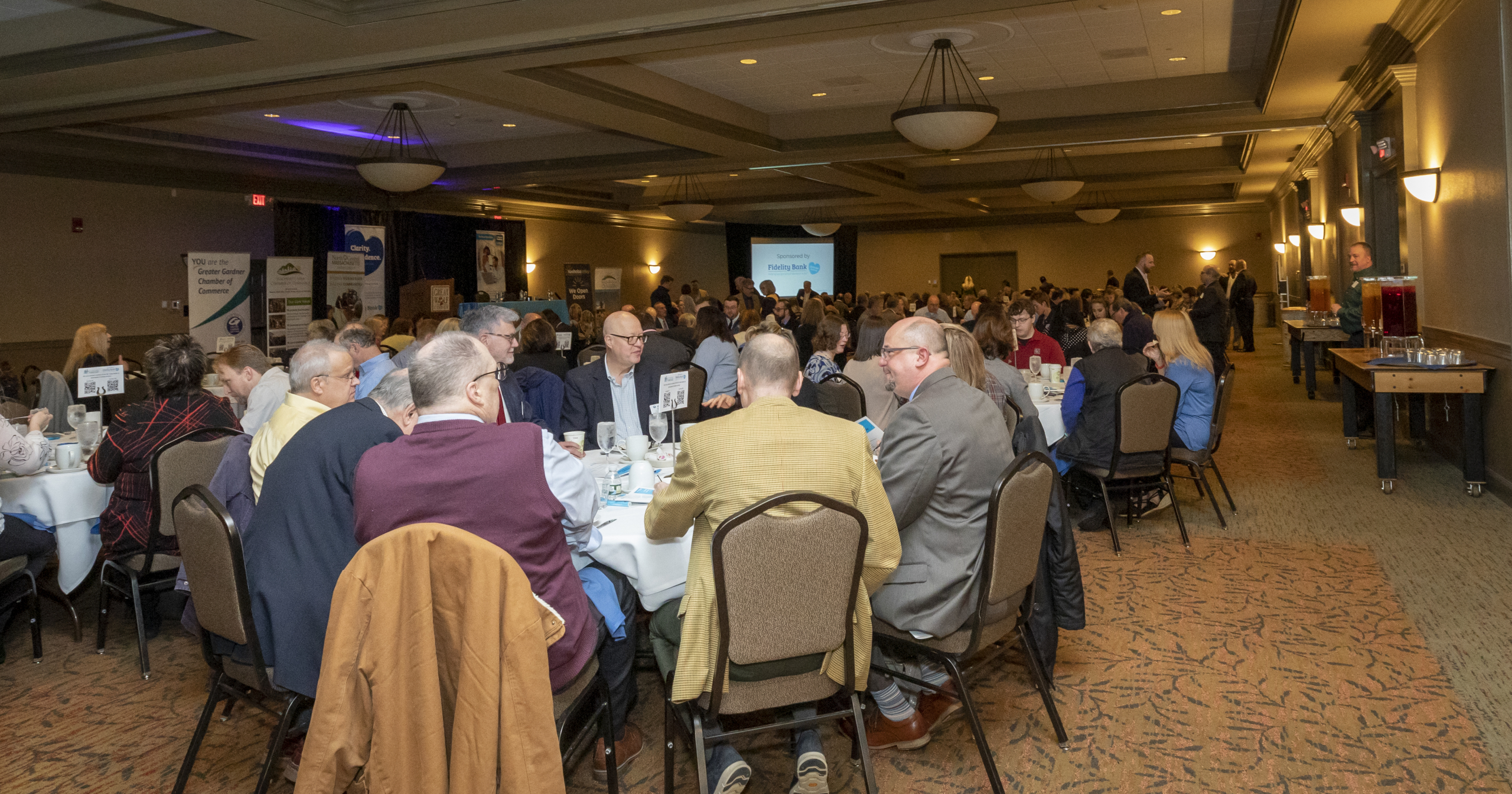
The Economic Forecast Breakfast crowd.
Despite plenty of obstacles, there was a profound sense of optimism at the Chamber’s Annual Economic Forecast Breakfast held on Friday, April 8ta at Great Wolf Lodge in Fitchburg.
“You persevered before and you’re expected to do it again. Very inspiring,” Manzi told a gathering of more than 200.
Business leaders from the region gathered to learn the results of a Regional Economic Outlook Survey, which was compiled from feedback from 519 consumers and 200 business leaders in Central Massachusetts.
Generally, the survey produced optimistic results from employees and business leaders. The biggest concerns among consumers/employees is inflation (20%) and the effects of COVID-19 (17%). For business leaders, the availability of skilled labor (28%) was the greatest concern, followed by inflation (18%).
The survey yielded signs of optimism, however. A majority (53%) of business owners, presidents or managers said they would increase pay to their employees this year, while 30 percent said they planned to spend more over the next 12 months.
Three speakers enlightened the audience – Dr. Nancy Murray, Fitchburg State University’s dean of the School of Education; Dr. Mark Melnik, the director of Economic & Public Policy Research at the UMass Donahue Institute; and Dr. Mahesh Ramachandran, the chief economist for the Executive Officer of Labor and Workforce Development.
Murray said Fitchburg State is meeting the challenge of producing students ready to enter the workplace by offering new majors and examining a MassHire survey which revealed, among other things, that access to childcare is preventing some people from returning to jobs. Murray said FSU is creating pathways in the STEM field and English for students to transfer to the school from Mount Wachusett Community College and supportive pathways for students to transfer from Fitchburg High to FSU.
Murray urged business leaders to “think outside the box” as they look to the rest of 2022 and beyond.
Melnik told the audience that “conditions on the ground” are shifting in Massachusetts and the North Central region from pre-pandemic days to the world going forward. Things are improving in the state, he said, noting that the unemployment rate in Massachusetts was 16.4 percent in April 2020. Today it is 4.7 percent, although the national average is 3.8. The COVID recession is the most uneven recession on record.
“Growing labor supply is critical for Massachusetts,” said Melnik, pointing out that in 2021, for the first time, the number of deaths in Massachusetts surpassed the number of births.
Chris McCarthy, Fidelity Bank’s president and chief operating officer presents the Economic Survey results.
Melnik said 9,400 jobs in the North Central region were lost during the pandemic, 7,000 of which have been recovered.
Ramachandran said Massachusetts is on the road to recovery, though the recovery is uneven due to a mismatch between skills demanded and skills available. The Leominster-Gardner area has a 5.2 percent unemployment rate, a far cry from the 17.6 percent rate in April 2020. There are plenty of opportunities for growth in healthcare, professional, scientific and technical service jobs, according to Ramachandran.
There were plenty of graphs and PowerPoint slides filled with numbers. But there was also a palpable sense that it was great for business leaders to see each other again. Two of the speakers said they were worried about forgetting how to tie their ties, drawing laughs from the audience.
The COVID-19 pandemic caused the 2020 in-person gathering to be canceled and the 2021 event shifted to online. The face-to-face gathering in a packed ballroom for the Economic Forecast Breakfast was a welcome sight for many weary from constant Zoom meetings.
“It’s good to be with people again,” said Chris McCarthy, Fidelity Bank’s president and chief operating officer. “While our Economic Forecast survey results included new categories related to the pandemic and how we foresee the next year as we move forward in the new normal, these results prove our region is resilient, strong and certainly optimistic that better days are ahead.”
The weather seemed to mirror the mood of business leaders weary from two years of unique challenges but optimistic about the future. Morning rain and plenty of clouds – with clearing skies and sunshine predicted for the afternoon.
The North Central Massachusetts Development Corporation (NCMDC), the economic development arm of the North Central Massachusetts Chamber of Commerce recently approved a $44,000 loan to RA Aldrich Trucking in Fitchburg to assist with the purchase of a 2020 Peterbilt tractor Model 389 to replace the current truck that NCMDC financed a couple of years ago.
“When I started my business three years ago, I applied for a loan to facilitate the purchase of my first truck to make petroleum deliveries,” said Rafael Aldrich, owner, RA Aldrich Trucking. “Thanks to the financial assistance and support from the North Central Massachusetts Development Corporation, I’ve been able to update my equipment and continue growing my business.”
Como entidad de microcréditos, NCMDC puede otorgar préstamos a pequeñas empresas de hasta $250,000 para capital de trabajo, bienes inmuebles, equipo, inventario y expansión, además de colaborar con nuestros socios bancarios para proporcionar financiamiento puente para la etapa final de un proyecto.
Para más información sobre los programas de préstamos de NCMDC, llame al 978.353.7607 o visite NorthCentralMass.com o ChooseNorthCentral.com.
On March 28, 2022 the Baker-Polito administration announced the designation of eight new Early College programs including Narragansett Regional High School (NRHS) in partnership with Mount Wachusett Community College and Fitchburg State University.
Early College programs provide college exposure to students in high school who might otherwise not have considered higher education as an option. The Early College Designation put forth by the Massachusetts Bord of Higher Education (BHE) and Board of Elementary and Secondary Education (BESE) states that approved designated early college programs in Massachusetts will provide equitable access; guided academic pathways; enhanced student support; relevant connection to career; and effective partnerships.
“We are proud to receive this designation, and grateful to our faculty and staff for supporting opportunities for NRHS students to explore their career interests and related college programming more deeply,” stated NRHS Principal Colby Young.
The Governor’s FY23 budget proposal includes $7.3 million for early college funding, representing a significant increase over FY22, to bring the total annual investment to more than $18 million.
“Early college is an invaluable tool that supports increased college enrollment among participating students, particularly students from groups historically underrepresented in higher education, and helps them succeed once they arrive on campus,” said Governor Charlie Baker in a press release from the Executive Office of Education on March 28. “Today’s announcement will boost participation rates at schools that already have programs, as well as launch new and exciting programs that will create more pathways to college.”
“This new designation is evidence of the success our existing programs have seen to date,” notes MWCC President James Vander Hooven. “Our Early College programs have helped hundreds of students start a college career that they might otherwise not have considered.”
“Early College programs improve outcomes and open doors of opportunity for students, and we are honored to build upon our record of success by adding Narragansett Regional High School to our list of partners,” Fitchburg State President Richard S. Lapidus said.
MWCC Early College programs have grown exponentially in recent years and currently include partnerships with Gardner High School, Gardner Academy for Learning and Technology, Leominster High School, Leominster Center for Excellence and Leominster Center for Technical Education Innovation, Fitchburg High School, the Sizer School, and now Narragansett Regional High School. Recruiting is now on-going for fall 2022.