Chamber Bids Fond Farewell to Three Staff Members

Former Staff Members

David Ginisi, Lauren Goulet, Chris McDermott (left to right).

The Chamber announces the recent departure of Marketing and Communications Manager David Ginisi and Public Affairs Manager Chris McDermott. Longtime Office Manager Lauren Goulet also departed the Chamber in early April.

David Ginisi, who began as an intern and worked for over five years at the Chamber recently accepted the position of Chief Marketing Officer at Montachusett Home Care Corporation in Leominster. Chris McDermott worked at the Chamber for over three years and left to become the Economic Development Manager for the Montachusett Regional Planning Commission, a quasi-public agency.  Lauren Goulet worked for the Chamber for nearly ten years and left in April to pursue a new career opportunity with a company based in New Hampshire. 

“We are saddened to lose Lauren, David and Chris, but also excited for them as they take on new leadership positions and further their careers,” said Roy M. Nascimento, President & CEO of the North Central Massachusetts Chamber of Commerce. “They have been important and dedicated members of our team and contributors to our success. I want to thank them for their hard work and commitment to the Chamber and wish them well in their new positions.” 

Data Shows Many in Mass. Have Left the Workforce

Fuente del artículo: State House News Service
Article By: Chris Lisinski

Departures Don’t Show Up in Improving Unemployment Rate

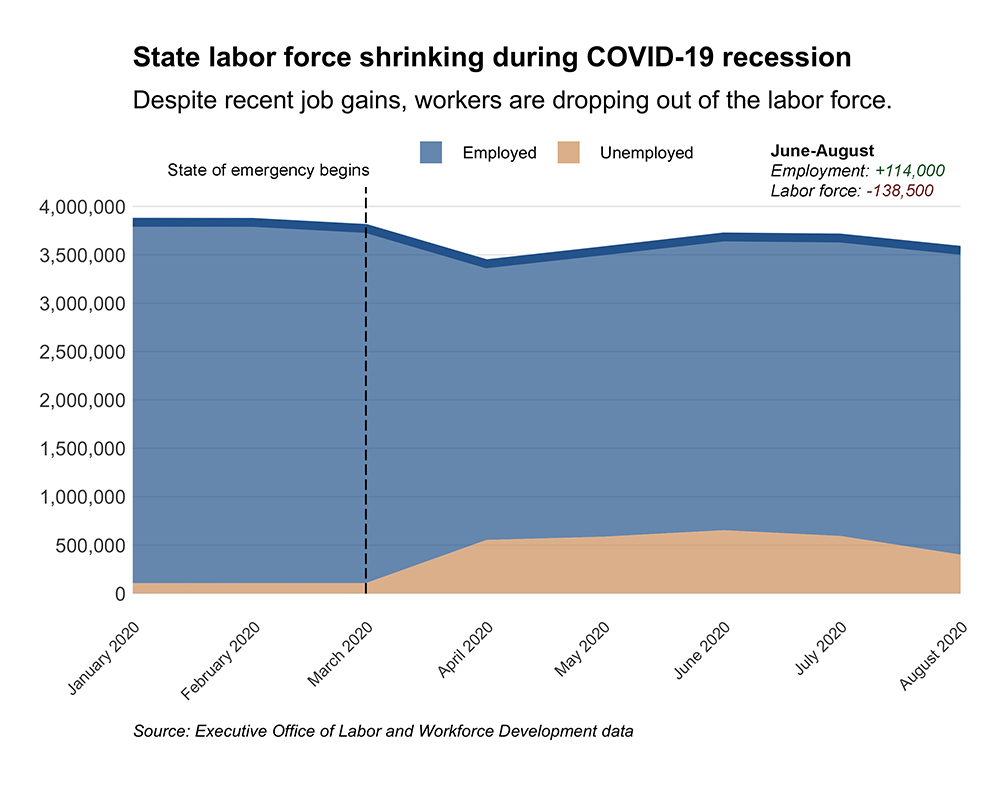
OCT. 9, 2020…..The number of Massachusetts workers counted as unemployed dropped by more than 250,000 over the past two months, a decline of more than a third that helped the state escape from a short streak of owning the worst jobless rate in the country.

Despite gains in total employment in the past two months, the Massachusetts labor force is shrinking, raising concerns about workers who have given up on finding employment amid the COVID recession. [Graphic: Chris Lisinski/SHNS]

About 114,000 more workers became employed in that span, too, a sign of continued steps toward recovery following the pandemic-related recession’s low point in the spring.

But the improving jobs numbers and unemployment rate likely mask deeper, more lasting damage at both the state and federal level: many people are dropping out of the workforce altogether, hinting that some — particularly women, who disproportionately fill caretaker roles — have given up attempts to find employment amid slow hiring and uncertainty about the COVID-19 health outlook.

“It’s a significant problem,” Federal Reserve Bank of Boston President and CEO Eric Rosengren said in a speech on Thursday. “The longer the pandemic goes on, the more you’re going to see people leaving the labor force, not only because they can’t find a job, but because they have to care for either elderly parents, people that are sick because of the pandemic, or children that are not able to go to school because schools have been closed and there is not availability of daycare.”

The trend, according to economist Alicia Sasser Modestino, indicates that the recent improvement in the state’s unemployment situation might be “not as rosy as it might seem.”

Between January and August, the working-age population in Massachusetts grew 13,400, according to data published by state labor officials based on a household survey. In that same span, the labor force — which counts both people who are employed and those who are unemployed but actively seeking work — shrunk by 290,000.

The drop was not limited to the earlier days of the COVID-19 crisis, when job cuts were severe. In July and August, a span in which the employed population grew and the unemployed population shrunk, the labor force declined by 138,500 — more than the 114,000 jobs added.

While both Massachusetts and the country as a whole have seen workers depart the market, the trends have taken different patterns.

Nationally, the rate of working-age adults participating in the labor force has been slowly but steadily climbing, reaching 61.7 percent in August after dropping to 60.2 percent in April. In Massachusetts, the rate fell to 60.3 percent in April, rebounded to 65.1 percent in June, and then fell back down again to 62.6 percent in August, household survey labor data show.

“We seem to be moving in the opposite direction from the country in terms of the number of people who are participating in the labor force, which means that our improvement in the unemployment rate is maybe not as rosy as it might seem,” Modestino, who is associate director of the Dukakis Center for Urban and Regional Policy at Northeastern University, told the News Service. “If some of that improvement is coming from people dropping out of the labor force, that’s not how we usually like to improve the unemployment rate during a recession.”

Both the fluctuating pattern and the scale of the changes are unusual. In general, the labor force shrinks during recessions and grows during expansions, but — like so much else about the pandemic — this economic slowdown is unprecedented.

Alan Clayton-Matthews, another Northeastern professor who is a senior research associate at the Dukakis Center, said the more acute labor-force changes in recent months reflect the new reality of the pandemic.

“In some sectors, you know you can’t get a job right now,” Clayton-Matthews said in an interview. “In a normal recession, you might have stayed in the labor force, but in this one where, because of COVID, there’s a virtual certainty that you’re not going to be able to get a job, you drop out of the labor force.”

Another factor, he said, was the now-expired increase in unemployment aid offered through federal programs to blunt the impact of massive layoffs.

While experts said the volatility in the labor force figures raises red flags, they stressed that the state-level data do not offer a clear picture of why workers have departed.

Some could have opted to halt working over health concerns, some could have resigned themselves to not finding a job in the current strained economy, some might need to shift their focus to caretaking, and some might have simply retired during the pandemic.

Many experts agree, though, that the employment impacts have been disproportionately concentrated among people of color, who are more likely to work low-wage jobs prone to disruption, and among women, who often perform a larger share of parenting and caretaking duties.

A survey Modestino conducted found that 13 percent of working parents either reduced their hours or lost their jobs because they had to take on child care duties during the pandemic. The effects were more concentrated among women, she said.

“Among women who became unemployed during the pandemic, 25 percent of them said it was solely due to child care,” Modestino said.

In February, about 31 percent of Massachusetts claimants seeking unemployment benefits were women, according to Modestino. By July, that rate had jumped to more than 56 percent, “a tremendous shift.”

A similar trend is occurring nationally. Between February and September, the percent of men aged 25 to 54 participating in the labor force dropped 1.6 percentage points, according to Bureau of Labor Statistics data based on the Current Population Survey. For women in the same age range, the labor force participation rate dropped 2.8 percentage points over that span.

“In a pandemic, where many schools are closing, when many people in the 25 to 54 age bracket are having children, many families have to make a choice of whether or not they can continue to work because they have children at home,” Rosengren said in his remarks. “Sometimes, that is borne by the husband, but frequently it is borne by the wife.”

The long-term effects of discouraged workers may not become clear for months or years, particularly amid enormous uncertainty over the public health outlook.

Key questions remain unanswered, such as when consumers will feel comfortable resuming pre-pandemic routines, when a vaccine or treatment will be available, and whether Congress will approve another stimulus package — that appears less likely after President Donald Trump said Tuesday he would withdraw from negotiations.

Clayton-Matthews described the risk of federal aid falling through as “the biggest sword of Damocles hanging over us.”

“The economy seems to be weakening, and without another stimulus, I don’t see how it’s going to get by until there’s a vaccine widely available,” he said. “We could see a prolonged recession if there’s not more support for incomes like there was in the beginning of this pandemic.”

Guest Columnist | Financial Recovery Post-COVID by Mayor Stephen DiNatale of Fitchburg

Financial Recovery Post-COVID

by Mayor Stephen DiNatale of Fitchburg


As we enter into the fall season, the state has seen the coronavirus test positivity rate fluctuating around 2%. Although this number is promising in that the Commonwealth has not seen drastic spikes in test rates, it is a signal that we all must proceed with caution as we enter into the winter months. By the same token, it is imperative that we review the economic effects of the shutdown and how it has impacted budgets at the municipal and state level. 

The challenging work of assessing line items for cost-saving measures within the city budget reinforces the critical role that revenue streams play at the state level and in our community. Cannabis has provided a relatively new source of revenue. Municipalities that host adult-use cannabis operators, like Fitchburg, have benefited from the revenue these businesses produce, a new growth opportunity that has proven helpful when settling municipal budgets across the Commonwealth. Without this source of funding, cuts to budgets could have been much deeper, equating to less services for constituents. For this reason, it is crucial that this new funding source continues to operate to not only provide revenue, but also maintain its workforce.  

Since the introduction of adult-use cannabis retail in November 2018, the industry has been a catalyst for growing state and local tax revenues, generating $93 million in taxes until the late March shutdown. Of this, $15 million went directly to the local communities that have embraced legalized cannabis, along with $10 million in host community agreement fees. 

While it’s difficult to pin down exactly how much tax revenue was lost during this time due to the drastic behavioral changes of social distancing, data published by the Cannabis Control Commission indicates that the last full week of adult-use cannabis sales, prior to the shutdown, yielded $15.5 million in sales while the first week post-shutdown yielded $13.5 million. Those sales are subject to a state sales tax (6.25 percent), state excise tax (10.75 percent), and a local tax to the municipality (3 percent).

If those numbers sound appealing to you, you are not alone. In April, New Mexico Governor Michelle Lynn Lujan Grisham expressed regret and sadness over the absence of legalized adult-use cannabis and the millions of dollars it would have brought to her state budget. This revelation speaks to what I and many of my peers across the Commonwealth have recognized: cannabis sales benefit our communities. 

Back in May, I, along with several of my mayoral colleagues, wrote to the Reopening Advisory Board to make this very point. In addition to preparing a rigorous protocol for safely resuming business, the industry’s record of compliance with Massachusetts oversight agencies gave us the confidence that they could operate as effectively as any other industry authorized to be open. Since the reopening on Memorial Day, adult-use cannabis businesses have shown they are up to the task. 

The capability to operate without undermining public health should be the most critical component of assessing whether a business should be authorized to be open. We recognize that this must be the priority in a health crisis, especially if cases of COVID-19 begin to rise with the gradual re-opening of the economy. As Mayor of Fitchburg, I am grateful to once again have that revenue stream to curtail further cuts. Given the cannabis industry’s track record of safety and their contributions to Massachusetts, they have proven themselves to be essential to the recovery efforts. 

Congressional Update

Join us live online with Congressman James McGovern and Congresswoman Lori Trahan on October 8, 2020 starting at 12:00 p.m. for our annual Congressional program. This is a great opportunity to hear from them on the progress on Capital Hill on important issues, including PPP forgiveness and the recovery bill. Members will also have an opportunity to submit questions. Matt Bruun of Fitchburg State University will serve as the emcee and moderator. 

The cost is just $10 for members. Pre-registration is required. For more information or to register, please visit www.NorthCentralMass.com. Thank you to our Sponsor Fitchburg State University!

Weekly Download | There’s a Pandemic Startup Surge

Weekly Download


Theres a Pandemic Startup Surge

While some of us were learning to bake or binge-watching Netflix during quarantine, others, especially those who were away from their regular workplace, were doing something entirely different. The number of new businesses that opened during COVID-19 is, well, a start-up pandemic.

Here at the North Central Massachusetts Chamber of Commerce, we are taking note of how new and existing businesses are taking advantage of the changing economic landscape to serve customers in new and unique ways. The Chamber’s economic development arm, the North Central Massachusetts Development Corporation, also works in partnership with local banks, credit unions, chambers of commerce and area nonprofits to support emerging micro-enterprises, small businesses, and community projects with loans and business assistance.

Are you ready to go into business for yourself? If you are, you aren’t alone. The week of August 10th, over 111,000 applications to start a new business were filed, according to the US Census Bureau, with 113,000+ filed the week before. And while the economic climate now may not be a bad time to start your own business, there’s a big difference between vision and success.

We’ll give you some tips on how to start your new business off on the right foot – and we look forward to welcoming you into the Chamber.

Vision Plus Experience Makes the Dream Work

Many small businesses start with a dream, a vision, and an understanding that there’s a niche to fill. Having a “big picture” concept of your business is essential to your purpose and helps shape your business plan (an essential document if you plan to apply for a Small Business Loan).

However, a successful start-up needs three kinds of personalities: Visionary, Expert, and Detail-Oriented.

Your vision for your company launches the blueprint for your purpose and goals. However, to get off the ground, you need the experience of someone who has actually done what you plan to do. They can give you practical advice on how to solve common problems as they come up and reference their own background in dealing with business growth and what their customer experience has been.

Finally, you need someone to mind the details. This is the person who may help balance your finances, spot little things that you miss, and make sure that your vision, plus the expert input, forms into a workable plan.

Watch Actions, Don’t Listen to Promises

When you hire someone for your start-up, it’s important they contribute to getting your business off the ground. You, as the founder and business owner, should be the visionary – and your team is there to help support the purpose of your business. When you set goals for your team, make sure that they follow through with what they say they’ll do, offering practical solutions for problems you encounter.

The advice from your expert should be practical and insightful. The assistance from your detail person should help you put it all together. A successful start-up doesn’t just start – it keeps going, and that’s why you need the expertise of someone who has managed or owned a business in the same field as yours. Your expert creates an action plan for you, and your detailed person puts it all together into a road map that you can all easily follow together.

Starting your own business is hard work, but for many, it’s also a labor of love. We’re all in this together, and at the North Central Massachusetts Chamber of Commerce, we understand the challenges and the triumphs of small businesses. Our mission is to support local businesses, our community and local economy, whether you’re an online business, a brick-and-mortar, or a click-and-mortar hybrid.

To learn more about the North Central Massachusetts Chamber of Commerce, please visit www.NorthCentralMass.com or call (978) 353-7600.

Hope and Engagement, But No Stimulus Deal in D.C.

Fuente del artículo: State House News Service
Article By: Katie Lannan

OCT. 1, 2020…..U.S. House Speaker Nancy Pelosi on Thursday said she’s optimistic that Republicans and Democrats can reach a deal on the next round of coronavirus stimulus funding and that she hopes to bring a bill to the floor for a vote later in the day.

“Right now, we are at the table discussing how we can go forward with a possible COVID bill,” Pelosi told reporters Thursday morning.

She said, “We’re hopeful we can reach agreement because the needs of the American people are so great, but there has to be a recognition that it takes money to do that, and it takes the right language to make sure it is done right.”

Pelosi and Treasurer Secretary Steven Mnuchin met for 90 minutes Tuesday in hopes of finding an accord, and a potential Wednesday evening House vote on the legislation was scrapped to allow time for more talks.

“We’ve had constructive conversations, Secretary Mnuchin and I, but they are not finished,” Pelosi said.

She said the two sides are “coming closer” on small business measures but “still way off in terms of state and local government.”

“We are coming closer on money for our health provisions in the bill,” Pelosi said. “It’s just a question of the language.”

Budget writers on Beacon Hill, who have not yet produced a full spending plan for this year while the state runs on temporary budgets, have been looking toward Washington to see if any additional federal aid emerges.

In filing a spending bill to close the books on fiscal year 2020 yesterday, Gov. Charlie Baker wrote that while “the need for public services continues unabated…the extent of federal support remains uncertain.”

Mnuchin, in a Wednesday evening Fox Business appearance, said he brought Pelosi “a very fair proposal that provides a lot of relief for hard-working Americans that have been hurt by this virus, particularly many of the small businesses, kids and jobs that are impacted by this.”

He said this is the first time the two sides have “seriously reengaged” in several weeks. He said President Trump “instructed us to come up significantly, so we have come up from the trillion dollar deal that we had been working on earlier.”

“We’re not going to do a $2.2 trillion deal,” Mnuchin said. “The good news is, the speaker has come down from her $3.4 trillion deal. If there’s a fair compromise, we’re prepared to do it.”

In coming up with lower price tags, Pelosi said the House Democrats are “not undermining our priorities but realigning some things in terms of the timetable, how long they would last.” She said a vote is important “for people to see that we completely identify with the concerns that they have and how we have allocated the resources necessary to get the job done.”

Chamber’s Economic Development Arm Closes Out a Successful Year

Employees reviewing loan filesThe Chamber’s economic development affiliate, the North Central Massachusetts Development Corporation (NCMDC), completed its fiscal year on September 30, 2020. The NCMDC works in partnership with local banks, credit unions, chambers of commerce and area nonprofits to support emerging microenterprises, small businesses, and community projects in North Central Massachusetts with loans and technical assistance.  The NCMDC provided a total of 47 loans in FY2020 totaling $1,130,401. These included 31 conventional microloans totaling $852,500 and 16 loans under the SBA’s Payroll Protection Program for $277,901. The average size of the loans was $24,051 with the smallest loan at $2,607 and the largest at $54,177. Our conventional microloans were leveraged by another $495,626 in financing from local banks and credit unions and $188,249 in equity from borrowers, and helped retain 169 jobs and create 22 new jobs.  Our PPP loans helped retain another 47 jobs by covering critical payroll and operating expenses to businesses adversely affected by the COVID-19 Pandemic.  During the year, the NCMDC also provided over 1,200 hours of direct technical assistance to start-up and existing small businesses and hosted several successful workshops and forums in partnership with the Chamber. The NCMDC also launched an Economic Recovery Fund to provide emergency loans with $415,000 in contributions and secured grant funding from the state and the Mass Growth Capital Corporation to assist with its efforts to provide technical assistance to small businesses.  The NCMDC is certified by the U.S. Department of the Treasury under the Community Development Financial Institution (CDFI) program and is a micro-loan intermediary for the U.S. Small Business Administration. For more information on the North Central Massachusetts Development Corporation, please visit www.choosenorthcentral.com.

Chamber Member Spotlight: ABM Insurance Largely Focused on Clients and Community

Brothers Thomas and Richard Bagley, president and executive vice president, respectively, of Anderson, Bagley, & Mayo (ABM) Insurance Agency, Inc. combine their unique and personalized service to the North Central Massachusetts area with approximately 100 years of tradition in the insurance industry.

ABM Insurance is a family-owned business, and grew through word of mouth and the acquisition of other insurance agencies, which helped to expand on the business. Rich and Tom’s grandfather became involved in the 1930s, and their father took over in the 1970s. In 2006, they took over ABM Insurance, practicing what they preach – providing efficiencies to clients, but with a personal touch.

ABM Insurance is the largest, independent, and locally-owned insurance agency in North Central Massachusetts, providing both personal and business insurances from Workers’ Compensation to Home Owners’ Insurance.

“We want to provide the best insurance for our clients’ needs,” they said. “We especially have a lot of close relationships with local and family-owned business owners, and want to meet the needs of any individual in the area.”

In a recent Arbella Insurance article, Rich and Tom were recognized for their commitment to charity within the community.  ABM gives to a wide range of charities every year, asking their employees where they feel is the greatest need. Due to the COVID-19 pandemic, instead of holiday parties, the Bagleys are utilizing that budget and putting it toward charitable purposes.

Although walk-in appointments have been greatly reduced to the pandemic, ABM ensures that they work closely with customers to understand the availability with online transactions and communications.

“Fortunately, most of the work we do can be done remotely and safely from home,” said Tom. “We’ve always tried to invest in technology and keep up to date with it. People’s lives are busy, but it’s something that is also convenient and useful for them.”

Tom and Rich feel that the North Central Massachusetts Chamber of Commerce is a great advocate for local-owned business in the area, connecting unique people their skill sets together through the community.

“North Central Massachusetts is full of unique people, identities, and skill sets that set us apart from other counties,” the Bagleys said. “The Chamber is great at making sure that that difference is recognized and promoted.”

ABM Insurance is a proud member of the North Central Massachusetts Chamber of Commerce and has four different locations in the North Central Massachusetts area: Leominster, Gardner, Westminster, and Princeton. They can be reached at 800.783.5133 and to learn more information on ABM Insurance, visit their website at www.abminsurance.com.

Governor Announces Start of Phase III, Step 2

Lt. Gov. Polito announced today, September 29, 2020 that Gov. Baker signed an Executive Order stating that low risk communities may move to Phase III, Step 2. This is due to good health metrics and will apply to towns with low risk beginning Monday, October 5, 2020.

Low risk communities are those that remain on the DPH weekly reports for 3 consecutive weeks, ranked as the gray, green and yellow communities on the map. https://www.mass.gov/info-details/community-level-covid-19-data-reporting

If a community remains ranked red for three consecutive weeks, that community must step back to Phase III, Step 1.

A small list of businesses is impacted by this step and will have restrictions.

Indoor / outdoor performance venues may operate at 50% capacity but with a max capacity of 250 people.

Recreational businesses (such as trampolines, laser tag, roller rinks) may operate at 50%. Stadiums are not included and may not open.

Retail may utilize fitting rooms.

Gyms, museums and flight schools may operate at 50% occupancy.

Gatherings are also revised:

·    Indoor gatherings are still limited to 25 people.

·    Outdoor gatherings at private residences or private venues are limited to 50 in low risk communities.

·    Outdoor gatherings at event venues and public spaces are now allowed to 100 people.

All safety protocols must continue: stay home if ill, wear a mask, maintain social distance, wash hands frequently and keep cleaning/disinfectant of spaces and surfaces. Updates will be posted on the Mass.gov website before the weekend.

Legislative Update – September 21st – 25th

Fuente del artículo: State House News Service
Article By: Katie Lannan

SEPT. 25, 2020….Sen. Elizabeth Warren has long been a prime target of President Trump’s tweets, and has been known to, on occasion, dish it right back over social media.

Sen. Ed Markey’s primary win over Rep. Joe Kennedy III earned him a few acknowledgments – if not by name – on the presidential Twitter feed earlier this month.

And on Friday, it was finally Gov. Charlie Baker’s turn.

“Wrong Charlie!” Trump tweeted, calling Baker a “RINO Governor.”

Governor Baker

After Gov. Charlie Baker rose to the defense of mail-in voting Thursday, and said it was “appalling” for an officeholder to suggest anything other than a peaceful transfer of power, he received a Twitter jab around 7:30 a.m. Friday from President Donald Trump. [Sam Doran/SHNS]

Trump, who’s been outspoken against the idea of expanding mail-in voting this cycle, was responding to Baker’s assertion Thursday that the expansion has worked “just fine” for the Massachusetts primary and in other states.

Baker’s defense of vote-by-mail came in the midst of a full-force and emotional denunciation of the president’s refusal to commit to a peaceful transfer of power if he loses the Nov. 3 election. Referencing the election of Abraham Lincoln, Baker said peaceful transitions are a foundational part of the country and called it “appalling and outrageous” for any officeholder to suggest they wouldn’t leave after a defeat.

“People think there’s a lot at stake in this election. And there is, whichever state you’re from, region you’re from or where you’re voting up and down the ticket,” an incensed Baker said, going on to add, “And those of us who serve in public life will do everything we can to make sure that the people’s will is followed through and executed on, because that is fundamentally why there’s the United States of America in the first place.”

Though Baker often says he didn’t get elected to talk national politics and expresses a preference for focusing on his “day job” of running the state and dabbling only in legislative elections, he can muster sharp criticism for specific federal actions or pieces of White House rhetoric when asked about them.

Thursday’s comments marked the second time in as many days that the usually measured governor raised his voice responding to news out of Washington.

Baker, who still hasn’t outlined his stimulus requests to Congress in writing, on Wednesday said he wants to see Congress reach a deal on that still-hasn’t-materialized next round of coronavirus aid that state budget writers have been waiting on, and not to let those talks get overshadowed by a Supreme Court vacancy fight.

He described the partisan battle over how to handle the late Justice Ruth Bader Ginsburg’s seat — the subject of his own weekend tweet asking Trump and the Senate to wait until after the election — as “one hundred percent ends justify the means, classic Washington behavior” and “a big part of why most people in this country think Washington is a problem.”

Word of Ginsburg’s death arrived last Friday night, with the Massachusetts judiciary still reeling from the passing just days earlier of Supreme Judicial Court Chief Justice Ralph Gants.

The prospect of another Trump appointee on the Supreme Court spurred reproductive rights advocates here to again call on lawmakers to pass the abortion access bill known as the ROE Act, casting it as a way to honor Ginsburg’s legacy.

On the Massachusetts high court, potential justices now have until Oct. 16 to apply for Gants’ seat, and Baker said he has yet to decide if he’ll elevate a current associate judge to the top spot or bring in a new chief from outside the SJC bench.

Regardless of why Americans might think of Washington, D.C. as a problem, Baker seemed to suggest this week it won’t be much of a problem for the state budget. At least not this year.

A week after Senate Ways and Means Chairman Michael Rodrigues said he’s anticipating $5 billion less in state revenue, Baker said state officials believe “we can work our way through” the fiscal 2021 budget, which has yet to be written after the pandemic and its economic turmoil scuttled original spending plans.

Last year’s budget, reflecting the months when the state was hardest hit by the COVID-19, will “be fine,” Baker said, and for next year, “it’s going to be important for the feds to support states and municipalities.”

As for the hard and fast numbers, which are all that counts in budgeting, there’s still nothing available on the government side. Beacon Hill still hasn’t seen its first post-pandemic state budget line item request.

Outside modeling from Tufts University’s Center for State Policy Analysis projects a roughly $1.6 billion revenue shortfall this year. That’s one number Rodrigues and his House counterpart, Rep. Aaron Michlewitz, might get to chew over at the virtual economic summit they announced this week.

The scheduling of the budget confab for Oct. 7 makes it likely that a full spending plan for the fiscal year that began in July likely won’t emerge until mid-October at the earliest, leaving the delayed budget season to potentially bump up against and more likely past November’s elections.

Count University of Massachusetts President Marty Meehan as among those waiting to see what’ll happen to his line item. Addressing UMass trustees this week, Meehan pointed out that while the Baker administration and the Legislature committed to holding local and K-12 school aid level in fiscal 2021, no such promise was made for higher education funding.

“We have no guarantees that we’re going to be level-funded and in fact, we were left out when it came time to say who was going to be level-funded,” Meehan said, adding “I think it is fiscally a mistake for us not to assume there would be some cut, and remember, if we got cut by 10 percent, cutting in the middle of the fiscal year is like a 20 percent cut. It’s really difficult if you get cut during the middle of a fiscal year.”

The UMass system’s steps to address a $335 million budget shortfall include 141 permanent layoffs and 1,616 indefinite furloughs, which together are projected to generate $40 million in savings. Union representatives ripped the workforce cuts, saying they’re detrimental at a time when students need more support.

The MBTA, faced with steep ridership declines, is also eyeing a financial squeeze, and talks continued this week on potential service cuts and other changes.

If there are any difficult budget choices to be made over at the Executive Office of Public Safety, after a few months, it won’t be Secretary Thomas Turco making those calls. Turco, a former Department of Correction commissioner who joined Baker’s Cabinet in December 2018, announced Wednesday he plans to retire at the end of the year.

Meanwhile, pressure remains for the six lawmakers reconciling House/Senate policing reform bills to arrive at a deal — Sunday will mark two months since the conference committee was formed, and because conference committees meet in private, since the last time details of the legislation’s progress were publicly known. Calls for action amped up after a Kentucky grand jury on Wednesday opted not to charge three Louisville police officers with offenses directly related to the death of Breonna Taylor.

A Massachusetts grand jury indicted two Holyoke Soldiers’ Home officials on charges in connection with the COVID-19 outbreak there that involved the deaths of at least 76 veteran residents.

Superintendent Bennett Walsh and former medical director David Clinton each face five counts of caretaker neglect and five counts of causing or permitting serious bodily injury to an elder or disabled person.

Attorney General Maura Healey based the charges, announced Friday, on decisions her office described as “reckless from an infection control perspective,” like consolidating groups of residents in close quarters regardless of their COVID-19 status.

The charges landed as the home’s board prepares to meet next Wednesday to consider Walsh’s future.

Hampden Superior Court Judge John Ferrara ruled Monday that Health and Human Services Secretary Marylou Sudders overstepped her authority in firing Walsh after the outbreak, and said that power properly lies with the board of trustees.

Healey said she believes the felony indictments against Walsh and Clinton mark the first criminal charges in the country arising from COVID-19 deaths in nursing homes. But they might not be the last here in Massachusetts.

The AG said she has active, ongoing investigations into “a number of” other facilities in the state.

STORY OF THE WEEK: Un-fired on Tuesday and facing criminal charges by Friday, it’s been a rollercoaster of a week for Bennett Walsh.

SONG OF THE WEEK: For the rise in rodent reports that prompted the Boston City Council this week to hold a virtual hearing on whether it’s more than just Allston Rat City.