Servicio de Noticias de la Casa del Estado Author: Michael P. Norton
Attorney General Andrea Campbell announced the settlement with the Workers’ Compensation Rating and Inspection Bureau and the State Rating Bureau, saying it will enable businesses to save about $130 million on workers’ comp insurance starting July 1.
“By lowering workers’ compensation insurance rates, we can help better protect workers and ensure that small businesses can offer higher wages, better benefits and lower prices,” Campbell said in a statement.
The attorney general’s office is a participant in the trial-like rate cases that are heard by the Division of Insurance and lead to rate resets. Campbell’s office said this year’s case started earlier than is required by statute because the AG “secured an order requiring that rates be reviewed sooner than the usual two-year cycle.”
Massachusetts insurers wanted to cut the average statewide workers’ compensation insurance rates by 4 percent starting in July, according to the Workers’ Compensation Rating and Inspection Bureau’s December filing with state insurance regulators. Campbell’s office said the AG “identified shortcomings in the industry’s projections and argued for a larger decrease.”
Chamber of Commerce | North Central Massachusetts | North Central Massachusetts Chamber | Massachusetts Business | Massachusetts Economy | Massachusetts Chamber of Commerce | Chamber of Commerce | Government Affairs | State House News Service | Workers’ Comp Insurance Rates
North Central Massachusetts Chamber of Commerce Strategic Plan Overview 2022-2025
Plan aligns with One North Central Regional Economic Development Plan focused on regional prosperity, market opportunities
The North Central Massachusetts Chamber of Commerce today announced a new strategic plan designed to build upon the considerable momentum generated through the keen vision and steady execution of their prior plan announced in 2018.
“Our new strategic plan capitalizes upon the successes experienced over the past four years while also acknowledging a significant number of emerging opportunities and challenges currently facing our region,” said Roy Nascimento, President and CEO, North Central Massachusetts Chamber of Commerce. “At the same time, it incorporates many of the invaluable recommendations of Uno del norte central, our comprehensive regional economic development plan commissioned by the Chamber in concert with our local partners and unveiled in 2021.”
The 2023-2025 plan includes five goals focusing on specific areas with accountable metrics and targets:
Goal 1: Strengthen the regional economy and improve the overall business climate;
Goal 2: Promote the region as an ideal place to live, work, visit and invest;
Goal 3: Partner with educational, business and non-profit communities to address the region’s growing workforce development needs;
Goal 4: Deepen the region’s understanding of complex issues, identify collaborative solutions and advocate to key decision makers and stakeholders;
Goal 5: Position the Chamber for long-term sustainability and success.
The strategic plan, which was approved by the Chamber Board and its affiliate Boards from North Central Massachusetts Development Corporation and Visit North Central Massachusetts, was prepared via a comprehensive process that included input from members, the Boards, staff and other stakeholders. The new strategic plan complements the One North Central plan while aligning with the Chamber’s advocacy agenda.
“We made great strides in achieving key goals set forth in our previous plan,” said Nascimento. “From launching a localized online jobs resource and a Latinx business initiative to better engage and support Latinx small businesses to securing nearly four million dollars in state, federal and private funding to supporting lending efforts and regional economic development, we are pleased with our work and look forward to continuing the momentum over the next three years.”
Programs and projects will be undertaken with care and consideration of actual resources of the Chamber and its members. The plan is also a fluid document of which the Chamber will update as needed to reflect the changing world.
Chamber of Commerce | North Central Massachusetts | North Central Massachusetts Chamber | North Central Regional Economic Development Plan | North Central Massachusetts Development Corporation | Visit North Central Massachusetts
The Healey-Driscoll Administration and Massachusetts Growth Capital Corporation (MGCC) announced two new grant programs totaling $78 million in funding to support Massachusetts small businesses.
“Small businesses are the backbone of our communities and our economy,” said Massachusetts Governor Maura Healey. “Through these new grant programs, small businesses will have access to much-needed capital and resources to help them grow and thrive. We’re grateful to our partners in the Legislature for allocating these critical funds.”
The Inclusive Recovery Grant Program will provide up to $75 million in funding through grants of up to $75,000 for businesses owned by people of color, women, veterans, immigrants, individuals with disabilities, or those who identify as part of the LGBTQ+ community; businesses that focus on reaching markets predominantly made up of socially and economically disadvantaged and historically underrepresented groups; and other underserved markets.
The Independent Movie Theater Grant Program will provide a total of $3 million in funding to support movie theaters in Massachusetts. Eligible applicants can receive $15,000 for each of the first two screens they add at a particular location and $10,000 for each additional screen at a particular location.
These funds will be administered by MGCC and were appropriated through the Commonwealth’s FY2023 Economic Development Bill.
“Small businesses employ half the workforce in our state and account for the majority of all our businesses,” said Massachusetts Lieutenant Governor Driscoll. “We’re pleased this targeted funding will support small business owners that have traditionally struggled to access needed capital and those serving historically underrepresented populations.”
“Our small business owners and entrepreneurs, many of whom are women, people of color, veterans, and immigrants, need access to capital in order to get their ventures off the ground and expand their footprint in Massachusetts,” said Massachusetts Economic Development Secretary Yvonne Hao. “We are grateful to MGCC for playing an important role in empowering small business owners and advancing equitable business growth across the state.”
“These programs provide an accessible and streamlined process for underserved businesses to access the capital that will be instrumental to their growth,” said Larry Andrews, President and CEO of MGCC. “Our extensive network of community partners is actively reaching out to their local businesses to provide the necessary technical assistance to assist through the application process.”
Applications are now being accepted for both programs and are available here (https://www.empoweringsmallbusiness.org/). The deadline to apply is Friday, April 28, 2023. Businesses interested in applying must fill out and submit the online application along with required documentation.
Chamber of Commerce | North Central Massachusetts | North Central Massachusetts Chamber | Massachusetts Economy | Government Affairs | Massachusetts Growth Capital Corporation (MGCC) | Healey-Driscoll Administration | Small Businesses New Grant Programs
Travel and Tourism Season Extension grant to support marketing projects that promote travel and tourism during “shoulder season”
Three leading tourism organizations in Central Massachusetts today announced they will receive a combined $1 million Travel and Tourism Season Extension (TTSE) Grant from the Massachusetts Office of Travel and Tourism (MOTT). Discover Central Massachusetts, in partnership with MetroWest Boston Visitors Bureau and Visit North Central Massachusetts, announced the grant during a special event at Mechanics Hall in Worcester.
The grant, which is funded through the U.S. Department of Commerce Economic Development Agency, will be provided over two years to support the partnership of the three organizations.
“These Travel and Tourism Season Extension grants support regional marketing projects that promote travel and tourism attractions between the months of November through April, known as the ‘shoulder season,’” said Massachusetts Office of Travel & Tourism Executive Director Keiko Matsudo Orrall. “We have an amazing state to showcase, and these funds will enhance tourism recovery during this important part of the year.”
“This is a great opportunity for all of our organizations to come together and share our collective attractions with leisure travelers, sports families, groups and convention attendees, among many others,” said Monique Messier, President, Discover Central Massachusetts. “By making this a collaborative effort with the MetroWest Boston Visitors Bureau and Visit North Central Massachusetts, we can unify our position as an attractive and competitive destination not just in Massachusetts but throughout New England and on the East Coast.”
Target cities include Boston, Mass., Providence, R.I., Manchester, N.H., New York City and surrounding suburbs, and Canada, with outcomes of increased tourism revenue, website traffic, newsletter subscriptions, and a larger social media following expected.
“The project is consistent with economic development goals in our region as we continue to recover from losses in visitor spending, tourism payroll and tax dollars which occurred during the pandemic,” said Roy Nascimento, President and CEO, Visit North Central Massachusetts. “This is an exciting opportunity to enhance our existing efforts and grow our tourism industry for the benefit of our businesses and communities.”
The campaign will connect experiences and opportunities across more than 80 cities and towns represented by the three destination marketing organizations.
“This collaboration expands the impact of our national and international campaigns far beyond what any of us could do working alone” said Erin Lynch, Executive Director, MetroWest Boston Visitors Bureau. “These partnerships weave together a story showcasing the tremendous assets and opportunities for exploration within our regions, driving a significant boost for our local economies.”
About Discover Central MA
Discover Central MA’s mission is to market Central Massachusetts as a competitive destination for travel and tourism, attracting visitors, national conventions, meetings and events. As a membership-based, destination marketing organization, DCM advocates for the growth and health of the local tourism industry. Membership is available to hospitality and tourism businesses in Worcester and 34 surrounding communities in the Central Mass. region. To stay up to date, follow Discover Central MA on Instagram, Facebook, Twitter, Pinterest, Linkedin, YouTube, and subscribe to the weekly newsletter.
About the MetroWest Boston Visitors Bureau
As the only regional organization with the mission of stimulating the MetroWest economy by marketing the region’s assets, MetroWest Boston Visitors Bureau has served hundreds of businesses, nonprofit agencies, and municipalities since its founding. This independent nonprofit organization markets the region’s cultural and recreational venues, retailers, restaurants, accommodations, and educational and other services to visitors and residents alike. These marketing efforts also serve to brand the region, to build collaborations across sectors and towns, to support jobs-producing enterprises, and to celebrate the diverse and vibrant MetroWest community. Learn more about the MWVB by visiting www.metrowestvisitors.org or by following on social media @visitmetrowest.
About Visit North Central Massachusetts
Visit North Central Massachusetts (VNCM) is the official designated Regional Tourism Council serving the 27 cities and towns of North Central Massachusetts. One of the sixteen Massachusetts Regional Tourism Councils, the organization’s primary mission is to educate the traveling public, tourists and residents of North Central Massachusetts about the many historical, cultural and hospitality related sites within this scenic New England Region. Through this mission, VNCM works collectively with local attractions, hospitality businesses and local communities to market the North Central region as a destination and provide information and services to the traveling public. The North Central Massachusetts region is comprised of the communities of Ashburnham, Ashby, Athol, Ayer, Barre, Bolton, Clinton, Devens, Fitchburg, Gardner, Groton, Harvard, Hubbardston, Lancaster, Leominster, Lunenburg, Pepperell, Petersham, Phillipston, Princeton, Royalston, Shirley, Sterling, Templeton, Townsend, Westminster, and Winchendon. For more information about Visit North Central Massachusetts please visit www.visitnorthcentral.com or call 978-353-7604.
Media Contact:
Lauren Howe
empHowered PR
978-400-3036
Chamber of Commerce | North Central Massachusetts | Worcester County | Discover Central MA | Visit North Central Massachusetts | Visit North Central Local Tourism | Massachusetts Office of Travel and Tourism (MOTT) | Discover Central MA | MetroWest Boston Visitors Bureau | U.S. Department of Commerce Economic Development Agency | Travel and Tourism Season Extension (TTSE) Grant
Funding expands certified home health services in Worcester County
The North Central Massachusetts Development Corporation (NCMDC), the economic development arm of the North Central Massachusetts Chamber of Commerce, recently approved a $100,000 loan to DivineTouch Home Healthcare, located at 95 Vernon Street, Suite 301 in Worcester.
Funding will support the business in becoming a certified homecare agency, making DivineTouch one of just a few home health agencies with such certification in Worcester County. As the business grows, the organization anticipates adding 19 salaried positions and 46 wage staff to the local economy over the next few years.
Founded by Grace Sterling, an immigrant from Jamaica with more than 12 years of hands-on health care experience, DivineTouch offers a number of programs and services, including skilled nursing, disease process teaching, medication administration, Alzheimer’s and dementia care, behavioral health management, and physical, occupational and speech therapy, as well as medical social worker, home health aide, and pastoral care.
“Taking care of others is my passion,” said Sterling. “As an expert in the home healthcare sector, I saw gaps in the system and realized there was a need for more home-based patient services in Worcester County. With the support provided by North Central Massachusetts Development Corporation, I will be able to build my business and help those in my community.”
Como entidad de microcréditos, NCMDC puede otorgar préstamos a pequeñas empresas de hasta $250,000 para capital de trabajo, bienes inmuebles, equipo, inventario y expansión, además de colaborar con nuestros socios bancarios para proporcionar financiamiento puente para la etapa final de un proyecto.
For more information about the NCMDC loan programs, please call 978.353.7607 or visit NorthCentralMass.com or ChooseNorthCentral.com.
Chamber of Commerce | North Central Massachusetts | North Central Massachusetts Chamber of Commerce | North Central Massachusetts Development Corporation (NCMDC) | DivineTouch Home Health Care | Microloan Lender
EQUITABLE LENDING LEADERS: The Chamber’s economic development arm, the North Central Massachusetts Development Corporation (NCMDC), participated in a 12-week cohort designed to provide equitable outcomes in our lending programs. Two of our team members worked through the cohort to connect with underserved populations, business owners, and resource partners to determine what changes or additions to our programs would help us provide more equitable outcomes for minority and low-income communities. The program ran from June to November 2022, and the team is now working on ideas that will help us reach our goals.
LATINX OUTREACH: The Chamber and NCMDC have continued efforts to engage and support Latinx businesses throughout Central Massachusetts. Efforts have included providing technical assistance, referrals to different resources, and collaborating with the Spanish American Center. We have also advertised our services in the Spanish publication El VOCERO, Facebook and LinkedIn.
REACCREDITATION: As reported in our previous edition, the Chamber is currently in the midst of five-year reaccreditation process. Chamber accreditation is an extensive, self-review process that is expected to last six to eight months to complete. We hope to have our submission prepared for the Accrediting Board by the end of March and decision made by July. The Chamber can only earn reaccreditation by meeting rigorous standards for leadership, staff development, chamber policy and procedures, programs – including governance, government affairs, technology, planning and finance. Our Chamber is one of less than a handful of chambers in Massachusetts to have received accreditation. This exemplifies our commitment to excellence and to supporting our members and communities at a high level.
NEW LOANS: The NCMDC has approved and closed 7 Small Business Loans for a total of $286,500, since Oct. 1, 2022. Three loans totaling $22,500 were approved and closed through the SBA Microloan program and the other 4 loans totaling $264,000 were funded through our CDFI loan program. Four of the loans were granted to fund start-up businesses. New loans are finding NCMDC through our resource partners, banking partners and through the SBA.
TECHNICAL ASSISTANCE: During the last quarter, our economic development team provided 678 hours of direct technical assistance to existing and start-up businesses in the region. Several members of our team also sit on local boards within the communities we serve, helping us stay informed on small business activities and various grants and programs available to our small businesses.
MINI-GRANTS: The NCMDC continues to offer mini-grants between $500 – $5,000 to our borrowers to assist with technical assistance. Examples of professional services that the grant can help cover include accounting/bookkeeping, marketing, and legal services. Prioritization is given to existing loan clients but we will consider other small businesses in North Central Massachusetts with a demonstrated need. For the quarter, NCMDC has awarded 3 mini grants totaling $8,178.69 for bookkeeping, marketing and signage assistance.
PODCAST SERIES: The Inside North Central Massachusetts Podcast series has hit over 50 episodes, and is now releasing episodes weekly. Listenership has continued to grow over time. Since the launch, we have had over 1,000 downloads on Podbean; over 475 on Apple; and 81 on Spotify. We have unable to determine downloads via Google Podcasts, but believe the numbers are strong via that channel too. The Chamber has invested in podcast equipment including a sound board; four headsets; four microphones and stands. This has allowed us to venture out on the road and a new series from member location called “On The Road”. To date, we have visited over 15 members representing restaurants, retailers and more. In January we produced our first podcast in Spanish with Maribel Cruz stepping in as host. Thank you to all the members who have participated in interviews and/or listened to the new Podcast series.
TOURISM GRANT: The Chamber’s tourism arm, Visit North Central Massachusetts, is partnering with two of our neighboring regional tourism councils – the MetroWest Visitors Bureau and Discover Central Massachusetts – on a joint effort to promote our collective regions. The three organizations collectively applied for and were successful in securing a $1 million grant from the U.S. Economic Development Administration to support tourism marketing during the shoulder season. The grant will be split and used to help fund advertising campaigns over a two-year period (FY24 & FY25). This will be a nice boost to our existing marketing efforts and help to attract more visitors and groups.
STRONG ECOSYSTEM PROJECT: A small advisory committee of members worked with our consultant, RKG Associates, to develop a strategic plan to strengthen the entrepreneurial ecosystem for start-up and early stage companies in the region. The project builds off of the work of our One North Central Regional Economic Development Plan, which prioritizes efforts to grow the region from within through small business support programs and initiatives. MassTech provided a small grant to help fund the development of the plan. We have submitted the final plan to MassTech and are awaiting word on if additional funding will be awarded to help implement the elements of the plan.
ACCOUNTING: The North Central Massachusetts Chamber of Commerce, North Central Mass Chamber Foundation, Johnny Appleseed Trail Association (Visit North Central), North Central Massachusetts Development Corporation and Chambers Insurance fiscal year-ends closed smoothly. The applicable Annual Audits and Tax Returns were processed and filed on-time and without incident.
HEALTH INSURANCE: Effective April 2023, next open-enrollment, the Chamber will no longer administer Tufts insurance, as they transition to a brokered account through their merger with Harvard Pilgrim. All existing Tufts employer groups with more than 5 employees will be directly brokered through Harvard Pilgrim and all groups with less employees will be brokered through SBSB (Small Business Service Bureau) or transitioned out to our other carriers brokered through Chambers Insurance, Inc. Our team has been working for several months with Tufts and SBSB to ensure a smooth transition of our Tufts subscribers without any interruption. We encourage any members who are impacted to contact us with any questions or concerns.
SOLAR PROGRAM: From its inception in August 2014 through December 2022 the solar field on Pleasant St. has produced 12,036,466 kWh of Net Metering Credits to the manufacturers participating in the Chamber’s program. The collective savings to participants totals $2,308,424.87.
Fitchburg | Chamber of Commerce | North Central Massachusetts | North Central Massachusetts Chamber of Commerce | Chamber Updates | Equitable Lending Leaders | LatinX Outreach | Reaccreditation | New Loans | Technical Assistance | Mini-Grants | Podcast Series | Tourism Grant | Strong Ecosystem Project | Accounting | Health Insurance | Solar Program
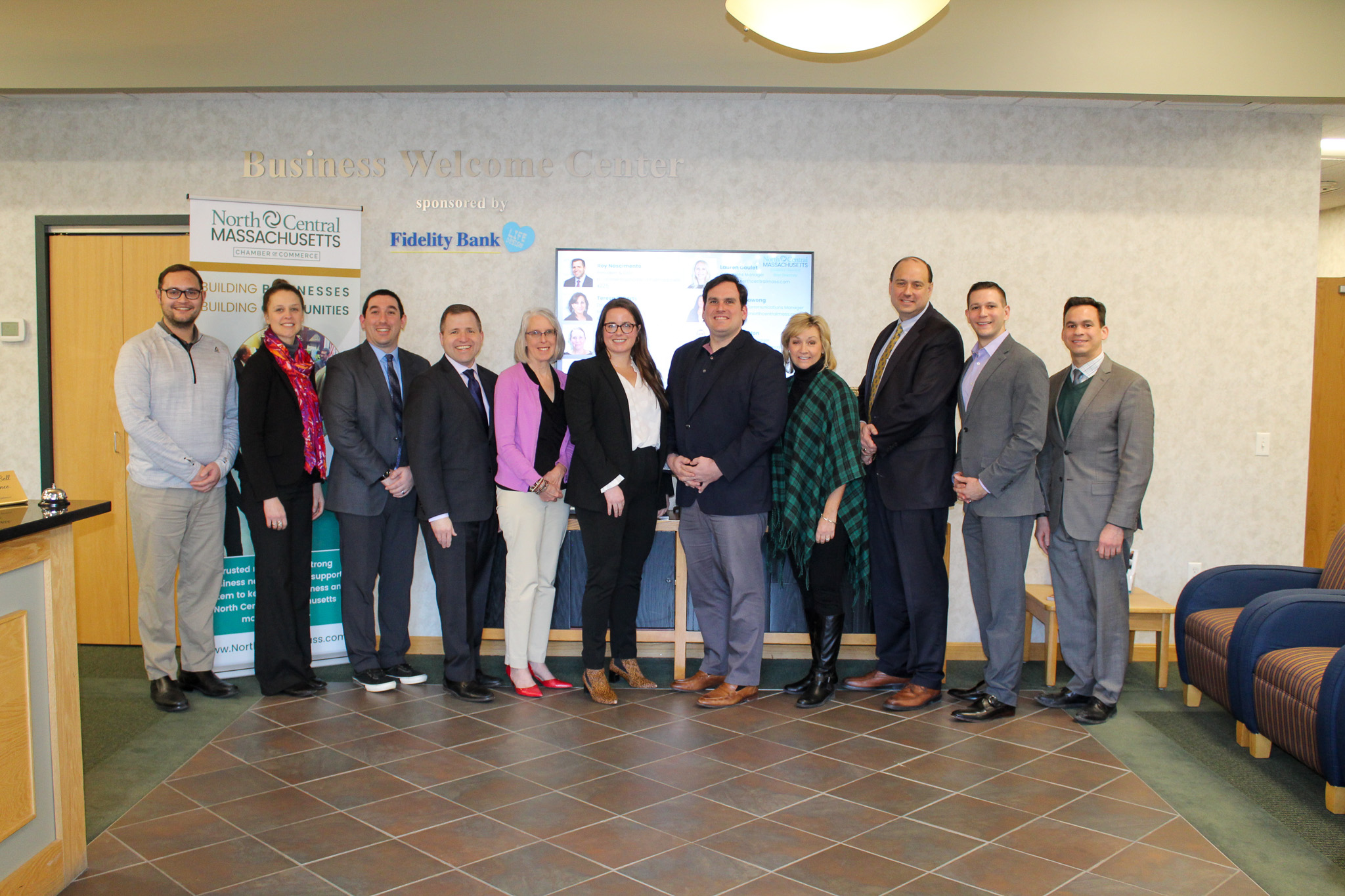
In February, the Chamber hosted a legislative briefing for members of the North Central Massachusetts legislative delegation. Pictured left to right: Nolan King, Aide to Representative Jon Zlotnik; Elizabeth Kazinskas, Aide to Representative Ferguson; Travis Condon, Chamber Public Affairs Manager; Representative Margaret Scarsdale; Representative Meghan Kilcoyne; Senator John Cronin; Representative Kimberly Ferguson; Senator Jamie Eldridge; Representative Michael Kushmerek; and Representative Danillo Sena.
As the Massachusetts Legislature settled into the new session with a new administration, the North Central Massachusetts Chamber of Commerce continues to advocate and strengthen our relationship with the region’s delegation on behalf of our members. Letters were sent to each of the newly elected officials in the region and statewide offices as well as those reelected. Chamber President and CEO, Roy Nascimento, also penned an open letter that was picked up by multiple media outlets thanking the Baker-Polito administration for their partnership and extending a welcome to the new administration. The letter included eight strategic recommendations for consideration to advance the region and the Commonwealth. The Chamber is closely monitoring the executive offices, and we expect more transitions and appointments in the early days of Governor Healey’s new administration.
While Beacon Hill prepares their priorities for the FY24 budget, the Chamber gathered the region’s delegates from the House and Senate at the Chamber office for our annual Legislative Briefing in February. This marked the first time the event has been held in person since the start of the pandemic, and there was a strong showing from the North Central Massachusetts delegation. The Chamber gave an overview on successes in the past year and outlined our priorities for FY24 from the public policy agenda in the areas of small business support, tourism and education and workforce. We also provided an update on progress made on a number of initiatives contained in our One North Central plan.
When it comes to the One North Central plan, the Chamber continues to work towards a number of initiatives from the plan including the implementation of a regional land bank. On this front, the Chamber worked closely with our delegation during the last session on a bill to extend the sunset date of the Fitchburg Area Economic Development Corporation (FAEDC) which expired in 2021 by another 50 years to 2071. The FAEDC was a predecessor to the NCMDC and the Chamber intends on using it as a vehicle for this land bank initiative. Special thanks to Senator Cronin and Representative Kushmerek for sponsoring the legislation. We would also like to extend our thanks to Representatives Zlotnik and Higgins for their support.
One big topic of conversation during the prior legislative session and election cycle was the topic of tax reform. Despite releasing plans last summer, Beacon Hill opted not to enact any major tax reforms. During her campaign, Governor Maura Healey did indicate she would pursue permanent tax relief measures, and the Chamber will monitor this situation and its potential impact on the area’s business community. When it comes to taxes locally, Mr. Nascimento, and Travis Condon, our Public Affairs Manager, attended the most recent tax classification hearing in Clinton. A 2018 recommendation by a select board committee had advocated for shifting towards a single tax rate, a shift that was paused during the pandemic. Mr. Nascimento testified for the continued move towards a single tax rate, but multiple board members first made a motion to increase the split which was defeated. A similar motion to decrease the split also failed before members voted in favor of maintaining the current split. While this is not the outcome we had hoped for, we did reach out to thank the Select Board members who voted for the reduction, and we will continue to advocate for reducing the split in the coming years.
The Chamber is also working to continue to build our relationships with the towns throughout the region and we have spent time since the beginning of the year meeting with various town administrators and economic development committees to discuss ways to strengthen our partnership and remind them that the Chamber is available as a resource.
If you have any questions or concerns, please feel free to contact Travis Condon, the Chamber’s public affairs manager, at 978.353.7600, ext. 224; or via email at .
Chamber of Commerce | North Central Massachusetts | North Central Massachusetts Chamber of Commerce | Community Development | Economic Development | Legislative Issues | Government Affairs | Elected Officials
Funding to support startup costs to open beauty salon in Leominster
The North Central Massachusetts Development Corporation (NCMDC), the economic development arm of the North Central Massachusetts Chamber of Commerce, recently granted a $13,000 loan to support the opening of Beauty Empire, a beauty salon located at 71 Main Street in Leominster. Funding will be used toward the purchase of equipment, lease hold improvements, inventory and working capital.
Owned by Nadia Ruiz, Beauty Empire will provide four hair stations, which are available for rent by hair stylists, and two nail stations. The location is the former Hair Obsession salon, and Ruiz hopes current Hair Obsession clients will continue to come to the location for their hair and nail services.
“I immigrated to the United States from Uruguay in 2014 and became a U.S. citizen in September 2022,” said Ruiz. “As I have grown my clientele while working at Divinity Hair Spa, I saw an opportunity to open my own salon and I am grateful to the North Central Massachusetts Development Corporation and NewVue Communities for helping me open the doors.”
NewVue Communities provided assistance to Ruiz in developing a business plan.
Ruiz will be leading the business and providing nail services. Ruiz holds certificates in both Advanced Cosmetology and Nail Technician and is a licensed professional as a Registered Cosmetologist in the Commonwealth of Massachusetts.
Como entidad de microcréditos, NCMDC puede otorgar préstamos a pequeñas empresas de hasta $250,000 para capital de trabajo, bienes inmuebles, equipo, inventario y expansión, además de colaborar con nuestros socios bancarios para proporcionar financiamiento puente para la etapa final de un proyecto.
For more information about the NCMDC loan programs, please call 978.353.7607 or visit NorthCentralMass.com or ChooseNorthCentral.com.
Chamber of Commerce | North Central Massachusetts | North Central Massachusetts Chamber of Commerce | North Central Massachusetts Development Corporation (NCMDC) | Beauty Empire | Microloan Lender
Servicio de Noticias de la Casa del Estado Autor: Chris Lisinski
Total employment in Massachusetts rebounded to pre-pandemic levels in January, 34 months after the COVID-19 state of emergency began, as employers added a robust 19,600 jobs.
The January gains brought the statewide employment to 3,743,500, labor officials announced Friday. That’s just 200 positions short of the total recorded in February 2020, the last month before a cascade of enormous job losses followed by a jobs recovery.
The industry with the biggest growth was education and health services, which employed 5,000 more people month-over-month. Other sectors with gains include trade, transportation and utilities (+3,200 jobs), leisure and hospitality (+3,000 jobs), and professional, scientific and business services (+2,300 jobs).
None of the industry categories tracked reported a net decrease in jobs in January; financial activities experienced no change.
Officials on Friday also revised December’s labor data to show an increase of 3,800 jobs, down from the original estimate of 6,300.
The revision bumped up the statewide unemployment rate in December from 3.3 percent to 3.7 percent, and officials said that figure fell to 3.6 percent in January. Massachusetts had a slightly higher unemployment rate in January than the 3.4 percent reported for the country as a whole.
Chamber of Commerce | North Central Massachusetts | North Central Massachusetts Chamber | Massachusetts Economy | Government Affairs | State House News Service | Jobs In Massachusetts
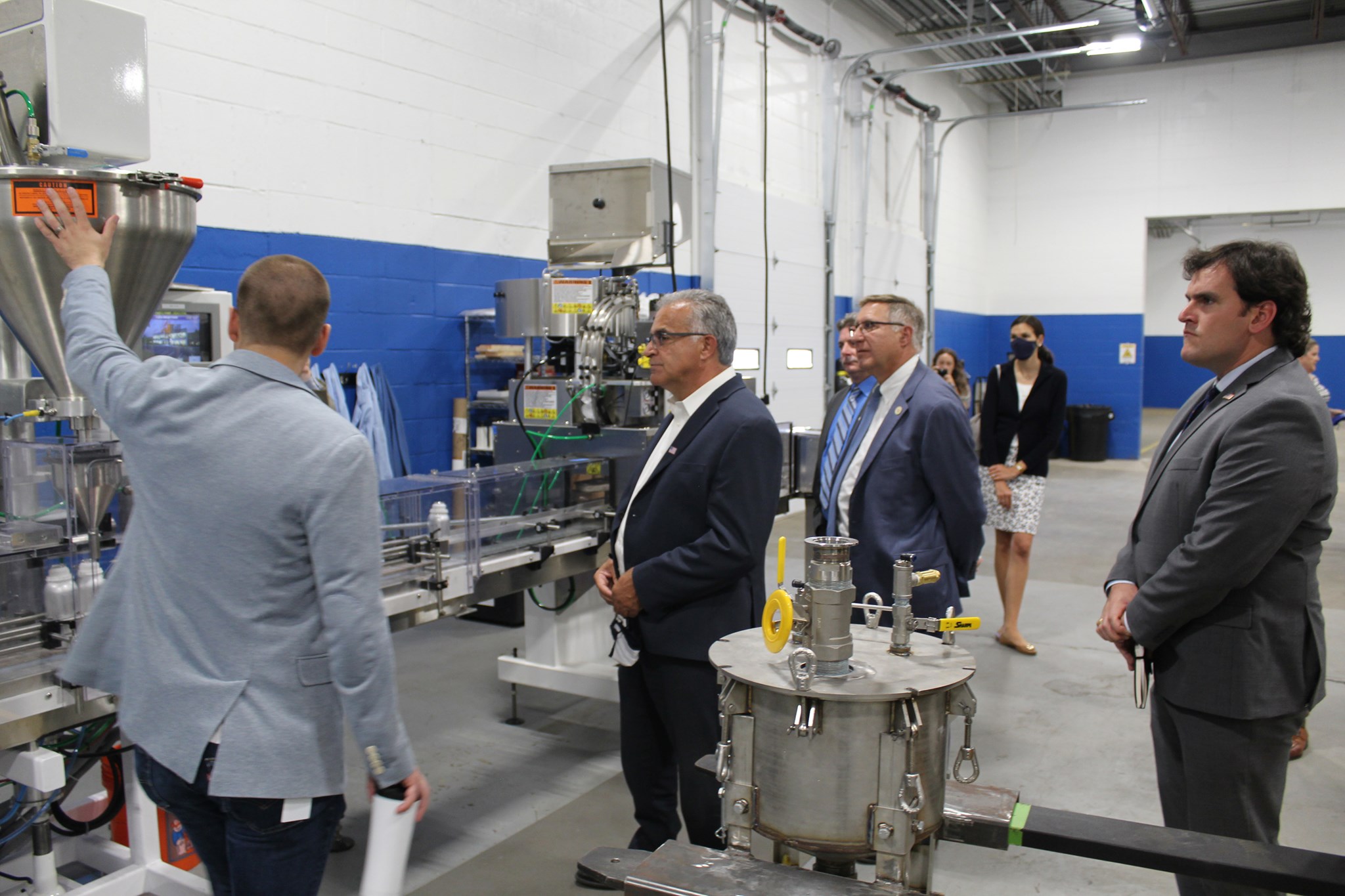
State and local leaders tour a local manufacturer. Pictured are Mayor Dean Mazzarella of the City of Leominster; State Senator Michael Rodrigues, Chair of the Ways & Means Committee; and Senator John Cronin.
One of the most valuable and often overlooked functions of the North Central Massachusetts Chamber of Commerce is the role as the region’s most powerful champion for the business community. The Chamber is uniquely positioned at the crossroads that connect businesses of all sizes and industries, non-profits, and local and state government to tackle the tough issues and get things done to ensure businesses can succeed and thrive in the region.
“I see our Chamber as both a respected facilitator and a strong networking hub,” said Mark Freeman, President, SteelFab, Inc., located on Crawford Street in Fitchburg. “The Chamber staff advocate and facilitate movements in an effective way, and they are excellent at using their relationships within local and state government and in the community to get the right people to the right meeting so we can get things done.”
And Freeman should know. As a longtime business owner in Fitchburg, Freeman, along with dozens of other business owners, worked with the Chamber to achieve a single tax rate in the city of Fitchburg following years of daunting work with little progress. “We never really made a ton of progress over the years going from a spilt tax rate to a single tax rate, but experienced incremental reductions,” he said.
Following more than 30 years of fighting what Freeman called an “uphill battle,” the Fitchburg City Council adopted a single tax rate with an 8-2 vote in 2019. “I believe we achieved this because the Chamber was very active to not only engage with candidates running for office, but by also then inviting the candidates who won their respective seats to meet with us as business owners and hear our concerns. The Chamber really leaned into this for us, and I think this achievement is a huge development for the city and region.”
Not only did the Chamber help facilitate discussions to achieve the single tax rate, which affected all businesses in the city, it also helps individual and clusters of businesses who experience a challenge and need some extra advocacy.
Take Crawford Street in Fitchburg, which is home to more than 20 businesses and some one-and-a-half miles of telephone pole wires, all of which did not provide high-speed internet services until 2017. Up until then, businesses on this well-traveled road were forced to deal with unreliable and weak service which affected their operations and daily business tasks. “We really needed the high speed internet to make our businesses run smoothly, but we just couldn’t get it to work with our service providers,” said Freeman. “The Chamber reached out to Fitchburg Mayor Stephen DiNatale and other advocates to have the service providers take a fresh look at what we needed. In the end, Mayor DiNatale was able to help bridge the gap to obtain the service with the state and help us get the bandwidth we needed, and the Chamber never wavered in their commitment to help us.”
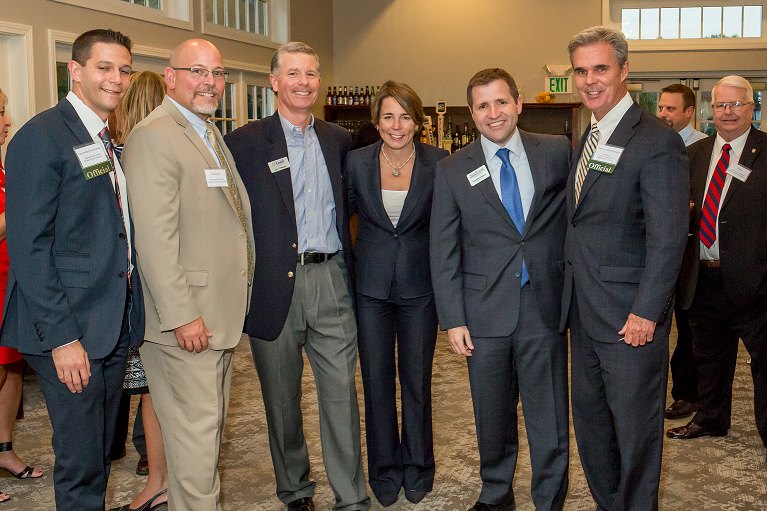
The Chamber organizes numerous opportunities to connect members and elected officials. Pictured here (L-R) are Representative Michael Kushmerek; Chris Hendry, President of IC Credit Union; John DiNapoli of Unitil; Governor Maura Healey; Roy Nascimento, President of the Chamber; and Worcester County District Attorney Joseph Early, Jr. at the Chamber’s Legislative Reception.
Freeman added that if the pandemic occurred when the former service was in use there likely would not be a business today. “Without the high-speed internet, we wouldn’t have been able to serve our customers by providing virtual inspections, use our systems and honestly just get work done, so we are happy to have the service and I know our neighbors on the street are happy about it as well.”
As Freeman pointed out, the Chamber is a “networking hub,” providing numerous opportunities through the year for members to come together at various events, forums and meetings. The goal with these programs is to make sure that members are informed and have a voice in the decisions that impact the communities in North Central Massachusetts. And, on occasion, the Chamber will also partner with other trade associations to advance an issue important to members or hire outside experts and commission studies on issues that impact the local economy and the future of the region, such as the current labor shortage.
In late 2022, the Chamber released a study, “Worker Shortages and the North Central Massachusetts Region: Engaging Hidden and Future Workers to Grow the Local Economy,” which was prepared by the UMass Donahue Institute’s Economic and Public Policy Research group, a leading provider of applied research to help clients make more informed decisions about strategic economic and public policy issues. Focusing on workforce growth challenges and solutions, the study outlines workforce barriers related to geography, skills, structure, and work-life balance, and includes short-, mid- and long-term recommendations for how to grow the North Central workforce.
“The study was intended to help shape public policy and advance thoughtful solutions to the labor challenges faced by our members,” said Travis Condon, Public Affairs Manager, North Central Massachusetts Chamber of Commerce. “The challenges and issues are very complex and have long-term implications for the region’s future and our ability to compete for talent.” One of the recommendations require all different community stakeholders in North Central to work together to meet the regions work force needs.
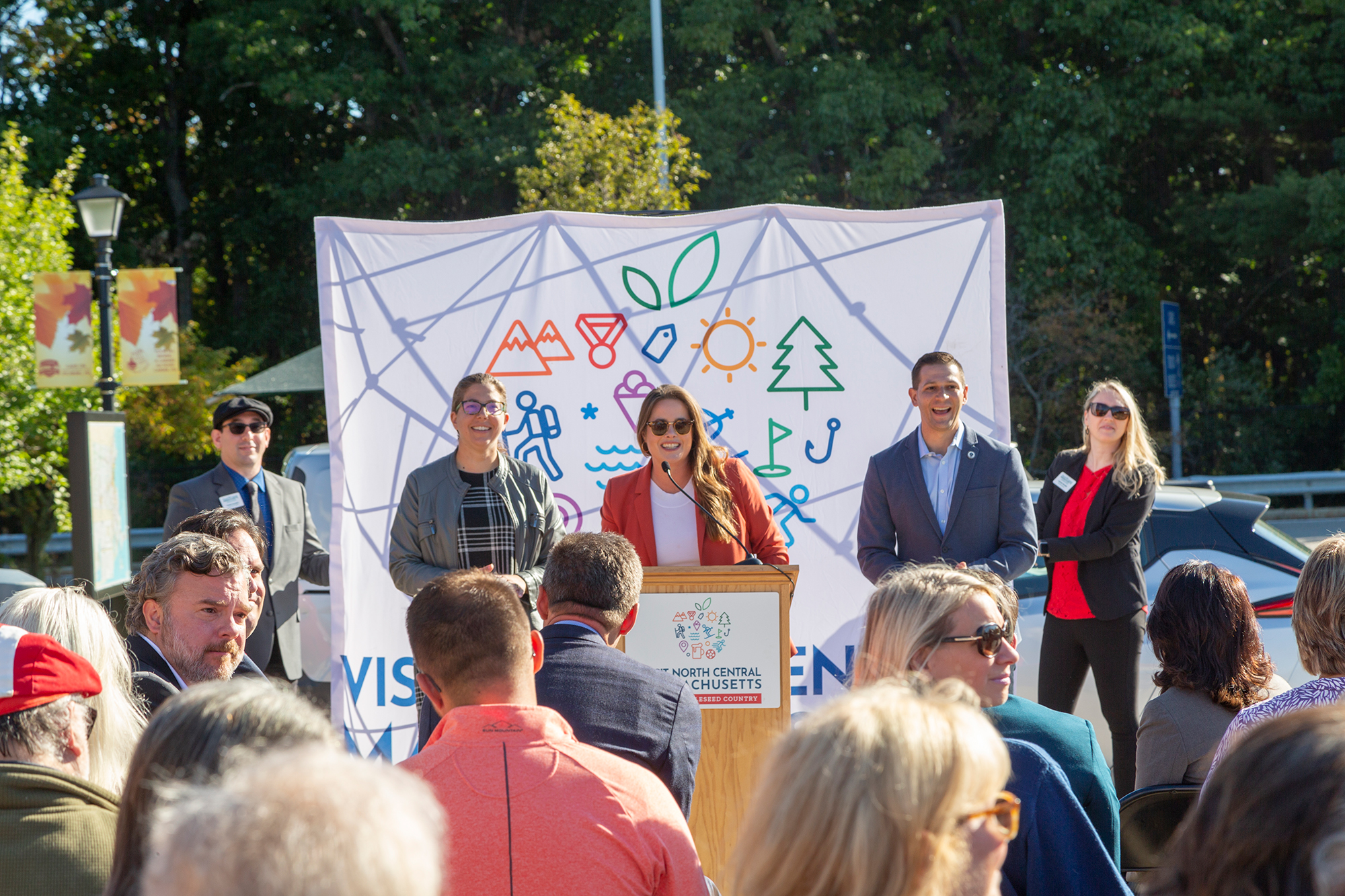
Local, state and federal officials joined members to celebrate renovations to the Johnny Appleseed Visitors Center, a project that was championed by the Chamber. Pictured (L-R) are Representatives Natalie Higgins; Meghan Kilcoyne; and Michael Kushmerek.
“As manufacturing is such a huge percentage of our local regional employment base, I’ve worked with the Chamber to engage with high schools and other grade levels on providing opportunities to tour our facility, offer mock job interview experiences, and bring mini-trade shows to school cafeterias during lunch to help spark an interest in the field,” said Freeman. “We owe it to the students to know of the opportunities available to them and the Chamber does a great job of collaborating with local businesses, superintendents and guidance counselors to bring these opportunities to our students and ultimately, help us meet our work force needs.”
Freeman noted the Chamber’s WorkNorthCentral Jobs Board as another great resource for employers and job seekers alike. “This website offers a job seeker the opportunity to view any number of jobs at a variety of employers, which is helpful for us and for those looking for work.”
Tamar Russell Brown, founder of Sitka Creations, a graphic design studio in Shirley providing clients with creative and effective graphic and web design and visual communication services, said she believes she would not be where she is today without the Chamber.
In addition to her location in Shirley, Russell Brown used to have a gallery on Main Street in downtown Fitchburg. The Chamber helped secure funding in concert with NewVue Communities to open the Gallery in 2016.
Upon opening her gallery on Main Street, she realized the sidewalk was uneven and needed repairs as many people in the older population were visiting the gallery and she was worried the sidewalk was not safe for her visitors. “I called the city and didn’t get the immediate attention we needed so I reached out to Chamber who helped get the issue resolved,” she recalled. “The Department of Public Works came out and fixed my sidewalk, so it really shows the power of the Chamber to help small businesses get what they need.”
When it comes to guiding its advocacy efforts, the Chamber only needs to look to its member-led Government Affairs Committee. This non-partisan committee meets to discuss local, state and federal priorities and is comprised of members from diverse industries. It is responsible for reviewing pending issues for their impact, developing positions and advising the staff and Board on programs that inform and encourage member involvement in its government affairs initiatives.
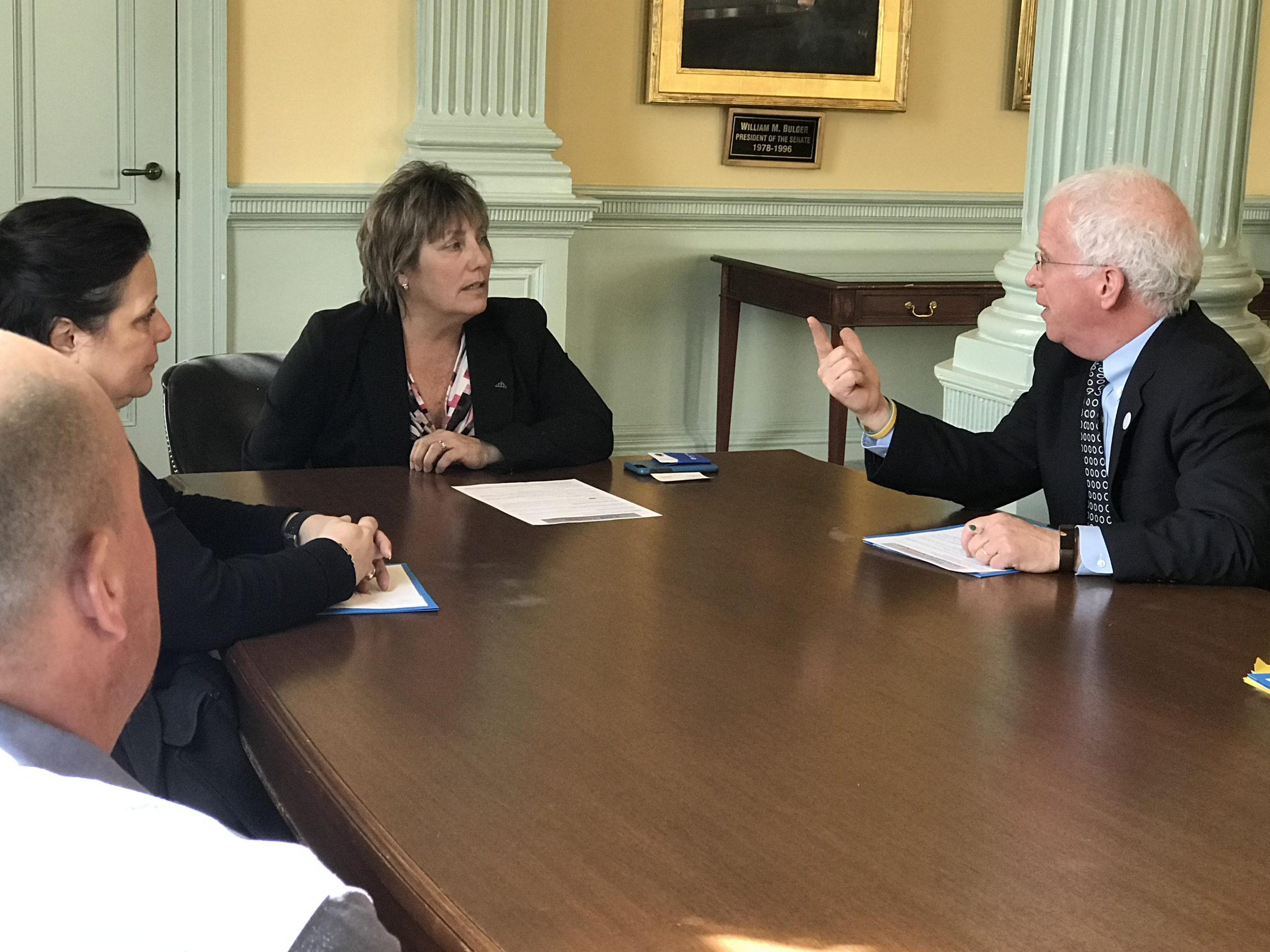
A delegation of Chamber members meets with Senator Anne Gobi at the State House to discuss legislative priorities.
In addition to the Chamber’s highly popular Legislative and Candidates Reception held each fall before Election Day and an annual Congressional Luncheon which compliments the quarterly Good Morning North Central breakfast series, the Chamber offers opportunities throughout the year to bring together the region’s elected officials, and business and community leaders to discuss topics that matter to them.
An active participant in many of the Chamber’s events, including a recent interview during the Good Morning North Central breakfast series, State Senator John J. Cronin has seen the work of the Chamber firsthand and the environment of collaboration to bring stakeholders from multiple areas together to achieve a common goal.
“From the North Central region to Beacon Hill, the Chamber is known for being an influential voice and an organization that gets things done,” said Sen. Cronin. “As a representative of several of the communities that make up North Central, I appreciate that my constituents have advocates at the Chamber engaging with policy leaders who impact businesses on a daily basis, and I always have my door open to the Chamber to help make connections and build relationships to help our businesses succeed and thrive.”
And businesses are thriving. Russell Brown just celebrated her 20th anniversary in business. “The Chamber knows you and they are such a huge part of the community by bringing so many of us together for after-hours events and networking,” she said. “If you are a member of the community and not involved with the Chamber you would have no idea of the many opportunities that exist for you.”
“This Chamber is where the rubber meets the road,” said Freeman. “There’s a million things the Chamber does, from resources for local businesses to help financing startups and they do it exceptionally well which is evidenced by the many awards and recognitions over the years.” In 2021, the Chamber was a finalist for “Chamber of the Year in the U.S.”
But, as Freeman adds, “We know we have one of the best quality chambers anywhere in the country.”
As a member, you have all of the Chamber’s resources and connections at your fingertips, and we encourage you to take advantage of that benefit and stay connected. If you have an issue or policy concern that you believe the Chamber should be aware of, please reach out to Travis Condon at 978.353.7600 ext. 224 or email him at .
Chamber of Commerce | North Central Massachusetts | Economic Development | North Central Massachusetts Chamber | Massachusetts Business | New England Town | Small Town Economy | Worcester County | Local Business | Community Development | Rural Economy | Massachusetts Industry | Business Growth | Quality of Life | Economic Diversity