Healey-Driscoll Administration Requests President Biden Issue a Major Disaster Declaration Following Devastating Impacts of September 11-13 Storms
/in Noticias de la Cámara /by Noroeste de MassachusettsGovernor Maura Healey has requested a Major Disaster Declaration from President Biden to support the ongoing recovery of Massachusetts communities impacted by severe weather and flooding in September. If granted, this declaration would secure access to federal assistance programs for Bristol, Hampden, and Worcester counties.
The storm that began on September 11 caused extensive flooding across the state and required evacuations, sheltering, water rescues, and construction of temporary roadways to allow residents and first responders access to homes.
“I saw first-hand the devastating impacts our communities experienced from the September storms. The extraordinarily heavy rainfall flooded thousands of homes and businesses, destroyed infrastructure, and required a significant public safety response,” said Governor Healey. “I’m requesting federal assistance to support our ongoing recovery efforts as communities and residents continue to rebuild.”
“Some cities and towns experienced more than seven inches of rain in a very short time,” said Lt. Governor Kim Driscoll. “A major disaster declaration is critical to helping our communities and residents gain access to federal assistance as they face an extensive recovery.”
Under the Robert T. Stafford Disaster Relief and Emergency Assistance Act, the President can declare a major disaster for any natural event they determine has caused damage that exceeds the combined capabilities of state and local governments to respond. A major disaster declaration provides federal assistance for individuals and public infrastructure through FEMA’s Public Assistance and Individual Assistance programs, as well as hazard mitigation assistance, which provides funding for eligible mitigation measures that reduce disaster losses.
Following a disaster, the Massachusetts Emergency Management Agency (MEMA) works directly with counterparts at FEMA Region 1 and impacted cities and towns to assess potentially reimbursable damages caused by, and costs related to, the disaster. Once these assessments are complete, FEMA validates whether the state and impacted counties have reached the required federal damage thresholds for a Major Disaster Declaration.
“Beginning on September 11, MEMA staff responded to Attleboro, North Attleboro, Lancaster, Leominster, Princeton, Springfield, and Sterling to support community response and recovery activities. I want to thank all of the state and municipal agencies, volunteers, and non-governmental organizations who worked together to respond to the storm, as well as the Healey-Driscoll Administration for their leadership,” said MEMA Director Dawn Brantley. “FEMA has been an excellent partner through the process of conducting joint preliminary damage assessments, and MEMA recognizes the commitment of the communities that dedicated significant time and attention to this endeavor while also facing the challenges of recovery.”
In response to the severe weather impacts, Governor Healey directed the execution of the State Comprehensive Emergency Management Plan, activation of the state’s Regional Emergency Operations Centers, and declared a State of Emergency on September 12, 2023. The administration also developed a website to centralize available resources for residents, businesses, and communities, which is continually updated.
Chamber of Commerce | North Central Massachusetts | North Central Massachusetts Chamber | Massachusetts Economy | Government Affairs | State House News Service | Healey-Driscoll Administration
Mass. Eyes Trillion-Dollar State Club
/in Noticias de la Cámara, State House News /by Noroeste de MassachusettsSource: State House News Service
Author: Colin A. Young
The broad goal of the economic development plan the Healey administration put forward this week is to build upon the state’s strong points to keep Massachusetts an ideal place to live, raise a family and grow a business well into the future.
But another aspiration was revealed Wednesday when Economic Development Secretary Yvonne Hao detailed the plan for lawmakers — for Massachusetts to join the small club of states that have a gross domestic product of $1 trillion or more.
The plan’s vision matches up traditional economic development topics like talent attraction and retention, boosting housing production, making public transportation more reliable, and streamlining access to state resources with Healey’s specific emphasis on values like inclusion as well as state policies around reproductive and civil rights. It aims to “lengthen our lead” in sectors like life sciences, health care, and advanced manufacturing, while also seizing opportunities to become new leaders in climate tech and tourism.
“This is the way we become more than a trillion,” Hao said in response to a question from Sen. Barry Finegold, co-chair of the Joint Committee on Economic Development and Emerging Technologies. She added, “The majority of our economy is aligned around industries that are growing — health care is growing, life sciences is growing, climate tech is growing, advanced manufacturing is growing, AI is growing, robotics are growing. So we have a ton of tailwinds in growth sectors and so we just need to make sure that we continue to lengthen our lead and continue to invest and continue to implement all of these initiatives here. Those sectors are growing already. If we can just continue to — not even just hold our share, but even increase our share, we’re going to become a trillion dollar GDP.”
GDP measures the market value of the goods and services produced in a state. Massachusetts had a GDP of $691.46 billion in 2022, according to the U.S. Dept. of Commerce’s Bureau of Economic Analysis. Only five states had a GDP equal to or greater than $1 trillion last year: California, Texas, New York, Florida and Illinois.
The discussion of a $1 trillion GDP as a goal for Massachusetts spurred Sen. Liz Miranda to highlight that using GDP as a measurement has “fostered a fixation on growing the pie that sometimes ignores” that economic growth is not spread evenly across the state but often concentrated in a select few areas.
Massachusetts is the most educated and wealthiest state in the country, the administration’s economic development plan says, but it is also the third-most unequal of the states, based on 2022’s Gini coefficient, a common measure of inequality that economists rely upon.
Miranda said she was “really feeling like we can’t totally evaluate the effectiveness of our economic development policies without a consistent, high-quality measure of how economic growth is distributed in the commonwealth, particularly across geographic and non-geographic communities who have historically been in lowest percentiles and living in the margins.”
“I know it’s incredibly important, we want to grow to a trillion. But how do we actually measure that so we actually know the truth about how it’s being distributed across the commonwealth?” Miranda asked Hao.
The secretary said she sees there being two ways to achieve equality: “We can be more equal but have everything stay the same. Or the real way to get equity, I think, is to continue to grow and have everyone lift up and to close the gap.”
“And so I think we need to measure multiple metrics. So looking at GDP overall is important, looking at GDP growth is important. But looking at the gap, and closing the gap, is really important. And so the Gini coefficient is a number that I pay a lot of attention to. I’m a former economist, and it is the universal way to look at income inequality. In our state, we want to look at Gini coefficient by different areas — by race, but also by region. Our gap in race is quite dramatic. So if you look at kind of average income by race, it’s a $20,000-$30,000 difference. It’s also equally dramatic by region. Western Mass. versus Eastern Mass., even amongst people of the same race, is $20,000 or $30,000. And so we have a lot of work to do on thinking about income inequality.”
Chamber of Commerce | North Central Massachusetts | North Central Massachusetts Chamber | Massachusetts Economy | Government Affairs | State House News Service | Healey-Driscoll Administration
North Central Massachusetts Development Corporation announces Regional Business Investment Fund
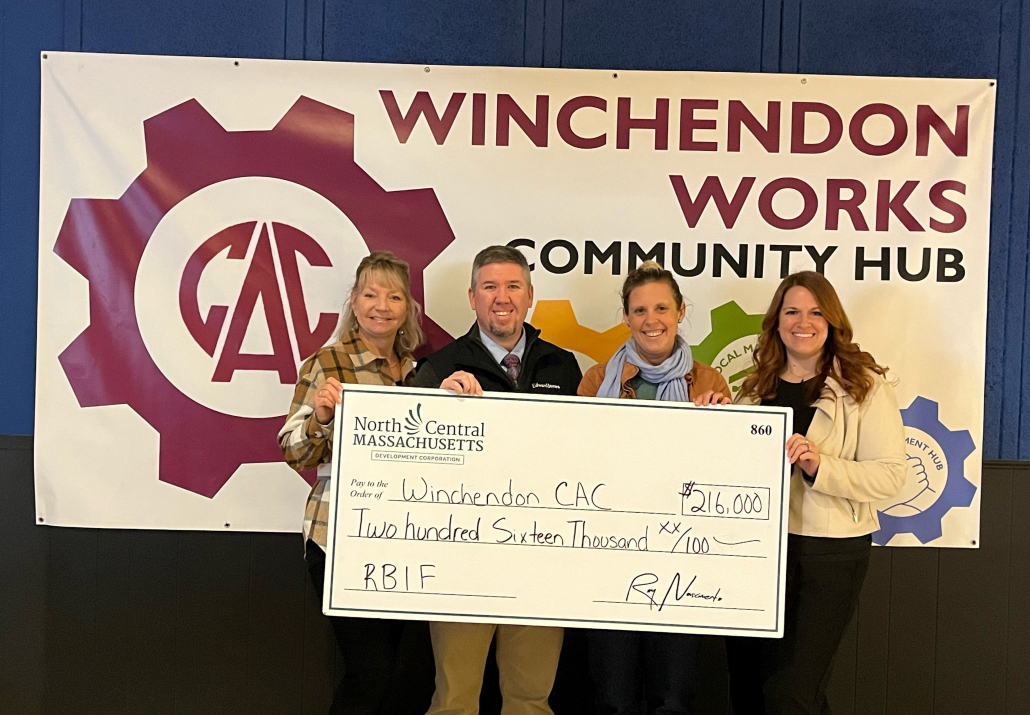
/in Noticias de la Cámara /by Noroeste de MassachusettsThe North Central Massachusetts Development Corporation, the economic development arm of the North Central Massachusetts Chamber of Commerce, recently announced a new funding opportunity to provide low or no-cost funds to developers.
The Regional Business Investment Fund (RBIF) is an initiative recommended by the North Central Massachusetts Chamber of Commerce One North Central regional economic development plan to encourage more real estate development in the region. The funding can be used by developers for engineering, soft costs, site work, infrastructure, and hard costs for specific developments in the 26 communities that make up the North Central region.
“As part of our One North Central plan, we learned that investment in new, ground-up real estate development has been limited in the region,” said Roy Nascimento, President and CEO, North Central Massachusetts Development Corporation. “Through this new fund, we are able to pool resources and coordinate efforts to help mitigate costs for developers to encourage them to look at our region for their next project.”
The RBIF differs from other loan programs offered through the North Central Massachusetts Development Corporation. The loans are very flexible and geared towards real estate projects, with flexible repayment terms, and can be used to cover soft costs and other expenses not traditionally covered by lenders. Also, unlike other loan programs, the RBIF can be used for housing projects and non-profits are also eligible. Projects in the communities that contribute toward the fund are given priority. The RBIF loans are intended to work in conjunction with other local, state, and federal incentives and financing to encourage priority real estate development projects in the region. Documented support from the local municipality must be provided to be eligible.
Initial seed funding of $500,000 was provided by the City of Fitchburg and the City of Gardner through the American Rescue Plan Act of 2021, with each city providing $250,000, as well as matching funding of $250,000 from the North Central Massachusetts Development Corporation. The North Central Massachusetts Development Corporation hopes to secure additional funding over time to help grow the fund and have a larger impact in projects.
A project in the city of Fitchburg was the first to receive funding under the RBIF loan program for a property located at 332-244 Main Street, known as the Dickenson Building. A loan of $60,000 was provided to property owner Christopher Iousa and will be utilized to repair an exterior wall to ensure safety for both the new plaza where the façade overhangs and for the tenants inside of the building over the next few months. Without repair, the issue would impact approximately 31 total employees while also leaving a blighted building in the downtown area. The repair also opens up the building to future housing development on the top floors.
“The city of Fitchburg has already benefited from this unique funding opportunity with the work completed on Main Street,” said Mayor Stephen DiNatale, City of Fitchburg. “We thank the North Central Massachusetts Development Corporation for their partnership in this program, which will provide an opportunity for developers to invest in Fitchburg and align with our efforts to reinvent our downtown.”
“We’ve been working to attract developers to our downtown area and this new opportunity through this new regional fund will enhance our current efforts,” said Mayor Michael Nicholson, City of Gardner. “With this new tool in our economic development toolbox, we hope developers will see Gardner as a place with tremendous opportunity to grow and sustain a property.”
Fitchburg | Chamber of Commerce | North Central Massachusetts | North Central Massachusetts Chamber of Commerce | Chamber Updates | Manufacturing Council | Chamber Updates | Regional Business Investment Fund
October Home Sales Fell To 12-Year Low
/in Noticias de la Cámara, State House News /by Noroeste de MassachusettsSource: State House News Service
Author: Colin A. Young
As Gov. Maura Healey and her team rolled out her plan to move the needle on housing production and ease housing hardships with outside-the-box policies, people looking to buy a home in Massachusetts faced much of the same in October: the thinnest inventory in more than a decade, record high prices and expensive borrowing costs.
There were 3,515 single-family homes sold in Massachusetts last month, down 16.9 percent from October 2022’s 4,228 sales and the fewest number of single-family home sales for any October since 2011, The Warren Group said in its first look at monthly real estate data since Healey filed her policy-heavy $4.1 billion housing bond bill on Oct. 18.
With the options for prospective homebuyers relatively few and far between, the median sale price for a single-family home jumped 10.6 percent year-over-year to $575,140, The Warren Group said. Like September’s $565,000 median sale price, October’s mark set a new all-time high for the month.
“Home sale prices in October climbed to the highest they’ve ever been during this time of year,” Cassidy Norton, associate publisher and media relations director at The Warren Group, said. “Inventory is far below historical norms, and limited choices make it more difficult to find a home. And record high prices paired with rising interest rates make the task of buying a home that much more formidable.”
Through October, there had been 34,515 single-family homes sold in Massachusetts this year. That represents a 23.9 percent decline from the first 10 months of 2022. The year-to-date median sale price is up 3.6 percent from last year, at $570,000, The Warren Group said.
Potential homeowners are running out of options in Massachusetts, the group said in its October analysis. Last month’s 1,562 condominium sales marked a 9.4 percent decrease from a year ago while the median sale price climbed 4.4 percent to $500,000. Year-to-date, condo sales are down 19.7 percent and the median price is up 4.9 percent to $515,500.
“Massachusetts condo prices soared to a record high in October, setting a new benchmark. Condos previous offered a more affordable purchase option; arguably, at just $75,000 less than a single-family home, those times are over,” Norton said.
High interest rates are affecting would-be homebuyers, and potential sellers. With rates as high as they are now, some prospective buyers have to limit their options because it is far more expensive to borrow money than it was two years ago. And people who are locked in at a much lower mortgage rate are less likely to give that up by making their home available for sale.
As of Thursday, the average interest rate on a 30-year fixed-rate mortgage was 7.44 percent APR, according to data compiled by Freddie Mac. A year ago, the average interest rate was 6.61 percent, and two years ago it was 3.10 percent, Freddie Mac said.
Healey and Housing Secretary Ed Augustus have hit the road over the last month to tout the five-year, $4.12 billion housing bond bill that they think will help to ease the housing crunch that threatens the state’s continued development and its competitive standing with other states. In Attleboro last month, Augustus said that 1.6 percent of housing units across Massachusetts were available for sale or rent, calling it the lowest vacancy rate of all 50 states.
“A healthy housing ecosystem should be 4 to 5 percent vacancy rate at any given time, which empowers a consumer to be able to get a rental unit or to make a reasonable offer on purchasing a home,” he said. “How many people here have a family member or experienced themselves or know somebody they’ve worked with who’ve had to make multiple over-asking offers and then still to come away not having the opportunity of homeownership? That is what that low vacancy rate represents to real people.”
He added, “And those people increasingly are saying, ‘Well, I guess that homeownership isn’t an opportunity for me here in Massachusetts. I’m looking elsewhere.’ And the governor was very clear and very specific: We can’t let that happen any longer.”
Healey has tried to attach a level of urgency to her bill (H 4138), suggesting it will be a missed production opportunity if the policies in her bill are not law before the spring construction season gets underway.
But the bill is now in the hands of a Legislature that has struggled to make quick decisions, meet its own deadlines and seldom reaches agreement on anything of consequence without taking it to, and sometimes beyond, the brink. Healey’s housing bill has not moved since it was sent to the Housing Committee on Oct. 18 and the Legislature is in a seven-week stretch of limited activity.
In Attleboro last month, the governor said she needed help from local officials and supporters “to get it done and get it done quickly.”
“Housing construction starts will start in the spring or not, right? So we’ve got to get this going and get this going now,” Healey said.
Chamber of Commerce | North Central Massachusetts | North Central Massachusetts Chamber | Massachusetts Economy | Government Affairs | State House News Service | Healey-Driscoll Administration
Healey-Driscoll Administration Announces Historic Financial Aid Expansion for Massachusetts Public College and University Students
/in Noticias de la Cámara /by Noroeste de MassachusettsToday, Governor Maura Healey and Lieutenant Governor Kim Driscoll announced a historic financial aid expansion that will benefit approximately 25,000 students attending the state’s public community colleges, state universities, and the University of Massachusetts. With close to $62 million in new program funding, the MASSGrant Plus Expansion program will cover tuition, fees, books, and supply costs for Pell Grant-eligible students and reduce out-of-pocket expenses for middle-income students by up to half.
Governor Healey announced the program this morning at Salem State University’s campus, along with Secretary of Education Patrick Tutwiler, Commissioner of Higher Education Noe Ortega, and Chair of the Board of Higher Education Chris Gabrieli. They were joined by Salem State University (SSU) President John D. Keenan; SSU students, faculty and staff; local and statewide elected officials; and public higher education leaders from across the state.
“For so many Massachusetts residents, higher education can be the ticket to their future career and economic stability. Our employers are looking to graduates of Massachusetts’ exceptional public colleges to meet their workforce needs, and those graduates are most likely to stay in Massachusetts. But far too many people are held back from pursuing the education of their choice because of high costs,” said Governor Healey. “This expansion of MASSGrant Plus will open doors for more students to access higher education, which will strengthen our economy as a whole. We’re grateful to our Legislative partners for making this funding available and look forward to our continued collaboration to make Massachusetts more affordable.”
“75 percent of our public higher education graduates stay in Massachusetts – like I did after my time at Salem State. They are our future educators, entrepreneurs, small business owners, and maybe even our future Lieutenant Governor,” said Lieutenant Governor Driscoll. “By making public higher education more affordable, we’re helping to grow the next generation of leaders and talents in our state – the folks who will staying here to work, raise their families and build their futures. That’s why our administration has taken numerous steps, from expanding MASSGrant Plus to making community college free for students 25 and old, to lower costs and increase access to higher education for everyone.”
Not including room and board, MASSGrant Plus Expansion will cover the full cost of tuition and fees for Pell Grant-eligible students, including, for the first time, the federal government determined expected family contribution (EFC) and an additional allowance of up to $1,200 for books and supplies. Middle income students – defined as those whose families earn between $73,000 and $100,000 annually in adjusted gross income — will have their costs for tuition and mandatory instructional fees reduced by up to half of their out-of-pocket expenses. While middle-income students must be enrolled full time to qualify, the expansion will extend MASSGrant Plus financial aid to both full- and part-time Pell Grant-eligible students for the first time.
“I’m thrilled that we’re able to deliver such a big investment and increase aid for nearly 25,000 public higher education students. By expanding access to higher learning, we’re able to connect even more students with the life changing opportunities, high quality educational experiences, and work-based training and skills development that our community colleges, state universities, and UMass offer,” said Secretary of Education Patrick Tutwiler.
“Massachusetts should be the number one state in the country when it comes to upward socioeconomic mobility, and college access is the way to get there,” said Commissioner of Higher Education Noe Ortega. “Any resident seeking an education and career that will bring them higher earnings and improved livelihood deserves our full support on that journey.”
“The Board of Higher Education identified the need for a new strategy on higher education financing, and in 2022 we created and unanimously approved a new framework,” said Board of Higher Education Chair Chris Gabrieli. “The framework’s top priority was to expand state financial aid and make college truly affordable for our lowest income students and less debt burdensome for our moderate-income students. We are excited and grateful that the Healey-Driscoll Administration and the Legislature have chosen to harness a meaningful portion of the Fair Share revenues to this priority, and we are dedicated to working closely with all our campuses to deliver on this new commitment to students.”
“Public higher education opens doors to transformational opportunities,” said Senator Jo Comerford (D-Northampton). “It’s absolutely thrilling to see state investment put to work so beautifully on behalf of our students through the MassGrant Plus Expansion program. Kudos to the Healey-Driscoll Administration for this tenacious work and thank you to Senate President Karen Spilka for leading the Senate’s enduring commitment to breaking down financial barriers to higher education. I am tremendously excited to see how this expanded student assistance will catapult students, and our Commonwealth, forward.”
The program will be retroactive to the start of the fall 2023 semester for currently enrolled students. Students who have already completed the Free Application for Federal Student Aid (FAFSA) for the 2023-2024 academic year will not need to take any further action to benefit from the additional financial aid dollars. Funds for the current semester will be credited to their accounts. Students who may qualify but have not filled out the FAFSA should do so immediately.
“MASSGrant Plus Expansion by the Healey-Driscoll Administration is a game changer for state university students. It is simply historic. I know at Salem State University, 40% of our students are Pell Eligible and hundreds of our students are considered as being from middle income families. This unprecedented investment will allow more of the Commonwealth’s students to pursue their dreams of a college education. It’s a win for them and a win for the future Massachusetts’ workforce,” said John D. Keenan, president of Salem State University and chair of the State Universities Council of Presidents. The Commonwealth’s state universities are incredibly grateful to this Administration for their unwavering leadership in making public higher education more affordable and accessible for all!”
“The Healey-Driscoll administration’s bold expansion of financial aid will open the doors of a world-class UMass education to students across the state and lower the cost for current UMass students,” UMass President Marty Meehan said. “This will accelerate the upward economic mobility of our students, about one-third of whom receive Pell Grants now, and strengthen the Commonwealth’s investment in its talent pipeline, which is critical to sustaining our competitive edge.”
“The 15 community colleges are excited by the opportunities the MASSGrant Plus Expansion will offer to our students,” said James Vander Hooven, president of Mount Wachusett Community College and chair of the Community College Council of Presidents. “We are grateful to the Governor, Lt. Governor Driscoll, and the entire administration for the continued investments in our students.”
MASSGrant Plus Expansion will invest approximately $61.7 million of additional state dollars into public higher education students. The funding for the MASSGrant Plus Expansion will draw on the $84 million delivered for financial aid expansion by Governor Healey and the legislature in the FY24 budget. Remaining funds will be used to support ongoing financial aid policies and to implement Massachusetts’ new tuition equity law, which allows qualifying non-U.S. citizens, namely undocumented students, who have completed high school in Massachusetts to access state financial aid.
This financial aid expansion announcement builds on the Healey-Driscoll administration’s significant investment in higher education earlier this fall, including a $20 million investment in MassReconnect, which made community college free for Commonwealth residents ages 25 and older regardless of income.
“We applaud the Legislature and the Healey Administration for this momentous investment in young people that uses dollars from the Fair Share Amendment and is rightly focused on low- and middle-income students and their families,” said Beth Kontos, president of the American Federation of Teachers Massachusetts. “The expansion of the MASSGrant Plus program will open the doors of Massachusetts public colleges and universities to thousands of deserving students, bettering their lives and strengthening our Commonwealth for the good of all residents.”
“As the president of the union that fought for and won more funding for our public schools through passage of the Fair Share Amendment, I applaud Governor Healey for rolling out the MassGrant Plus Expansion program. This is a major step forward in the fight for educational equity, making it possible for more low-and middle-income students than ever before to seek out, and complete, their higher education degrees right here in the Bay State, which will benefit our economy by keeping our talented young people in Massachusetts. With the overturning of federal affirmative action last June, I’m glad to see our governor taking steps toward achieving debt-free public higher education for all,” said Max Page, President of the Massachusetts Teachers Association.
“This new form of legislation is going to work wonders for students who need the financial assistance. After being told about the student aid program I have hopes that paying for school and getting through my degree will be much simpler,” said Kiana Alexis, a student at Salem State University. “As an independent student who is in their senior year of college, goes to class full time and works to just make ends meet; I have always struggled to have my aid meet my needs. When it comes time to paying for essentials like medicine and groceries and having to pay for course materials out of pocket such as textbooks and access codes, and other varying project materials not covered by the bookstore advance, it begins to add up; especially when federal assistance such as FAFSA, and various aids such as TRIO Support Services on campus, loans and grants can only do so much before other students and I are stuck paying for the rest out of pocket. Hopefully by getting to be a part of this program will take some of the weight off my shoulders of the stress of paying for school.”
“It’s important to expand financial aid so that more students will be able to go to college and fully utilize their time while there not being bogged down by the financial stressors that students with limited or no financial aid face,” said Nicholas Alves, a student at Salem State University.
Chamber of Commerce | North Central Massachusetts | North Central Massachusetts Chamber | Massachusetts Economy | Government Affairs | State House News Service | Healey-Driscoll Administration | Financial Aid Expansion for Massachusetts Public College and University Students
Retailers See Flat Spending This Holiday Season
/in Noticias de la Cámara /by Noroeste de MassachusettsSource: State House News Service
Author: Michael P. Norton
Citing the impacts of high inflation and interest rates, Massachusetts retailers don’t expect a big bump in holiday season shopping sales this year.
The Retailers Association of Massachusetts is predicting a 1 percent increase in local sales based on a survey of its membership. Holiday sales in the 2022 season rose only 1.2 percent locally, the association said.
“With inflation and interest rates eroding the purchasing power of our consumers and the margins of small businesses, it is more important than ever that we all work harder to protect, promote, and preserve our Main Streets and our important local shopping districts,” RAM President Jon Hurst said Wednesday.
November and December retail sector sales in Massachusetts (excluding restaurants, auto sales and gas) typically total about $24.17 billion, RAM said, and historically represent on average 20 percent of annual retail sales.
The association also surfaced “profitability questions” for small businesses that are seeing sales levels similar to last year, saying those questions are being brought on by “the inflation strain on families, and the increased costs on sellers including inventory, wages, borrowing costs, and energy.”
The National Retail Federation projects a 3 percent to 4 percent increase in holiday season sales, and national sales rose 7 percent in the last cycle.
RAM’s holiday season sales projection would be the continuation of a trend as its members are reporting average increases in sales of only about 1 percent year to date. Consumer savings rates increased and debt levels dropped during the pandemic, the association said, “yet those numbers have reversed given inflation and interest rates, and sellers report customers spending levels and the number of in store transactions have been relatively flat to 2022.”
The local numbers are some of the worst in recent years, following sales increases of 9 percent in 2020, 3.9 percent in 2019, 4 percent in 2018, and 3 percent in 2017. Sales dropped by 1 percent in 2016, but rose every other year between 2010 and 2015.
Chamber of Commerce | North Central Massachusetts | North Central Massachusetts Chamber | Massachusetts Economy | Government Affairs | State House News Service | Healey-Driscoll Administration
North Central Massachusetts Chamber Welcomes Babcock, Ogeto and Berthet-Garcia to its Professional Staff
/in Noticias de la Cámara /by Noroeste de MassachusettsThe North Central Massachusetts Chamber of Commerce is pleased to announce the following appointments to its professional staff.
Maureen Babcock is appointed Executive Assistant, bringing a wealth of skills and experience to the role, including more than a decade of experience in project management, registration, and program coordination. In this position, she will be responsible for managing the Chamber’s database, providing administrative and operational support, and coordinating special projects. A resident of Devens, she has been very active in the community, including volunteering with Troop 1 Boy Scouts and Harvard Parks & Recreation as the Ski Club Coordinator. She also serves as the Chair of the Devens Educational Advisory Committee, which advises MassDevelopment on education-related matters for the Devens community. She holds a bachelor’s degree in political science and business from Mount Saint Mary’s College.
Duke Ogeto is appointed Marketing Coordinator and will assist with marketing and communications efforts, including graphic design, and website and social media management for the Chamber and its affiliate organizations. He holds a master’s degree in digital marketing from Southern New Hampshire University, a bachelor’s degree in graphic design from UMass Lowell, and an associate’s degree in interactive media & design from Quinsigamond Community College. A resident of Leominster, he previously served as marketing assistant for World Farmers, located in Lancaster, and as a marketing assistant and graphic designer for UMass Lowell.
Nicolas Berthet-Garcia is appointed Community Business Advisor. In this position, Berthet-Garcia will be responsible for leading outreach efforts to engage and support the Latinx community in North Central Massachusetts. This includes assisting Latinx small business owners and entrepreneurs with one-on-one technical assistance as well as connecting them to resources in the local business community. He has deep roots in North Central Massachusetts, having grown up locally after his family immigrated from Uruguay. In 2015, Berthet-Garcia became the owner and operator of a cleaning company working with clients across Massachusetts. In 2021, he served as the regional lead on a citywide initiative to distribute public health information in collaboration with the city of Leominster. A resident of Fitchburg, he is bilingual in Spanish and English, and is a certified interpreter.
“We are very excited to have Maureen, Duke and Nicolas join our dynamic team and help contribute to the Chamber’s work of strengthening the business climate and advancing the economy of North Central Massachusetts,” said Roy M. Nascimento, president & CEO, North Central Massachusetts Chamber of Commerce.
Maureen Babcock can be reached at 978.353.7600 ext. 222 or via email at ; Duke Ogeto at 978.353.7600 ext. 252 or via email at ; and Nicolas Berthet-Garcia at 978.353.7600 ext. 223 or via email at .
Fitchburg | Chamber of Commerce | North Central Massachusetts | North Central Massachusetts Chamber | Maureen Babcock | Duke Ogeto | Nicolas Berthet-Garcia | Chamber of Commerce | New Hire | Executive Assistant | Marketing Coordinator | Community Business Advisor
Fraud Prevention: Protect Yourself and Your Business
/in Noticias de la Cámara /by Noroeste de MassachusettsThe North Central Massachusetts Chamber of Commerce has received several reports recently from members indicating that they have received unsolicited emails from a third party, with a domain name not associated with the Chamber, offering to sell our “list” of event attendees. This is a common scam and is not legitimate. The Chamber does not sell our attendee information. We would like to remind members to be cautious and to always be on the lookout for possible scams and frauds. Online fraud is on the rise and businesses continue to be a target of thieves and scammers. Often fraudsters try to impersonate trusted institutions, like your bank/credit union, government agencies, or trusted non-profits in the community like the chamber of commerce. When in doubt, always feel free to contact the Chamber directly to confirm of any emails or solicitations you receive.
- The North Central Massachusetts Chamber will never ask you for any personal data through unsolicited emails, texts messages, pop-up windows or website banners. If you were to receive something electronically that looks suspicious and claiming it’s from the Chamber then reach out to us immediately;
- If you ever receive a suspicious call from someone claiming to be from the Chamber or one of our affiliate organizations* (listed below) and asking for personal or financial details, then reach out to us immediately. We may occasionally call to collect or confirm information, but you should not provide any sensitive information unless you are absolutely certain that it is a legitimate call from the Chamber;
- The North Central Massachusetts Chamber of Commerce does not utilize telemarketing firms. If you ever receive a suspicious call from a telemarketer claiming they are soliciting donations for the Chamber or saying they are updating their records, then you should contact us immediately. Do not provide any sensitive personal information;
- The North Central Massachusetts Chamber of Commerce does not endorse any particular products, services, candidates, companies or charities other than its own affiliate organizations. Any solicitations you receive claiming that they are affiliated with the Chamber, endorsed by the Chamber, claiming their product is distributed by the Chamber or using similar language should be viewed with some level of caution. You should contact the Chamber immediately to confirm validity;
- The North Central Massachusetts Chamber of Commerce is an independent organization that is not affiliated with any national, state or local chamber of commerce. Anyone approaching you claiming that they are another “chapter” of the chamber or a business group that is associated with our Chamber or one of our affiliate organizations should be viewed with caution. You should contact the Chamber to confirm validity.
- In general, we encourage you to always scrutinize unknown or suspicious emails that you receive with attachments or with requests for sensitive details or money transfers. Scammers will mask their email domains to impersonate legitimate sources. If you are suspicious about an email you receive, then you can scroll over the email address to reveal the domain. An email from the Chamber should have the domain of @northcentralmass.com. When in doubt, call to confirm the legitimacy of the email you received.
We encourage you to continue to be alert and don’t fall for any scams that may compromise your business or personal information. For useful information regarding Coronavirus related scams, please visit the Federal Trade Commission, https://www.ftc.gov/.
*Affiliated organizations of the North Central Massachusetts Chamber of Commerce include the North Central Massachusetts Development Corporation; Johnny Appleseed Trail Association DBA Visit North Central Massachusetts; the North Central Chamber Foundation; and Chamber Insurance, Inc.
Chamber of Commerce | North Central Massachusetts | North Central Massachusetts Chamber | Fraud Prevention | Protect Yourself and Your Business